Ready-made, one-time
$2,799
Threads Clone
Live in 6 working days from kickoff
- Full source code
- White-label under your brand
- 60 days of technical support
- 1 year of free updates
- App publishing support
Text conversation app
Text-first social where creators get paid and strangers need consent to message.
A white-label text conversation network with four feed types, realtime direct and group chat, hashtag trends and a full monetization stack: your own ad server, paid verification plans and a creator bonus program. Members, creators, advertisers and operators each get a surface, and the full source code is yours.
The facts a buyer checks first, in one place. Everything on this page is the product as it ships.
| Product type | Text-first social network with an ad platform, paid verification and creator bonuses |
|---|---|
| Platform price | $2,799 one time, with full source code |
| Launch time | 6 working days from kickoff |
| Role scopes | Member, admin and superadmin from one codebase |
| Web and API | Next.js and React web app; Node.js, Express and TypeScript API in sixteen route families |
| Data layer | PostgreSQL with Prisma, more than 40 models, migrations and seed scripts |
| Realtime | Socket.io rooms for chat, typing, delivery and read signals |
| Mobile | Branded Android build on the same API and Socket.io contracts |
| Payments | Stripe, using your own account and webhook verification |
| Support and updates | 60 days technical support, 1 year of free updates, app publishing support |
A Threads clone is a ready-made text-first social network: threaded posts with media and polls, personalized and chronological feeds, hashtag discovery and realtime messaging. Ours is original software on Next.js, Express, PostgreSQL and Prisma. It ships with the surrounding layers that a real community needs, namely creator tools, advertising and operator governance.
Three role scopes run from one codebase. Members publish and connect. Creators monetize and measure, with analytics, verification plans, KYC submission and bonus enrollment. Admins and superadmins run moderation, ad review, KYC review and platform policy from a dedicated console, with role guards enforced on the protected route families themselves rather than by hiding menu items.
Branding is a runtime setting. Name, tagline, logo, favicons, media policy and ad economics are stored as configuration, so a second brand or a changed upload limit does not need a release. That makes the same deployment easy to license to a partner under their own identity, with no fork to maintain separately.
Threads is the text-first social app from Meta, tied to Instagram accounts. Members follow people, read short posts and replies, and move between a ranked feed and a chronological one. The experience is closer to a conversation than a gallery: posts are words first, with media and polls as supporting actors, and replies nest under the post that started them.
A white-label Threads clone reproduces that shape as software you own. It is an original implementation rather than a copy of the code of any other product, sold under your name, your colors and your rules. It does not include Meta, Instagram or their members. What it gives you is a conversation product with messaging, moderation and revenue tools already wired, so you can spend your effort on the community instead of the plumbing.
Each role works in its own side of the same product. The screens come from the working demo.
A member registers, sets how public the account is and starts reading and writing short threaded posts. Four feeds, hashtags and trends help them discover people, and message requests stop strangers filling the inbox.
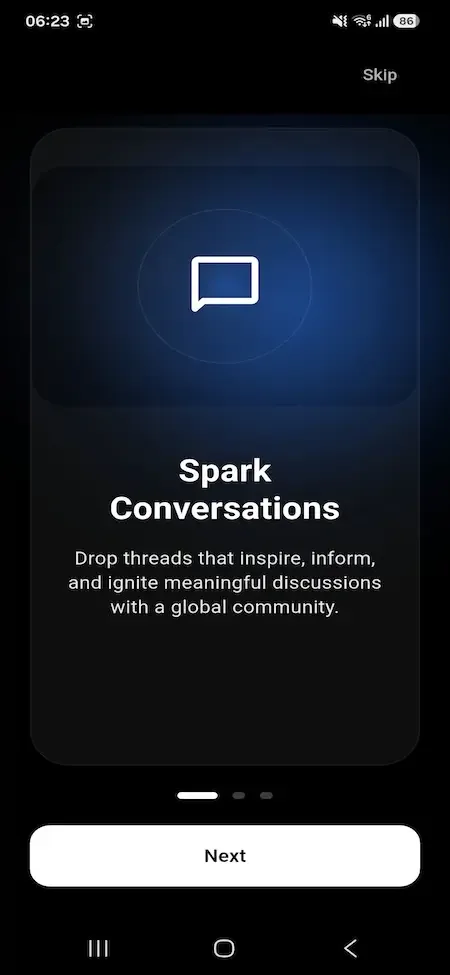
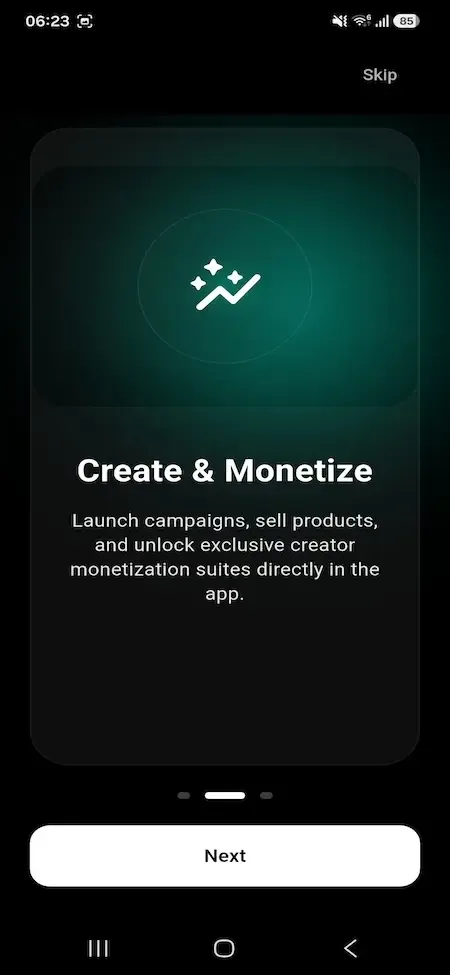
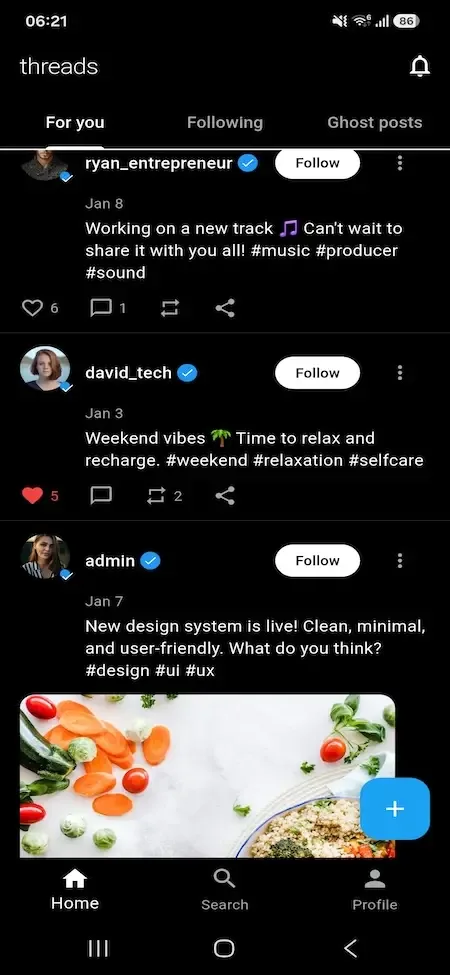
Creators get measurement and status tools. They can see how posts and profiles perform, pay for a verification plan, complete identity review and join the operator bonus program that rewards participation.
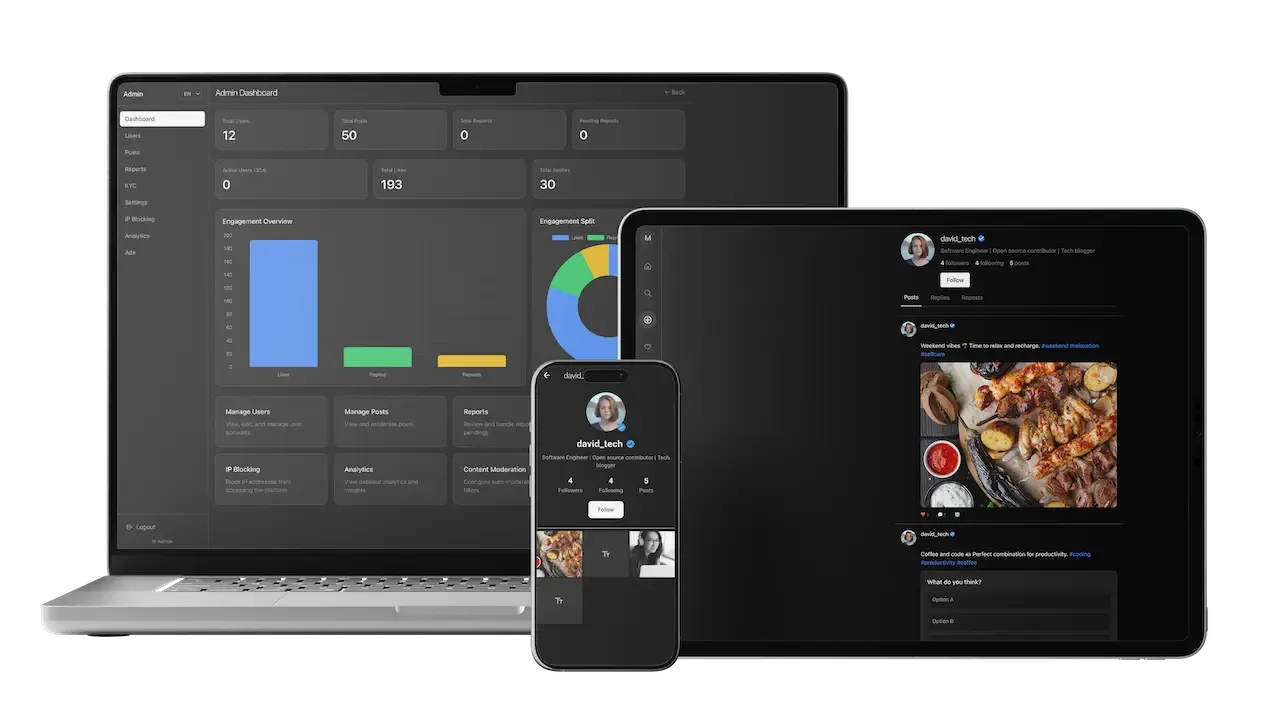
An advertiser works in a self-serve ads manager. They provision an ad account, fund it, build campaigns and creatives, set targeting and watch event-based spend, with an operator reviewing campaigns before any money is used.
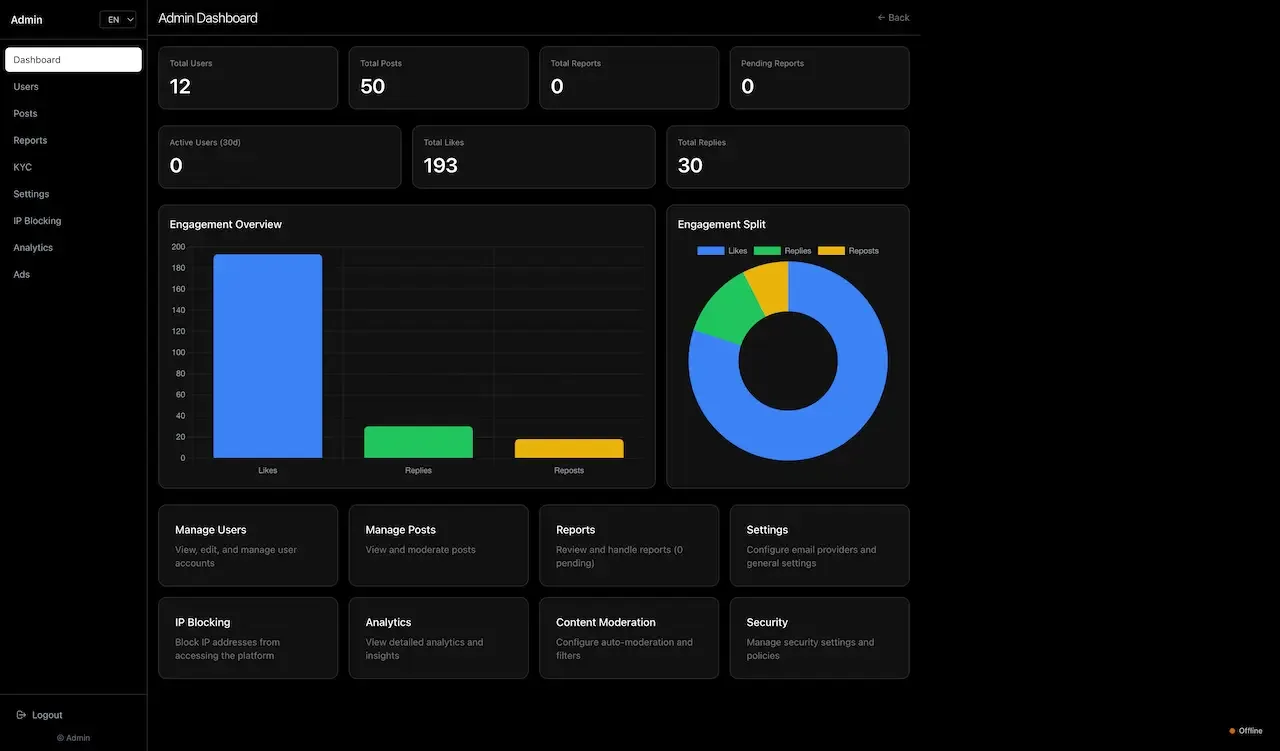
Operators run a console with moderation, trust review and commercial policy in one place. Role guards separate admins from superadmins, and branding and ad economics change at runtime without a deploy.
17 screens from the working demo, grouped by where they live. Your platform ships rebranded with your name, logo and colors.
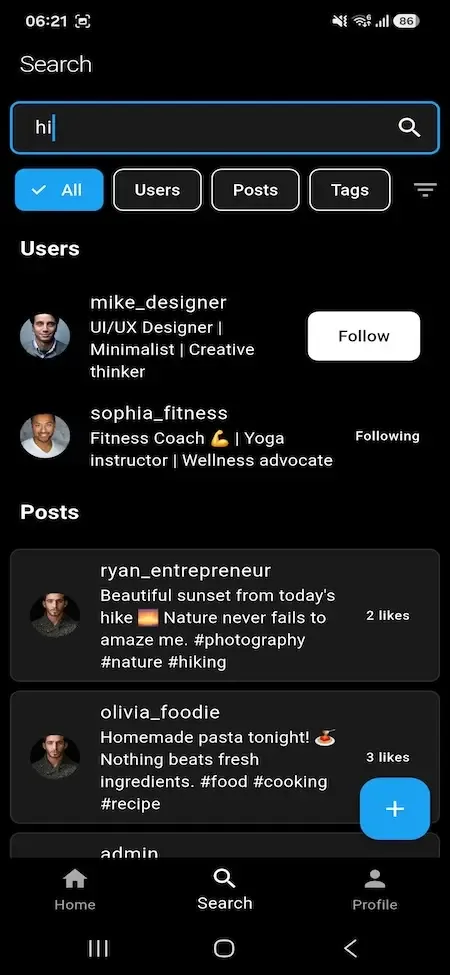

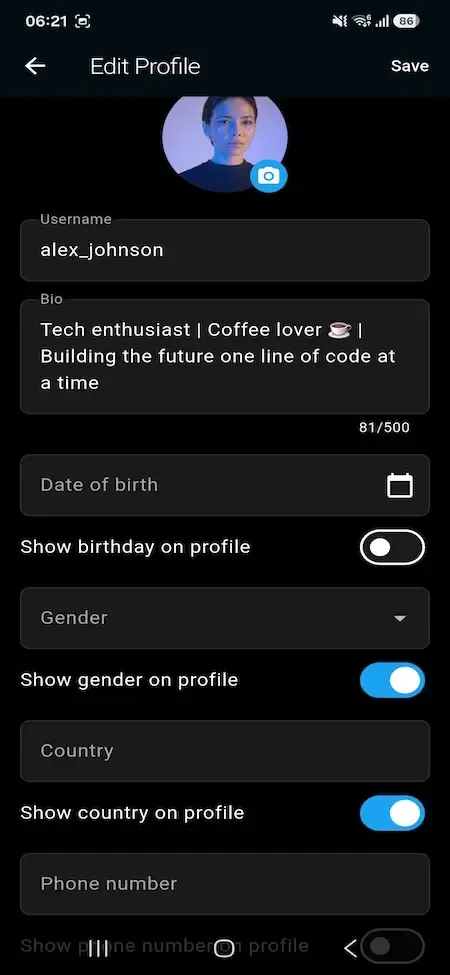
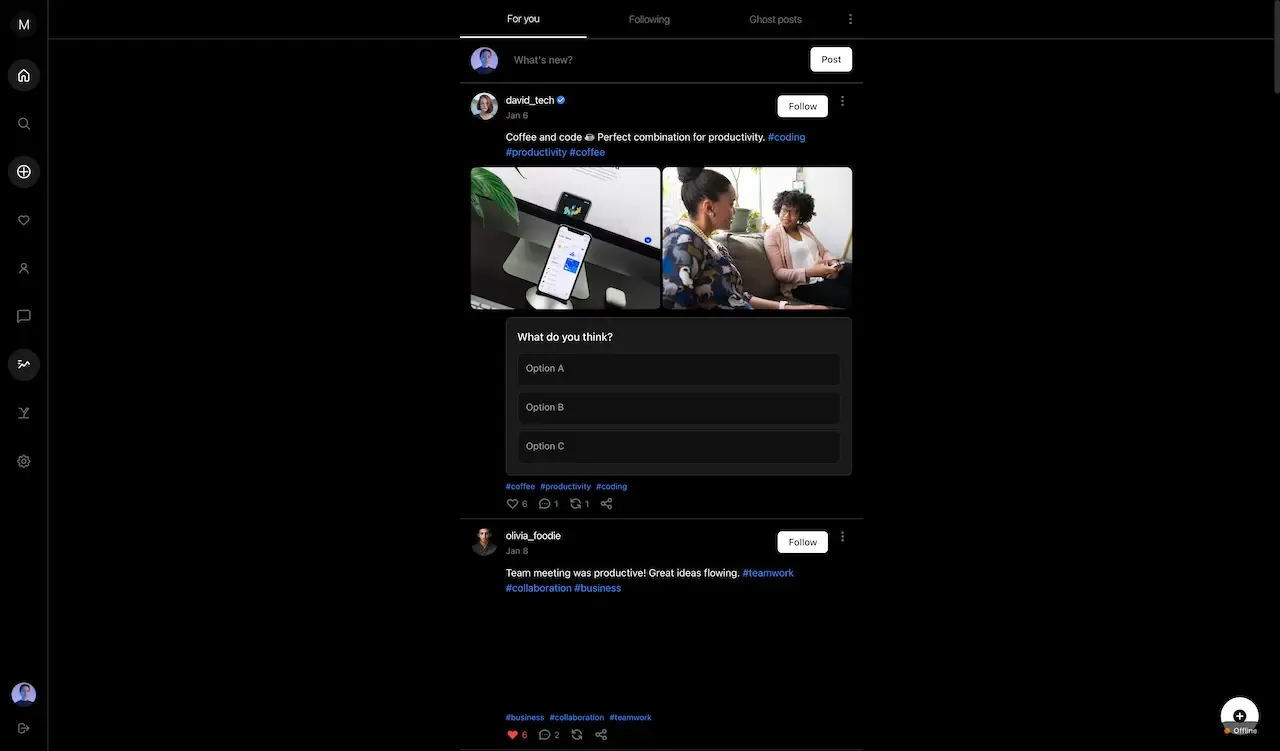
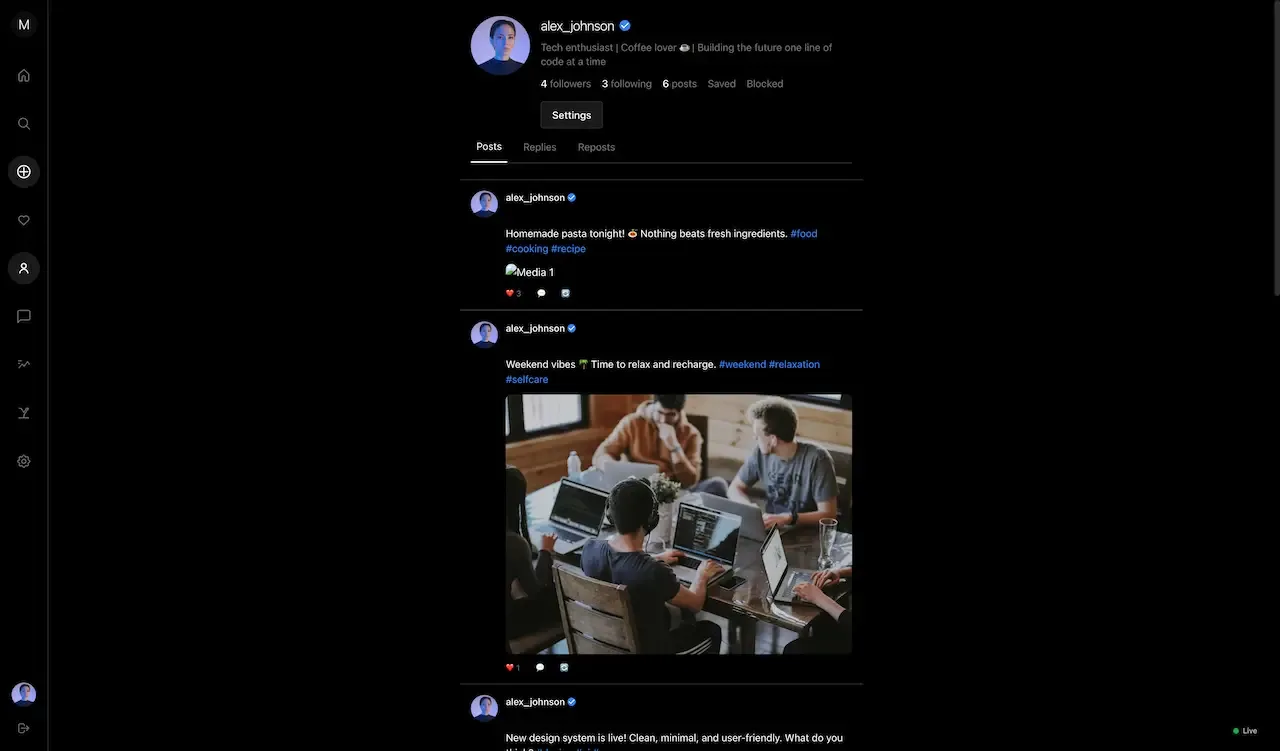
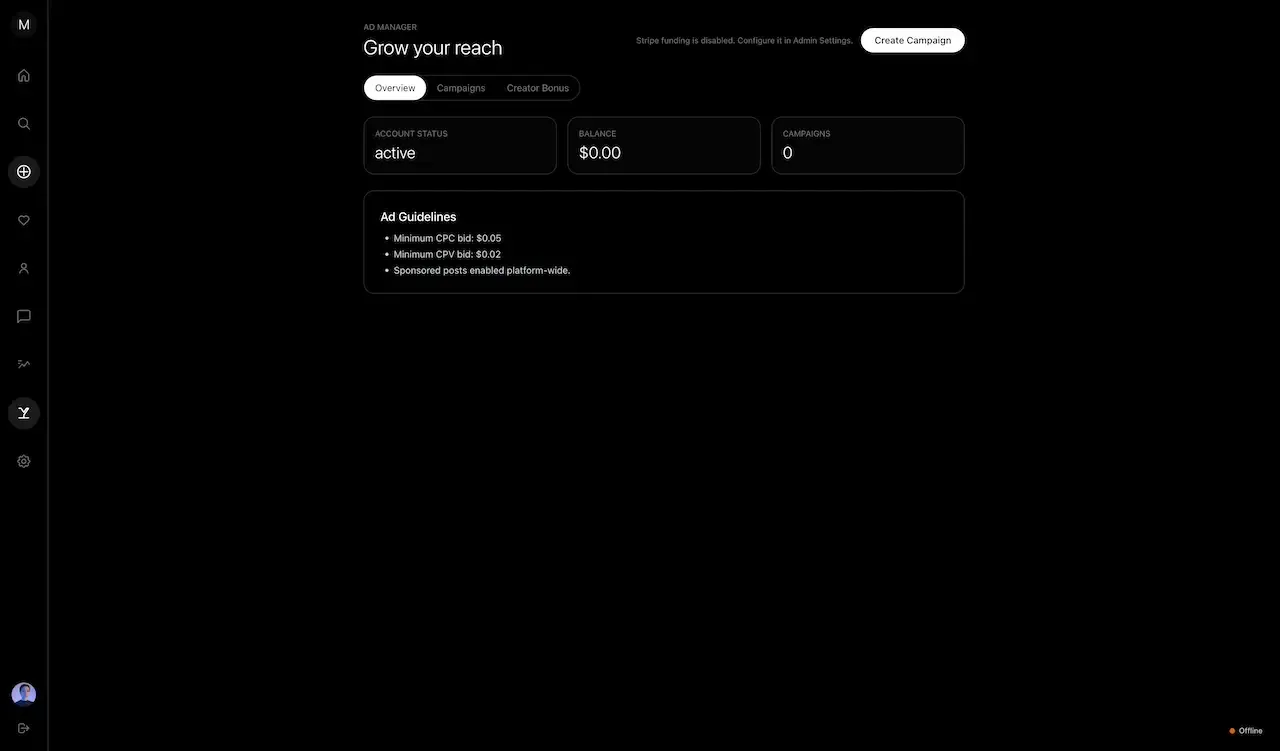
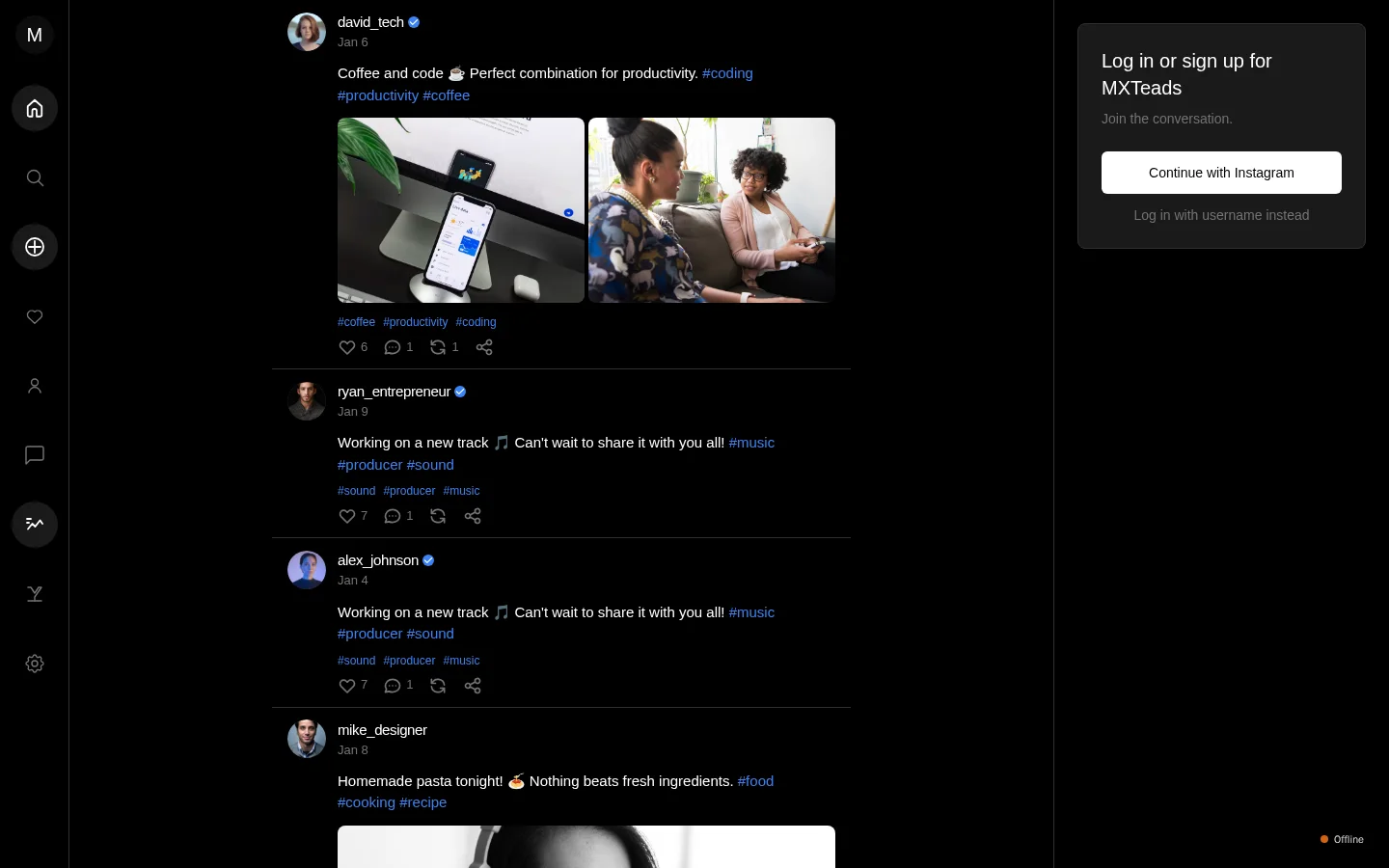
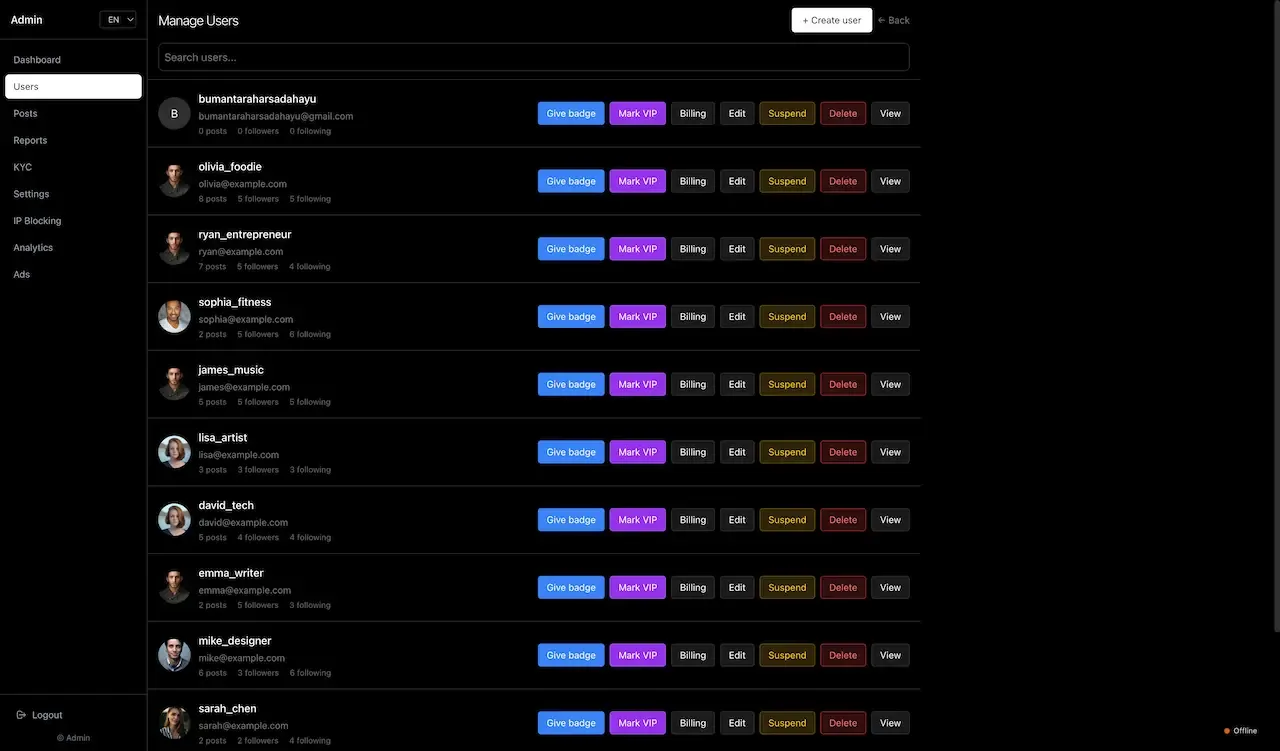
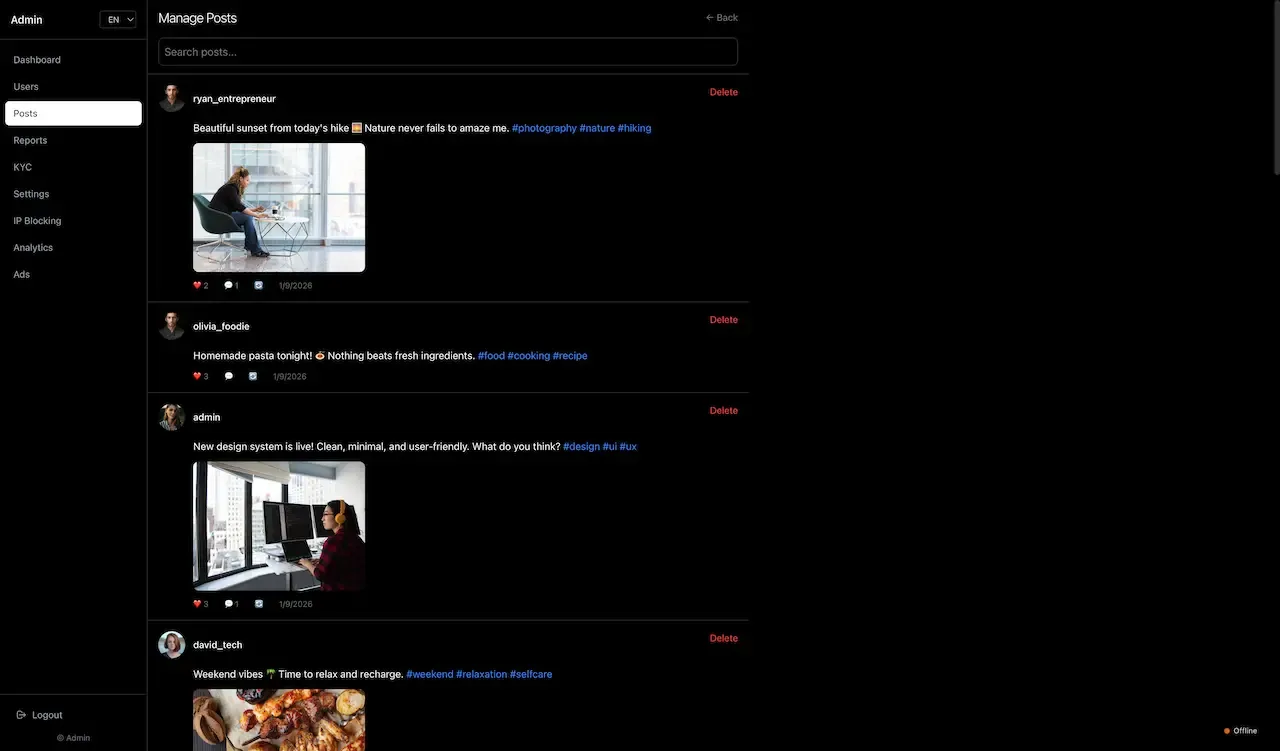
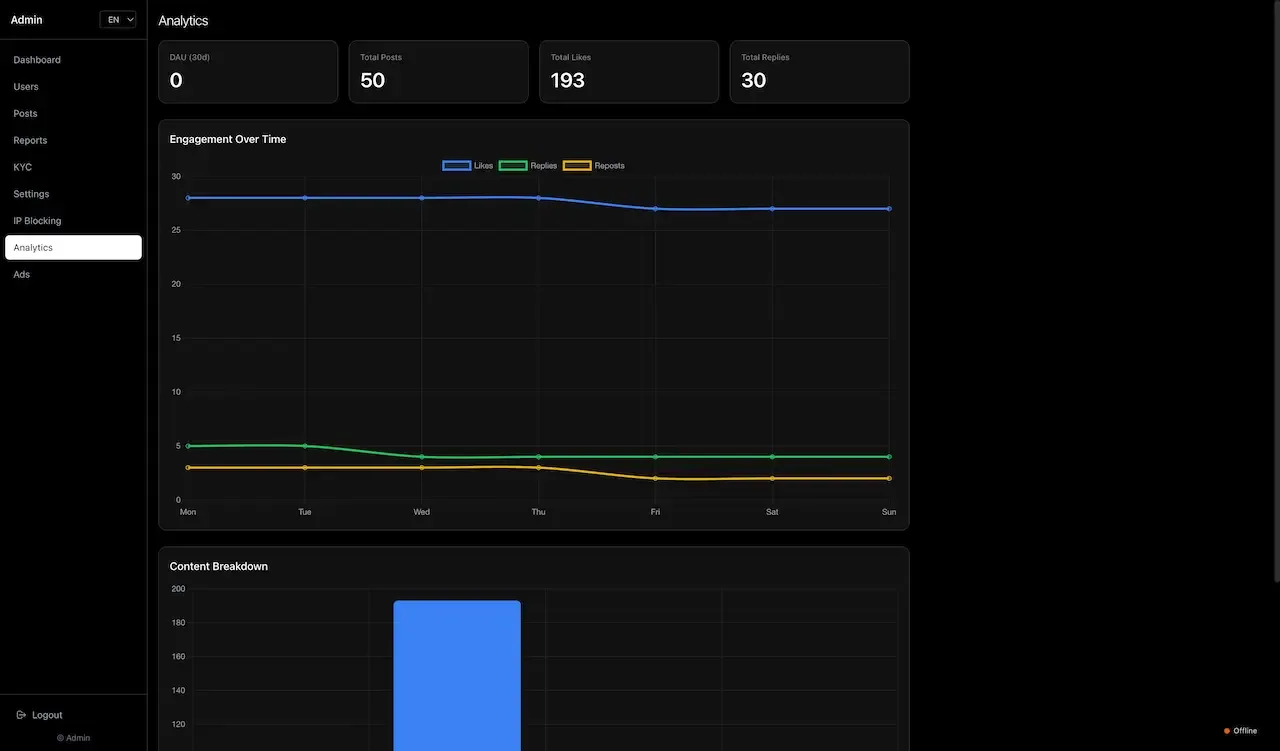
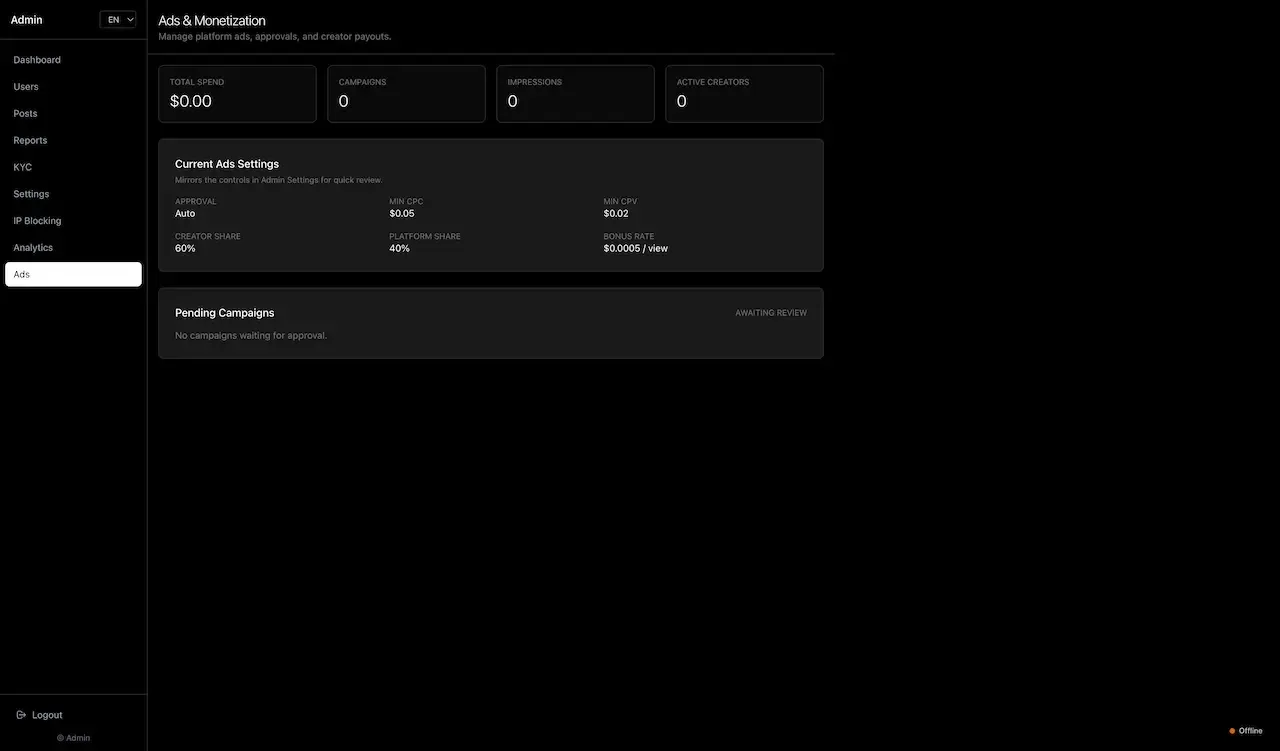
The demo is the shipped build running with demo branding, with a working login for every role so you can follow one thread of activity across the whole product. Publish a post, send a message request, launch an ad campaign and resolve a report, each from the account that would really do it.
alex@example.compassword123mike@example.compassword123emma@example.compassword123alex@example.compassword123admin@demo.comAdmin_$321alex@example.compassword12353 features across 4 roles. The first six of each role are here and the full list is one click away. Nothing is held back for a sales call.
Register, log in and recover a password with a controlled reset token lifecycle.
Members who want stronger security set up, verify and disable an authenticator code themselves.
An account can be open or approval-based, which changes how followers and replies behave.
Privacy settings apply per surface, so a member can show a profile but hide other areas.
A real route lets members remove their account and the data attached to it.
Follow and unfollow, with follower and following views and suggestions for who to follow next.
14 more Members features are in the full list.
Creators see how individual posts perform, which tells them what to write next.
Profile-level numbers show how an audience grows over time.
Plans have monthly pricing and recurring billing through Stripe, set up by the operator.
Members manage a subscription themselves, which reduces support requests.
Each plan moves through pending, active, past due and canceled states driven by Stripe webhooks.
Creators send identity details for review, feeding the trust and verification path.
4 more Creators features are in the full list.
Each advertiser gets an account that holds campaigns, creatives, funds and history.
A campaign defines the goal, budget and schedule that creatives run inside.
Several creatives sit under one campaign, so advertisers can test variations.
Targeting settings tell the system who should see an ad.
Spend accrues from ad events, and events are stored apart from transactions.
Cost per click and cost per view are both modeled, with operator price floors.
3 more Advertisers features are in the full list.
Platform metrics and recent activity show what needs attention first each day.
Operators view full account records, assign roles and suspend or restore accounts.
Reports move through pending, reviewed, resolved and dismissed, so moderation is a workflow.
Post-level review and removal are tied to the report lifecycle with a decision recorded.
Submissions are approved or rejected, and the rationale for rejection is preserved.
Campaigns and creatives are gated by approval before any spend starts.
8 more Operators features are in the full list.
The path through the product, in the order it happens for the people using it.
Members sign up, recover passwords and can add TOTP two-factor, then set an avatar and privacy options.
Posts carry media, polls, hashtags and mentions. Replies nest, and members like, repost, quote and save.
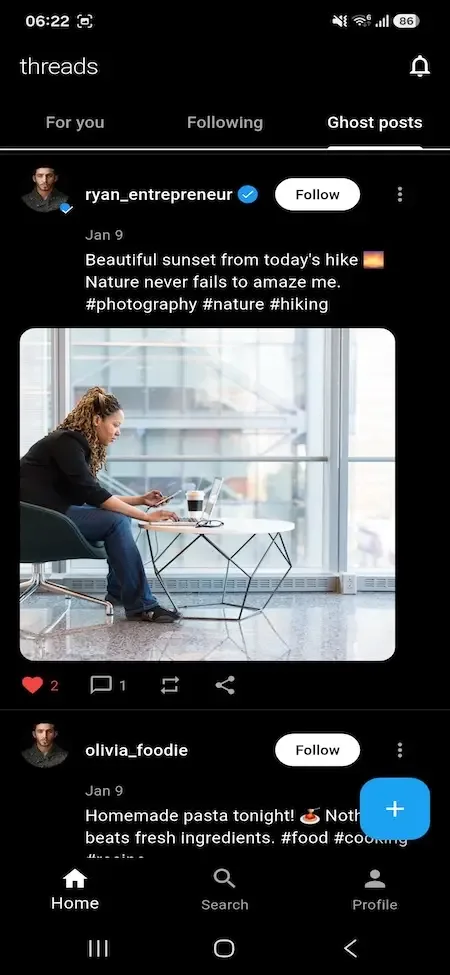
For You, Following, Ghost and Public feeds plus hashtags and trends carry posts beyond the author's followers.
Mutuals chat directly. Everyone else sends a request that the recipient accepts, declines or reports.
Advertisers fund campaigns, members buy verification, creators join the bonus program, and operators work the report, KYC and ad queues.
Every earning route built into the product you receive: how it works, who pays and where the operator earns.
| Revenue model | How it works | Who pays | How you earn |
|---|---|---|---|
| Ad campaigns | Advertisers fund an account through Stripe and spend against campaigns, with CPC and CPV economics and your price floors. | Advertiser | Campaign spend with no ad network taking a cut |
| Verification subscriptions | Members buy a monthly plan with recurring Stripe billing, lifecycle tracking and a self-service portal. | Member or creator | Recurring plan revenue that scales with trust and status |
| Promoted placement | The campaign and creative model supports paid distribution inside the feed surfaces. | Advertiser | Revenue from attention organic reach would otherwise give away |
| Creator bonus program | Creators enrol and receive payouts under policy you configure, to buy supply rather than audience. | Platform | An investment: it costs money but attracts creators early |
| Revenue-share settings | Ad settings expose controls for the split between platform and creator. | Operator decision | A policy lever you tune without code |
| White-label licensing | Branding, media policy and ad economics are runtime settings, so one deployment can be licensed on. | Partner | Licence fees from partners using their own brand |
The flow of money, the gateways you can connect and how payouts are handled.
Stripe is the payment layer. Advertisers fund ad accounts through checkout, and members subscribe to verification plans with recurring billing and a customer portal. Subscription state follows Stripe webhook events, so your records and the processor stay aligned, and gateway secrets are stored encrypted in settings. You need your own Stripe account, and webhook signature verification must be configured at deployment.
| Gateway | What it covers |
|---|---|
| Card | |
| Stripe | Checkout, subscriptions, billing portal and webhook lifecycle; needs your own account |
You operate the platform, so legal compliance in each market you serve is yours. This is the tooling that ships in the product. It is not legal advice.
A message from someone a member does not follow arrives as a request with pending, accepted, declined and reported states. The member decides whether a conversation opens at all, and reporting from that screen feeds the moderation queue. This is structural rather than a content filter, so open registration does not turn private messages into a spam folder.
Reports, KYC submissions, ad reviews and subscriptions each carry an explicit lifecycle state, so work is queryable and not inferred. Rejections keep their reason. Staff the queues before you open registration, and decide in advance how quickly each queue must clear, because slow review is itself a trust problem for members and advertisers.
KYC submission and review feed the verification path. What you ask for, how long you retain it and who may see it are your decisions, subject to the privacy and data rules of your market. Collect only what you need, restrict access to the reviewers and set a retention rule before the first document arrives.
JWT verification pins the signing algorithm and checks expiry, passwords are hashed with a controlled reset lifecycle and TOTP two-factor is optional per account. Role and ownership guards run on protected routes, with relation filters that prevent one user reading another data. Requiring two-factor for staff is a policy you set.
Uploads are checked on extension, MIME type and magic bytes, with size and count limits from media settings. Separate limiters cover general, auth, registration, reset and upload traffic, and abuse detection can block or suspend. A shared store for limits at scale and strict production CORS settings are deployment tasks.
Stripe webhook signature verification is documented as mandatory, so a forged callback cannot change subscription state. Ad events and transactions are recorded separately. Test each failure path with test keys before going live, and keep your own reconciliation routine between Stripe and your ad spend records.
Private accounts, visibility toggles, notification preferences and an account deletion path that removes associated data are included.
The layers of the product as delivered. You receive the full source code for every one of them.
| Layer | Built with | Hosting note |
|---|---|---|
| Web application | Next.js, React, TypeScript | Next.js and React in TypeScript, serving member, creator, advertiser and operator screens in one app. |
| API service | Node.js, Express, TypeScript, sixteen route families | Node.js, Express and TypeScript, layered route to middleware to controller to service. |
| Data | PostgreSQL with Prisma, 40+ models | |
| Realtime | Socket.io rooms with authentication before join | Socket.io rooms authenticate before join; a socket adapter is chosen when running several instances. |
| Security | Helmet, JWT, TOTP, Zod validation | |
| Billing and integrations | Stripe, configurable email provider, Instagram connect | A configurable email provider and a Stripe webhook endpoint with signature verification. |
| Mobile | Branded Android build on the same API and Socket.io contracts | |
| Database | PostgreSQL through Prisma, with migrations, seed scripts and indexed foreign keys. | |
| Rate limiting | In-process limiters by default; a shared backing store is the documented step at scale. | |
| Scheduler | Scheduled posts need a worker wired during deployment so they publish at the chosen time. | |
The API is stateless, so growth is mostly a matter of running more instances behind a load balancer. A PostgreSQL database holds the social graph, and Socket.io carries chat signals. The documentation lists what you must wire at deployment, so there are no surprises at go-live.
A Threads-style network is built on who follows whom. That single choice drives what members see, how they find new people and how safe the inbox stays. Understanding the model helps you configure it rather than inherit it by accident.
Meta has added optional sharing between Threads and the fediverse, the loose network of servers that talk through a shared protocol. Operators therefore ask whether their own Threads-style network can join it. The documented package is a single-operator network: one database, one policy, one billing relationship, and no federation layer.
A closed design is simpler to run and easier to monetize. You decide who can join, which content is allowed, and how verification and ads work, without negotiating with the owners of other servers. Federation offers reach and interoperability, but it also exposes you to content and moderation decisions taken elsewhere, and it makes consistent paid features harder.
If interoperability matters, we can build it around your plan, with scope confirmed with us. Many communities never need it, because the value of a niche network comes from its members and rules rather than its connection to everyone else. Decide by asking whether your members expect to follow people outside the network.
Cost guides list ads, subscriptions, in-app purchases, affiliate deals and sponsorships. Here is how each maps to the ready-made product, so you can see what is already wired and what you would add yourself.
| Option | In the platform | What you add |
|---|---|---|
| Advertising | Ad accounts, campaigns, creatives, targeting and a review queue | Advertiser sales and your own pricing rules |
| Subscriptions | Verification plans through Stripe with a billing portal | Your Stripe account and plan design |
| Creator payments | A bonus program with enrolment and payout records | Funding rules and how you pay creators out |
| Promoted placement | Placement for sponsors in the ad system | Rate cards and clear labeling to members |
| Sponsorships | Campaign records you can sell directly | Contracts, reporting and relationships |
| In-app purchases | Set up around the platform for your build | Your store accounts and disclosure rules |
| Affiliate links | Link-friendly posts are supported | Tracking, disclosure and partner terms |
One fixed price for the ready-made platform, published here so you can plan before you talk to us.
Ready-made, one-time
$2,799
Live in 6 working days from kickoff
The engineers who deploy your platform stay with it once it is live.
Need more? We tailor the platform to your plan, typically in 2-8 weeks, and confirm the scope with you before work starts. App store review times are set by Apple and Google.
Everything here is available around the ready-made Threads clone. We confirm the scope with you before any price is agreed.
An iOS build on the same API and socket contracts; native packaging is set up for you.
Confirm with usNative push registration and delivery through APNs or FCM, on top of the shipped notification model.
Confirm with usThe worker that publishes scheduled posts on time, wired to your infrastructure during rollout.
Confirm with usA dedicated audit datastore with retention schedules, export tooling and legal hold for enterprise buyers.
Confirm with usA shared store for rate limits and cache, plus a socket adapter for multi-instance realtime.
Confirm with usLog shipping, alerting on auth and webhook failures and SIEM federation.
Confirm with usSAML or OIDC sign-in for organizations that need it beside email, password and TOTP.
Confirm with usA search service for when content volume outgrows relational queries.
Confirm with usMost of the platform ships ready and the rest is set up around your plan. This table lists the pieces of a text-first network and where each stands in the ready-made product. Where something ships as data but needs wiring at deployment, the note says so instead of letting the word included mislead you.
Posts with media, polls, hashtags, mentions and nested reply chains.
Authors can govern who may reply to or quote their post.
Posts can be saved and resumed from the composer.
The data model ships complete; the worker that publishes on time is wired at deployment.
For You, Following, Ghost and public feeds from one content graph.
Safety actions enforced at the query layer, not only hidden in the interface.
Messages from non-mutuals arrive as requests with four lifecycle states.
Direct and group conversations with member role control and reactions.
Typing indicators, delivery confirmation and read status over sockets.
Search across users and content, with history and saved searches.
Ad accounts, campaigns, creatives, targeting, funding and an operator review queue.
Data-driven plans with a billing portal; your own Stripe account is required.
Enrolment and payout records with economics the operator configures.
Submissions are reviewed with approve and reject dispositions.
Report states from pending to dismissed, plus IP blocks with expiry.
Time-based codes can be set up, verified and disabled by members.
Connect, disconnect and import flows are part of the integration set.
Name, logo, palette and copy change from the console without redeploying.
A branded Android build on a platform-neutral API.
We set up native packaging and APNs or FCM delivery for your build.
Relational search suits a launch; we set up a dedicated engine for larger volume.
We set up SAML or OIDC for procurement teams that require them.
The platform is a single-operator network; we build federation around it if your plan needs it, with scope confirmed with us.
Four pages go deeper on the questions buyers ask most about the Threads Clone. This page stays the overview.
Text-first publishing looks simple from the outside and runs on a tightly sequenced pipeline underneath: identity, publishing, distribution, private conversation, earning and governance.
See the full breakdownA text-first network has friendlier economics than a video platform, because there is no transcoding pipeline and no bandwidth bill that grows with watch time.
See exact pricingIn a social product the asset is the graph of members and the relationships between them, and both belong to whoever runs the infrastructure.
See the playbookAny developer can show a feed of short posts.
Compare optionsFrom kickoff to a live Threads clone under your brand: what we do each day, and what we need from you.
1Day 1
2Day 2
3Day 3
4Day 4
5Day 5
6Day 6
Text-first social is lighter than video social, since there is no transcoding pipeline and storage does not grow with watch time. The cost sits elsewhere: relationship modeling that stays correct as the graph grows, realtime chat that survives reconnects, a message request system, review queues with lifecycle states and a commercial layer that reconciles ad spend with subscriptions. Those make a from-scratch build slow, and a rented service constrains them. Buying the working surface lets your budget go to operations and audience.
| Factor | Build from scratch | Rent a SaaS | Own it with GetFame |
|---|---|---|---|
| Feed and graph | Needs careful relational design to stay correct at scale | Opaque and not yours to tune | Four feeds on one content graph with indexed paths |
| Messaging | Realtime, requests and group roles are separate work | Limited to vendor features | Direct and group chat with consent-gated requests |
| Advertising | Accounts, campaigns, funding and review take months | Usually absent | Ad accounts, campaigns, creatives and review included |
| Verification and KYC | Billing, review queue and states to design | Controlled by the vendor | Plans, billing portal and KYC queue included |
| Factor | Build from scratch | Rent a SaaS | Own it with GetFame |
|---|---|---|---|
| Time to launch | Long before governance is safe | Quick, but rented | 6 working days to a branded deployment |
| Fees on revenue | Payment processor fees only | Recurring fees that grow with members | No per-seat fee and no revenue share |
| Changing the brand or rules | Code change and release | Limited by vendor settings | Branding, media policy and ad economics at runtime |
Running costs. The $2,799 platform price excludes hosting, a PostgreSQL service, an email provider, your Stripe account and its fees, and any shared store you add for scale. Moderators and support staff are the main running cost on a social product. Mobile push, an iOS build and a scheduler worker are separate tasks. Set aside time for security review before launch, with your own technical lead.
Text-first apps look light on the surface, which tempts teams to underestimate them. The real effort sits in messaging, safety and billing. This table sets what each module involves when you build it against what is waiting in the ready-made product.
Build it yourselfNested replies, edit history and restrictions that stay readable as chains grow deep.
Ready-madeThreaded publishing with per-post reply and quote controls.
Build it yourselfRanking, chronological and logged-out surfaces, each tuned against a real graph.
Ready-madeFour feeds served from one content graph.
Build it yourselfA consent model with states, reporting and notification rules; usually added after spam hits.
Ready-madeRequests with pending, accepted, declined and reported states from the start.
Build it yourselfAuthenticated socket rooms, presence and delivery events that survive more than one server.
Ready-madeSocket rooms authenticated before join, with typing, delivery and read events.
Build it yourselfReport triage, account actions and review queues; many launches stay invite-only for lack of it.
Ready-madeQueues with lifecycle states, user moderation and abuse controls.
Build it yourselfDocument intake, reviewer tooling and records, with legal care around personal data.
Ready-madeA KYC submission and review pipeline with dispositions.
Build it yourselfCampaigns, creatives, spend events and funding reconciled against transactions.
Ready-madeAd accounts with event-based spend, funding records and a review queue.
Build it yourselfPlan lifecycle through pending, active, past due and canceled, plus a self-service portal.
Ready-madeVerification plans with lifecycle states and a billing portal.
Build it yourselfBranding baked into code, changed only by a new deployment.
Ready-madeName, logo, palette and copy edited at runtime from the console.
Build it yourselfToken pinning, upload checks, validation and layered limits assembled over time.
Ready-madeAlgorithm-pinned tokens, upload checks, validation and rate limits documented.
Threads is widely known as a text-first conversation app with short threaded posts. This platform follows that shape and adds advertiser, verification and creator layers. The table compares operating model only, makes no claim about any company finances, and the platform is independent of the named app.
| Aspect | The Threads model | This platform |
|---|---|---|
| Who owns the network | One company runs a single network | You run your own, under your brand |
| Account basis | Tied to an existing account on another service | Independent accounts, with optional Instagram connect and import |
| Messaging from strangers | Rules set by the platform owner | Consent-gated requests you control |
| Advertising | Sold by the platform owner | Your own ad accounts, campaigns and price floors |
| Verification | Criteria and pricing set by the owner | Your plans, your KYC queue and your reviewers |
| Creator rewards | Programs run by the owner | A bonus program with economics you configure |
| Source access | Closed product | Complete source with the Prisma schema |
The founders and teams this product fits most directly, one line each. The launch ideas that follow turn these audiences into a first-week plan.
Attract creators with verification tiers, analytics and a bonus program before the audience can pay them through ads.
Build a discussion layer around journalism, with report triage, reply restrictions and IP-level abuse controls.
Run a network under your own name with private accounts, runtime branding and consent-gated messages.
Use KYC review and verification subscriptions as the membership mechanism itself.
Serve a market with your own moderation policy, commercial terms and language.
Separate member, admin and superadmin roles and keep deployment control for procurement reviews.
Text-first networks are cheap to run compared with video, which makes them a sensible choice for a focused audience. These are the shapes that tend to work, with the settings worth touching first before you open registration to the public.
Writers, analysts and educators who want followers in a place they control. Members read threads and reply under tight reply controls. Switch on verification plans and the creator bonus early, but measure engagement before paying bonuses, and keep message requests on so fans do not flood inboxes.
A newsroom or magazine hosting reader conversation on its own graph. The public feed lets logged-out visitors read, while following feeds serve regulars. Set house rules first, use the report queue for editors, and keep ads for later once the conversation has a steady daily rhythm.
A club, product community or fan organization with its own identity. Runtime branding lets you launch under a name and change it without a release. Use groups with roles for sub-communities, and configure the first rules so volunteers have something to point to when they moderate.
Associations and trade groups where credibility matters. KYC review and verification plans help establish who is who. Keep registration approved at the start, document how reviewers decide, and treat identity documents as sensitive data with a clear retention policy.
A market where the big networks fit local language and norms poorly. Write policy in the local language and plan localization and push delivery early. Check which payment methods members actually use before pricing verification, and start with a modest feed that feels alive.
Short-lived networks around a conference, a course cohort or a season. Hashtags and trends carry the conversation, and groups hold side threads. Decide in advance what happens to the network after the event so the graph survives into the next one.
Most listings of apps like Threads help a reader choose what to install. This one helps a builder choose what to run. The options below differ in who controls them, which is the question that matters if you plan to own the network, the rules and the revenue.
Hosted app from Meta
Members who want a large audience tied to their Instagram identity.
You cannot buy, host or reconfigure it; rules and ranking belong to its owner.
Hosted public network
People who want broad public reach and real-time news.
Terms, pricing and access can change without your say.
Open protocol and hosted app
Users who like custom feeds and a portable identity.
You build on a protocol instead of owning a closed branded product.
Open-source federated network
Communities that want independent servers in a wider network.
Self-hosted, with shared moderation norms and no built-in ad or billing stack.
Hosted photo and video network
Visual creators and brands sharing photos and video.
Text conversation is secondary, and you do not control the platform.
A white-label Threads clone is for the operator who wants the text-first shape under their own brand. You choose the moderation policy, set ad economics, define verification plans and keep the source. You give up the reach of a very large network and any federation with other servers. It suits communities, creators and publishers who value control more than borrowed audience.
Longer answers to the questions buyers of this model ask before they commit.
Open registration is a gift to spammers, and direct messages are where they strike first. The message request flow addresses that structurally: strangers land in a queue and the member decides whether to open the conversation. Keep that default strict at launch. You can relax it later for verified accounts, but tightening it after a spam wave damages the experience that earned you members.
Pair requests with limits and review. The layered rate limiters for registration, reset and upload slow automated sign-ups, and IP blocks with expiry let you react without making permanent decisions. Watch the first weeks of reports closely, and note which patterns repeat. If you see coordinated behavior, tighten the relevant limiter instead of adding a manual step for everyone.
Seed conversation with real voices. Invite people in your niche before opening publicly, give them the For You feed and hashtags to build topics around and use the Public feed to make the network visible to logged-out visitors. A busy public feed is your front door, and its quality tells a newcomer within seconds whether the place is worth joining.
The approval gate is your quality control. Every campaign and creative waits in a pending state until an operator approves or rejects it, so nothing spends before a person has looked. Write simple ad rules, decide response times and train your reviewers on borderline cases. A fast, consistent review process is a selling point to advertisers as much as a safeguard for members.
Set price floors with your audience in mind. CPC and CPV economics are modeled, and you control the minimums in ad settings. Too low and you undersell attention that does not exist at scale yet. Too high and early advertisers go away. Start with direct deals, learn what your members respond to, and use the spend records to show advertisers what they got.
Keep the money trail clean. Ad events and transactions are recorded separately, and Stripe funding creates a clear record of what was added. Reconcile them regularly, particularly in the first months, so you catch any mismatch before an advertiser does. Be open about how spend is counted, because trust in your numbers is what brings advertisers back.
A verification plan sells trust and status, so tie the price to what the member gets. If verification is purely a badge, keep the plan simple and make the review honest. If it unlocks features, say so plainly. The console lets you create plans with monthly prices and Stripe links, so try one plan first and change it as you learn.
Use KYC where it earns its keep. Requiring identity checks for verified creators protects your community, but it also adds friction and puts you in charge of sensitive documents. Limit what you collect, restrict who sees it and write down how long you keep it. Rejections preserve their reasons, which helps when a creator asks why.
Treat the creator bonus as marketing spend. It buys supply of content before audience exists, and the economics are yours to set. Define who qualifies, what they must do and how long the incentive lasts, then review payout records against the activity you hoped to see. End or reshape the program when it stops producing the behavior you wanted.
The platform ships complete as software, but some parts need work in your environment. Stripe needs your own account and verified webhook signatures, scheduled posts need a worker that publishes on time, production CORS should list only your real origins and secrets should be strong and rotated. Writing that list at the start avoids a scramble the week you want to launch.
Plan for scale in steps rather than all at once. The API is stateless, so adding instances is straightforward. Rate limits and cache run in-process by default, so a shared store is needed once you run several nodes, and realtime chat needs a socket adapter for the same reason. Do these when traffic justifies them, and test them before you rely on them.
Finish with a security and policy review. Read the VAPT and compliance document, run the walkthrough as each role and decide who holds the superadmin scope. Write your terms, privacy notice and moderation rules before registration opens. A short, careful pre-launch review costs far less than fixing a public mistake after members have already arrived.
Projects and comments as published by our parent company, Miracuves, with the release notes as printed there.
The message request flow is the reason we could open registration publicly. Non-mutuals land in a queue instead of the inbox, and the spam problem never materialized.
We expected to bolt monetization on in year two. Having ad accounts and verification plans in the schema from day one changed the whole business plan.
Our moderators live in the report queue. Having triage states rather than a flat list of flags is what makes the workload survivable.
Rebranding was a settings screen, not a sprint. Name, logo, favicons and media policy were all runtime configuration.
The moderation console is what let us open registration. Without it we would still be invite-only.
An operator in India launched a branded text-first network on this platform, with creator monetization and a moderation console live from the start. The brief moved to go-live in five weeks, with three revenue streams and four feed variants shipped. Message requests and moderation were the stated priorities.
v2026.1Jul 2026
It includes a Next.js web app, an Express API with sixteen route families, a Prisma and PostgreSQL schema with 40+ models, a Socket.io realtime layer, a monetization stack and an operator console. Members get four feeds and consent-gated messaging. Creators get analytics and verification plans. You also receive the full source.
The ready-made platform is $2,799 one-time, with no per-seat fee and no revenue share. A branded deployment takes 6 working days. Extras like native iOS packaging, scale infrastructure or enterprise audit storage are available too. We tailor them to your plan, typically in 2 to 8 weeks, with scope confirmed with us at kickoff.
Through the creator bonus program, which tracks enrollment and payout records under policy you set, and through the revenue-share setting in the ad configuration. Creators also use analytics and verification plans to build an audience. Payout rules and the split are operator decisions, adjustable without code changes.
A message from someone who is not a mutual connection lands as a request, with pending, accepted, declined and reported states. The recipient chooses what to do. Mutuals chat directly. Group chats support member roles, and reactions work on individual messages.
No. This is independent software built to a functional target, and the name describes the category. No code, design or content comes from the Threads website or apps. You launch under your own name, logo and colors, which you can change at runtime from the settings screens.
Advertisers create an ad account, fund it through Stripe and build campaigns with creatives and targeting. Spend is counted per event under CPC and CPV rules with price floors you set. Everything passes through an operator review queue before it goes live, and you keep the revenue.
Next.js, React and TypeScript on the web, Node.js and Express for the API, PostgreSQL with Prisma for data and Socket.io for realtime. Security middleware uses Helmet, JWT with algorithm pinning, optional TOTP and Zod validation. These are mainstream tools, so hiring for them is straightforward.
Stripe credentials and webhook signature checks, the scheduled-post worker, native mobile packaging and push delivery, strict production CORS, secret management and a distributed rate-limit store. We handle these with you during the 6-day deployment where they are in scope, and name the rest openly.
A branded Android build comes with the package, using the same API and Socket.io contracts as the web app. iOS is an additive step because the contracts are platform-neutral, and native packaging is configuration work. App publishing support is part of the package.
The price includes 60 days of technical support and 1 year of free updates. First response comes within 2 hours, Monday to Saturday, 10:00 to 19:00 IST. Support covers the platform we shipped, not code your team writes on top, though we will review an approach if you ask.
It can be, but collecting identity data brings obligations that vary by country: lawful basis, secure storage, retention limits and access control. You decide what to collect and how long to keep it. We provide the review workflow and no legal advice, so take local counsel on privacy and data protection before you enable KYC for creators.
No. Members register with their own email and password on your network. Instagram connect, disconnect and import flows are optional features for creators who want to bring content over. The platform does not depend on Instagram, so you can run it without ever enabling that integration.
The platform ships four feeds served from one content graph. Which ones you show and how prominently is a product decision, and removing or reordering feeds is a small change we can make for you. Many operators keep Following and Public prominent while a new community is too small for personalized ranking to add value.
Draft and scheduled post entities ship complete, and the composer supports them. The worker that publishes at the chosen time is wired during deployment, because it depends on your infrastructure. Until it is configured, scheduled posts are stored but do not publish, so test the worker explicitly before promising the feature.
The ad funding and verification subscription flows are built around Stripe. You can launch the social features, moderation and branding without it, but advertising and paid verification need Stripe. Using another processor is integration work we can set up, with scope confirmed with us before any work begins.
The platform has three scopes: member, admin and superadmin, enforced by route guards on protected families. Admins work moderation, review queues and plans. Superadmin authority covers wider platform control. Keep the superadmin group very small, and use separate accounts for staff so actions can be traced to a person.
A branded Android build is available, and the API and socket contracts are platform neutral. An iOS build and native push delivery are separate configuration tasks that we scope and quote. Publishing to the App Store needs your own Apple developer account, and Apple decides on review.
The API is stateless and the database uses indexed access paths, so scaling mostly means adding instances and a shared store for limits, plus a socket adapter for chat. We do not quote member-count limits. Run a load test against your own expected traffic before a public launch, and size the database accordingly.
It depends on who controls the product. Threads and X are hosted services you join. Bluesky and Mastodon are open options, one a protocol and the other federated software you can host. A white-label Threads clone is the option when you want a closed network under your own brand, rules and revenue. The comparison table above lays out the trade-offs.
The ready-made network is a single-operator one with its own accounts and policy, and we can build federation around it if your plan needs it, with scope confirmed with us. If joining the fediverse is central to your plan, raise it early. Many niche communities choose a closed network precisely to keep consistent rules and billing.
Think in sequence. Verification plans need an audience that wants a badge, ads need inventory worth selling, and creator bonuses need engagement to reward. The platform ships all three as separate levers, so you can switch them on one at a time. Many operators start with verification and move to ads once attention is steady.
Posts can carry links, and you can sell sponsorships through ad campaigns. Purchases inside a mobile app and affiliate tracking are things we can set up for your build, with scope confirmed with us. If either is core to your model, raise it early so the scope, store accounts and disclosure rules can be planned.
Several layers work together. Messages from people a member does not follow arrive as requests, authors can restrict replies and quotes, reports feed a triage queue, and IP blocks and abuse detection add a defensive layer. None replaces a human moderator, and you still need clear house rules, but the structure keeps the inbox usable.
The feeds are separate surfaces, so a Following-only experience is a configuration choice rather than a rebuild. Many young networks lead with chronological reading because ranking over a thin graph feels random. Confirm the exact setting during the demo and decide whether you want it hidden entirely or simply not the default.
The sources do not describe a standard process. Several published pages show client stories with names withheld under NDA, so confidentiality is practiced. If your concept is sensitive, request a non-disclosure agreement in writing before you share specifics, and keep early conversations focused on scope and timing.
Text is cheap to store and deliver, so infrastructure stays modest. The recurring cost is people: moderators, reviewers for identity checks and staff who handle appeals. The platform gives them queues and states, but you still need to staff them. Plan this before opening registration, not after the first incident.
The integration set includes connect, disconnect and import flows for Instagram, so members can link an account and bring content across. Availability depends on the connection being configured with the right credentials and permissions on your side. Test it in the demo and ask what accounts and approvals Instagram requires for your use.
Scheduled posts ship as data and a composer control, with the worker that publishes on time wired during deployment. Push notifications need APNs or FCM set up as configuration-required work. Both are normal deployment steps rather than missing features, but plan them so launch day does not surprise your team.
→Start here
Share the platform and your market. You get a walkthrough of the live demo, the exact scope of what ships, and a fixed price in writing. First response in under 2 hours, Monday to Saturday, 10:00 to 19:00 IST.
This page uses the name Threads to describe a type of platform. The product sold here is separate software, built independently, and Threads has no part in it.
"Threads clone" is industry shorthand that founders use when searching for software with a comparable business model. It names a category of product, not a copy of Threads.
The platform is an original product designed and written by Miracuves. It contains no code, design, graphics or content originating from the Threads website or applications, and it ships under your own brand.
Threads and its logos are trademarks of their respective owner and are named here for reference only. GetFame is not affiliated with, sponsored by or endorsed by Threads. Rights holders can write to legal@miracuves.com.
Operator responsibility. The operator of a launched platform is responsible for legal compliance in the markets it serves. Nothing on this page is legal advice.Read the full disclaimer
First response under 2 hours, Mon-Sat 10:00-19:00 IST
India+91 98300 09649 United States+1 516 202 3950