Ready-made, one-time
$3,999
DramaBox Clone
Live in 6 working days from kickoff
- Full source code
- White-label under your brand
- 60 days of technical support
- 1 year of free updates
- App publishing support
Micro drama app
One drama catalog, opened in every language market
A white-label micro drama app designed for operators who sell across borders. Five interface locales ship ready, Hebrew and Arabic mirror the whole layout, and wording lives in the console as editable data. Coin packs, VIP plans and payment rails are set per territory, and one catalog serves a web app, a Flutter app and an operator console.
The facts a buyer checks first, in one place. Everything on this page is the product as it ships.
| Product type | Multi-language micro drama app with an operator-owned wallet |
|---|---|
| Interface locales | English, Hebrew, Hindi, Arabic and Spanish, mirrored layout for Hebrew and Arabic |
| Clients included | Consumer web app, one Flutter binary for iOS and Android, operator console |
| Market controls | Currency catalog, region chips, dated licence windows and gateway switches |
| Price | $3,999 one time, no per-seat or revenue-share fee |
| Launch time | 6 working days from kickoff |
| Source code | Full source code, yours to change and redeploy |
| Payment gateways | PayPlus, Stripe, Razorpay, Flutterwave and Google Play billing |
| Hosting | Your own server, with local disk, AWS S3 or DigitalOcean Spaces |
| Support and updates | 60 days of technical support and 1 year of free updates |
A DramaBox clone is a micro drama streaming service that you run under your own name and that can speak to several language markets at once. It combines a catalog of titles and numbered episodes, a vertical player, and a wallet, with localization treated as a first-class feature and not a late translation pass.
Interface wording is stored as language data that your team edits in the console. A market that phrases a paywall differently needs a text change, not a new build. Subtitle and audio tracks on an episode are kept apart from the interface language, so a viewer can read the app in one language and watch in another.
Territory rules sit in the same catalog. Region chips decide which titles appear where, a currency catalog decides what each buyer sees at checkout, and gateway switches let a market settle on the payment rail it trusts. You provide the content and the merchant accounts, and we deploy and connect them.
DramaBox is a consumer short drama app, commonly associated with vertical series offered in several languages through subtitles and dubbed audio, with coins and passes used to open later episodes. What sets the idea apart from a single-market drama app is geography: the same story library can be shown to audiences that read, pay and expect rights in quite different ways.
A DramaBox clone here means the software model for running that kind of service under your own brand. The code is yours, the catalog and the audience are yours to build, and nothing from the original app is reused. The commercial question is whether you can serve each market properly, which comes down to language, layout, currency, payment rails and territory rights.
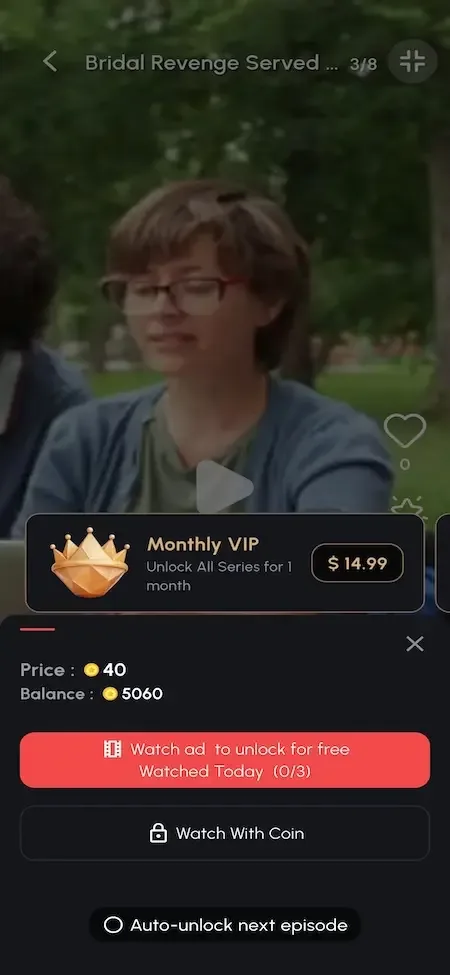
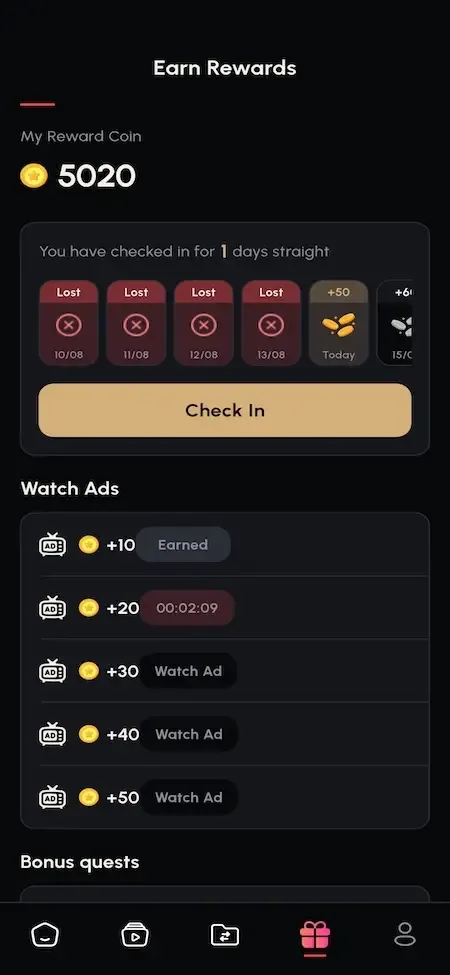
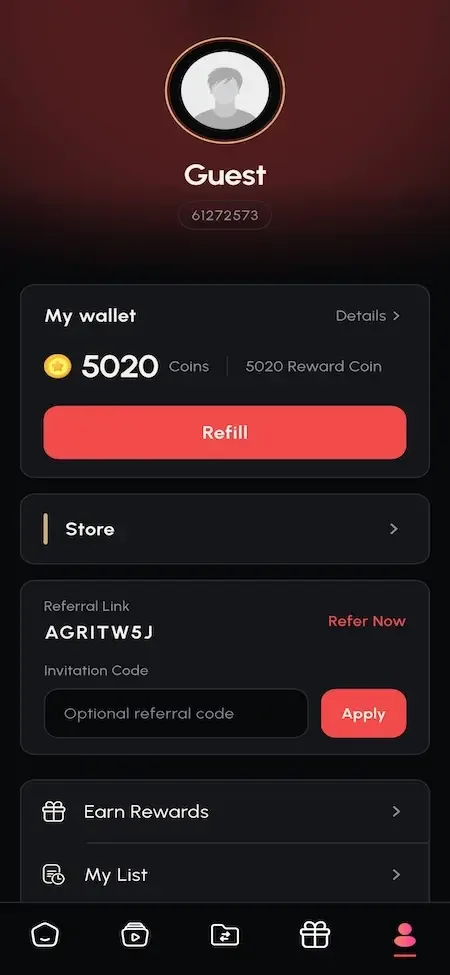
Each role works in its own side of the same product. The screens come from the working demo.
Language is handled as data you own. The same catalog can be read in five interface languages, two of which flip the whole layout, and the words a market sees on a paywall are edited in the console and not frozen inside a release.
A multi-country service has to answer what each audience pays, in which currency, through which rail and for which titles. These controls turn a new territory into configuration work, with no need for a separate build or a second deployment.
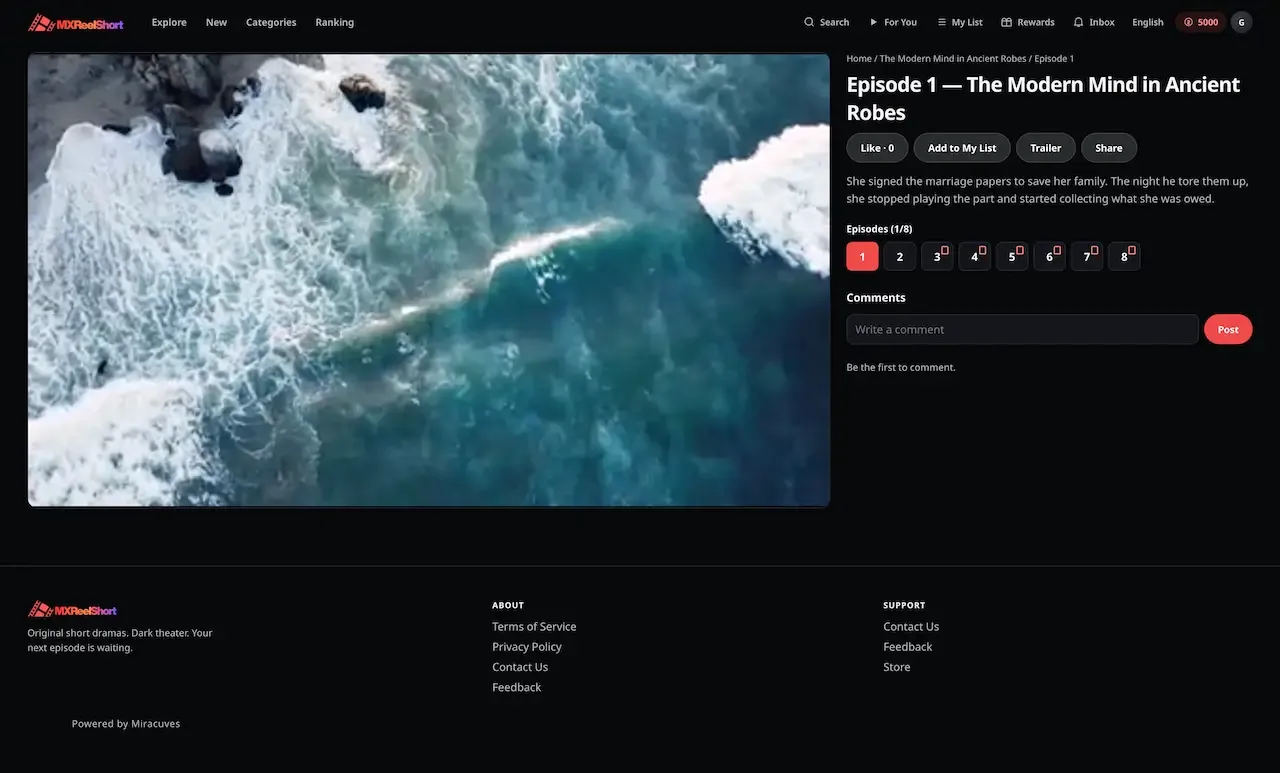
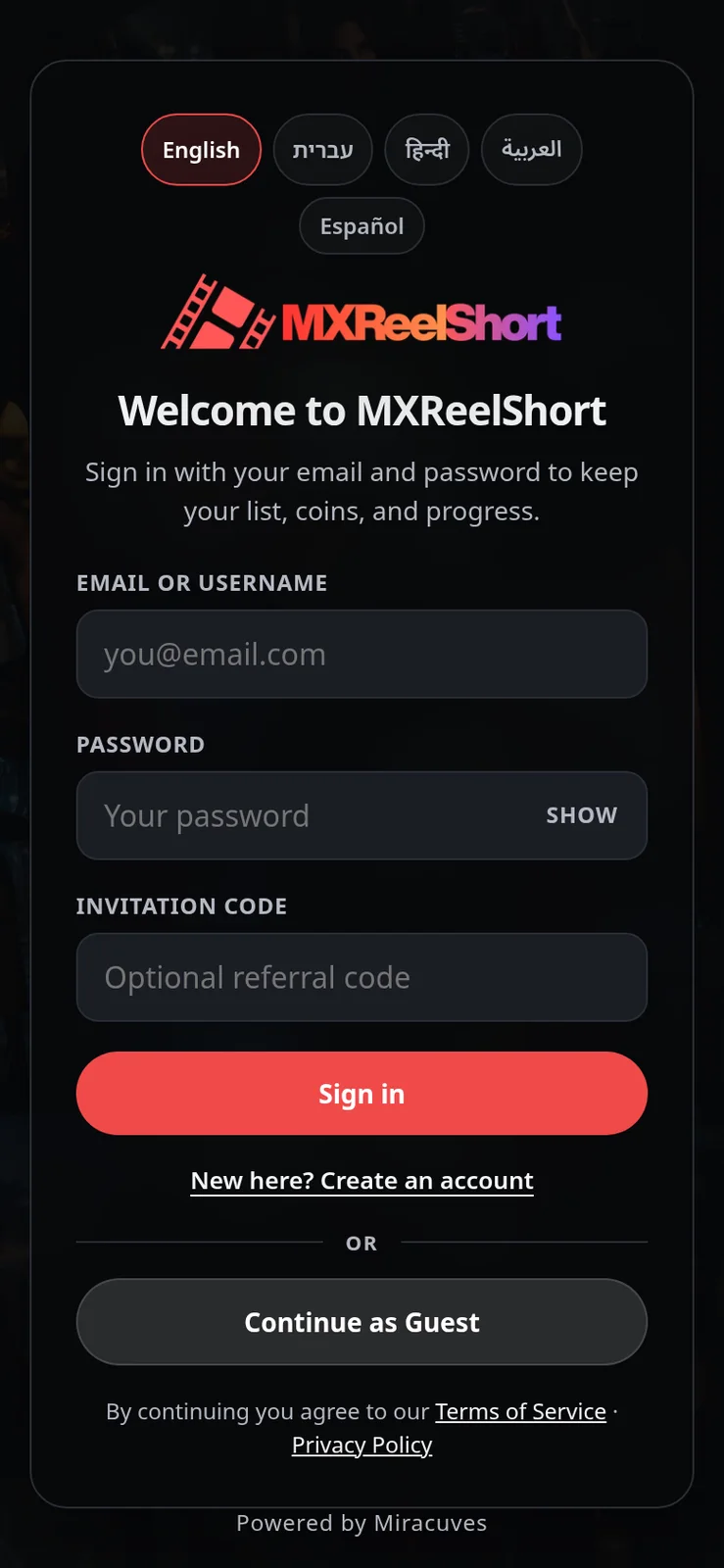
Viewers see none of the machinery. They land in their own language, watch the first episodes free, and meet a lock that offers coins, a rewarded ad or a VIP pass, with the wallet and rewards available on whichever device they use.
The people running a multi-market service need to see each market separately while managing one library. The console gives them roles, queues and analytics, and a view-only demo login for showing partners how it works without risk.
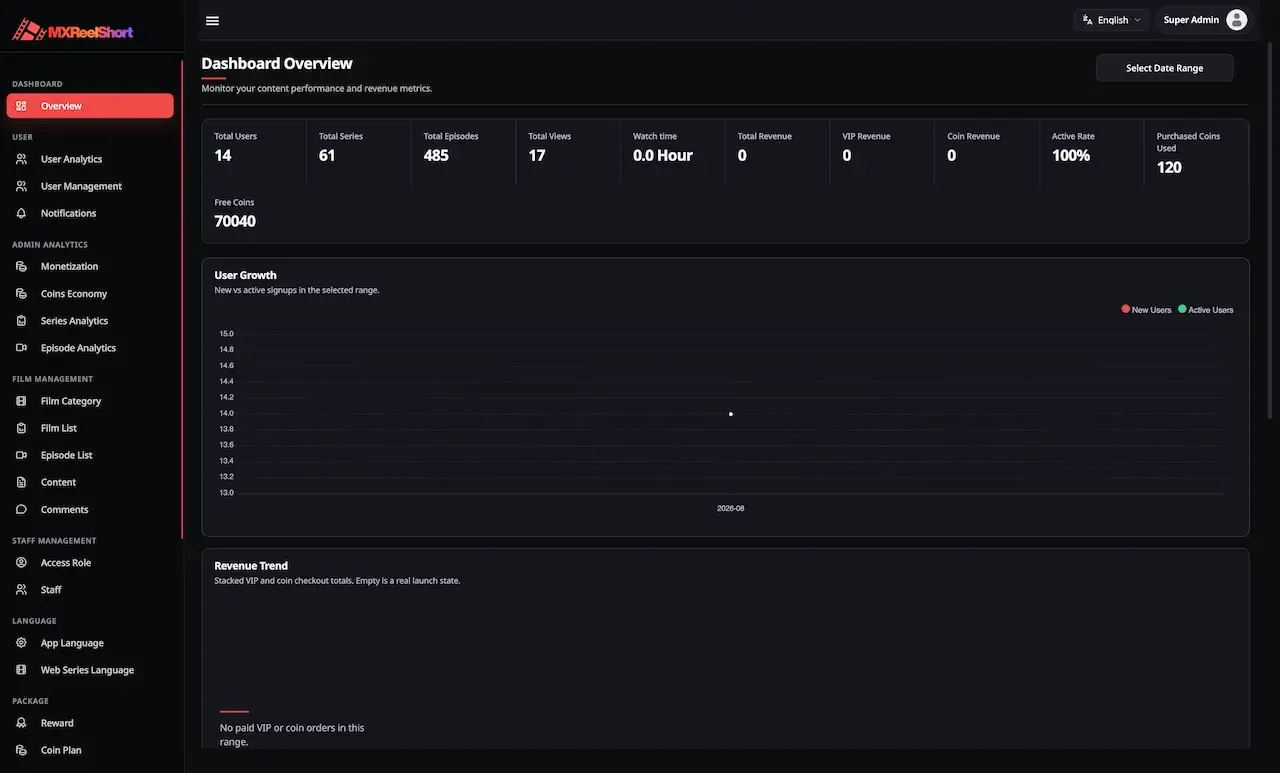
14 screens from the working demo, grouped by where they live. Your platform ships rebranded with your name, logo and colors.
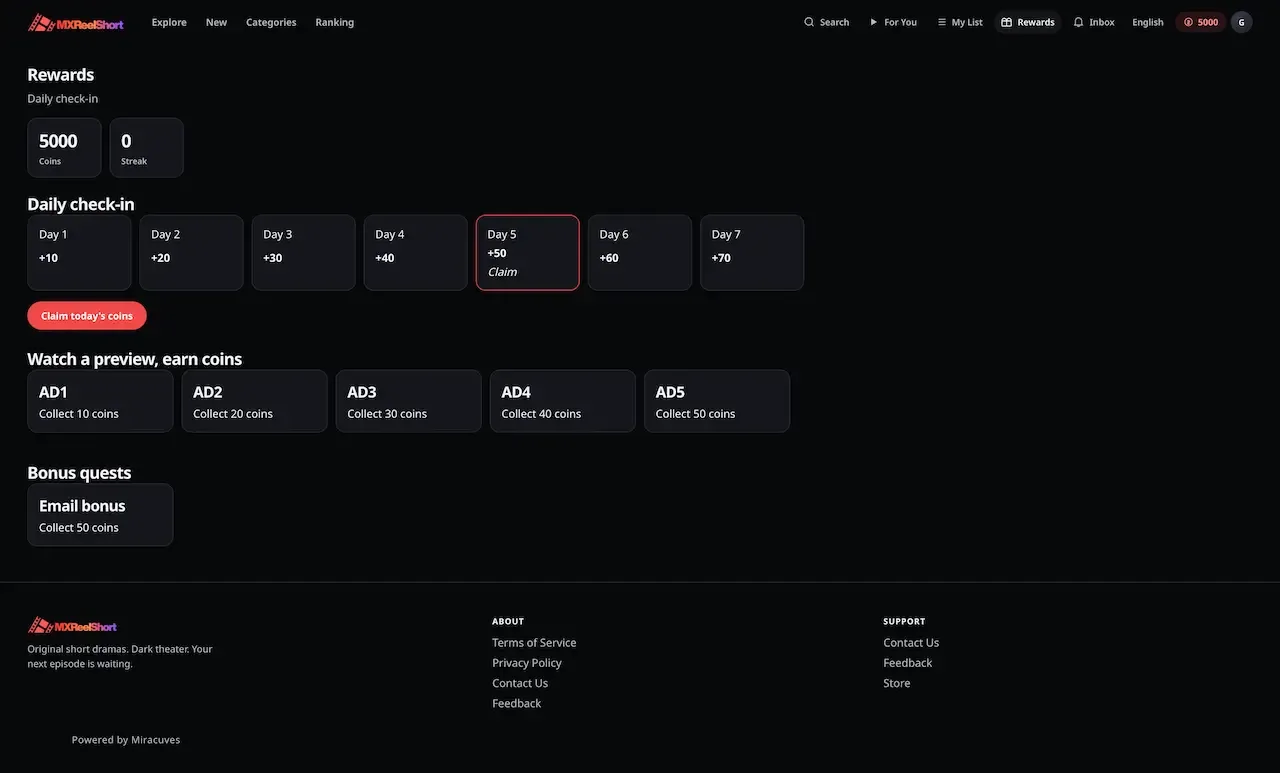
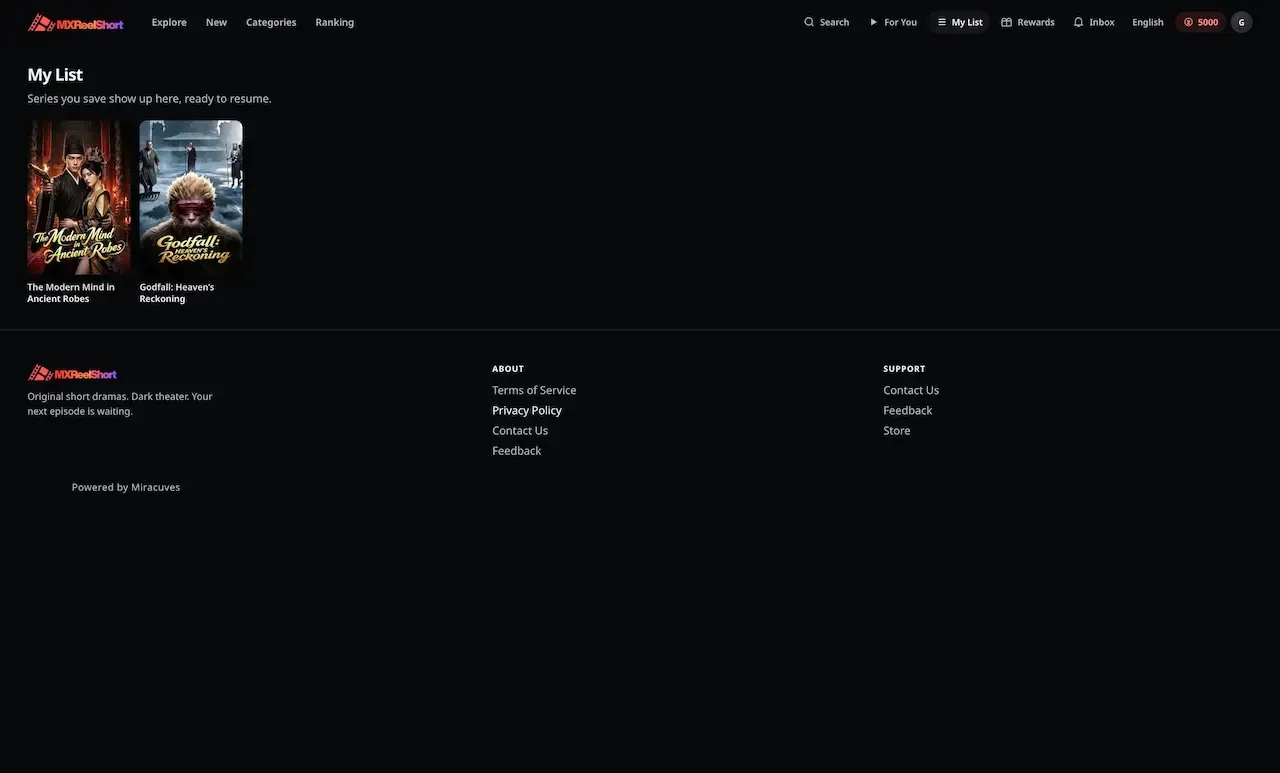
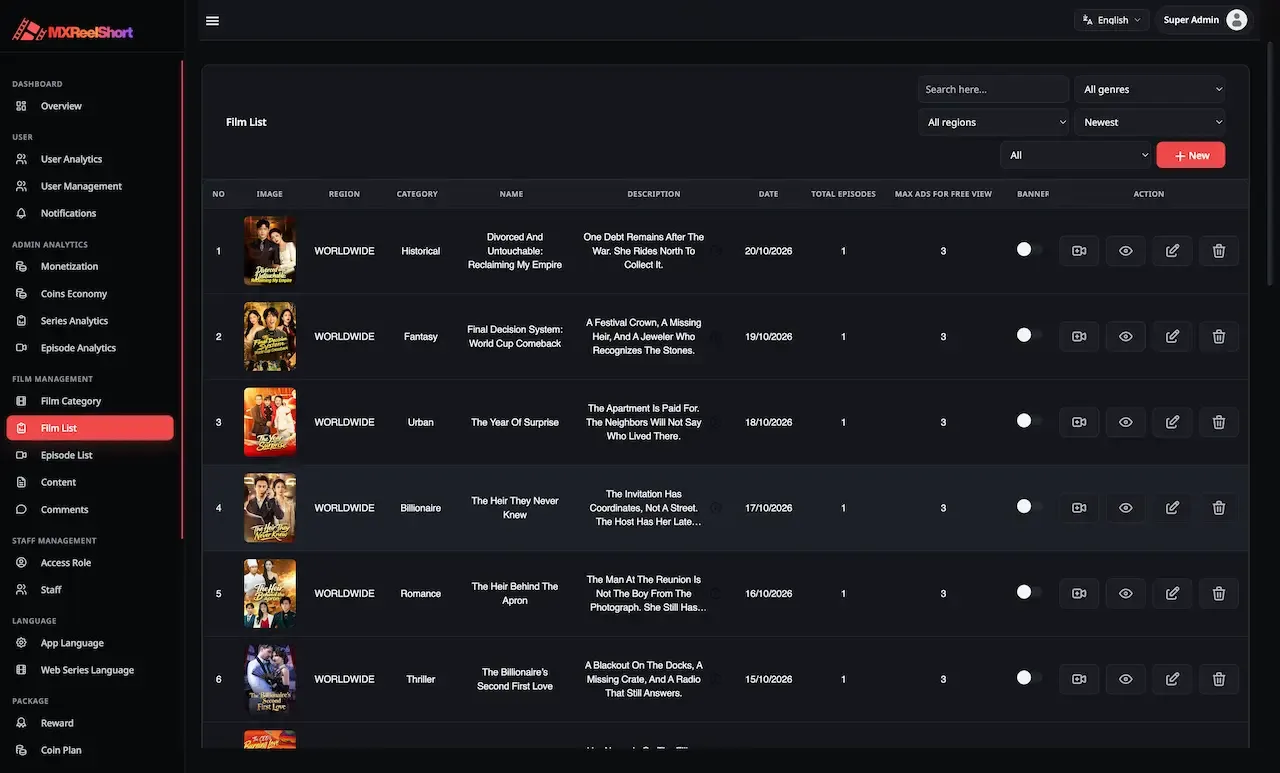
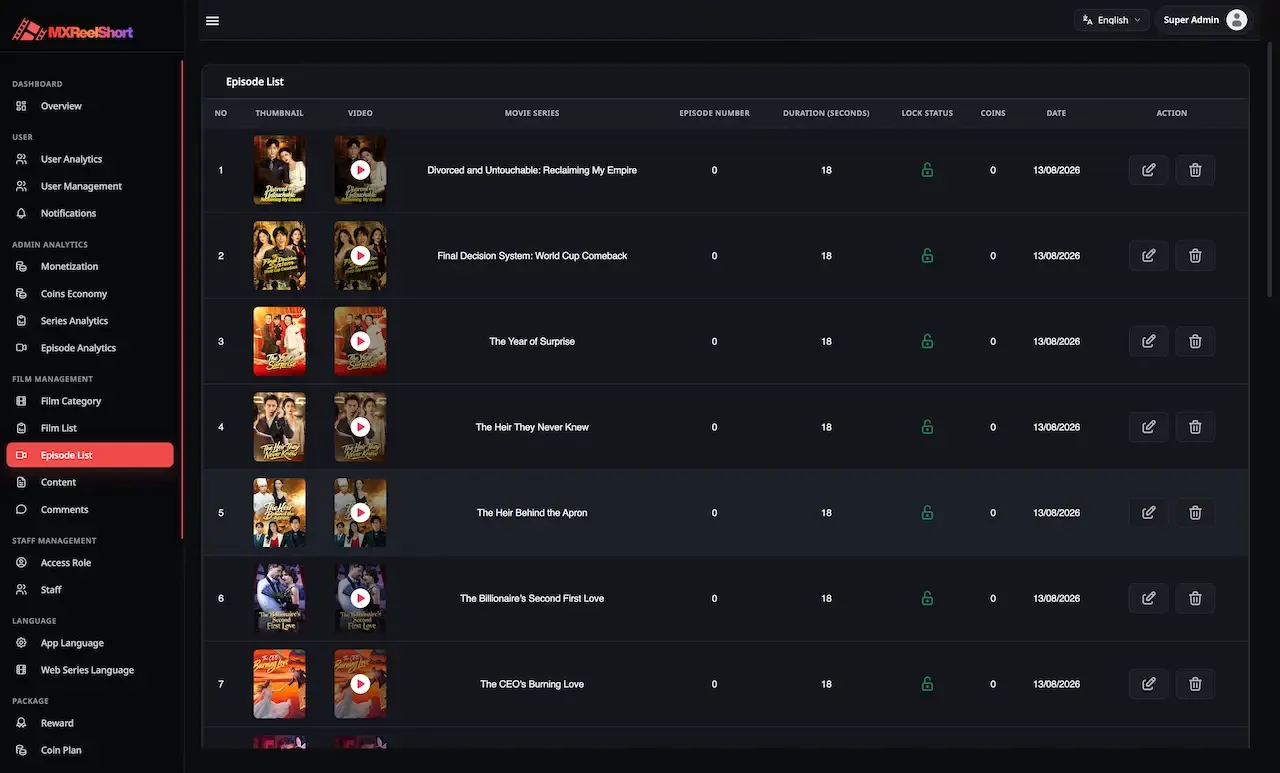
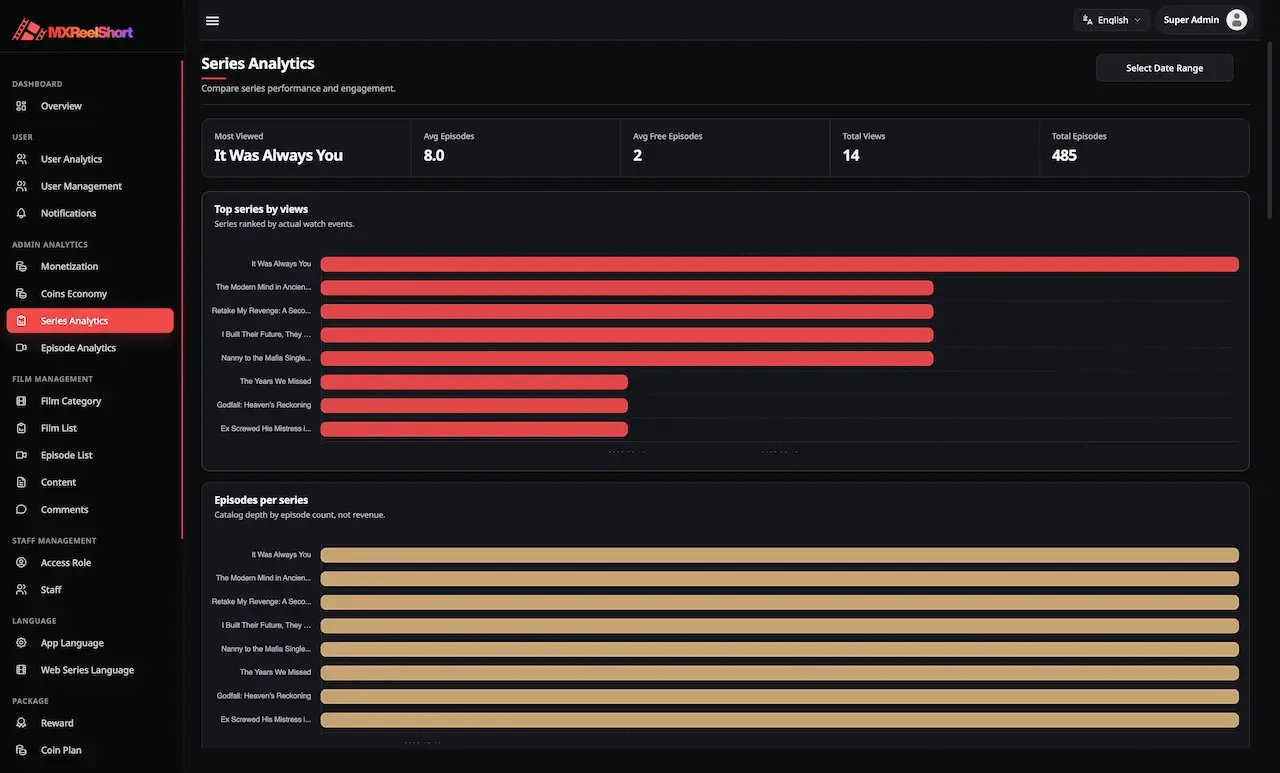
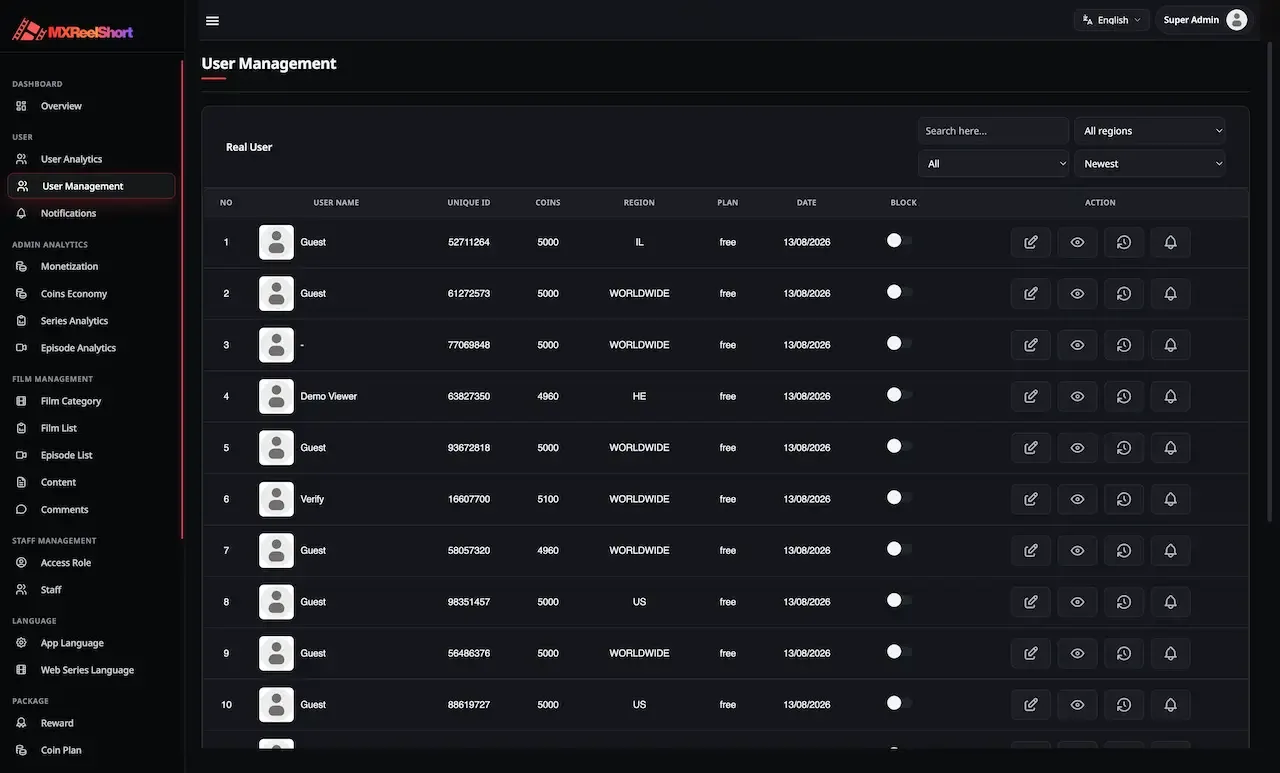
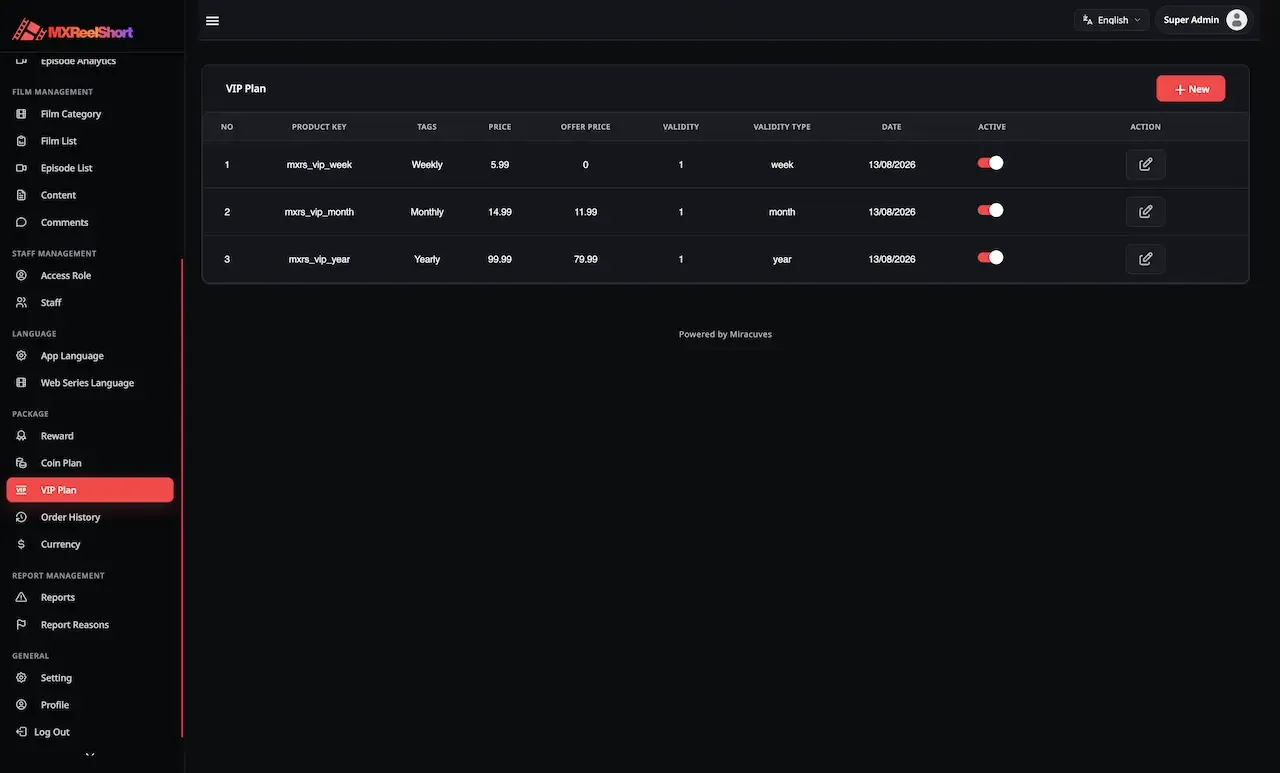
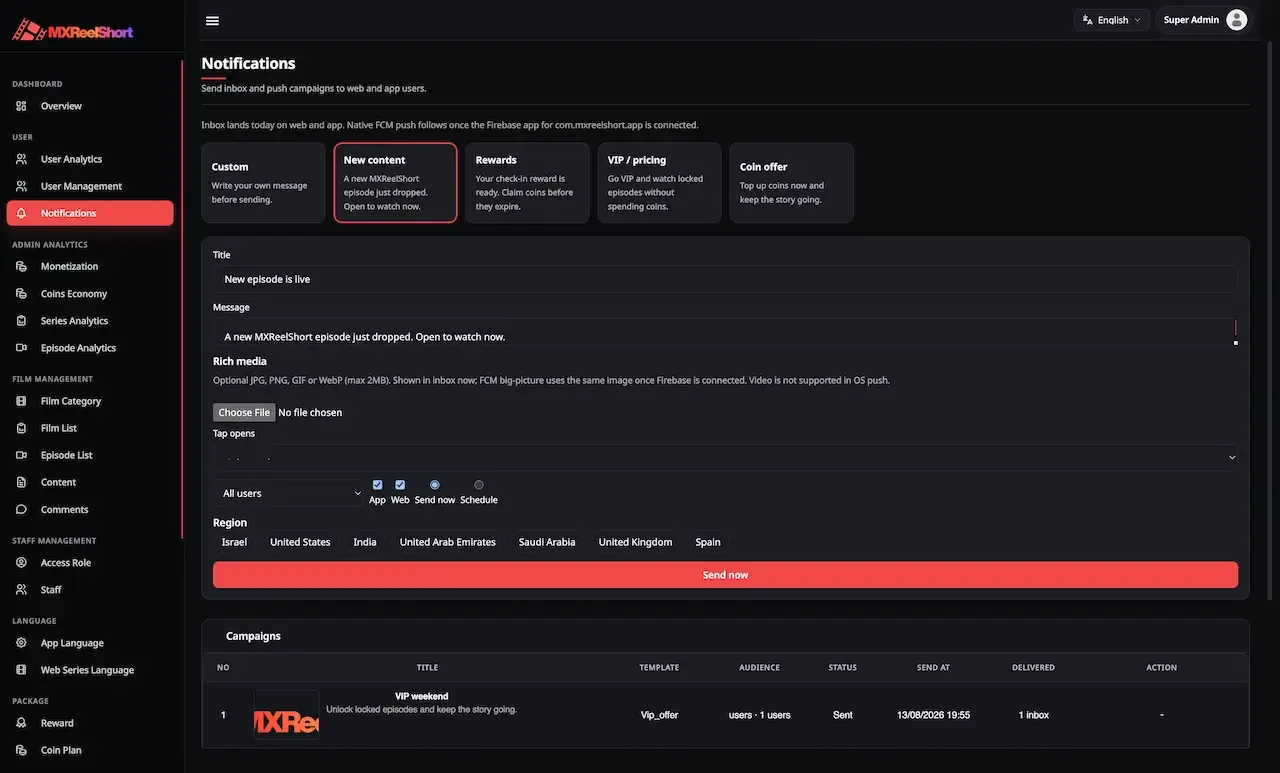
The demo shows the language side of the product best: a viewer app on the web and on Android, and a view-only operator console. It carries our demo branding and a seed catalog of royalty-free stills, so judge the layouts, wallet and settings screens rather than the titles.
webuser@demo.comUser_$321admin@demo.comAdmin_$321webuser@demo.comUser_$32146 features across 4 roles. The first six of each role are here and the full list is one click away. Nothing is held back for a sales call.
Each of the five locales has a flag in the console, which switches it on for the web app, the store app and the console.
Hebrew and Arabic reverse the full interface direction on all three surfaces, covering the player, the store and the console.
The app language JSON is edited inside the console, so a changed button label or paywall sentence goes live without a release.
A series language catalog is kept apart from interface copy, so a Spanish interface can show Hindi-language dramas.
Settings choose the locale a first-time visitor lands in, ahead of any picker choice they make.
Viewers change language from inside the app on the web and the store build, and the choice carries across sessions.
6 more Localization features are in the full list.
A list of currencies with operator-set rates, instead of a live feed, so each price is a deliberate decision.
The default currency decides what a buyer is quoted at checkout, which lets different markets see different money.
Country codes and zip allowlists can be defined as part of the market model for territory-specific rules.
Territory chips on a title are matched in the same query that builds a shelf, so out-of-licence titles never appear.
A title can publish and retire on schedule inside a licence window, matching what a distribution contract allows.
Playback addresses are signed, expire and apply geo rules, which supports territory restrictions at the file level.
5 more Markets and pricing features are in the full list.
A visitor reaches rails and trailers without registering, which keeps first impressions free of sign-up friction.
Trailers live inside the title as episode zero, and they are region targeted exactly like the episodes around them.
The opening run plays freely, then a lock offers each route forward at the moment the story hooks.
Earned and purchased coins are tracked apart with a single total on display, and promotional coins expire.
A seven day ladder with a streak pays coins that a viewer can spend on any market catalog.
A referral credits the referrer when a friend signs up, which suits tight-knit language communities.
5 more Viewers features are in the full list.
Roles list modules and actions, and a staff account takes one role, so a translator sees only the screens meant for them.
Menu items the role cannot use are hidden, which keeps each team focused on its own market tasks.
Viewer reports collect in one queue and close with a solved state that notifies whoever filed them.
A comment can be hidden and a user blocked from the console without touching the database.
Message templates are written once per language and reused across campaigns and audiences.
Campaigns can be scheduled or cancelled and show delivery statistics after sending.
6 more Operators and staff features are in the full list.
The path through the product, in the order it happens for the people using it.
Choose the locales, currencies and territories you open with, and tell us which gateways each market should use.
Set the default locale, edit client wording, load the currency catalog and attach region chips to titles.
A visitor sees the interface in the chosen language, mirrored for Hebrew or Arabic, with rails limited to titles available there.
At the lock the viewer spends coins, watches an ad or uses a VIP pass, and any purchase is quoted in the market currency.
Filter users by country and review revenue per series to decide where to adjust prices or add a language.
Every earning route built into the product you receive: how it works, who pays and where the operator earns.
| Revenue model | How it works | Who pays | How you earn |
|---|---|---|---|
| Coin packs by market | Packs with bonus coins are quoted in each market default currency and bought through the gateway that market trusts. | Viewer | Pack revenue per territory, tuned by size, bonus and offer price |
| Episode coin price | Each episode carries its own coin price, so a finale or a back catalog title can be priced apart from the rest. | Viewer | Coin spend as each locked episode is opened in that market |
| VIP and Premium windows | Plans by validity window grant open access while they run, with lengths that can differ for each audience. | Viewer | Plan income that repeats as windows renew |
| Rewarded ads | On the store app a viewer without coins watches a rewarded video to open an episode, within a daily cap. | Advertiser, through your ad network | Ad network payout for completed rewarded views |
| Regional pricing | Local prices and currencies per country on coin, VIP and Premium plans, charged on the server. | Viewer | Higher conversion where a local price fits the market |
| Reward coins as retention | Check-ins, quests and referrals pay in coins that expire, bringing viewers back without cash outlay. | Operator, as a promotional cost | Return visits that lead to paid unlocks |
| Territory licensing of titles | Region chips and licence windows let you sell the same title to different distributors or audiences by territory. | Licensee or partner | Licence fees you agree outside the platform |
The flow of money, the gateways you can connect and how payouts are handled.
A cross-border service rarely settles every audience on one rail. The gateway switches let you enable the processors that fit each market, while the currency catalog decides which amounts a buyer sees. All paths credit the same wallet and write the same ledger, so finance reads one record regardless of how money arrived. Merchant accounts are yours, and we connect them during delivery.
| Gateway | What it covers |
|---|---|
| Card | |
| PayPlus | Hosted checkout, so card details are taken by the processor and not stored in your database. |
| Stripe | Confirmed with the processor on the server before coins or VIP days are credited. |
| Regional | |
| Razorpay | A regional rail for markets where it is the usual choice, verified on the server before credit. |
| Flutterwave | A regional switch for markets served by this processor. |
| Other | |
| Google Play billing | In-app billing switch where store rules require digital goods to use store payments. |
You operate the platform, so legal compliance in each market you serve is yours. This is the tooling that ships in the product. It is not legal advice.
Region chips and dated licence windows keep a title off shelves outside its licensed territories, and signed expiring links with geo rules add file-level enforcement. These are tools for applying a contract and not a substitute for one. Check each distribution agreement for exact territories, dates and platforms before publishing, and keep the records.
Hosted checkout takes the card on the processor page, so card numbers do not reach your MongoDB. Stripe and Razorpay purchases are confirmed on the server before credit is applied. Each market may need its own merchant account and approval, so start those applications early, as they usually take longer than configuration.
Reports, comment hiding and user blocking are available, and report reasons are written in your own words. The harder part is people. A service in five languages needs reviewers who can read each of them, so plan staffing per market and give each reviewer a role limited to the work they do.
Accounts can be exported, anonymized or permanently deleted from the console, which gives you a mechanism to respond to access and erasure requests. Which rules bind you depends on where your viewers live. Publish privacy and terms pages in each language you serve, and take local legal advice, since we do not provide it.
Uploads are inspected at the byte level and anything that is not an image, video or subtitle file is discarded. Release builds of the mobile app block screenshots natively. Neither is a complete defence against piracy, and a catalog under strict licence may also want DRM, which we set up.
The product documentation lists hardening items, such as stronger password hashing, request rate limiting and wider enforcement of staff permissions, as work we agree with you. Ask for the security reference and decide the list for go-live. We set these up for your build, with scope confirmed at kickoff.
Hosted checkout takes card details on the processor side, so no card number is stored in your database on that path.
The layers of the product as delivered. You receive the full source code for every one of them.
| Layer | Built with | Hosting note |
|---|---|---|
| Consumer web app | Vite, React, React Router | A static React build served by the proxy, which keeps browsing off the API process.One Express service under PM2 behind nginx, serving both the viewer and admin routers. |
| Mobile app | Flutter, GetX, one binary with all five locales | |
| Operator console | Next.js 14, Redux, ApexCharts | Next.js 14 on its own subdomain, used by staff in every language you operate. |
| API and data | Node.js, Express, Mongoose, MongoDB | |
| Hosting layer | nginx, PM2, node-cron | |
| Media storage | Local disk, AWS S3 or DigitalOcean Spaces | Local disk, AWS S3 or DigitalOcean Spaces, one active at a time, among eight supported providers.A CDN in front of your bucket is a deployment choice and the main lever for audiences far from the origin. |
| Database | MongoDB with indexes on the paths that rails, search and the ledger use most. | |
| Background jobs | Node cron resets daily ad counters and dispatches due campaigns from inside the API process. | |
A multi-market service cares most about where media sits and how close it is to viewers. The platform keeps files off the API host through a storage switch, leaves the CDN decision to you, and runs as ordinary Node processes, so a European, Gulf or Asian audience can each be served from infrastructure you choose.
Markets are not interchangeable, and the checklist for one rarely fits another. The table groups common audience types by what to set up and what tends to go wrong. It describes configuration, not forecasts, and each row should be tested with real viewers from that market before you scale spending.
| Market profile | What to configure | Watch-outs |
|---|---|---|
| Right-to-left language audience | Mirrored layout, editable wording, a local default currency and a trusted payment rail. | Subtitle fonts and numerals can look wrong. Review every screen in the real language, not only the menu. |
| Hindi-speaking audience | Hindi locale, small coin packs, a regional gateway and rewarded ads on the store app. | Some later web strings fall back to English, so complete the copy before launch. |
| Spanish-speaking audience | Spanish locale, subtitles or dubs per title and a currency suited to each country served. | One language spans many countries with different habits, so price lists may need to differ. |
| Crowded English-language market | Sharper positioning, tighter catalog curation and careful free window testing. | Acquisition costs are usually highest here, so be wary of copying large apps. |
| Mixed-language country | Viewer language picker, several subtitle tracks and clear labels for each title language. | Titles can confuse viewers if language and subtitle choices are not clearly shown. |
| Rights-sensitive territory | Region chips, dated license windows and signed links with geographic rules. | A title served outside its license is a contractual problem, so verify before publishing. |
| Low card-use market | Local gateways, rewarded ads and a check-in ladder that earns coins. | Without a trusted rail, viewers who want to pay may have no way to do so. |
Money is where a second market most often stalls. Cards, local wallets and store billing each behave differently by country, and the rules for in-app digital goods are set by the stores, not by us. Plan these points per market and check current store policy before pricing anything.
Language is the core of this model, and the platform stores and plays subtitles and audio tracks but does not create them. Anything automatic is something we build on a provider you contract. The table separates what exists today from what could be added, and what a human must still check.
| Layer | What exists in the product | What lies beyond it |
|---|---|---|
| Interface wording | Five locales ship, and an editor changes wording without a rebuild. | A sixth language needs a translation pack and layout checks, which we set up with you. |
| Subtitles | Files attach per episode and render as a track in the web and mobile players. | AI drafting or translation of subtitles can be added and needs human review. |
| Dubbed audio | Selectable audio tracks sit beside the original on the same episode. | AI voice dubbing can be added, and rights to alter a performance are yours to clear. |
| Series language catalog | Kept apart from the interface language, so viewers can mix them. | Deciding whether a dub is a track or a separate title is a catalog choice for your team. |
| Marketing and legal text | Policy pages and campaign templates are content you write per language. | No automatic translation of marketing copy ships, so budget for a human translator. |
| Moderation in several languages | A report queue and comment controls are available to staff. | Staff need language skills for each market, or a provider we help you set up. |
One fixed price for the ready-made platform, published here so you can plan before you talk to us.
Ready-made, one-time
$3,999
Live in 6 working days from kickoff
The engineers who deploy your platform stay with it once it is live.
Need more? We tailor the platform to your plan, typically in 2-8 weeks, and confirm the scope with you before work starts. App store review times are set by Apple and Google.
Everything here is available around the ready-made DramaBox clone. We confirm the scope with you before any price is agreed.
Per-country prices and currencies on coin, VIP and Premium plans, charged on the server through Stripe, PayPlus or Razorpay, with country detection at the edge.
Confirm with usAdaptive bitrate playback for weaker mobile networks, with encoding on Mux or Cloudflare Stream under your own account.
Confirm with usA licence step in front of packaged streams for rights holders who require it, using your Widevine or FairPlay vendor.
Confirm with usScheduled import of licensed titles from partner APIs, so a new territory can be stocked without manual uploads.
Confirm with usAudience polls on which title returns for another season, with extra votes for VIP members.
Confirm with usA sixth interface language needs a locale flag, a translation pack and layout checks, we set up as configuration and translation work.
Confirm with usA withdrawal flow and payout desk built to the rules of the countries where you operate.
Confirm with usThis matrix is arranged around the questions a cross-border operator asks first: which languages work, who controls wording, how territories and currencies are handled, and what we set up around your plan. Most of the platform ships ready, and the rest is tailored to your markets.
English, Hebrew, Hindi, Arabic and Spanish ship with the interface already translated.
Hebrew and Arabic mirror the whole layout across the web app, store build and console.
An app language editor in the console changes copy without a rebuild or a store review.
Viewers choose their interface language, separate from the language of the series.
Subtitle files attach to each episode and play in a language unrelated to the interface.
A dubbed audio file can sit beside the original on the same episode.
A title is targeted to chosen territories and kept off shelves elsewhere.
A title can publish and retire on schedule to match a rights agreement.
Operator-set rates and a default currency per market drive what checkout shows.
Several gateways and a Google Play billing switch let each market settle on its own rail.
Three ways to open an episode, with a per-title daily cap on rewarded ads.
Reward coins expire on a schedule you set, while purchased coins stay.
Links expire, and geographic rules keep titles inside the territories you serve.
Scheduled messages reach an in-app inbox for every targeted user.
Staff roles with module grants let teams in different places share one console.
The iOS app is delivered with Apple in-app purchase, set up with you during delivery.
Local prices and currencies per country on packs and plans, which we set up for you.
Connection-aware playback, useful where networks are uneven; we set it up for you.
A stream license step for catalogs whose licensors require it; we set it up for you.
Fills the catalog from licensed partner feeds on a schedule; we set it up for you.
A new locale needs a translation pack, a flag and layout checks; we confirm scope with you.
We can add AI translation or dubbing against a provider you choose, with scope confirmed with us.
We build both for your plan; confirm scope with us before promising them to a market.
Four pages go deeper on the questions buyers ask most about the DramaBox Clone. This page stays the overview.
Most short drama software handles one language and treats every other as a translation job added later.
See the full breakdownServing several countries changes the budget less in software than in content, language work and payments.
See exact pricingThe expensive part of short drama is the catalog, and a catalog costs the same whether one country watches it or ten.
See the playbookAnyone can promise a multilingual app, and few can show right-to-left layouts working in a wallet screen or territory rules attached to a title.
Compare optionsFrom kickoff to a live DramaBox clone under your brand: what we do each day, and what we need from you.
1Day 1
2Day 2
3Day 3
4Day 4
5Day 5
6Day 6
Going multilingual changes where money goes. The platform price covers the product, but every added market adds translation, payment onboarding, rights paperwork and moderation capacity. Teams often budget the software and forget that a fifth language means a fifth set of reviewers and a fresh merchant approval. Building localization into a custom app is also easy to underestimate, since mirrored layouts touch every screen. The comparison below shows what each route leaves for you to solve once the first market is live and the second begins.
| Factor | Build from scratch | Rent a SaaS | Own it with GetFame |
|---|---|---|---|
| Right-to-left support | Retrofitted into every screen, often late | Depends on the vendor and plan | Already mirrored on web, app and console |
| Editing wording | Usually a release for each change | Limited to the fields the vendor exposes | Language JSON edited in the console |
| Per-market currency | Designed from scratch | Often a higher tier | Currency catalog with a default per market |
| Territory control | Needs a rights model before launch | Basic or absent | Region chips and dated licence windows |
| Factor | Build from scratch | Rent a SaaS | Own it with GetFame |
|---|---|---|---|
| Adding a country | New engineering for each market | Within the vendor supported list | Configuration, plus translation and gateway onboarding |
| Ownership | Yours | The vendor holds code and data | Full source code and your own database |
Running costs. Outside the platform price you will pay for translation and review in each language, merchant account fees, store developer accounts and any commission on in-app coin sales, encoding and subtitling, hosting and bandwidth near your audience, and the moderators who read each language. Content rights per territory are the biggest variable.
A single-language app can hide many shortcuts. Adding a second or third market exposes them one by one: strings baked into builds, layouts that only work left to right, one price list for everyone. This comparison shows what each piece involves when you build it and when it is already in place.
Build it yourselfStrings compiled into each app build, so a wording change in one market waits for a release and a store review.
Ready-madeClient wording is editable data in the console, so testing a paywall phrase is a text edit.
Build it yourselfMirroring every screen, the player controls and the console, usually retrofitted late and found to be incomplete.
Ready-madeHebrew and Arabic mirror across the web app, the store build and the console.
Build it yourselfFormat support, per-episode storage, a language label and a player that renders tracks consistently on web and mobile.
Ready-madeSubtitle files attach per episode and render as a track in both clients.
Build it yourselfA player that switches audio streams cleanly, plus a storage model for dubs of the same episode.
Ready-madeSelectable audio tracks sit beside subtitles on each episode.
Build it yourselfRules that keep a title off shelves in unlicensed regions, applied everywhere a list is built.
Ready-madeRegion chips are applied where rails are assembled, so a title never reaches the wrong shelf.
Build it yourselfScheduled publish and retire dates, with jobs that actually run and a way to verify them.
Ready-madeDated windows publish and retire a title on schedule.
Build it yourselfExchange rate sources, rounding rules and a checkout that quotes the same figure the ledger records.
Ready-madeA currency catalog with operator-set rates and a default per market drives checkout.
Build it yourselfOne integration per processor, each with its own signature checks and approval timeline.
Ready-madeSeveral gateway switches ship, so each market can use the rail it trusts.
Build it yourselfPolicy pages per language, each needing a way for non-developers to edit and publish them.
Ready-madePrivacy and terms pages are content you manage, one set per locale.
Build it yourselfRole design so a local moderator sees only what they should, enforced on the server.
Ready-madeNamed roles with grants by module and action, enforced on the admin API.
DramaBox is widely known as a short drama app that reaches viewers in many countries and presents stories in the language each audience reads. This comparison is about that general model and not about the internals of any company, and it shows where an operator-owned build differs in practice.
| Aspect | The DramaBox model | This platform |
|---|---|---|
| Language coverage | Set by the owning company and its roadmap | Five locales ship, and copy is yours to edit |
| Territory decisions | Made by the company that holds the rights | You tag titles with region chips and licence windows |
| Pricing per market | Decided by the owning company | Your currency catalog and plans decide what each buyer is quoted |
| Payment rails | Chosen by the owner for its app | You enable the gateways your merchant accounts allow |
| Interface wording | Edited by its own team | Edited by you in the console, without a release |
| Audience ownership | Viewers are registered with the brand, not with a licensee | Viewers sign up on your domain and store listing |
| Ability to modify | Not offered as a product | Full source code, redeployable where you choose |
The founders and teams this product fits most directly, one line each. The launch ideas that follow turn these audiences into a first-week plan.
Run one catalog in several languages with pricing and rails adjusted for each country.
Serve Hebrew and Arabic audiences with a mirrored layout across web, app and console.
Publish the same series with several subtitle and audio tracks and keep them apart from interface text.
Limit each title to its licensed regions and show a rights holder per-series results.
Open a new community language by editing wording in the console and attaching titles to its region.
Because language, layout and currency are settings rather than separate products, a launch can start with one market and grow. These ideas describe who pays in each case, what they pay for and which setting to configure before the first title goes live.
An operator serves Arabic readers who rarely see a properly mirrored drama app. Viewers pay per episode and through a pass. Configure Arabic as the default locale, then set the currency and a gateway that local buyers accept. Check that every title carries the right region chip before it appears on any shelf.
A publisher serves Hebrew speakers with local and dubbed stories. The audience expects a layout that reads from the right throughout, including the player and legal pages. Configure the locale and the editable wording first, then test the paywall copy with a small group before widening the free window.
A studio targets Hindi speakers who pay in small amounts through local rails. Coin packs sized for low spends work better than large bundles. Configure the currency catalog and a regional gateway first, and consider rewarded ads on the store app for viewers who are not ready to spend.
An operator already running in one language adds Spanish for a second audience with the same catalog. Titles keep one record with additional subtitle or audio tracks. Configure the Spanish locale, then decide whether each dub is a track on the same title or a separate title for clearer reporting.
A brand serves communities abroad who want stories from home in their own language. Viewers may live in several countries, so territory rules matter. Configure region chips and license windows carefully before launch, and decide which currency each group sees by default at checkout.
A distributor holds one library and licenses branded copies to partners in different countries. Each partner wants its own language, name and prices. Configure branding and the default locale per deployment, and agree who holds the merchant and store accounts for each partner before kickoff.
Reaching more than one market does not require owning a platform. The routes below trade control for speed in different ways, and the right one depends on how much of the viewer relationship and pricing you want to keep. Here is a neutral view of the realistic options.
Consumer drama app
Producers who want existing multilingual reach without running an app of their own.
The brand, the wallet and the viewer relationship stay with the app.
Consumer drama app
Content owners testing how a title performs with an international audience.
Placement, terms and pricing rules are decided by the app rather than by you.
Consumer drama app
Studios comfortable licensing titles to a large app that already has an audience.
You trade control of pricing and data for distribution you did not have to build.
Hosted video SaaS
Teams wanting a hosted site with languages handled through plain text pages.
Usually built for monthly plans, so per-episode coins and territory rules need workarounds.
Bespoke development
Operators with unusual market rules and the calendar to specify each one.
Right-to-left and currency handling consume far more time than first planned.
A white-label platform suits an operator who wants to be the brand in each market, not one title on the shelf of a larger app. You choose the languages, set the prices, pick the payment rails and keep the viewer relationship. You also carry the work that a large app absorbs: subtitles, dubs, rights and local support.
Longer answers to the questions buyers of this model ask before they commit.
Treat the second market as a separate launch, not as a translation job. Before you switch a locale on, confirm that you hold rights to a set of titles for that territory, that you can accept payment there and that someone on your team reads the language well enough to handle reports. If any of the three is missing, the market will stall.
Start narrow: one locale, one currency, one gateway and a small shelf of titles that suit the audience. Keep the free window generous, because a new audience has no habit yet, and tighten it only when you see viewers reaching the lock and paying. Use the country filter on the user list to judge the market on its own numbers.
Keep the first market running while you learn. Because one deployment serves every locale, your wallet, ledger and console stay shared, which makes comparison easy. The real cost of a new market is attention, so add them one at a time.
The lock screen is the most valuable text in the product, and a direct translation often reads wrong. Some audiences respond to urgency about the story, others to clarity about price, others to a sense of belonging. Because client wording is editable data, you can test phrasing per locale without waiting for a release.
Ask a native reader to review every locale, including the small strings such as error messages, report reasons and empty states. Hebrew and Arabic also need checking in the mirrored layout, where punctuation, numbers and icons can look wrong even when the words are right. Fix those details before you spend on acquisition.
Keep a simple log of each copy change with its date, so that you can line it up against the revenue by series in the console. You are not running a formal experiment, but a dated record turns a hunch about wording into something you can discuss.
Rights are the quiet risk in a cross-border drama service. A title licensed for one region and shown in another can end a distribution relationship. Make region chips part of your publishing checklist, so that no title goes live until its territories and dates have been entered from the contract.
Use the licence window to retire titles on time and not by memory. A window that closes by itself protects you on the day the contract ends, when nobody remembers to unpublish. For catalogs under tight terms, ask about signed expiring links with geo rules, and about DRM if the licensor requires it.
Keep your own record of what each territory is allowed to show. The console enforces what you enter, and it cannot know what the contract says. A short shared sheet, reviewed whenever a deal changes, is usually all you need.
Start by asking how viewers in the market normally pay for digital goods. In some places cards dominate, in others local wallets or regional processors do, and store billing may be mandatory for in-app purchases. Enabling the wrong rail leaves an otherwise good audience unable to buy a pack.
Then match the rail to your paperwork. Each processor wants its own merchant account and approval, and approval for small, repeated purchases can be slower than for larger ones. Begin applications during development and enable gateways one by one as they clear, rather than waiting for all of them.
Finally, keep prices simple. Set the market default currency, a few pack sizes and one plan, and review the order history after the first weeks. Regional Pricing, which we can set up, can refine prices per country later, once you know how each market behaves.
Projects and comments as published by our parent company, Miracuves, with the release notes as printed there.
Right-to-left was the requirement that eliminated every other option we looked at. Here it was already in the web app, the store build and the console.
We ran the free window at three episodes for a month, then five. Being able to move that number from a settings screen rather than a release changed how we test pricing.
Coin unlock is the whole business. Viewers who would never take a monthly subscription will happily pay for the next three episodes at midnight.
The product page notes that this build and the sister drama product ship from one codebase, so this is a single deployment rather than a separate client. A regional service went live with five locales, right-to-left layout, coin unlock and VIP windows from the first day, sharing one catalog and one wallet across web, app and console.
v2026.5Sep 2026
v2026.4Sep 2026
v2026.3Sep 2026
v2026.2Aug 2026
v2026.1Aug 2026
The ready-made white-label platform is $3,999 one time and goes live on your server in about 6 working days, once we have brand assets, hosting access, your catalog and merchant accounts. Extra locales, a live ad network, CDN setup and store publishing are available, with scope confirmed with us. Tailored work runs 2 to 8 weeks.
English, Hebrew, Hindi, Arabic and Spanish. Hebrew and Arabic use right-to-left layout on the web app, the Flutter app and the console. You can edit any client wording from the console and choose which locale new visitors see first.
Yes. Adding a locale means a flag and a translation pack, and the console editor handles the wording from there. We set up additional locales for you, so tell us the language and we confirm the scope. Note that some later Hindi, Arabic and Spanish web strings fall back to English until you complete that copy.
A currency catalog holds operator-set rates and a default, which decides what checkout displays. You set the catalog and gateways per deployment. Regional pricing is available too: it charges different local prices per country, and we set it up with scope confirmed with us.
Attach region chips to a title and it only appears on shelves in those territories. Titles can also carry dated licence windows. These tools support your rights management, but you remain responsible for holding valid licences in every market you sell into.
PayPlus hosted checkout is the primary path. Stripe, Razorpay, Flutterwave and Play switches are also present, and purchases are confirmed with the processor on the server before coins or VIP days are credited. You bring the merchant accounts, and we connect them.
No. Episodes can hold multiple subtitle tracks and selectable audio tracks, and the series language catalog is separate from interface copy. A viewer can run the app in Arabic and watch with Spanish subtitles, for example. Interface wording is edited as data in the console, so a copy change needs no rebuild.
Yes, completely. You receive the web app, the Next.js console, the Express API, the Flutter app, a seed script and deployment configuration. There is no per-seat fee and no revenue share. Optional Plus modules arrive only if you buy them, as separate folders.
You operate it under your own brand and your own licensed catalog. The software follows common micro drama patterns and carries no code, design or content from any existing app. We are not affiliated with DramaBox, and rights and compliance in each country stay with you. This is not legal advice.
Yes. A language picker is available in the web app and the store app, and the choice persists. You also set a default locale in settings for first-time visitors, so a viewer arriving from a specific market can be greeted in the language you expect before they touch anything.
Episodes support selectable audio tracks and subtitle tracks stored per episode, so a dubbed audio file can sit beside the original. The series language catalog is separate from interface language. How you organize dubs, as one title with tracks or as separate titles per language, is a catalog decision for your team.
Yes, the full layout reverses on the web app, the Flutter app and the console, not just the text direction. Some later Hindi, Arabic and Spanish web strings currently fall back to English, so plan a copy review with native readers before launch and complete any strings that remain.
Add each currency to the catalog with a rate you set, choose a default per market and create the packs and plans that suit it. The default currency drives what checkout displays. Rates are set by you and are not a live feed, so review them whenever exchange rates move enough to matter.
Yes. Region chips on the title restrict where it surfaces, and a licence window controls when it publishes and retires. Signed expiring playback links with geo rules add another layer at file level. You remain responsible for entering the correct territories and dates for every title.
No. A single Flutter binary carries all five locales, and the viewer or the default setting selects one. That keeps store management simple, with one listing per brand. If you want separate store listings for separate markets, we can set that up for you with scope confirmed with us.
Yes. The console is a web application with named roles, so teams in different countries can share it while seeing only the modules their role allows. The one-hour session limit applies to each login, and the country filter on users helps each team focus on its own audience.
No. The platform ships five locales of interface copy and an editor for changing wording. It does not translate your series content, subtitles or marketing text. You supply subtitle files and audio tracks, and your reviewers check every language before it goes live.
Consumer apps in the same space include ReelShort, ShortMax, GoodShort, NetShort and DramaWave, which differ in catalog, markets and monetization details. They are apps to watch on, not platforms to own. A white-label DramaBox style clone is for operators who want to run their own service, with their own catalog, brand and prices.
Start where you can serve the audience properly: a language you can subtitle or dub well, a rail viewers trust and titles you are licensed to show there. A less crowded language market often costs less to reach than a crowded one. Test with a small local group before spending on acquisition.
Yes. Episodes hold subtitle files and selectable audio tracks, so one title can offer the original audio, a dub and several subtitle languages. Some operators prefer separate titles per dub for clearer reporting. Both are catalog choices, and the series language is kept apart from the interface language the viewer picked.
They depend on where you operate and where viewers live. Expect to deal with content licensing for each territory, data privacy rules, consumer and payment rules, and store policies. The platform gives you region targeting, license windows and data export or delete tools. It does not give legal advice, so consult a lawyer for your markets.
Use layers. Playback links are signed and expire, titles carry territory rules and license windows, and the access rule is checked on every request. DRM and adaptive streaming are available for catalogs that require them. No control stops every copier, so set realistic expectations with licensors.
No. One binary carries all five interface locales, and viewers pick their language inside the app. You can still publish separate store listings per market if your branding calls for it, which is a marketing choice rather than a technical need. Store accounts and review timelines are yours to manage.
Compare what you pay to run the service with what viewers pay you. Costs include the platform price of $3,999, licensed or produced titles, hosting and bandwidth, payment fees, store commission where billing applies and support staff. Revenue comes from coins, passes and ads. Your own tests set the numbers, so avoid borrowing figures from other operators.
Licensing titles for each territory, producing good subtitles and dubs, finding payment rails that viewers trust, and acquiring audiences at a sensible cost. Store fees and moderation in several languages also add up. The software removes the build problem. The editorial, rights and acquisition work still needs a plan and a budget.
Neither ships in the standard build. The product is a web app, a Flutter store app and a console. If your audience watches on televisions or travels often, we can build both, so confirm scope with us before promising them. Because you own the source, either can be added by our team or yours.
Yes, because price sits on each episode. A dubbed version kept as its own title can carry its own coin prices, and a region chip can limit it to the markets where that price makes sense. If the dub is a track on the original title, price follows the episode instead.
→Start here
Share the platform and your market. You get a walkthrough of the live demo, the exact scope of what ships, and a fixed price in writing. First response in under 2 hours, Monday to Saturday, 10:00 to 19:00 IST.
This page uses the name DramaBox to describe a type of platform. The product sold here is separate software, built independently, and DramaBox has no part in it.
"DramaBox clone" is industry shorthand that founders use when searching for software with a comparable business model. It names a category of product, not a copy of DramaBox.
The platform is an original product designed and written by Miracuves. It contains no code, design, graphics or content originating from the DramaBox website or applications, and it ships under your own brand.
DramaBox and its logos are trademarks of their respective owner and are named here for reference only. GetFame is not affiliated with, sponsored by or endorsed by DramaBox. Rights holders can write to legal@miracuves.com.
Operator responsibility. The operator of a launched platform is responsible for legal compliance in the markets it serves. Nothing on this page is legal advice.Read the full disclaimer
First response under 2 hours, Mon-Sat 10:00-19:00 IST
India+91 98300 09649 United States+1 516 202 3950