Ready-made, one-time
$4,299
Bigo Live Clone
Live in 6 working days from kickoff
- Full source code
- White-label under your brand
- 60 days of technical support
- 1 year of free updates
- App publishing support

Live streaming app
A live platform where agencies bring the hosts and gifts pay everyone
This Bigo Live clone script is a white-label live streaming platform built around the part that decides whether a live app survives: host supply. Talent agencies recruit and manage broadcasters for a share of earnings, viewers send gifts bought with coins, and a configurable split settles every gift between platform, agency and host. You receive the full Bigo Live clone source code and brand it as your own.
| Product type | White-label live streaming and gifting platform with an agency layer |
|---|---|
| Surfaces | Web app for viewers and hosts (44 routes), operator admin panel (15 routes), Expo mobile app covering core flows |
| Price | $4,299 one time, with nothing taken from gifts and no per-seat fee |
| Launch time | 6 working days from kickoff, with hardening scheduled alongside |
| Source code | Full monorepo: backend, web, admin, mobile, schema and Docker stack |
| Backend | NestJS 10 with over 200 endpoints across 17 modules |
| Database | PostgreSQL 16 with 74 Prisma models and 29 enums |
| Media and payments | Agora RTC for audio and video, Stripe for coin purchases, all on your own accounts |
| Hosting | Your servers, via a seven-service Docker Compose stack behind Nginx |
| Support and updates | 60 days of technical support, a half year of priority defect fixes, then 1 year of free updates |
A Bigo Live clone app gives you a ready-built product for running your own live video and gifting community. Founders usually want one as an app like Bigo Live that launches under their own name. Hosts broadcast in video or voice rooms, viewers join, chat and send virtual gifts, and the platform turns those gifts into host earnings that an operator approves for withdrawal. The result is a gift-funded entertainment business rather than an advertising one.
The hard parts are rarely the video player. They are a revenue split that can differ by room type and region, an agency structure with contracts and transfers, seat management for multi-guest rooms, and a moderation stack that can cope with live user-generated content. Those are the layers this platform already contains.
It ships as one monorepo with three surfaces: a 44-route web app for viewers and hosts, a 15-section admin panel for operators, and a mobile app that covers the core viewer and host flows. The backend exposes over 200 endpoints across 74 database models, and you own all of it.
Bigo Live is a live-streaming social app. Broadcasters, called hosts, go live on video or voice, viewers watch for free, and the money comes from virtual gifts: viewers buy in-app currency, spend it on animated gifts during a stream, and the host earns a share that can be cashed out. Much of the host supply arrives through talent agencies that sign broadcasters, coach them and take a cut of what they earn.
In this context a clone is no replica of that company or its software. It is a platform running the same model under your own name: the room formats, the gift economy, the agency layer and the moderation tools, with a code base you own. What you add is the market, the hosts, the commercial terms and the policies that decide whether people stay.
This is the layer that sets the platform apart from a plain streaming app. Agencies are partner businesses that bring hosts in bulk, and families are social groups that hold viewers in place. Both are modeled with contracts, roles and money, not just labels.
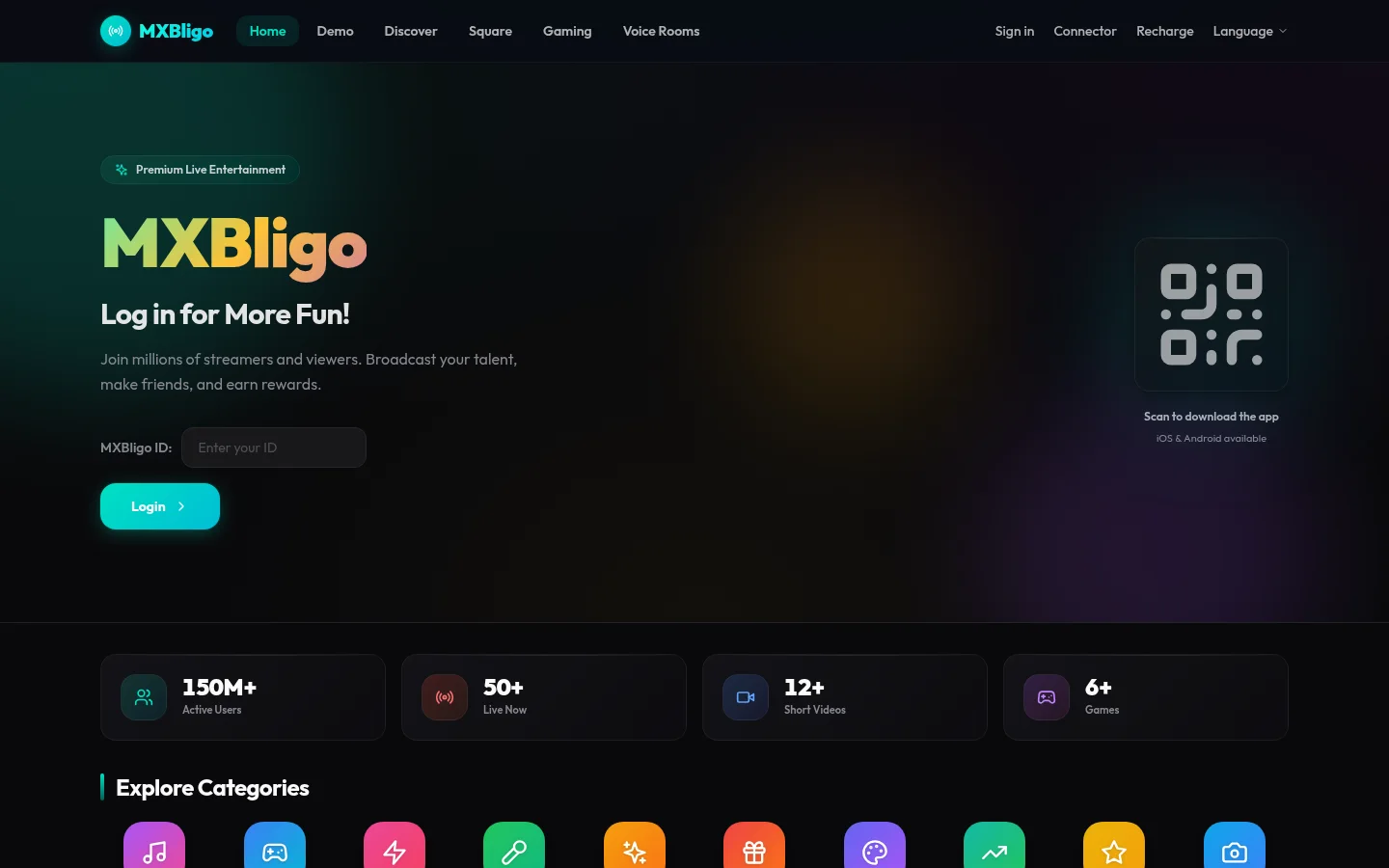
A host goes through identity review, picks a room format that suits the content, and then runs the room with full seat control. After the stream, gifts turn into a withdrawal request that an operator approves, so earnings are visible at every step.
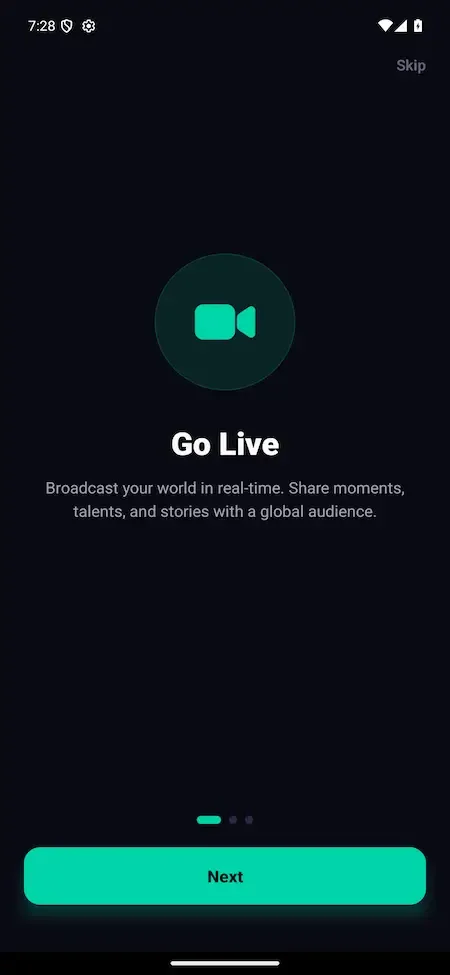
Viewers need a reason to open the app when nobody they follow is live, and a frictionless way to spend. Discovery, gifting, a wallet and VIP status are all in one flow, and guests can look around before they create an account.
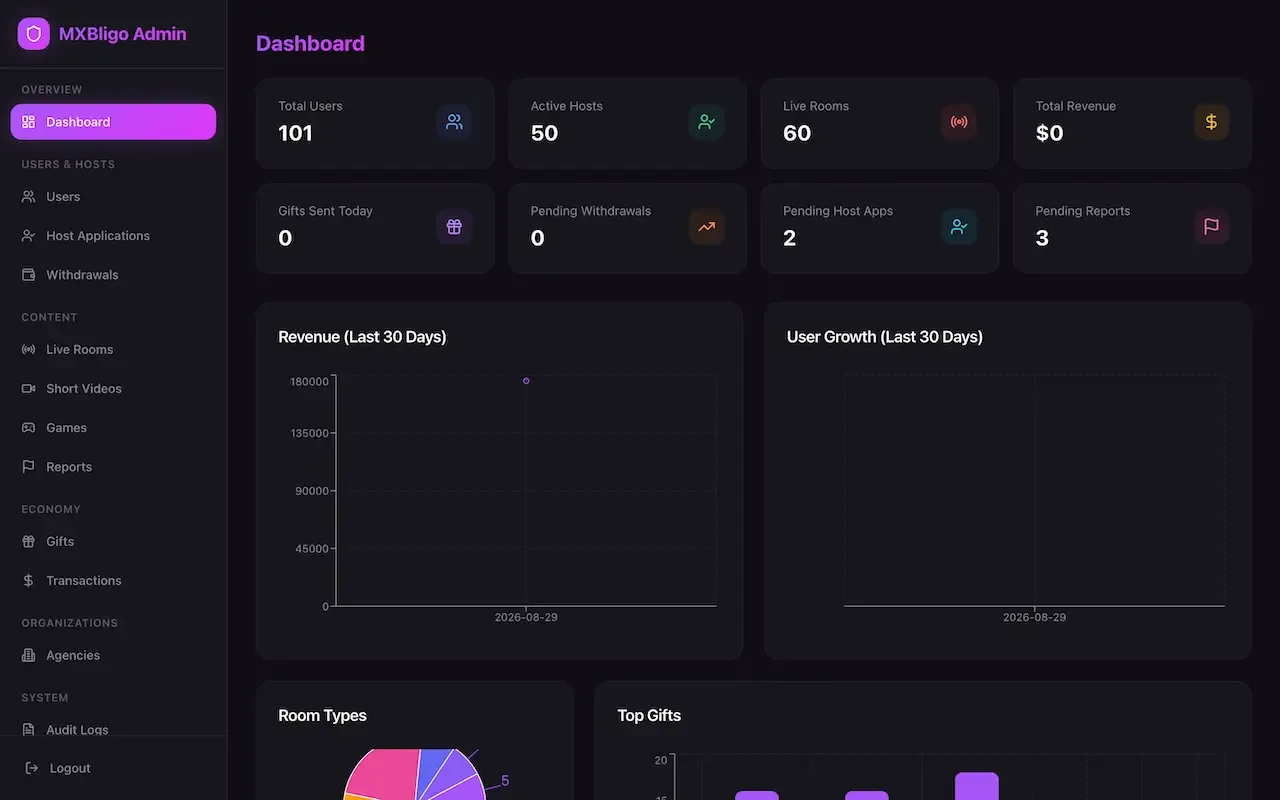
The operator controls who may broadcast, who may recruit, how money splits and when it leaves the platform. One admin panel holds those decisions, with an audit trail behind every action so staff changes can be reviewed later.
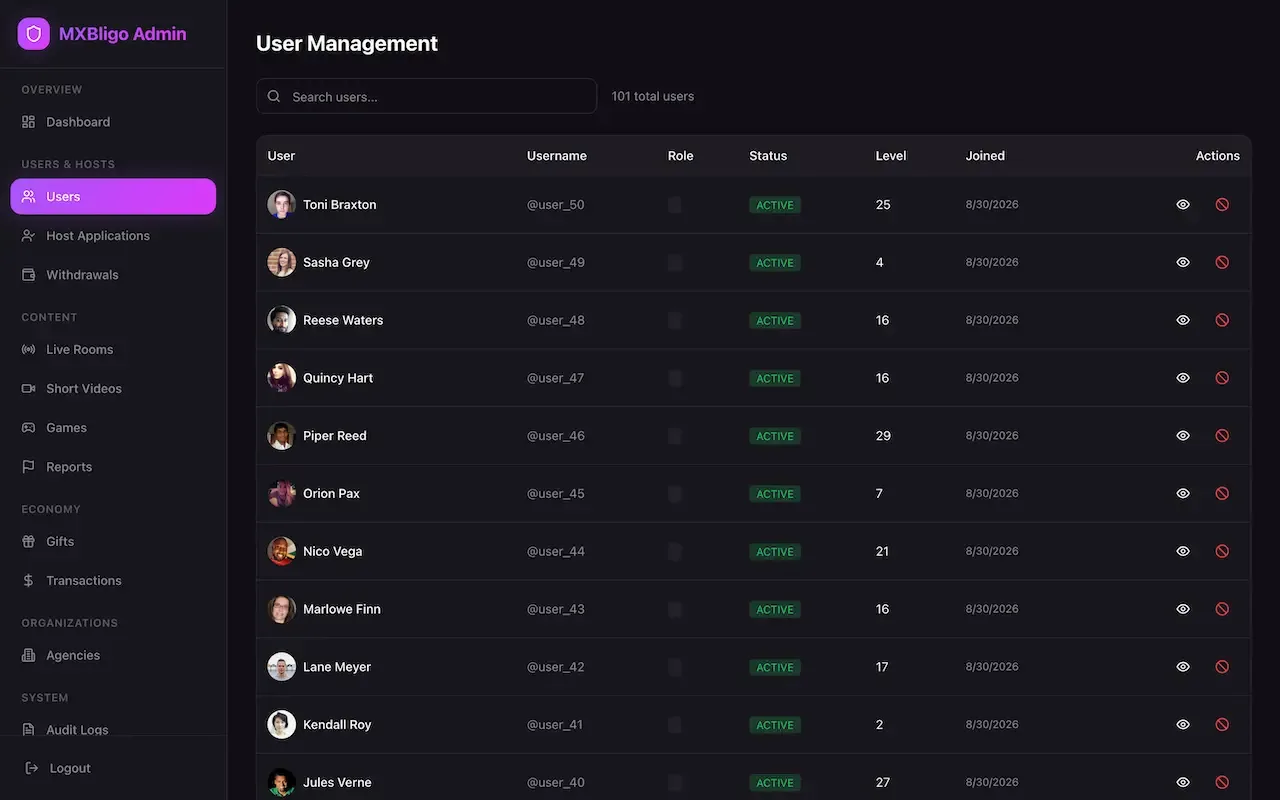
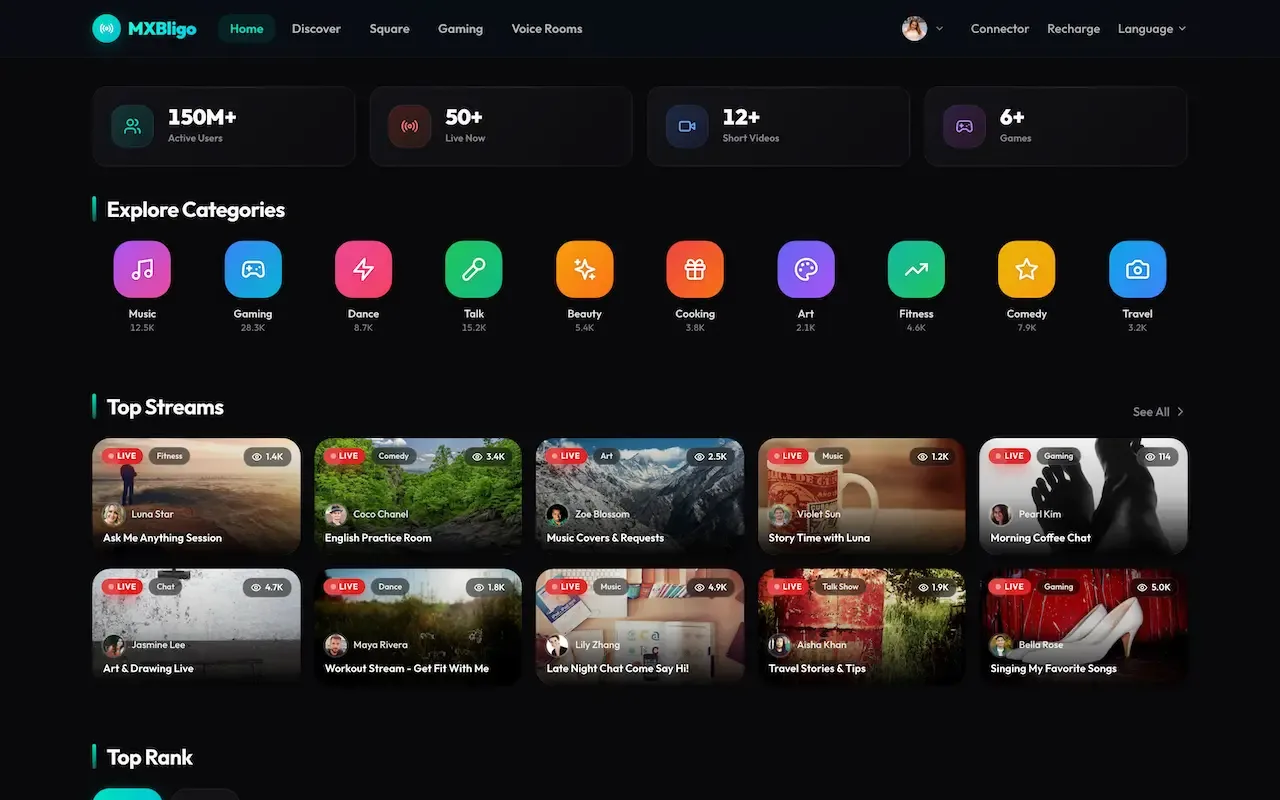
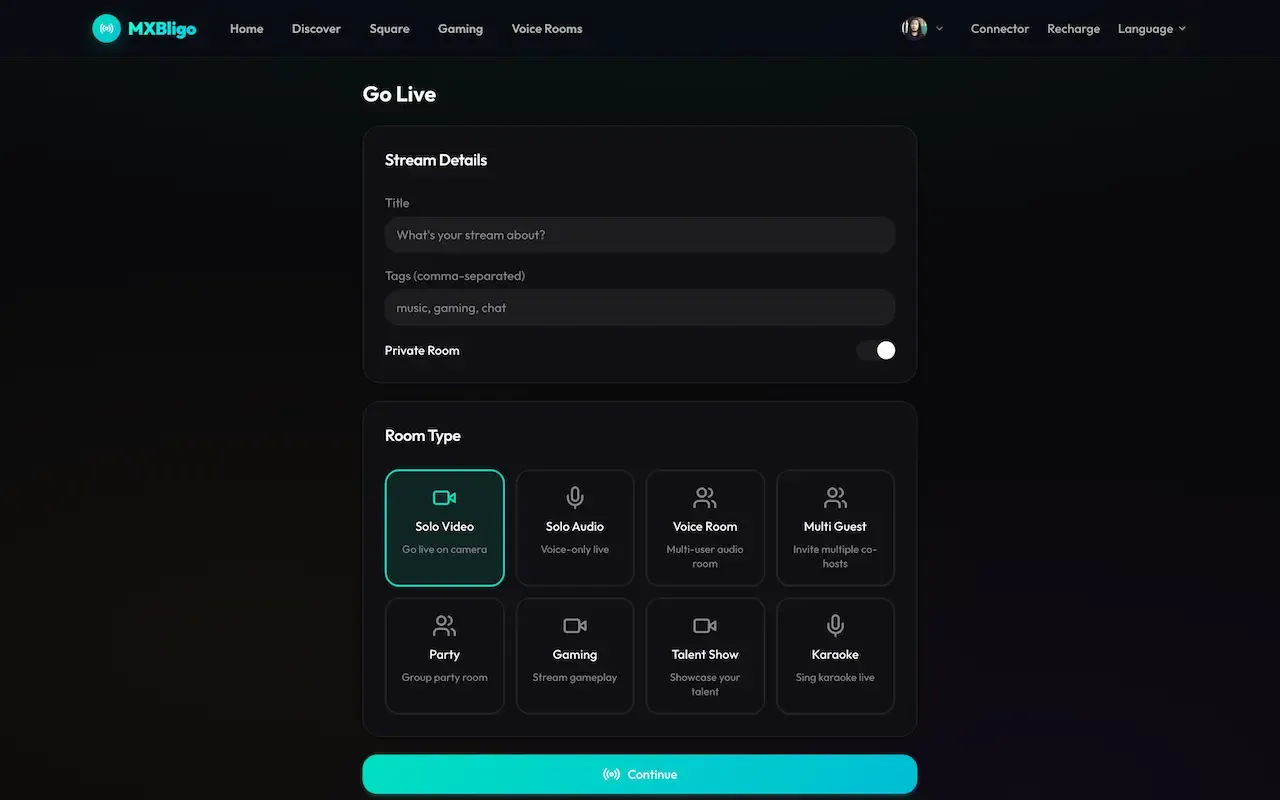
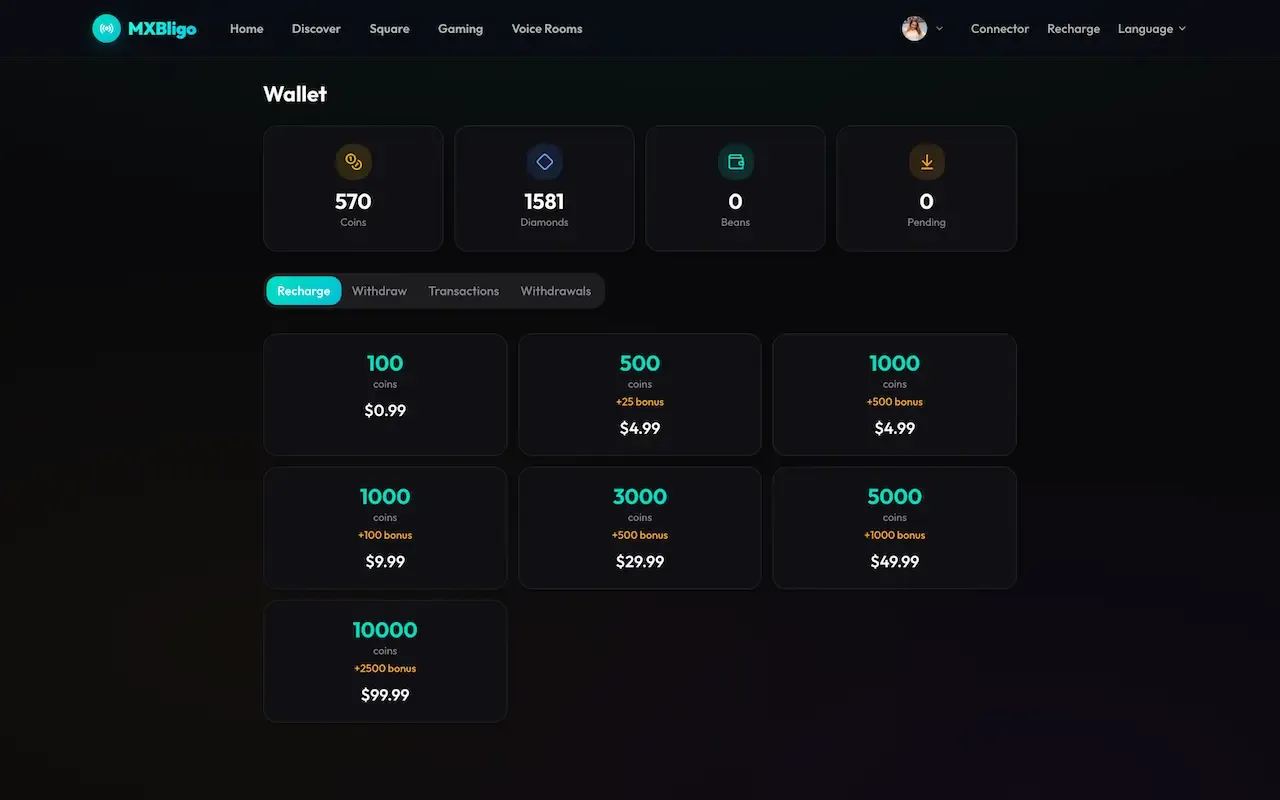
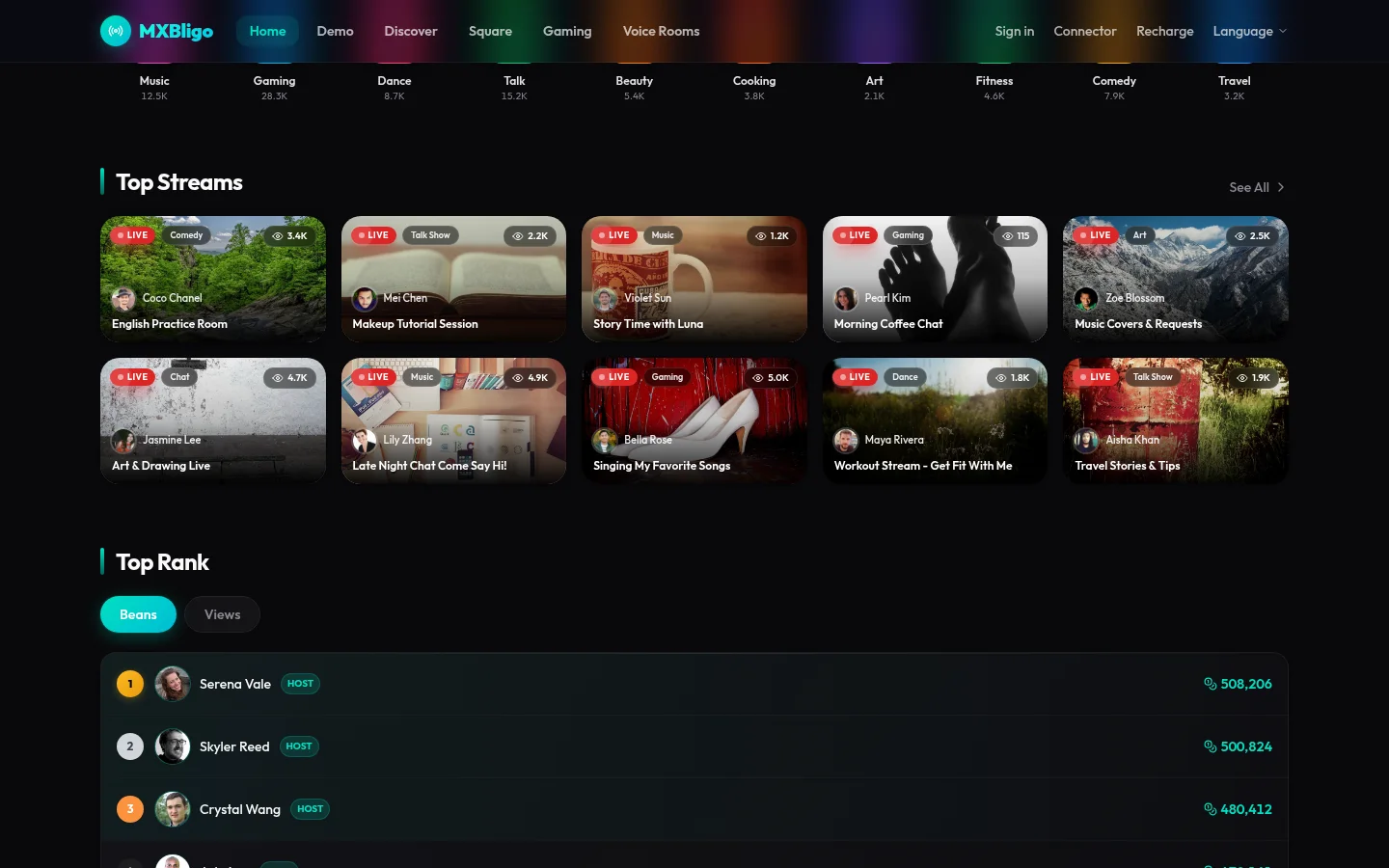
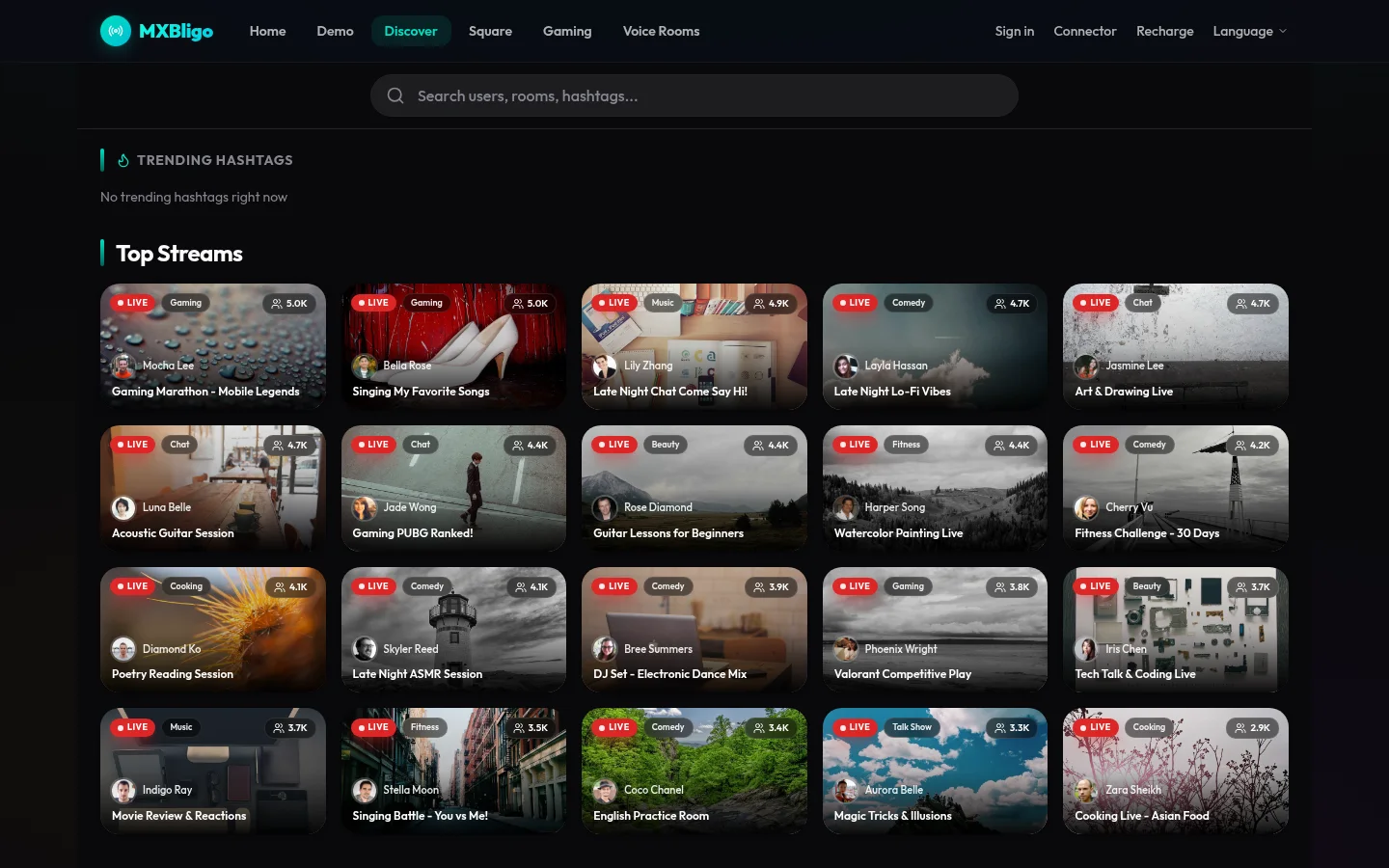
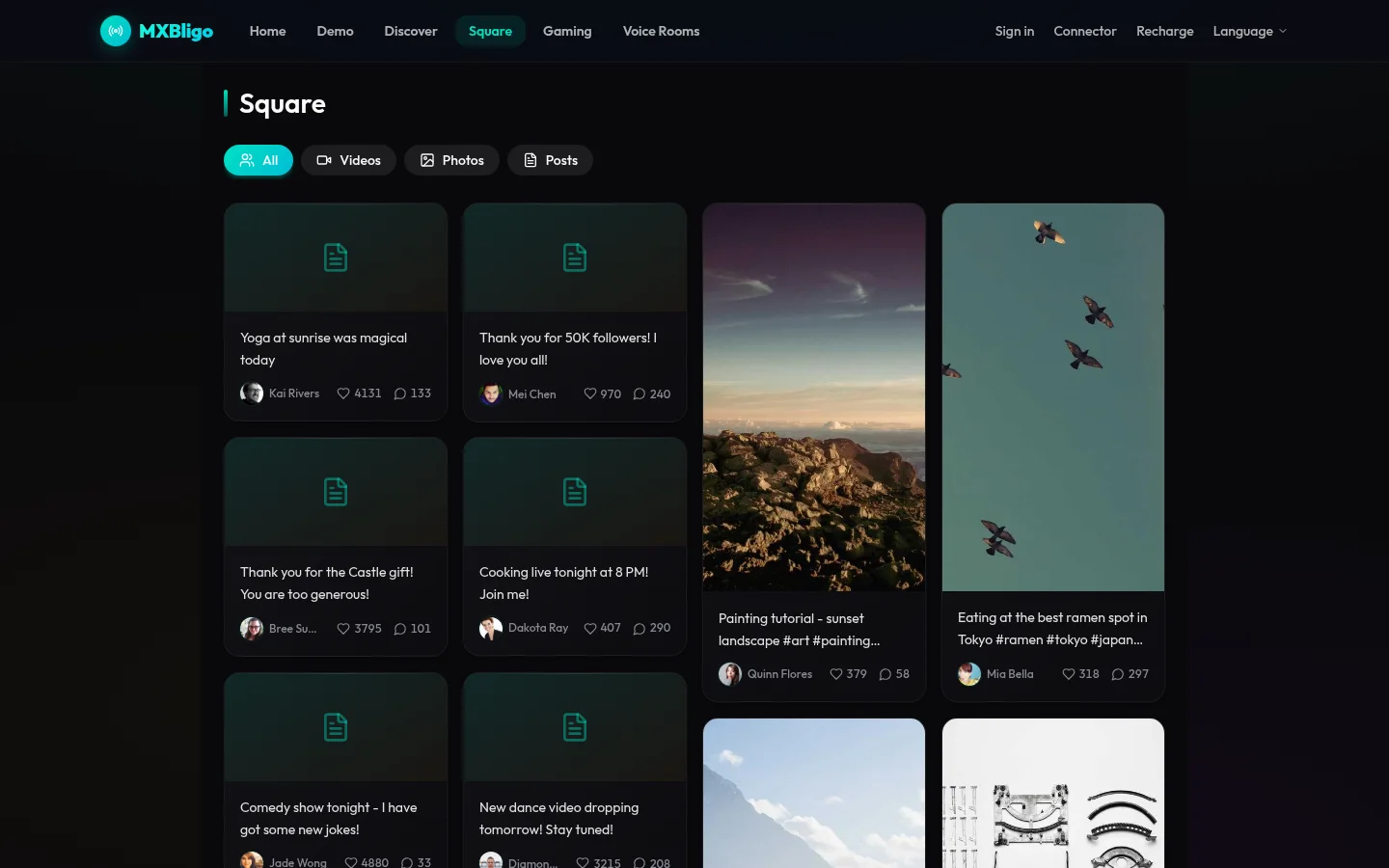
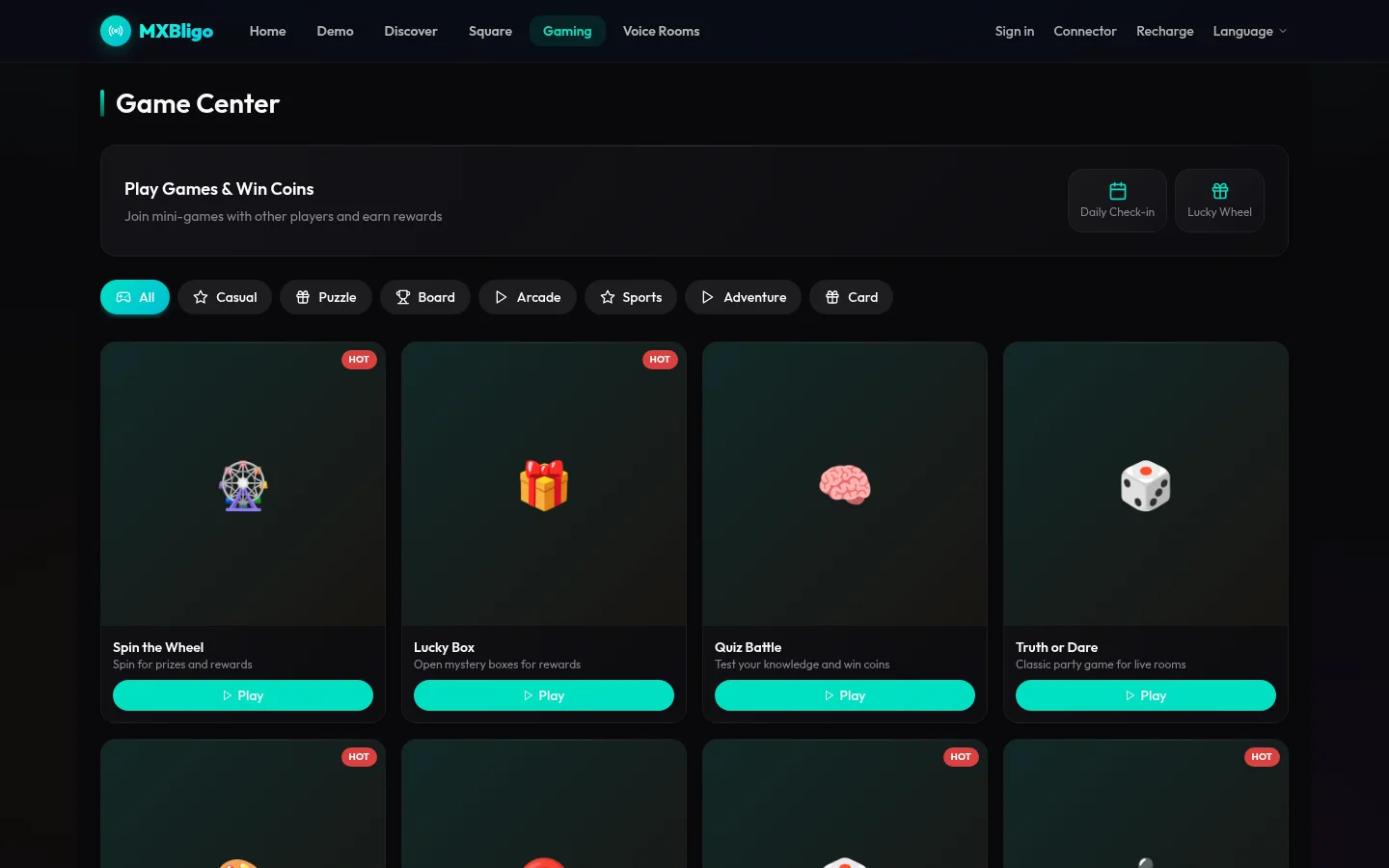
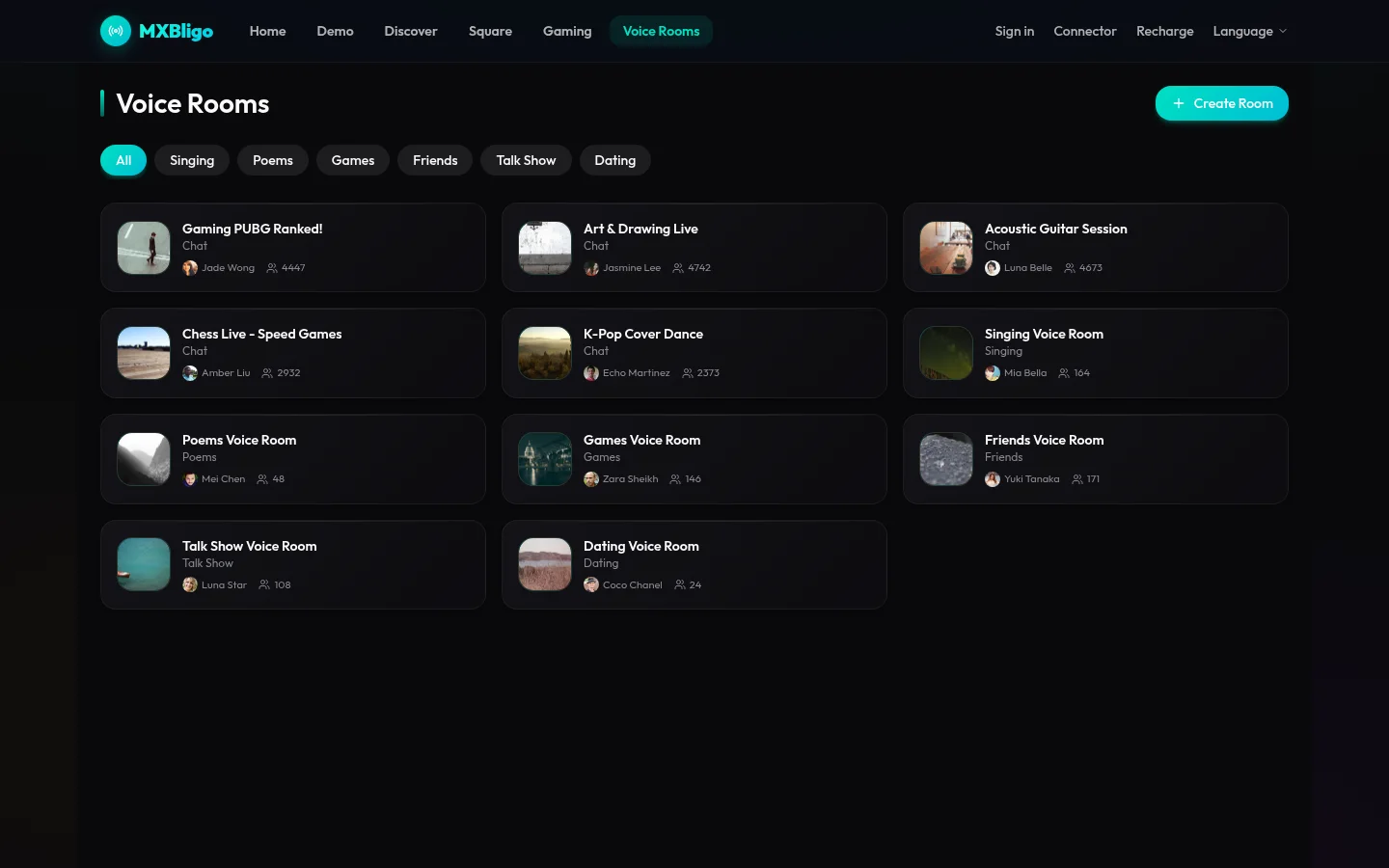
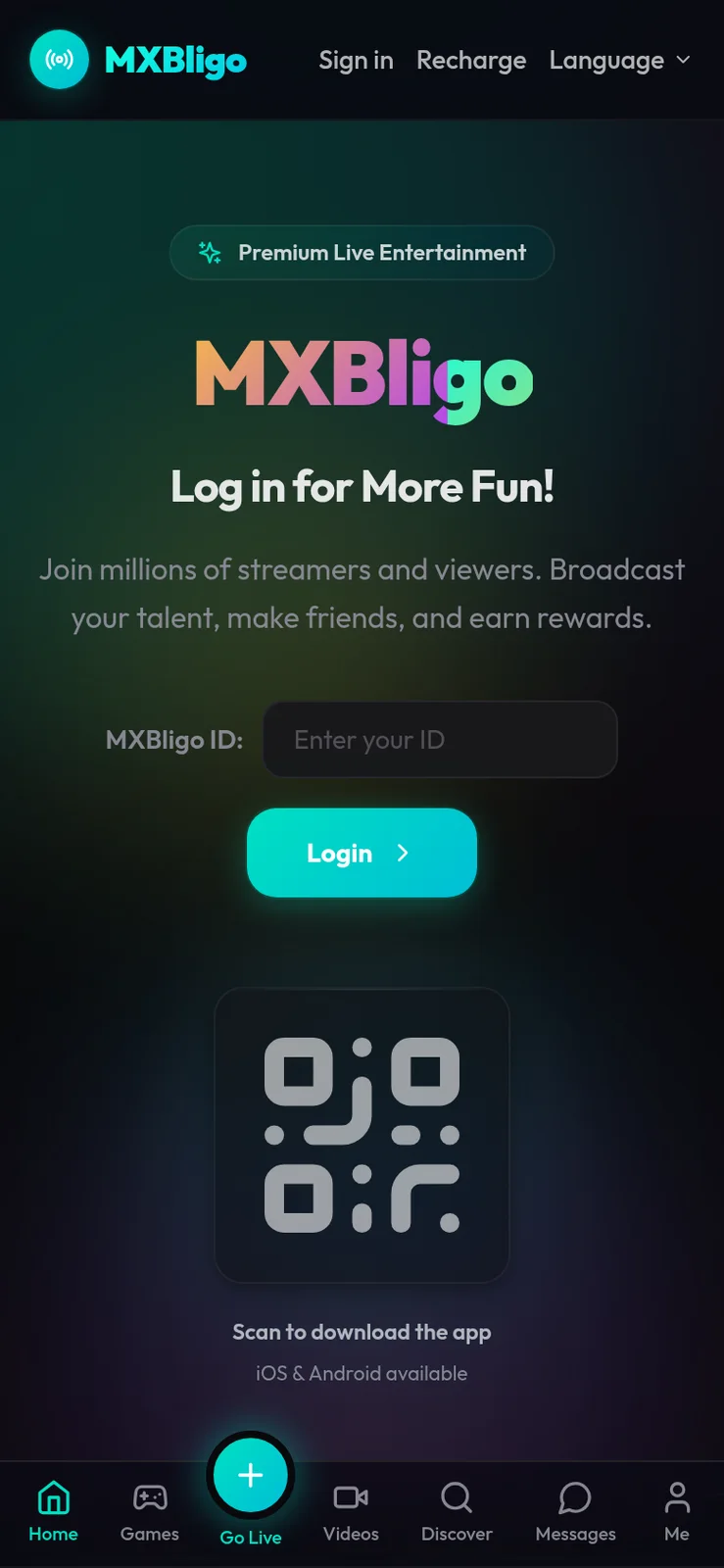
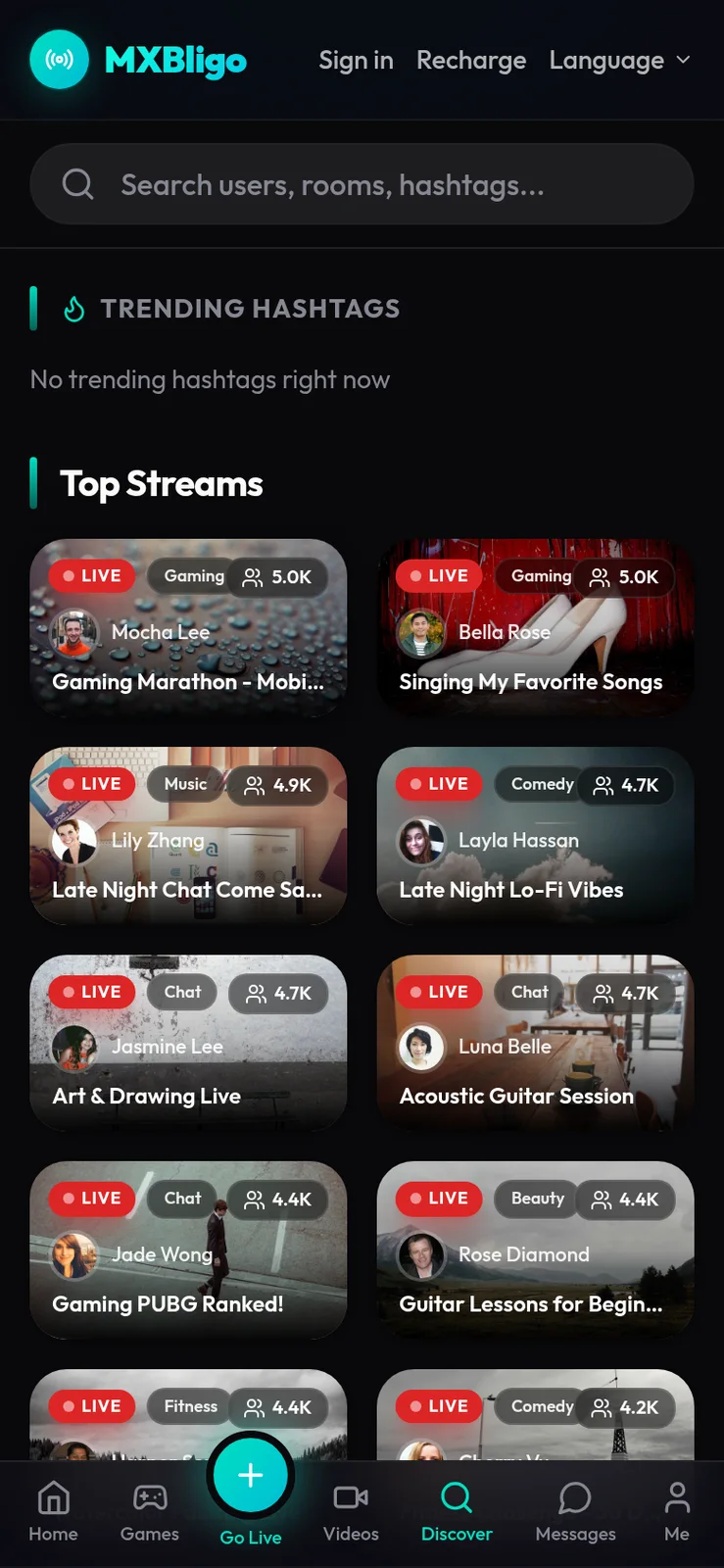
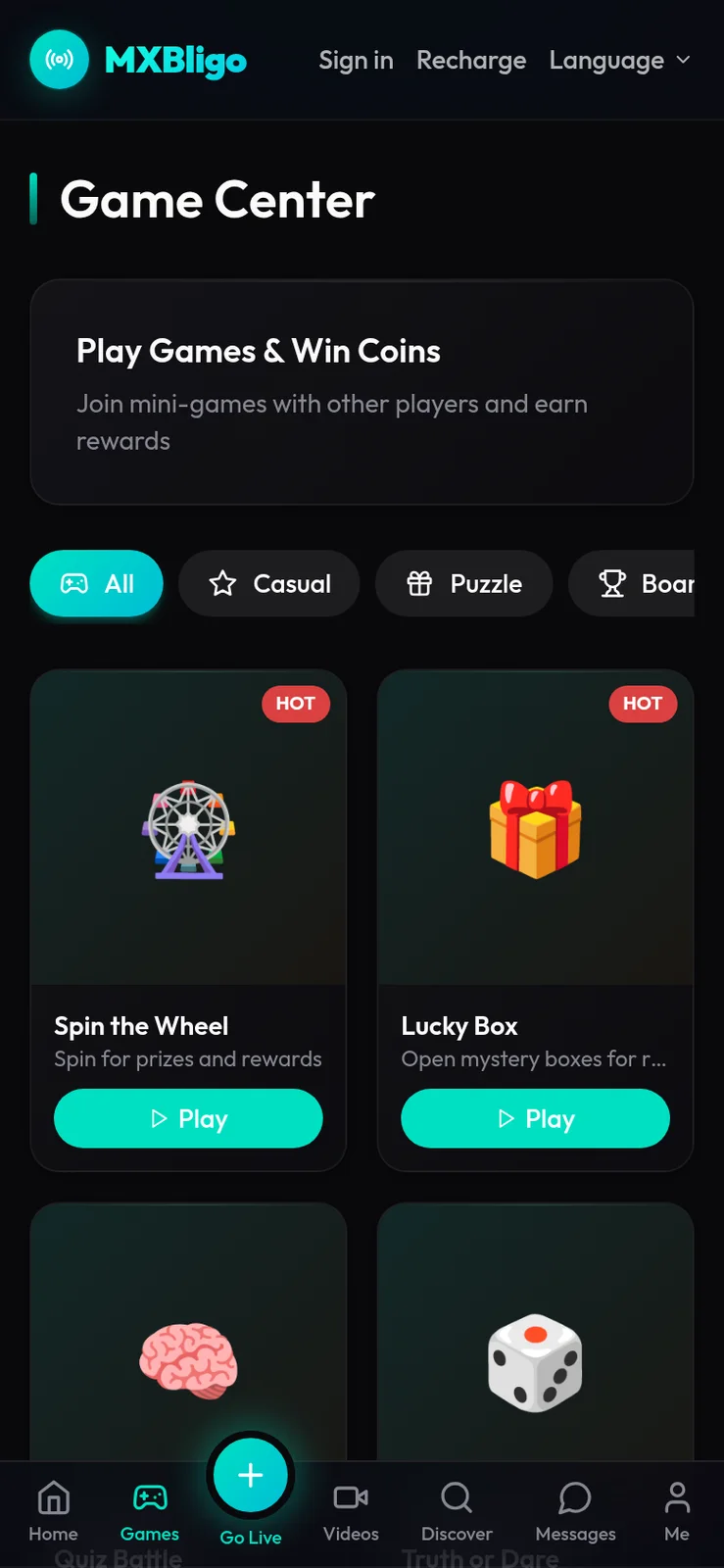
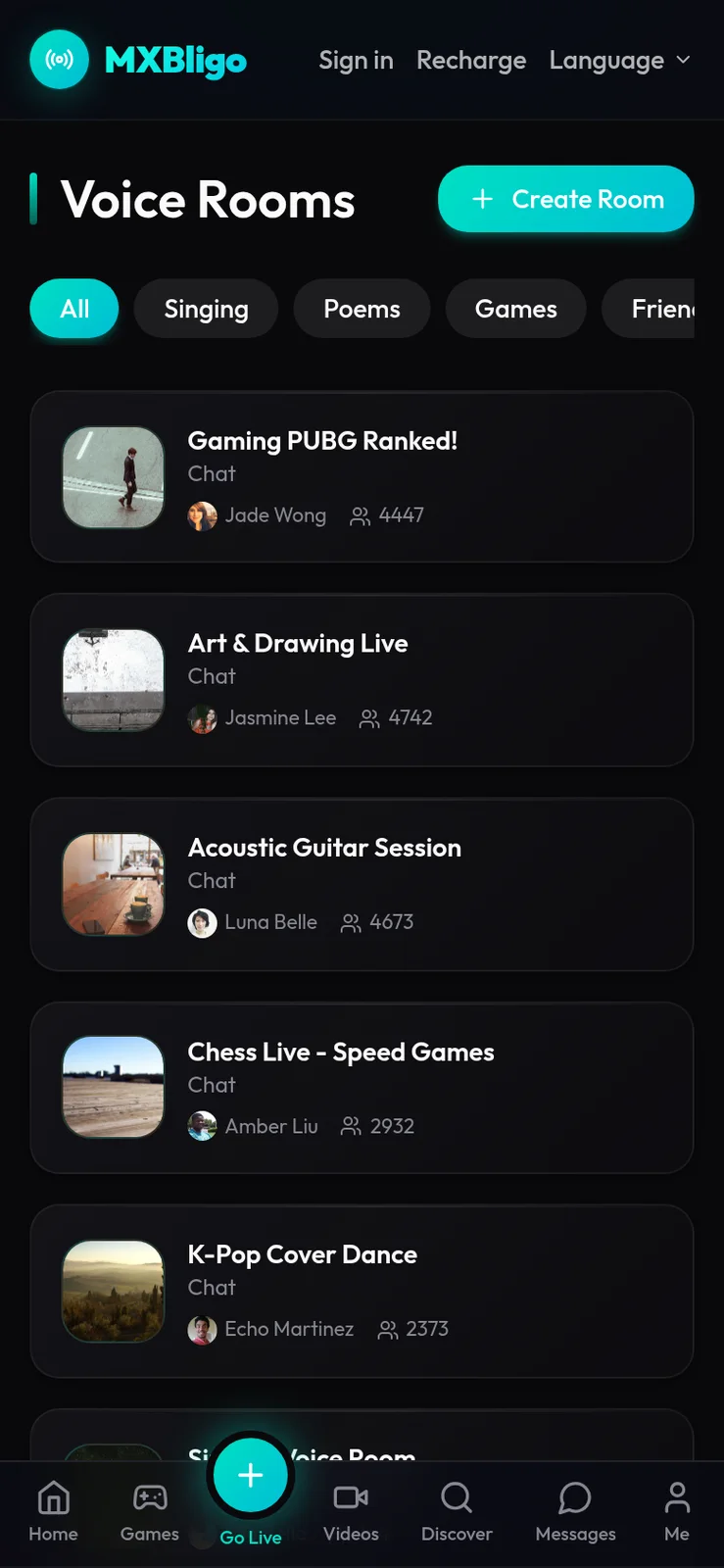
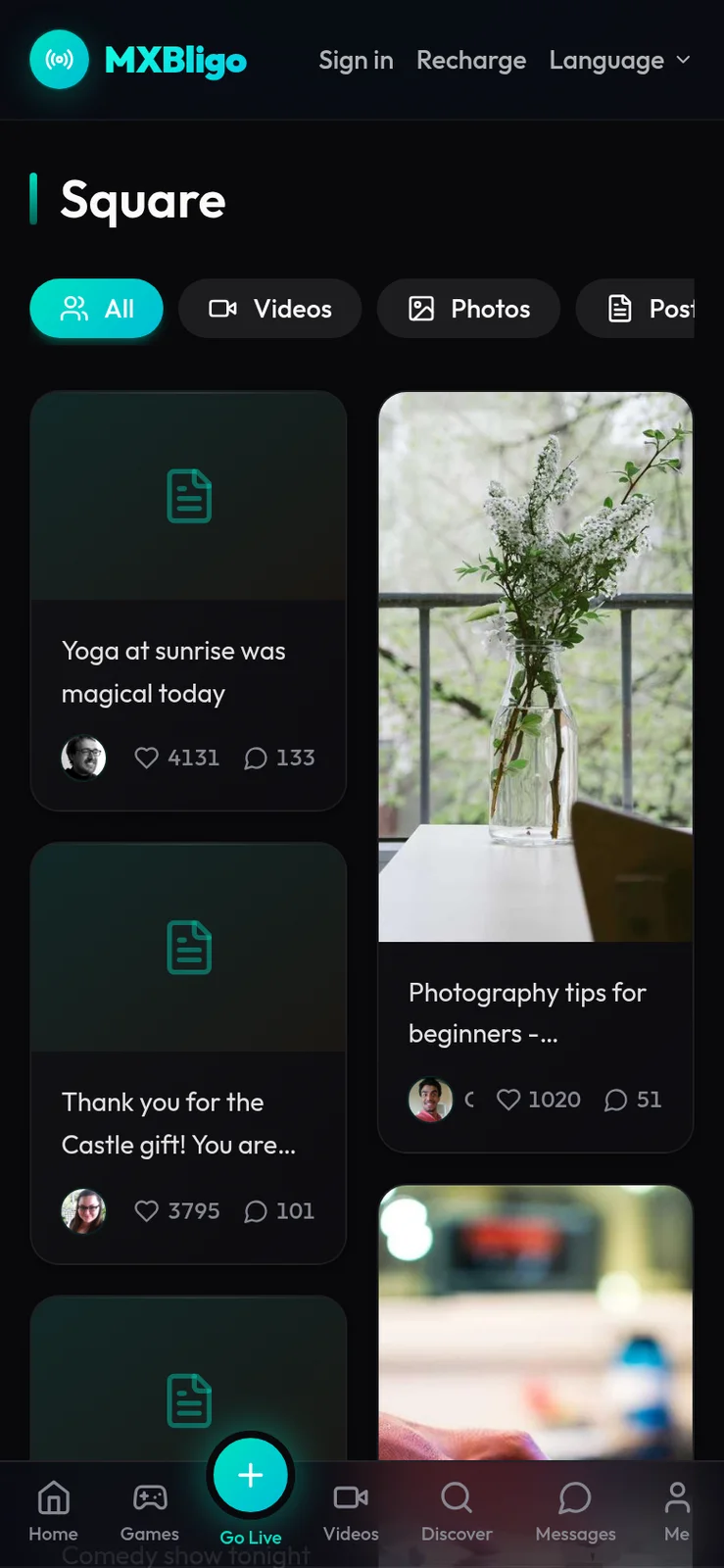
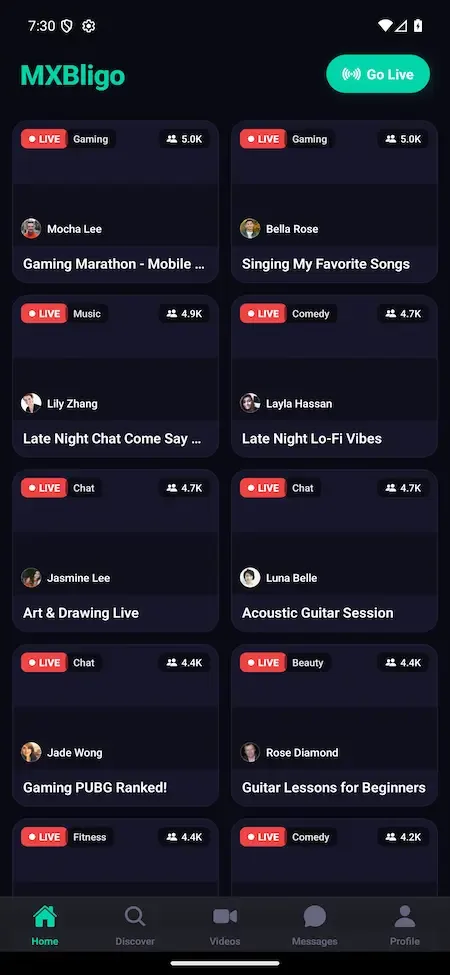
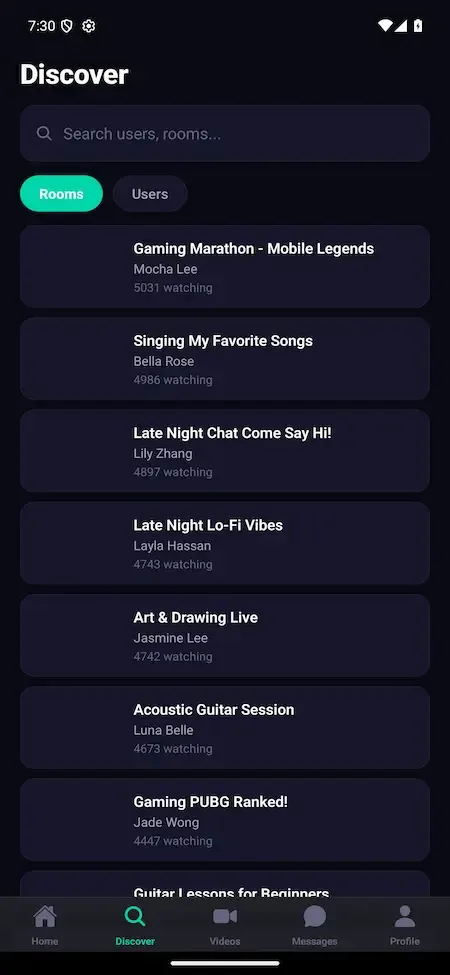
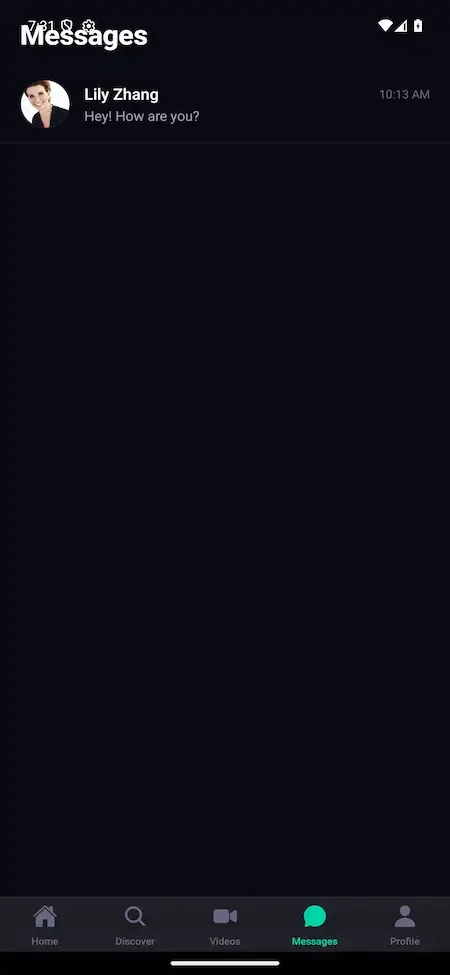
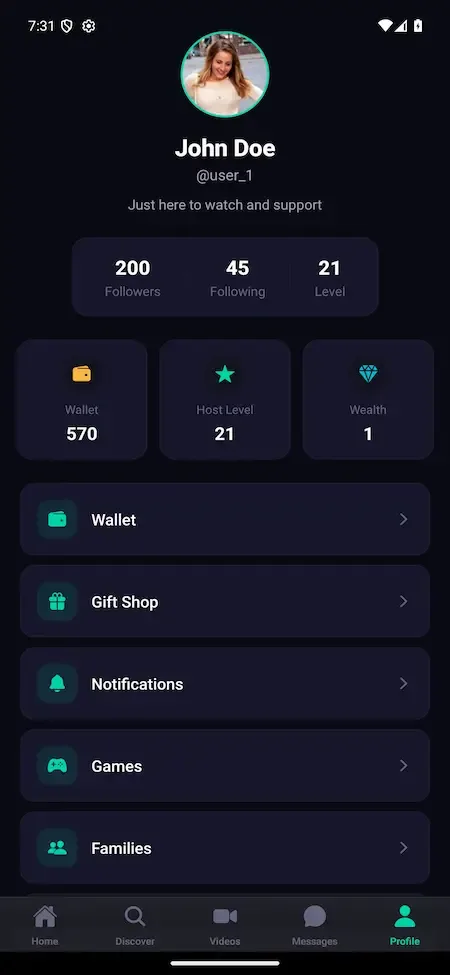
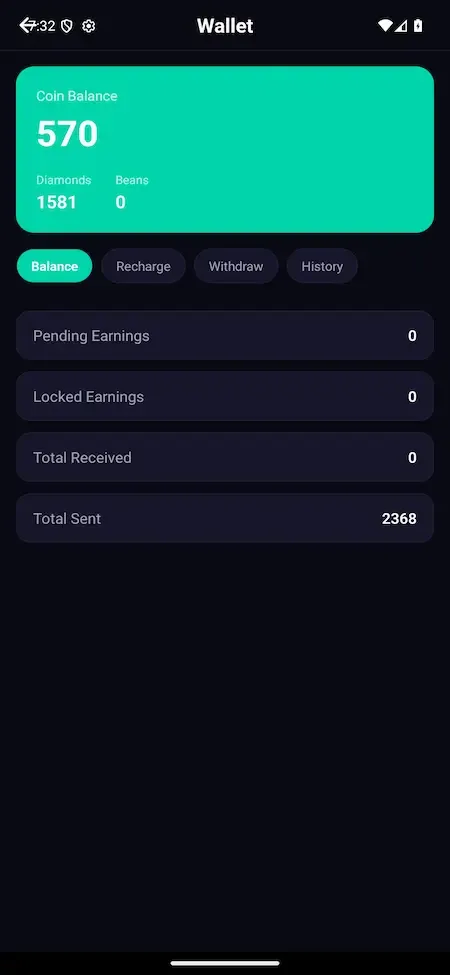
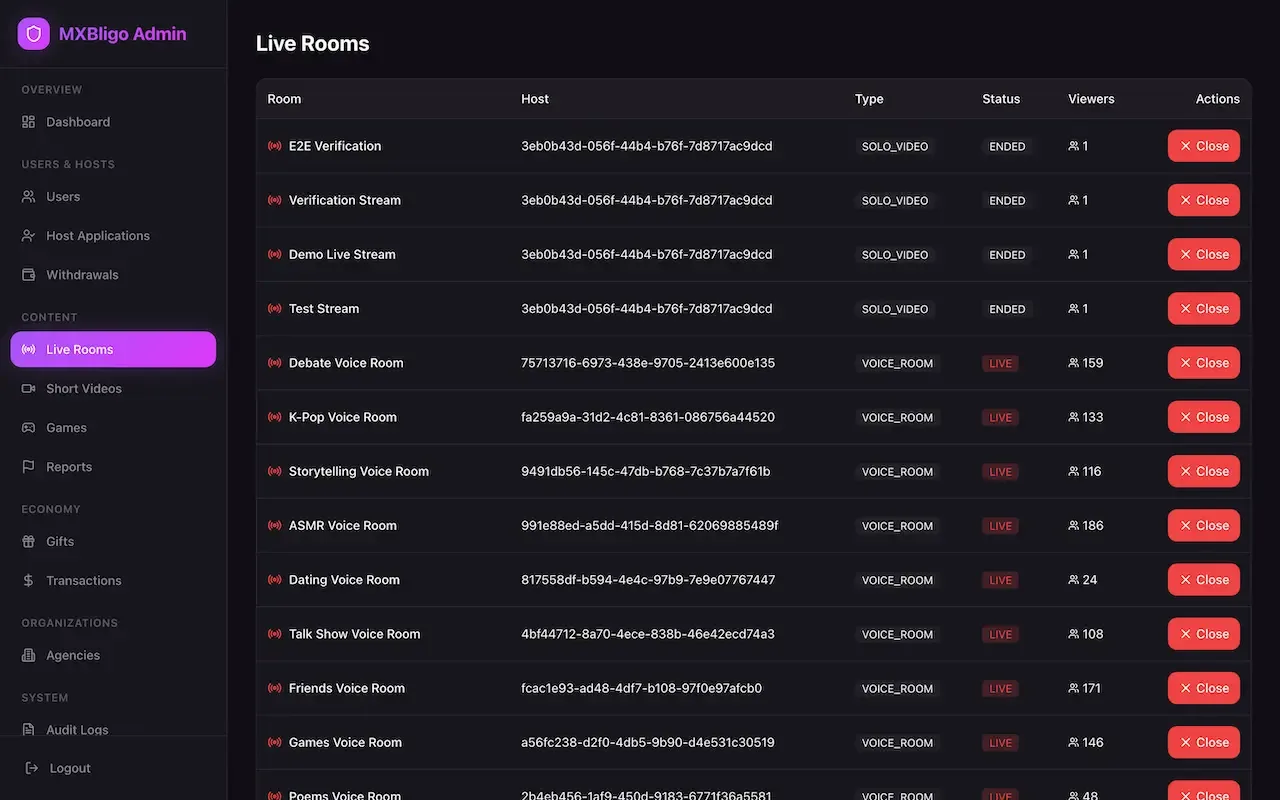
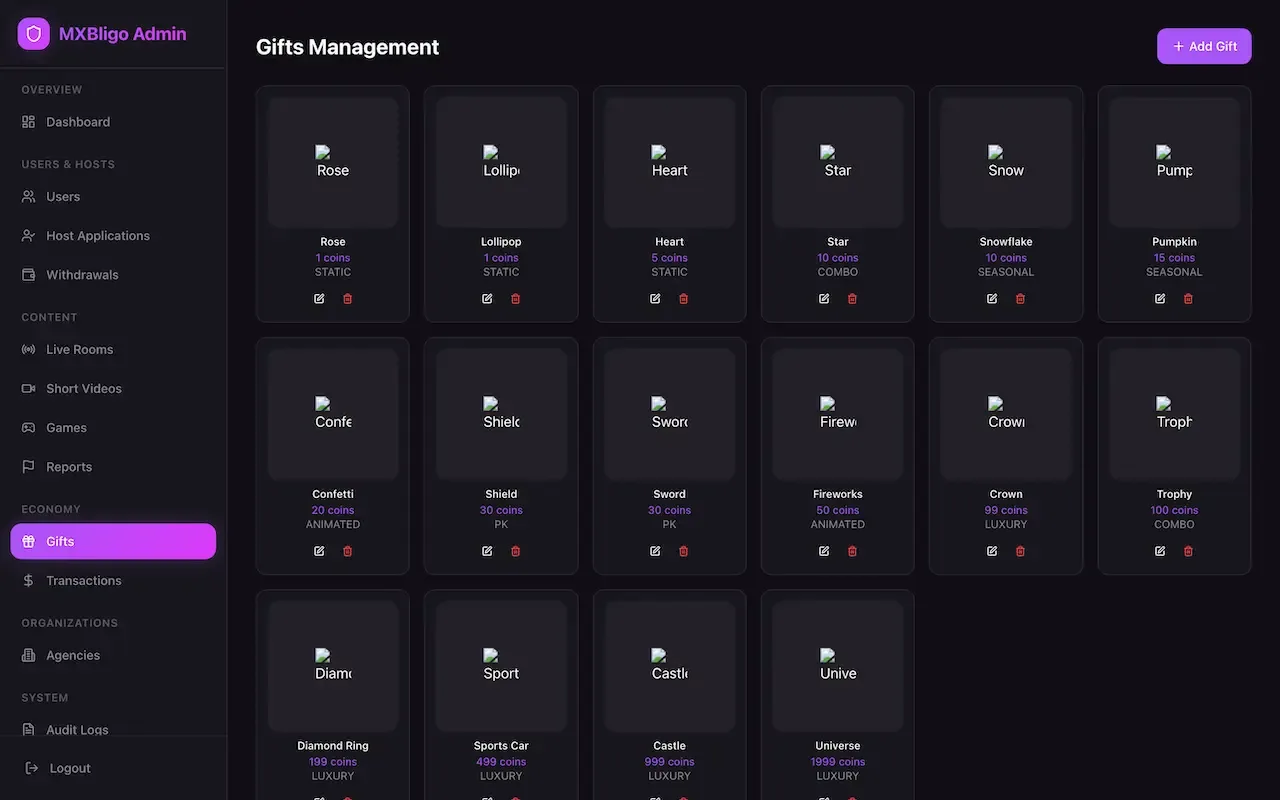
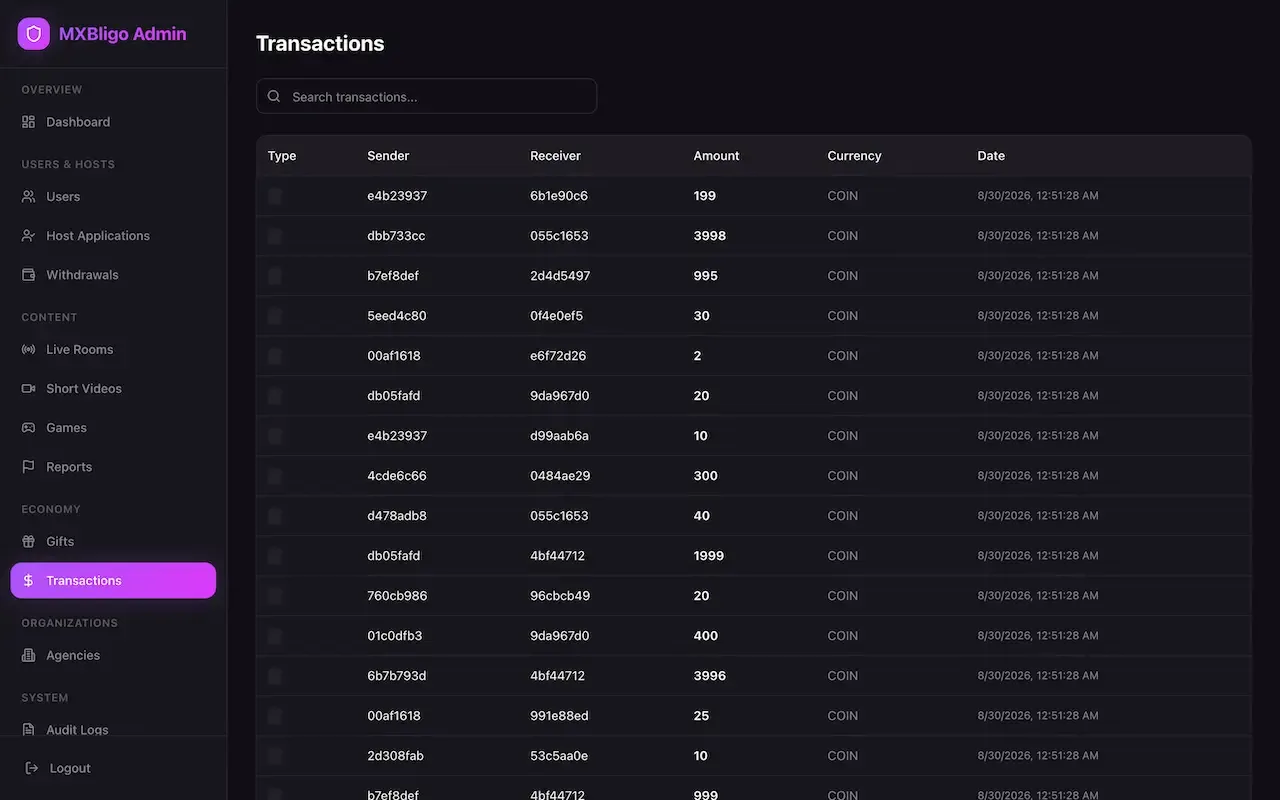
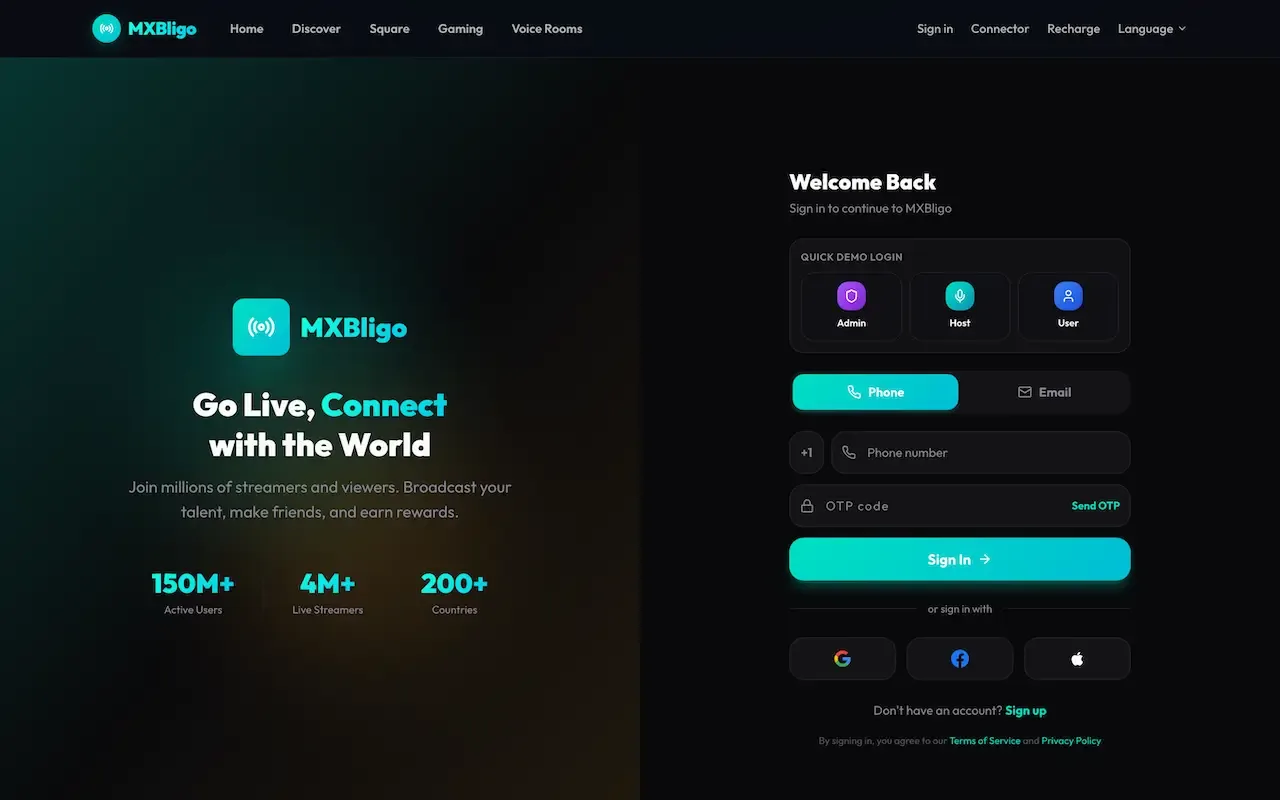
This demo is the platform running live under demo branding with public sample accounts, so you can play every role without installing anything. Join a room as a viewer, sign in to the agency console that recruits hosts, then open the operator console and watch the same gift show up in the settlement and review queues.
brunosalg@demo.mxbligo.com123456 (one-time code)Agency ID 410227Agency code 88014moderator@demo.mxbligo.comStaff@12345brunosalg@demo.mxbligo.com123456 (one-time code)53 features across 4 roles.
A prospective agency submits an application, and recruiting stays locked until an operator approves it, which keeps unvetted recruiters away from your host pool.
Operators can suspend an agency at any time, which immediately stops it from recruiting while existing hosts and records remain intact.
Each agency invites hosts through a code, so every host can be traced back to the recruiter who brought them in.
Agency staff hold distinct roles, so a manager, a scout and a bookkeeper do not all share the same permissions.
A host contract can pay the agency a percentage of earnings, which suits partners who share in upside.
A host contract can instead be a fixed salary arrangement, for agencies that guarantee income to attract established talent.
A host can be moved from one agency to another, with the record kept so earnings history is not lost in the handover.
Agencies can set rates for sub-agencies beneath them, which models the layered recruiter chains common in live entertainment.
Each agency sees what its hosts have earned and what it is owed, so no spreadsheet reconciliation sits beside the platform.
A leader starts a family, with one family per leader, and members gather around a shared identity inside the app.
Families can be open, request-based or closed, so a leader decides how exclusive the group should feel.
Leader, co-leader, elder and member roles give a family internal structure and a path for members to progress.
Members contribute to a family treasury and their input is tracked, which gives loyal fans a visible scoreboard.
Families and agencies can enter PK battles against each other, with scores aggregated across everyone gifting on their side.
Applicants submit their real name, ID, bio and specialties, and no one can go live until staff have reviewed the application.
Rooms come in solo, voice, party, panel, co-host and multi-guest shapes, plus karaoke, talent, gaming, dating, talk show, event, private and subscriber-only versions.
Each room format starts with sensible seat counts, so a six-seat voice room and a solo stream do not need manual setup every time.
Guests ask for a seat and the host accepts or declines, keeping the stage curated rather than open to anyone.
Seats can be locked to stop new guests and occupants can be removed, giving hosts a quick answer to disruptive behavior.
Hosts mute or disable video for seat occupants without ending the room, which is essential for karaoke and panels.
Rooms can be private, age restricted and tagged with a language, so discovery sends each audience to the right place.
Battle formats include one-on-one, team, room, family, agency and tournament, each scored on the gift value received while it runs.
A loser can request a rematch, which extends a competitive spike and gives viewers another reason to keep gifting.
Received gifts accumulate as diamonds, which convert to beans at an operator-set rate before any cash-out.
A host requests a payout from their beans, can follow its status, and is paid only when an operator signs off, with the fee applied.
Hosts post clips up to 200MB with captions, hashtags and music metadata, keeping their audience engaged between live sessions.
The square accepts text, image, video and poll posts, which gives hosts a lightweight place to talk to followers.
Streaks, missions and a lucky wheel reward consistent behavior, which helps new hosts build a schedule.
People can look around before registering, which lowers the barrier for a first visit from a shared link.
Email or phone sign-up with a one-time passcode verifies accounts, with device binding for push notifications and session tracking.
Rooms are filtered by type, country and language, so a Spanish-speaking karaoke fan is not shown English gaming streams.
A distance calculation surfaces rooms close to the viewer, useful for regional operators with city-based communities.
Room chat runs over Socket.IO with rate limits, so one noisy account cannot flood a busy stream.
Eight gift categories, including combo and luxury items, are paid for in coins and animate for the whole room.
Packages with bonus coins on larger bundles push viewers toward bigger purchases through Stripe.
Free, Bronze, Silver, Gold and Diamond levels carry badges and benefits that make status visible inside rooms.
Audio and video calls between members include call history, which extends the product beyond public rooms.
Follows, blocks, mutual followers, a profile visitor list and fans ranked by gift value give members reasons to return to specific people.
Members find people and content by username and hashtag, which keeps discovery from depending only on the home feed.
Six notification categories with quiet hours let members stay informed without feeling spammed.
Eight cards plus revenue, user growth, room type and top gift charts give the first view of platform health each morning.
Search the user base, ban or unban, verify accounts and change roles, with every action written to the audit log.
Applications arrive with identity and specialty details so reviewers can approve or reject without chasing information.
Every bean-to-cash request is approved or rejected by staff, which is the main defense against payout fraud.
Staff watch active rooms, force-close one that breaks policy and feature rooms worth promoting on discovery.
Reports about users, rooms, streams, messages, videos, posts or comments are resolved or dismissed from one place.
Violation types, strikes and an appeal path give moderators a consistent process rather than ad hoc decisions.
Three levels of restriction let staff respond in proportion, from silencing a member to quietly limiting their reach.
A keyword list catches known abusive terms and spam patterns before they reach a live audience.
Create and retire gifts across eight categories, setting price and animation type that viewers will see.
Operators add, edit, retire and review each of the 45 modeled game types, deciding which games your audience can play.
Operators change the revenue split, withdrawal and live limits and feature toggles from settings, with no code change.
A paginated trail records operator actions and moderation decisions, so any dispute can be traced to a person and a time.
Users sign up with email or phone and a one-time passcode, or browse as guests, and bind a device for push and session tracking.
A would-be host submits identity and specialty details. An operator reviews the application, and an agency may invite the host by code.
A host chooses from fifteen room formats. The backend creates the room and seat records and issues the media token.
A viewer sends a gift. Coins leave the sender, the value is divided between platform, agency and host, and the receiver gains diamonds, all in one database transaction.
Diamonds convert to beans at the configured rate, the host asks to withdraw and an operator signs off the request with the fee applied.
| Revenue model | How it works | Who pays | How you earn |
|---|---|---|---|
| Coin sales | Viewers buy coin packages through Stripe, with bonus coins on larger bundles, and spend them on gifts and games. | Viewer | Real money enters the economy here, on your merchant account. |
| Gift commission | Each gift is split across platform, agency and host at the moment it is sent, with a default of 30 percent to the platform. | Viewer | The platform keeps its configured share of every gift as it happens. |
| Agency share | Agencies keep a share you can configure, 10 percent unless you change it, from the hosts they recruit and manage. | Viewer, via gifts | Indirectly: partners recruit hosts for you in return for this cut. |
| Withdrawal fee | Converting beans to cash carries a 5 percent fee after the operator approves the request. | Host | The cash-out step contributes to margin instead of only costing review time. |
| VIP tiers | Five VIP levels from Free to Diamond sell badges and benefits that make status visible in rooms. | Viewer | Recurring revenue alongside gifting, priced and configured by you. |
| Game participation | Games with coin wagering, a lucky wheel and check-in rewards give coins somewhere to go between streams. | Viewer | Additional coin spending in the idle time between hosts going live. |
| Family and agency battles | Group PK battles scored on gifts concentrate spending into short, competitive moments. | Viewer | Higher gift volume per session, which raises commission without changing rates. |
Money moves in a fixed order. A viewer buys coins through Stripe on your merchant account. Sending a gift deducts coins and splits the value across platform, agency and host in a single database transaction, so a failed send cannot debit a viewer without crediting a host. The host accumulates diamonds, converts them to beans, and raises a withdrawal request. An operator approves it, the fee is applied, and the payout is made.
| Gateway | What it covers |
|---|---|
| Card | |
| Stripe | Coin recharge and VIP purchases, running on your own merchant account and keys. |
| Bank | |
| Cash-out method | Beans withdraw to fiat after operator approval; no payout rail is named in the product, so we confirm the method with you. |
Nobody can broadcast until an operator approves an application containing real name, ID, bio and specialties. Agencies are also approved before they can recruit. This gives you a human checkpoint at the two points where bad actors usually enter a live platform. Verification of documents against official sources is your operational process, and staff need clear rules about what counts as acceptable ID in each market you serve.
Live content cannot be reviewed before it airs, so the tooling is built for fast response. Reports cover seven content types, strikes and appeals follow a defined path, and bans, mutes, shadow bans and blocked keywords give staff graduated responses. Operators can force-close a room from the monitoring view. You are responsible for staffing moderation hours that match the time zones your hosts and viewers actually stream in.
Gifts run inside database transactions and every withdrawal passes through staff approval, which limits internal fraud. Before real money moves we complete payment hardening for your build, including webhook signature verification on every gateway callback, and we treat that as a launch gate.
Authentication uses JWT with refresh token rotation, bcrypt password hashing and device binding, and the documentation calls it the strongest part of the build. Requests pass through Helmet headers, CORS, a validation pipe and a throttler before reaching a controller. Demo credentials seeded for the demo must be removed and secrets rotated before launch, and the admin token should move to an HttpOnly cookie.
Thirteen legal and policy pages come with the web app, and the operator audit log records administrative actions. Erasure, retention and consent mechanisms are available with scope confirmed with us, and room passwords and identity data need additional protection before launch. If you serve markets with data protection law, scope those items with us early. Legal compliance in each market is the operator responsibility, and we supply tooling rather than legal advice.
Alongside launch we set up the operational layer for your build: automated tests on the money paths, versioned database migrations, structured logging and alerting, and mobile screens matched to the web flows. The technical documentation names each item, so nothing is discovered after real users arrive.
Before you go public we complete a hardening pass: removing demo credentials, a global auth guard, Stripe webhook verification and migrations are set up as part of launch work, with scope confirmed with us.
| Layer | Built with | Hosting note |
|---|---|---|
| Backend | NestJS 10 on Node 20, TypeScript 5, Swagger, Passport and JWT | Seven-service Docker Compose definition that runs the same way locally and in production. |
| Database | PostgreSQL 16 with Prisma 5 (74 models, 29 enums) | PostgreSQL 16 holding 74 models, with JSONB and full-text search available, portable to any PostgreSQL host. |
| Web and admin | Next.js 14, React 18, Tailwind and Zustand | |
| Mobile | Expo SDK 50 app covering core viewer and host flows | |
| Real-time media | Agora RTC for media, with Redis 7 behind Socket.IO 4 | MinIO provides S3-compatible storage for uploads, and you can point it at another S3-compatible store.Agora RTC on your account, with the backend issuing publisher and subscriber tokens rather than relaying streams. |
| Payments and messaging | Stripe, Twilio for SMS passcodes, Firebase Cloud Messaging and SMTP | |
| Deployment | Docker Compose (seven services), Nginx, MinIO and GitHub Actions | |
| Reverse proxy | Nginx routes api traffic to the backend, admin to the panel and everything else to the web app, with rate limiting and SSL termination. | |
| Cache and presence | Redis 7 holds the active room list, who is online and the rate-limit counters, away from application memory. | |
| Initial capacity targets | Documented targets are 100 concurrent rooms and 5,000 socket connections on a single instance. | |
| Scaling beyond one instance | Needs a Socket.IO Redis adapter, pooled connections and clustering, all of which we set up for you. | |
The platform runs on infrastructure you control, using a conventional containerized stack. Media does not pass through your servers, because Agora carries audio and video, which keeps hosting costs tied to API and socket traffic instead of concurrent video minutes.
In this category the hosts rarely arrive one by one. Agencies bring them in groups, families keep viewers close to a community, and the operator holds the gate. This table sets out the three management layers, what each does inside the platform and what still sits outside software.
| Layer | What the platform gives it | What stays with you |
|---|---|---|
| Host | Application with identity details, room formats, seats, earnings view and withdrawal request | Deciding who deserves approval and which hosts to feature |
| Agency owner | Creation request, invitation codes, member roles, contracts, transfers and earnings tracking | Agency vetting criteria, written agreements and dispute handling |
| Agency member | A defined role beneath the owner, with commission or salary terms attached | Training, scheduling and day-to-day coaching of hosts |
| Family leader | Join policies, roles, contribution tracking, a treasury and family battles | Culture, activity calendars and keeping the group civil |
| Operator | Approval and suspension of agencies, host queue, withdrawals, room oversight and audit log | Policy, staffing the review queues and the payout calendar |
| Sub-agency | Separate rates for agencies recruiting under another agency | Deciding whether to allow layered recruiting at all |
| Transferred host | Move between agencies with the record intact | Rules on exclusivity, notice and who owns a host relationship |
Public discussion of live-streaming apps often turns on safety: minors, explicit content and payment disputes. The software supplies tools, but the policy is written and enforced by whoever operates the platform. This section is not legal advice; it lists the decisions an operator needs to make and the tooling that supports each.
Think of the economy as four wallets with different jobs. A viewer pays real money for coins. Spending a coin on a gift removes it from the viewer and, at that instant, divides its value between the platform, the agency and the host, using the percentages you set. The host holds the result as diamonds, which measure what they earned from gifts and nothing else.
Diamonds are not cash. When a host wants to be paid, they convert diamonds into beans, and beans are what a withdrawal request draws on. An operator reviews each request and a fee can apply on the way out. Points sit alongside all of this and drive rankings for families and agencies. Keeping the four apart means you can answer, for any host, what they earned, what they spent and what is waiting to be paid.
Ready-made, one-time
$4,299
Live in 6 working days from kickoff
Removes demo credentials, registers the auth guard globally, moves the admin token into a protected cookie, verifies Stripe webhooks and replaces default secrets.
Confirm with usUnit, integration and end-to-end tests following the testing roadmap in the technical documentation, so releases stop depending on manual checking.
Confirm with usBrings the Expo app from core viewer and host flows to match the 44-route web app, which matters if mobile is your main surface.
Confirm with usReplaces db push with a migration history, which is safer once real member balances are stored.
Confirm with usStructured logging, metrics and alerting so an incident during a live room is something you can see and diagnose quickly.
Confirm with usInstalls the Socket.IO Redis adapter, adds connection pooling and clustering for Redis, PostgreSQL and MinIO to go past one backend instance.
Confirm with usErasure, retention and consent mechanisms for markets with data protection requirements, built on top of the shipped policy pages.
Confirm with usPuts a content delivery network ahead of short video files and static assets once upload volume grows beyond what storage serves directly.
Confirm with usCompetitors sell tiered packages with a feature count per tier. This table is the plain version: the bulk of the platform is ready to use, and the remainder is configured to suit your plan. Each line says which is which, and statuses follow what the product documentation states.
Solo video and audio, voice, multi-guest, karaoke, dating, private and subscriber-only rooms among others, each with its own seat defaults.
Hosts approve, lock or remove occupants and control microphone and camera per seat.
Six battle shapes scored on gift value, with winner logic and revenge rounds.
Gift categories including combo and luxury, managed by the operator with price and animation type.
Coins, diamonds, beans and points kept apart so earnings and spending never blur.
Shares for platform, agency, host, family and co-host, configurable by room type, gift category and region.
Invitations, member roles, commission or salary contracts, host transfers and sub-agency rates.
Leader-run groups with join policies, roles, contribution tracking and a shared treasury.
Nobody broadcasts before an operator approves identity and specialty details.
Every cash-out request is approved or rejected by an operator before money leaves.
Five tiers with badges and benefits for recurring viewer revenue.
Uploads, discover and following feeds, plus text, image, video and poll posts.
Game catalog, lucky wheel, missions and check-in streaks that give coins another use.
Audio and video calls between members with call history.
One report queue across users, rooms, messages, videos and posts, with bans and keyword blocks.
Dashboard, users, hosts, withdrawals, rooms, catalogs, agencies, audit log and settings.
The mobile app covers core viewer and host flows; we bring it to match the web app, with scope confirmed with us.
We write a suite that follows the testing roadmap in the documentation.
Running more than one backend instance needs socket adapter, pooling and clustering work, which we set up for you.
Policy pages exist; we set up erasure, retention and consent mechanisms for regulated markets.
Coin purchases run on Stripe; local wallets or other processors can be integrated into your build, scope confirmed with us.
The revenue model is gifting, not ads; we can build an ad layer to your design, with scope confirmed with us.
The software is the smaller part of a live platform budget, even when you begin from a ready-made live streaming app. Three things dominate the economics: the engineering needed to build a ledger that reconciles, the media minutes you pay Agora for as audiences grow, and the cost of recruiting and retaining hosts. A custom build also carries the hidden effort of designing seat logic, battle scoring and agency contracts correctly the first time, because mistakes in those areas surface as payout disputes.
| Factor | Scratch build | SaaS | GetFame |
|---|---|---|---|
| Time to launch | A long multi-quarter programme before the first host goes live. | Quick to start, but limited to what the vendor exposes. | Six working days for the ready-made build, then hardening on its own schedule. |
| Agency layer | Contracts, transfers and sub-agency rates must be specified and built from nothing. | Rarely modeled, so agencies run on spreadsheets beside the product. | Included: invite codes, six member roles, contracts, transfers and sub-agency rates. |
| Gift economy | Four-currency ledger and split rules are easy to get wrong and expensive to fix after payouts. | A single coin balance with a fixed percentage. | Coins, diamonds, beans and points with splits configurable by room type, gift category and region. |
| Ongoing fees | Team salaries and infrastructure. | Often priced per host or as a share of gifting, charged on growth. | No license fee or revenue share; you pay only your own providers. |
| Source ownership | Yours. | Not available. | Complete monorepo and schema on standard PostgreSQL. |
| Production readiness | Depends on the team and time spent on hardening. | Handled by the vendor, with no visibility into it. | Feature complete, with testing, migrations and observability set up as launch work. |
| Customization | Unlimited, at your own pace. | Limited to settings and plugins. | Extend it with a new Prisma model, NestJS module and web route; providers change through an environment variable. |
Running costs. Running costs sit outside the platform price. Agora bills by media minutes, Stripe charges its own processing fees, Twilio charges for SMS passcodes, and Firebase and SMTP providers have their own plans. You also need servers, storage and eventually a CDN, plus moderators and a finance person who reviews withdrawals. Plan the pre-launch hardening list with us at kickoff so there are no surprises.
The video player is the easy part of a live gifting product. The slow parts are the economy, the seats, the agencies and the safety tooling. This comparison goes module by module so you can see where a from-scratch project spends its calendar and where a ready-made base removes that work.
Build it yourselfIntegrating a real-time media SDK, issuing publisher and subscriber tokens, and handling web and mobile separately.
Ready-madeToken flow already wired for web and mobile against your own media account.
Build it yourselfRequest, approve, lock, kick and device control across many room types, a long exercise in edge cases.
Ready-madeSeat handling and per-format defaults built and demonstrable in the demo.
Build it yourselfA double-entry style ledger that debits, splits and credits atomically, and still reconciles at volume.
Ready-madeGift sending runs inside one database transaction with sender, host and room totals moving together.
Build it yourselfDesigning coins, earnings and cash-out currencies, with conversion rules and fees, then testing every path.
Ready-madeFour currencies and conversion steps already modeled with operator-set rates.
Build it yourselfContracts, roles, invitations, transfers and per-agency earnings: a product of its own for a team to design.
Ready-madeAgencies, contracts, sub-agency rates and earnings tracking included.
Build it yourselfLive scoring, timing, winner rules and rankings across individuals and groups, a specialist realtime task.
Ready-madeSix battle formats with live scoring and leaderboards.
Build it yourselfAdmin screens for hosts, payouts, reports and settings, usually deferred and then never finished.
Ready-madeA multi-section admin panel covering money, people and content from day one.
Build it yourselfReports, strikes, appeals, bans, keyword filters and an audit trail built before the first incident.
Ready-madeReport queue, strike and appeal flow and moderation action log included.
Build it yourselfContainers, reverse proxy, storage and continuous integration assembled by a platform engineer.
Ready-madeA containerized stack with proxy, database, cache and storage and a deployment runbook.
Build it yourselfArchitecture, schema and API references written after the fact, if at all.
Ready-madeA multi-document technical suite you can hand to your own engineers or an investor reviewer.
Bigo Live is widely known as a live entertainment app where gifts bought with virtual currency fund broadcasters, and talent agencies recruit hosts. This platform follows that model on software you own. The table covers the model, not anything about the original business, and the product is independent of the brand.
| Aspect | The Bigo Live model | This platform |
|---|---|---|
| Who owns the rules | The company that runs the app sets splits, policies and payout terms. | You set splits, limits and policies as operator settings. |
| Host supply | Hosts arrive through the app and through partner agencies. | Agencies, invite codes, contracts and transfers are built in for your own recruiting network. |
| Virtual currency | Viewers buy currency and send virtual gifts to broadcasters. | Coins, diamonds, beans and points, with conversion rates you control. |
| Room formats | Video and voice rooms with multi-guest options. | Fifteen formats, including karaoke, dating and subscriber-only rooms. |
| Competitions | Hosts compete in head-to-head battles scored on gifts. | Six PK formats including family, agency and tournament battles, with revenge matches. |
| Moderation | Run by the company behind the app, under its own policies. | Reports, strikes, appeals, bans and an audit log under your own team. |
| Data and audience | Held by the platform owner. | Your database, your members and your host relationships. |
Founders who need the room engine, coin economy and agency layer working from the first day.
Agencies that already manage hosts and want their own platform, built around contracts and earnings.
Audio-first operators running voice rooms, karaoke and talk shows on the seat model, with no video needed.
Teams targeting markets where coin gifting is the norm, using country, language and per-region split settings.
Products that place the modeled game types and lucky wheel beside live rooms.
Delivery partners extending a documented NestJS backend instead of starting from an empty repository.
The same engine fits quite different businesses. What changes is which room formats lead, how generous the host share is and who you recruit first. These are directions operators tend to consider, with what to set up before anything goes public.
Audiences who come to hear amateur singers and tip for performances. Enable the karaoke and voice formats first, keep seats few, and make the gift catalog lean toward applause and celebration items. Recruit a small group of strong singers before opening registration to everyone.
A platform for one language or country where global apps feel foreign. Use country and language discovery, set payout terms that match local expectations, and write policy pages in the local language. Your first job is a trusted payout method hosts actually use.
Agencies that already manage rosters elsewhere and want a base they control. Set up their contracts, sub-agency rates and earnings views before the hosts arrive. The pitch to hosts is accurate payouts and a manager who can see how they are doing.
Viewers who stay between streams to play. Lean on the game catalog, lucky wheel and missions so coin spending continues outside gift moments. Decide early how wagering sits with the rules where you operate, and check it before enabling any game.
Casual hangouts where members sit on seats, chat and send small gifts, with no camera needed. Build around party and talk show rooms, family groups and rankings. Retention comes from belonging to a family, so seed a few leaders before launch.
Adults who want a lighter way to meet through shared live rooms. Use the dating format and one-to-one calls, with age restriction and strict reporting. Safety review is the main work here, so settle verification and blocking rules before the first member joins.
Talent contests, tournaments and live shows with rankings that people care about. Use event rooms and tournament PK battles, publish clear scoring rules and run a calendar. A good first test is a single seasonal contest with a small host group.
Anyone entering live entertainment is choosing between joining an existing platform, building on an SDK, or owning a platform. These are the common routes and what each one trades away. None is right for everyone, and the right answer depends on whether you want an audience, a business or a technology asset.
Established live app
Hosts and agencies who want an existing audience and reach.
You operate inside its rules, revenue terms and discovery; the host relationship is not yours.
Feature of a short video app
Creators who already hold a following on that app.
Live is one surface of a larger product, and the platform controls terms and payouts.
Game streaming service
Gaming and community broadcasters building a following over time.
Different economy built around subscriptions and cheering, with no agency-led host supply model.
Developer toolkit
Teams with engineers who want full control over a custom product.
You receive video transport only; the economy, agencies and moderation are all yours to build.
Packaged source code
Founders who want a quick demo on a small budget.
Often one room type with a gift button, little agency support and limited documentation.
A white-label platform you own sits between an SDK and a joined network. You keep the host relationships, the revenue split and the data, and you start from a working economy rather than a video feed. The cost is that you also carry the work an established network carries: recruiting hosts, running moderation, paying people accurately and meeting the rules of your market.
Start with supply, not software. A live app with no one broadcasting is an empty room, and viewers will not return to one. Before launch day, decide who your first hosts are and how you will keep them. A curated group of recruited hosts almost always works better than open registration because it protects the quality of what first-time viewers see.
Bring agencies in once there is something to offer them. Their value is bringing many hosts at once, but they join a platform that already shows they can be paid correctly. Prepare a clear commission or salary contract template, a visible earnings dashboard and a transfer policy before you ask any agency to commit.
Soft launch in one language and one region. Use the room formats that match that audience instead of enabling all fifteen, and keep discovery filters tight so viewers find rooms in their own language. Add the extra formats and regions after you can see which rooms actually fill up.
Treat the first month as an operating exercise. Watch the withdrawal queue, the report queue and the gift totals daily, and adjust splits only when you have evidence. Finishing the hardening list before real money flows is part of launching properly, not a later improvement.
The split is a retention decision as much as an accounting one. A host who sees diamonds arrive as gifts land trusts the platform, and one who waits for a statement at month end is already talking to a competing agency. The default shown here keeps the larger share with the host, and many operators leave it generous in the beginning.
Think about the three parties separately. The platform pays for infrastructure and moderation, the agency pays for recruiting and coaching, and the host creates the actual content. If you move the platform share up before hosts have built an audience that follows them, you risk losing the roster to anyone offering better terms.
Use the configuration depth. Because the split can differ by room type, gift category and region, you can run richer terms on formats you want to grow, such as voice rooms, and lighter terms on those that already perform. Document every change so agencies can explain it to their hosts.
Remember the cash-out fee. A small fee on withdrawal is accepted when it is predictable and posted clearly. Surprises, such as a rate that changes without notice, damage trust faster than a high but stable percentage.
Fifteen formats are a menu, not a requirement. Every enabled format needs hosts who know how to run it and moderators who understand its risks, so begin with two or three. A solo video room is the easiest to explain to newcomers, and a multi-guest or voice room adds the social dynamic that keeps people returning.
Choose formats to match your audience. Voice, karaoke and talk shows suit regions where people want company more than polish. Gaming and talent rooms suit audiences that watch for skill. Dating and private rooms carry more moderation weight and deserve a stricter rulebook before you open them.
Seat logic is where formats differ. A panel needs approved speakers, a party needs many open seats, and a karaoke room needs a queue. Test each format with real hosts before opening it to the public so you learn how seat requests behave in practice.
Add formats gradually and watch whether they split your audience too thinly. Several half-empty room types look worse to a newcomer than two busy ones, so promote a format only when there are enough hosts to fill it at the hours your viewers are online.
Open the demo with every role. Sign in as a viewer, a host and an operator, send a gift, and follow the money through to the withdrawal queue. A platform that only demonstrates a video player has not shown you the hard parts, which are the ledger, the seat logic and the agency contracts.
Ask for the technical documentation before paying. A good vendor can hand you a schema diagram, an endpoint list and a candid security assessment. This platform includes a ten-document suite, and you should read what it says is incomplete, because every product has gaps and the useful question is whether they are disclosed.
Clarify what lives on your accounts. Media, payments, SMS, push and storage should all run on credentials you hold, so that ending a relationship with any vendor does not interrupt your business. Confirm the source code and the data stay with you.
Check scaling honestly. Ask what the single-instance limits are, what has to change to exceed them, and who does that work. A clear answer with named steps is a better sign than a promise that the platform scales without limits.
Moving the platform share up too early is the most frequent error. Operators looking at early revenue raise their cut before hosts are bound to the platform by audience, and the best performers move to an agency that offers a better deal. Keep terms generous until viewers follow hosts rather than the app.
Another mistake is skipping moderation staffing. Live content needs people who can respond within minutes, in the language of the room. Tools alone do not close a harmful room, so plan shifts, escalation paths and clear rules published to hosts.
Some operators launch every feature at once. Games, VIP tiers, families and tournaments all work, but each one needs enough activity behind it to feel meaningful. Switch on the next lever when the previous one has stabilized, not before.
Finally, do not treat payout review as an afterthought. Approvals take staff time and carry fraud risk, so set limits, define who can approve and keep the audit log reviewed. Smooth payouts are the strongest retention tool you have for hosts.
Release notes from Miracuves, our parent company.
Miracuves reports 4.9 out of 5 from 83 reviews for its Bigo Live Clone App. View rating source on Miracuves.
v2026.1Aug 2026
You receive the full monorepo: a NestJS backend with over 200 endpoints, a Prisma schema of 74 models, a web app of 44 routes, an admin panel of 15 routes, the Expo mobile app, the Docker Compose stack and a ten-document technical suite. Everything is white-labeled under your brand with full source code ownership.
The ready-made build costs $4,299, one time. Rebranding and deployment to your server take 6 working days from our side. Anything that needs input from you, such as brand assets, hosting access, gift catalogs and Agora or Stripe accounts, can extend the calendar, and tailored work usually runs 2 to 8 weeks.
Viewers buy coins, and a gift costs coins. Sending one runs in a single database transaction that deducts the sender, splits the value across platform, agency and host, and credits the receiver in diamonds. Diamonds convert to beans, and beans withdraw to cash with a 5 percent fee after operator approval.
The defaults are 30 percent to the platform, 10 percent to the agency and 60 percent to the host. All three are operator settings, and configuration can be set per room type, gift category and region, so you can run different terms in different markets.
Agencies are talent organizations that recruit hosts, sign them on commission or salary contracts, move hosts between agencies and take a configurable share. Families are social groups with leaders, member roles, contribution tracking and a treasury that exist mainly to retain viewers. Each has its own battle formats.
Yes. The Expo SDK 50 app runs the core journeys for viewers and hosts and comes as an installable Android release build today, with an iOS TestFlight build on request. The web app has 44 routes, and any further mobile screens are completed to your scope during delivery, with the scope confirmed with us.
Pre-launch items include removing demo credentials, registering the auth guard globally, moving the admin token to an HttpOnly cookie, verifying Stripe webhooks and replacing db push with migrations. We can set up an automated test suite for you. We plan this hardening alongside the launch.
Our initial targets are 100 concurrent rooms and 5,000 concurrent socket connections on a single instance. Agora carries the media, so video does not load your servers. Running several instances calls for the Socket.IO Redis adapter, pooled database connections and clustering, which we set up for you.
Yes. Building a platform like Bigo Live with a similar model is lawful. Using the Bigo Live name, logo, content or code is not allowed, and nothing from Bigo Live is inside this product. You launch under your own brand, and your own legal duties cover the markets you serve. The name is only used descriptively, the code, design and graphics are written by our team, and nothing is taken from the Bigo Live website or apps. Read our disclaimer for the full position.
For a business launch, a ready-made platform is usually the better fit. A Bigo Live clone open source project gives you free code but typically no support, no updates and gaps you must fill yourself. Here the payments, moderation and agency tools are already built. Teams weighing apps like Bigo Live get the full source code here, plus technical support for 60 days and free updates for a full year.
The software does not decide that. Live streaming, virtual gifts, cash-out of earnings and data handling are regulated differently from market to market, and the operator is responsible for compliance where they operate. We supply tooling such as host approval, moderation and audit logs, and we do not give legal advice, so speak to a local adviser before launch.
Yes. Several of the fifteen room formats, including voice, karaoke and talk show, are audio-first and use the same seat management as video rooms. You can enable just those formats and leave the rest off, and the discovery filters will show only what you have switched on.
No. Agencies are a layer you can leave dormant while you recruit hosts directly. When you are ready, you approve agencies, share invite codes and set contracts. Because the data model already includes them, turning the layer on later does not require rebuilding anything.
Coin purchases flow through Stripe on your own merchant account, so the money lands with you first. Host withdrawals are requests that your staff approve, and the payout method is arranged with you during launch. We do not hold or route funds at any point.
The Expo mobile app covers core viewer and host flows, and we help with store submission. It is graded as a partial build next to the web app, so completing it to your scope is part of delivery, and we bring it to full parity if mobile is your main channel, with scope confirmed with us.
Yes. The stack is a Docker Compose definition over PostgreSQL, Redis and S3-compatible storage, so it runs on any provider that supports containers. Because you hold the repository, the database and the provider accounts, migration is an engineering task and not a vendor negotiation.
Your own provider accounts and their usage fees, servers, moderation staff and the hosts themselves are yours to bring. The hardening list, test suite, migrations, observability, multi-instance scaling and full mobile parity are all things we can set up for you, and we go through them before purchase so they are not a surprise.
Discovery already filters rooms by country and language, and revenue splits can differ by region. Translating the interface into additional languages is tailored work we set up with you, since the delivered interface is built for a single language by default.
Yes. Viewers can climb five VIP levels, from Free through Bronze, Silver and Gold to Diamond, and each level shows its own badge and perks inside rooms. VIP purchases run through Stripe on your merchant account, and you decide what each level costs and what it unlocks.
The media layer runs on Agora, with publisher and subscriber tokens issued by the backend and a single account of yours behind it. Chat and presence use Socket.IO with Redis. The documentation describes provider changes as configuration for some services, but replacing the media SDK itself is tailored work we can set up, so ask before assuming another vendor is a drop-in.
Each gift is divided at the moment it is sent, using the shares you configured for platform, agency and host. The host collects diamonds, converts them to beans and raises a withdrawal request that an operator approves. How an agency settles with its own hosts depends on the contract type you enable, either commission or salary.
Yes, you can set the split separately for each room type, gift category and region, so one market can run different terms from another. Changing a share affects gifts sent afterward. Tell hosts before you alter terms, because payout trust is the thing that keeps them on the platform.
PK battles run in six formats, party rooms are one of the room types and games are part of the platform, with a catalog an operator can edit. Not every modeled game type is built into the web app, so check the demo for the ones you plan to promote and tell us about any others you need.
Through tools and your own staff. Hosts are approved before broadcasting, rooms can be age restricted, members report content into one queue, and operators can mute, ban, shadow ban, block keywords and force-close rooms. The software does not watch streams itself, so you still need people on the queue and a written policy.
Most operators start with a curated group instead of open registration, because the quality of the first hosts decides whether early viewers return. Approach agencies with a clear contract and share, invite a few strong performers directly and give them accurate payouts. Open registration comes later, once the review queue and policies are working.
Coin purchases and subscriptions are charged through Stripe on a merchant account you hold, and withdrawals leave through the cash-out method you configure. We can integrate local wallets or other processors for your build. Payment rules differ by country, so confirm that your processor supports the markets you plan to serve.
Yes. The web app, admin panel and mobile app all carry your name and logo, and the mobile app is published under your own developer accounts, and we can help with the process. Store approval is decided by the stores, and their rules on virtual currency and live content apply, so plan for a review period and do not promise a launch date to hosts.
A ready-made base costs far less than a custom project and is live much sooner, because the economy, seats, agencies and moderation already exist. A custom build makes sense only when your model differs from gifting at its core. In most cases it is cheaper to start ready-made and add specific extensions.
→Start here
Share the platform and your market. You get a walkthrough of the live demo, the exact scope of what ships, and a fixed price in writing. First response in under 2 hours, Monday to Saturday, 10:00 to 19:00 IST.
This page uses the name Bigo Live to describe a type of platform. The product sold here is separate software, built independently, and Bigo Live has no part in it.
"Bigo Live clone" is industry shorthand that founders use when searching for software with a comparable business model. It names a category of product, not a copy of Bigo Live.
The platform is an original product designed and written by Miracuves. It contains no code, design, graphics or content originating from the Bigo Live website or applications, and it ships under your own brand.
Bigo Live and its logos are trademarks of their respective owner and are named here for reference only. GetFame is not affiliated with, sponsored by or endorsed by Bigo Live. Rights holders can write to legal@miracuves.com.
Operator responsibility. The operator of a launched platform is responsible for legal compliance in the markets it serves. Nothing on this page is legal advice.Read the full disclaimer
First response under 2 hours, Mon-Sat 10:00-19:00 IST
India+91 98300 09649 United States+1 516 202 3950