Video and streaming infrastructure
What Happens to a Live Stream When the Network Drops?
Run a live-stream network recovery test with controlled disconnects, repeatable conditions and separate measurements for video, chat and reconnect time.
Short answer
A live stream network recovery test introduces one controlled interruption in an authorized test room and records the viewer's video, sound, chat, access and test-transaction outcomes separately. Define the timing method, visible recovery boundary and observation deadline before starting. Keep unrecovered trials in the report. The supplied trace is synthetic and demonstrates calculations rather than measured platform reliability.
Key takeaways
- A transport connection recovering is different from the viewer regaining usable picture and sound.
- Record interruption duration and restoration-to-playback time separately.
- Keep unrecovered observations visible beside summaries of completed trials.
- Test chat and synthetic gift records independently from media playback.
- The local example checks timestamps and arithmetic without measuring a live service.
On this page 10 sections
- What should a live stream network recovery test measure?
- Record the actual media path before changing the network
- Choose one controlled failure at a time
- Define the clock and the visible recovery boundary
- Calculate interruption and recovery separately
- Inspect sound, chat and gifts as independent outcomes
- Use technical counters without overstating what they prove
- What should the reconnect message tell the viewer?
- Repeat without turning a small sample into a promise
- Leave the review with one trace and a clear next action

A live stream network recovery test should follow what the viewer can see and hear after a controlled interruption. A reconnect icon on the host's phone does not prove that video resumed, sound recovered or a gift was recorded exactly once.
Use a permitted test room, a known build and synthetic activity. Record a baseline, interrupt one network path, restore it and inspect each affected workflow separately. Keep the conditions and observation window attached to the result so another tester can repeat the exercise.
This guide includes a repeatable protocol and an invented five-trial trace for demonstrating the calculations. No live service, customer room or production network was tested. The accompanying checker validates the example's timestamps and arithmetic, not the reliability of GetFame or any media provider.
When evaluating a white-label Bigo Live clone, bring this protocol alongside the normal room demonstration. It asks a narrower question than whether a broadcast can begin: what remains understandable and correct when part of the connection stops working?
What should a live stream network recovery test measure?
Separate the media journey from the control journey. The host sends audio and video; the viewer receives and renders it. Joining a room, posting chat, changing a seat and sending a gift may involve other connections and application records. One component recovering does not establish that every component recovered.
Measure the event that matters to the person. A viewer can receive new packets while the picture remains frozen. Chat may resume before sound. A host may regain a connected status while viewers are still watching buffered material. The record needs both technical observations and independently annotated user-visible behaviour.
Write down the decision the test supports. A product owner might need to approve the reconnect message, an engineer might be comparing two configurations, and an operator might be deciding when to tell a room that the host has left. Those decisions require different evidence.
Our live-streaming app launch guide covers formats, hosts and operating setup. This article stays with a single permitted failure exercise. It does not establish audience capacity, geographic performance or the reliability of an entire launch.
Record the actual media path before changing the network
Document the host device, viewer devices, operating systems, application build, media route and test region. Include capture settings such as resolution and frame rate where they are available. Keep an unknown field visible instead of guessing a configuration from the picture's appearance.
Different media paths have different recovery mechanisms. Cloudflare's live-stream documentation describes an ingest and delivery pipeline and notes the role of broadcaster reconnection for interrupted RTMP feeds. That is a provider-specific example of why the sender's behaviour belongs in the record. It is not evidence about the media route of the application you are evaluating.
For a browser WebRTC route, MDN's connection-state reference explains the transport-related states exposed by that API. Preserve relevant state changes as supporting evidence. Do not relabel the API's connected state as proof that the viewer has usable pictures and sound.
Draw the path in plain language: test camera to broadcaster, ingest or media connection, delivery path, viewer playback. Add chat and gift records beside it rather than inside the same undifferentiated "stream" box. That sketch tells the tester which path to interrupt and which unaffected path can act as a comparison.
Choose one controlled failure at a time
Begin with a stable baseline in a room whose participants have agreed to the test. Use synthetic identities, non-sensitive content and a small authorized group. Confirm that the controls can be reversed before beginning; do not disrupt a shared office network or an actual paid event.
Choose a specific intervention. Disconnecting the host, interrupting only the viewer, reducing available bandwidth and changing the host's network are different cases. Running them together makes it difficult to identify which change caused the observed result.
The reference protocol uses a ten-second host-path interruption as one illustrative condition. It is a test parameter, not an industry standard or a recommended maximum outage. Set the actual duration according to the permitted environment and the question you need to answer.
| Case | Controlled change | Comparison to preserve |
|---|---|---|
| Host interruption | Stop the host's test-network path, then restore it | A second viewer's behaviour on an unchanged network |
| Viewer interruption | Stop one viewer's path | Host and unaffected viewer remain observed |
| Constrained connection | Apply an agreed test profile | Same build and content without the constraint |
| Host returns | Rejoin using the supported route | Room identity, access and activity before rejoin |
Write the reset procedure too. A room left in an abnormal state by a previous trial is not a clean starting point. If recovery requires an application restart, preserve that as an observation rather than quietly restarting before the timer stops.
Define the clock and the visible recovery boundary
Use one shared observation clock for the reference calculations. A recording with annotated elapsed time is enough for a small demonstration if its limits are stated. Mixing a host's wall clock with a viewer's unsynchronized log can produce a precise-looking interval that has no defensible meaning.
Record when the intervention starts, when the path is restored, when the viewer first visibly stalls and when continuous playback resumes. Keep the time at which the observer recognizes a freeze distinct from the time a particular network packet was lost. They measure different layers.
Define continuous playback before running the test. In this proposed protocol, the observer marks the beginning of resumed moving video and verifies that it continues for a following ten-second window. Sound is checked separately. This is an editorial test definition, not a standard's universal recovery metric.
The observation deadline matters. A trial with no verified recovery before that deadline is an unresolved or unrecovered observation within the window. Do not enter zero, the deadline itself or a guessed eventual recovery time into a column intended for measured recovery.
For a more complete study, engineers can improve time synchronization and instrumentation. The small protocol remains useful when it honestly states the capture method, annotation resolution and uncertainty. It should never imply millisecond accuracy from a coarse human annotation.
Calculate interruption and recovery separately
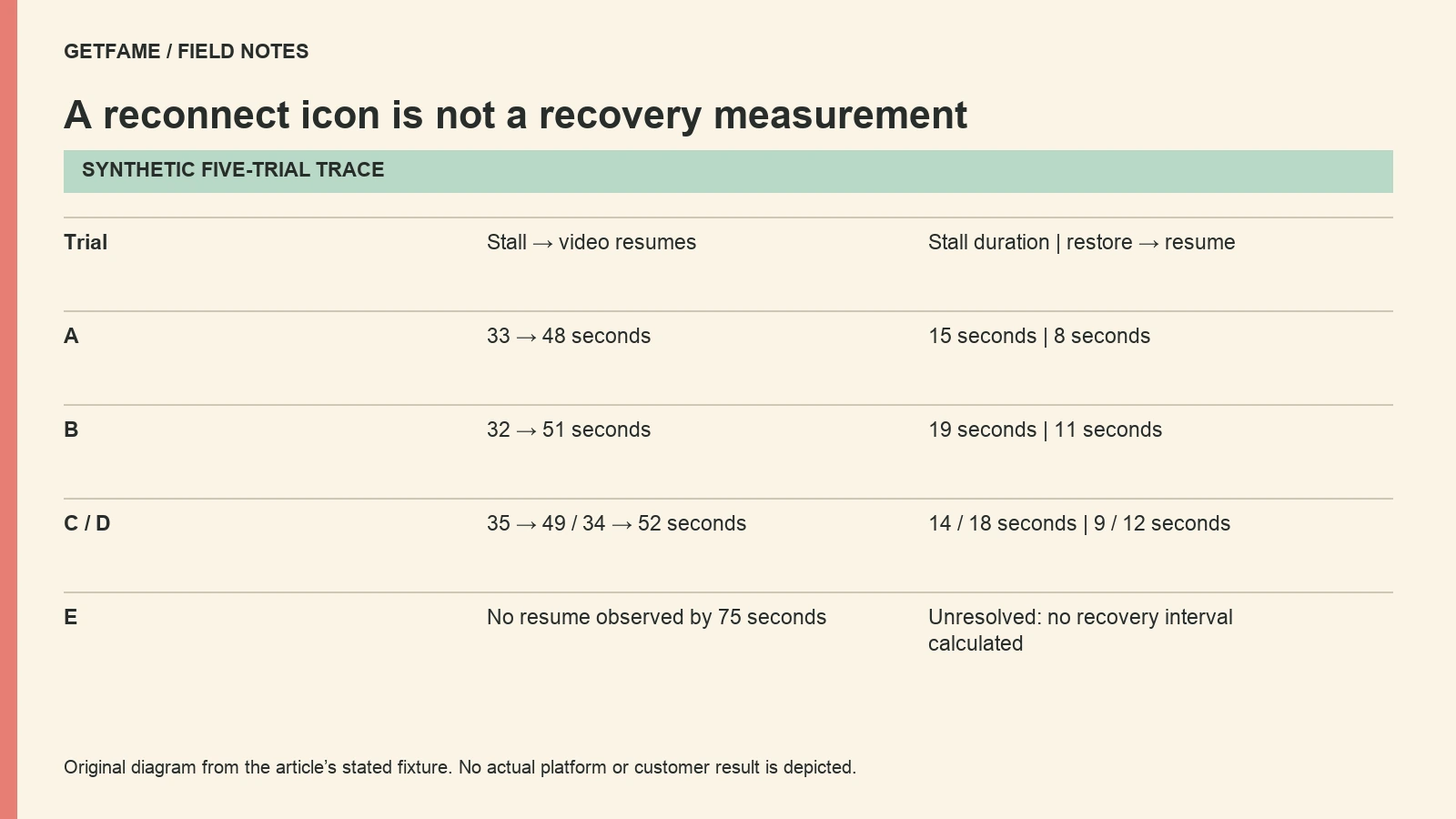
The invented trace below uses seconds on one common elapsed-time clock. The host path is interrupted at second 30 and restored at second 40 in every trial. The observed stall and the beginning of verified continuous video recovery can occur later.
| Synthetic trial | Observed stall | Verified video resumes | Stall-to-resume interval | Restore-to-resume interval |
|---|---|---|---|---|
| A | 33 | 48 | 15 | 8 |
| B | 32 | 51 | 19 | 11 |
| C | 35 | 49 | 14 | 9 |
| D | 34 | 52 | 18 | 12 |
| E | 33 | Not observed by 75 | Not calculated | Not calculated |
For the four completed synthetic observations, the median stall-to-resume interval is 16.5 seconds: the middle two sorted values are 15 and 18. The median restore-to-resume interval is 10 seconds, from the middle values 9 and 11. These are calculations on invented input, not measured service performance.
Keep trial E beside those summaries. It has no observed video recovery within the chosen window, so the completed-only medians cannot represent every trial. A summary that silently drops E would conceal the most important observation.
The ten-second intervention is not the same as the visible interruption. A buffer can delay the first visible symptom, while recovery work can extend the disruption after the network returns. Record both intervals rather than use one attractive number for every part of the experience.
Keep start-up delay and live delay outside the recovery total
Joining a room for the first time measures another journey. Record the join action and the first usable picture if start-up delay matters, but do not substitute that interval for the restoration measurement. A player can start quickly with older buffered material while still being far behind the host.
Live delay needs an observable relationship between the captured event and the displayed event. If the source and viewer recordings cannot be aligned, mark that measurement unavailable. The host's clock appearing on a screen can help with a controlled demonstration, but its precision and synchronization still need to be explained.
The recovery worksheet deliberately does not calculate a universal latency score. It retains the individual timestamps and names the intervals it can support. That lets another reviewer correct an annotation without reverse-engineering a single final number whose ingredients were discarded.
Keep one untouched copy of the recording and an annotation log. Record when a visible freeze was recognized, the resolution of the time display and any uncertain boundary. If two reviewers differ by a second, preserve the uncertainty instead of reporting a fractional result as though the source supported that precision.
Inspect sound, chat and gifts as independent outcomes
Listen as well as look. Record silent playback, repeated sound, unexpected audio from an earlier moment and any mismatch between the visible host and the audio. A moving thumbnail is not an adequate test of a conversation room.
For chat, send uniquely labelled synthetic messages before, during and after the intervention. Record which ones are acknowledged, which appear to each viewer and their displayed order. If a retry occurs, inspect whether the same message appears twice rather than infer correctness from the latest message arriving.
Treat gifting as a transaction check rather than a visual animation check. Use test currency or a permitted simulation, not a real purchase. Give the attempted gift a stable test reference and compare the displayed outcome with the authoritative test ledger. An animation can replay without a second debit, or disappear despite a recorded debit.
The worksheet keeps chat continuity and gift outcomes separate from video recovery. A room that resumes its media but leaves a financial action unresolved needs an explanation even if the picture looks normal again. Conversely, a temporarily hidden animation does not establish that a duplicate financial movement occurred.
The Bigo Live clone features page identifies the relevant room workflows for a product discussion. Attach the test references and expected outcomes to that scope instead of assuming that all live-room functions share one connection or recovery rule.
Use technical counters without overstating what they prove
Where the actual media route supports it, collect diagnostic statistics before and after the intervention. The W3C WebRTC statistics specification defines relevant observations, including receiver-side video-freeze statistics. Those definitions support instrumentation; they do not certify a particular application's user experience.
Check which fields the actual browser and route provide. MDN's inbound RTP statistics reference documents receiver-side fields and their scope. A missing or unsupported metric should remain unavailable in your worksheet, rather than become a fabricated zero.
Preserve the statistics object identity and sampling times. If a new connection or stream is created during rejoin, a counter may belong to a new observation series. Subtracting a new series from an old one can create a negative delta that looks like a miraculous improvement.
Use technical evidence to explain the visible trace. A state change, a freeze counter and a recorded image can agree, disagree or cover different intervals. When they disagree, retain the discrepancy and investigate the measurement boundary before deciding the product is broken.
Our video delivery, storage and transcoding guide covers the wider infrastructure choices. This test should not jump from one counter to a recommendation to replace a delivery provider. Identify the observed failure and the evidence needed to locate it first.
What should the reconnect message tell the viewer?
The interface must explain the state it actually knows. "Trying to reconnect" and "The live session has ended" lead the viewer to different decisions. A message that appears too early can end a conversation unnecessarily; a spinner that remains forever can leave the viewer unsure whether the event still exists.
Record when each message appears and what action it offers. Test a retry control once, then test repeated taps in a separate case. Check whether it opens duplicate room memberships, restarts only playback or creates an entirely new room. Keep the result attached to the relevant trial.
After the host returns, compare room identity and permissions. A member who was permitted to join should follow the agreed access rule; an unauthorized viewer should not gain entry merely because recovery used a different route. Use harmless synthetic accounts to test both sides.
Inspect the host's own view too. It should not encourage a second broadcast without explaining what happened to the earlier room. If the product deliberately creates a replacement session, document that behaviour and the effect on viewers, chat history and activity records.
These are proposed acceptance questions, not claims of a defect in a named product. The evidence may show an intentional design choice, a misleading label or a technical error. Keeping those possibilities separate makes the eventual correction more precise.
Repeat without turning a small sample into a promise
Repeat the agreed case under the same conditions before changing the configuration. Record every attempt, including setup failures and trials that never recover. Decide beforehand which setup problems make a trial invalid and preserve the reason for exclusion.
Separate distinct device or network conditions rather than combine them into a single average. A result from an unchanged desktop viewer and a result from a phone changing networks may answer different questions. Keep the sample description visible beside the summary.
Use the five-row synthetic trace to practise that reporting discipline. Four completed observations and one unresolved recovery demonstrate how a completed-only median can hide a timeout. They do not establish a useful reliability percentage, a production service level or a performance advantage over another supplier.
If an engineer changes a retry setting, compare a fresh, documented series with the earlier one. Keep the capture method, content and starting state consistent where possible. A shorter interval after changing several conditions is a finding to investigate, not proof that one setting caused the improvement.
Put the work and assumptions into the Bigo Live clone development-company discussion. Agree which environment, devices and failure cases form part of acceptance. A promise of "fast reconnect" is less useful than a protocol another team can repeat.
Annotate audio recovery and a delayed gift separately
Add a separate fictional trace to the worksheet. The test path returns at second 40. The transport reports a connected state at second 42. The viewer hears continuous new audio from second 46, but the picture remains frozen until second 54. A following ten-second observation confirms that moving video continues. These invented observations describe a reporting exercise, not another completed trial in the five-row dataset.
Under the same restore-to-resume definition, audio recovery takes six seconds and video recovery takes fourteen seconds. The transport indication arrives two seconds after restoration, but it cannot replace either user-visible interval. If the tester writes only "recovered at 42," the record conceals four seconds before usable sound and twelve seconds before moving video.
Record what the viewer actually hears during the gap. Continuous new sound, repeated buffered sound and silence need different annotations. A host saying a unique harmless phrase after restoration can help distinguish new audio from replay in a controlled test. The annotation still needs a declared clock and uncertainty; recognizing a phrase by ear does not create precise transport timing.
Now add one synthetic gift intent submitted before the interruption. In this fictional sequence, the authoritative test ledger records one debit at second 39, while the viewer receives the acknowledgement at second 50. The acknowledgement delay is eleven seconds from that ledger event. It is neither an eleven-second video recovery nor evidence of an additional gift. Retain the gift reference beside both observations so the reviewer can connect them.
Suppose the viewer presses retry at second 47 because no acknowledgement has appeared. The proposed acceptance check asks whether that retry is associated with the existing intent and whether the ledger still contains one permitted movement. It must inspect records rather than infer correctness from a single animation. A second acknowledgement may be a repeated presentation of one result; a second debit is a different finding.
The interface should also preserve uncertainty accurately. Before the result is known, a message can explain that confirmation is pending under the agreed design. It should not promise that nothing was charged merely because the animation is absent. After confirmation, the displayed history should give the same outcome as the authoritative test record.
Keep this extension outside the original median calculation. It introduces independent audio, video and transaction observations, with a different set of illustrative timestamps. Its purpose is to prevent a room-level success label from swallowing a partially recovered conversation or an unresolved action. A real run would need the permitted environment, capture, ledger evidence and timing notes before any of those proposed observations could become a result.
Retain the viewer's attempted action in the trace even when its acknowledgement appears after recovery. If the tester starts a new case as soon as moving video returns, a delayed gift result can be assigned to the wrong trial. Use a reset condition that accounts for outstanding synthetic actions, and record unresolved ones before leaving the room. That keeps media timing and transaction attribution connected without treating them as one measurement.
Leave the review with one trace and a clear next action
Keep a result package that contains:
- The named build, devices and media-path description.
- The controlled condition and the starting state for each trial.
- The annotated timeline and its timing uncertainty.
- The relevant diagnostic records and their sampling boundaries.
- Separate media, chat, access and synthetic transaction observations.
- Every unrecovered trial and the action assigned to it.
Keep source recordings private where needed and publish only a permitted, redacted demonstration.
Give each finding a next action tied to evidence. A misleading message may need revised wording. An unresolved test gift needs its reference traced through the ledger. Missing video after the connection returns needs an investigation of the relevant media path. None of those actions should be replaced by a general claim that the network was bad.
Before approving a change, rerun the case that exposed the problem and one ordinary baseline. The correction should improve the named outcome without creating a new contradiction elsewhere. Record what was not tested so the next reviewer does not inherit an exaggerated scope.
For a Bigo Live clone platform evaluation, bring the worksheet to an authorized demonstration and ask for the supporting trace. The valuable outcome is an explainable recovery journey under stated conditions, with unresolved cases still visible. Smooth office playback can remain the opening demonstration; the disconnect supplies a different kind of evidence.
Download the companion files
Download the companion kits and worksheets. Worked examples are labeled synthetic, public-source registers retain their references, and unrun protocols are identified. Read each kit's method and limits before using it.
Questions and answers
How do I run a live stream network recovery test?
Use an authorized test room with known devices, a named build and recorded media and control paths. Establish a baseline, change one permitted network condition, restore it and observe video, audio and application activity separately. Preserve the trace, observation deadline, starting state and any uncertainty in the timing method.
Does a connected status prove that streaming has recovered?
No. A transport-related status and usable playback describe different layers. Inspect the viewer's picture and sound as well as any technical state changes. Record when continuous playback resumes under the chosen definition, and keep chat, access and test-transaction outcomes separate rather than infer them from the connection label.
Should a trial without recovery be removed from the median?
Keep that trial visible as an unrecovered observation within the stated window. A completed-only median may still be calculated for the completed subset, but it must be labelled and shown alongside the unresolved cases. Do not invent a recovery timestamp or substitute zero to make the summary appear complete.
Are the recovery times in this article a performance benchmark?
No. The five trial records are invented to demonstrate measurement boundaries and arithmetic. Their completed-only medians are not observations of GetFame, a media provider or any actual network. A real performance comparison needs documented conditions, permitted tests, appropriate instrumentation and an adequately described sample.
Why should chat and gifts be checked during a network interruption?
Those workflows may depend on application connections and records that differ from media delivery. A message can replay or a gift animation can disagree with the authoritative test ledger. Use unique synthetic references and inspect acknowledgements and recorded outcomes separately, without sending real-money gifts merely to test recovery.
Sources
- Cloudflare Stream: live video and RTMP reconnection scope
- MDN: peer connection transport state
- W3C: WebRTC statistics definitions
- MDN: inbound RTP stream statistics
Source review dates are recorded in the article and companion material. Draft modification dates do not establish a new source check. Rules, fees and programme terms change; confirm on the source before you rely on them.