Coins, gifts and wallets
How Virtual Gifts Work on Live Streaming Apps, Step by Step
How virtual gifts work on live streaming apps: the gift is sent, split between host, agency and platform, turned into earnings and paid out after review.
Short answer
How virtual gifts work on live streaming apps: they run through a common system that separates viewer purchases, gift spending, creator earnings and payout review. The exact flow varies by app: Bigo describes Diamonds and Beans, while TikTok's US policy treats Diamonds as a popularity measure that does not guarantee reward payments.
Key takeaways
- A common gifting design separates purchased currency, gift value, creator earnings and payout requests; named platforms can use different reward rules.
- Platforms use separate currencies so the money viewers spend and the money hosts withdraw are never the same ledger line.
- GetFame's live product lets operators configure platform, agency and host shares; other apps determine rewards under their own terms.
- Leaderboards and PK battles turn gifting into a visible contest, which is what drives repeat spending.
- Gift purchases inside store apps normally go through Apple's in-app purchase and Google Play's billing.
- Fraud controls and withdrawal review decide whether the economy stays solvent.
On this page 11 sections
- How do virtual gifts work? Money in, gifts out, earnings paid
- Step 1: the viewer has spending currency
- Step 2: sending a gift
- Step 3: the split between platform, agency and host
- Step 4: converting to earnings
- Step 5: withdrawal and review
- Leaderboards, PK battles and why they drive spending
- Where agencies fit
- Where do virtual gift systems go wrong?
- Example: a 1,000-coin pack, 500 coins gifted, and who gets what
- What this means if you run a platform
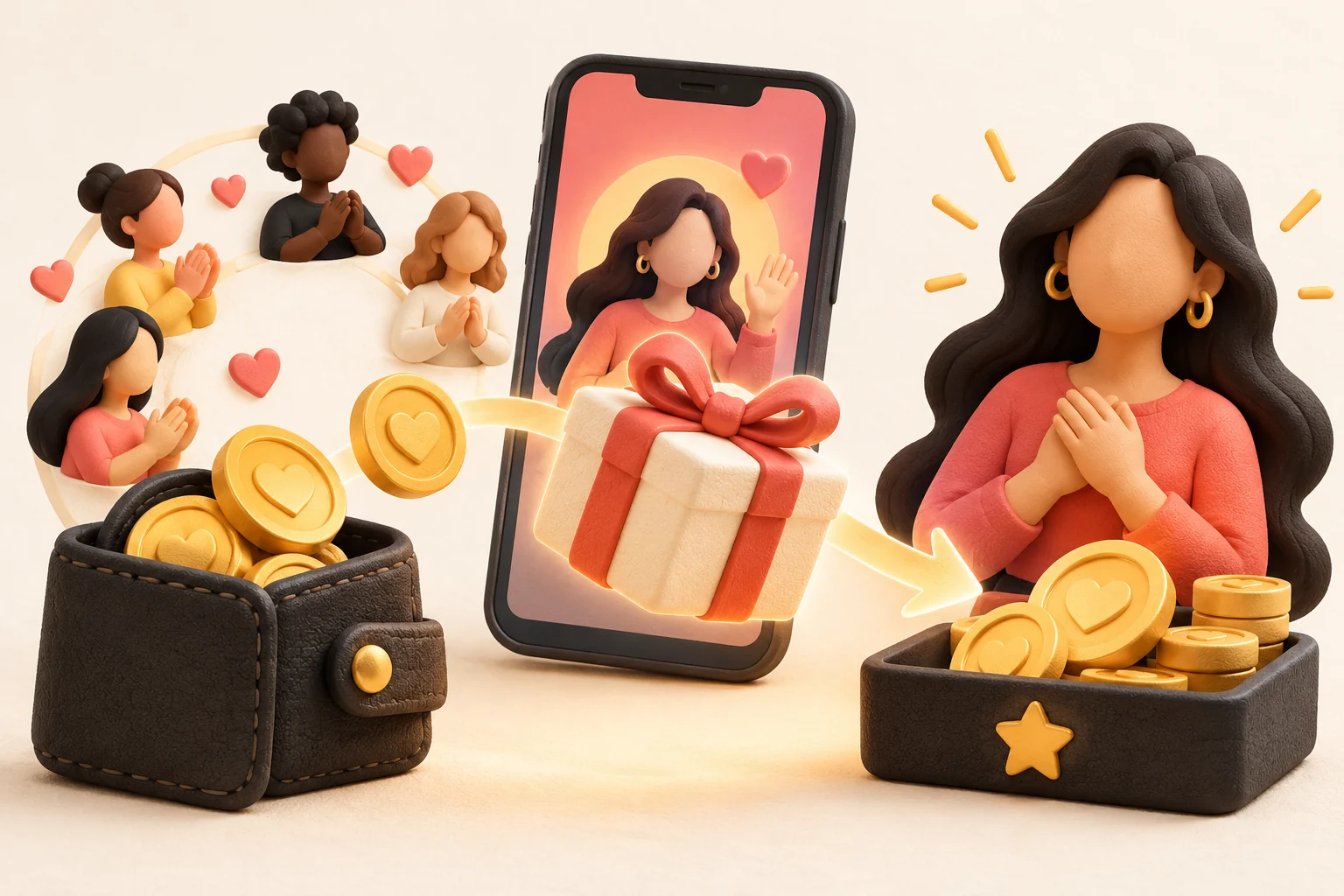
Virtual gifts on live streaming apps come down to one design: a common operator-designed gifting system separates viewer purchases, gifts, creator earnings and payouts. The viewer buys an in-app currency with real money, spends that currency on a gift during a broadcast, the app credits the host with a different earnings currency, and the host later converts and withdraws it. Each step has a currency, a rule and an operator decision behind it.
This guide follows a common gift-to-payout design and compares it with Bigo Live and TikTok, whose published rules differ. In particular, TikTok's current US policy treats Diamonds as a popularity measure, not cash or an automatic payment entitlement. If you are modeling the same flow for your own product, a white-label Bigo Live clone implements the full chain described here. The numbers in the worked examples are illustrative and show how the arithmetic behaves, and no figure here describes any real company's split.
How do virtual gifts work? Money in, gifts out, earnings paid
Three parties are involved: the viewer, the host and the platform. A fourth, the agency, appears on many live apps. The loop runs like this.
- The viewer recharges. Real money buys a pack of the app's spending currency.
- The viewer sends a gift. The gift has a price in that currency, and the room sees it as an animation.
- The platform splits the value. The host, the platform and any agency each receive a share.
- The host holds an earnings balance in a separate currency.
- The host converts it and requests a withdrawal, which the operator reviews before paying cash.
What the viewer is paying for is attention and status more than the animation. A gift makes the viewer visible to the host and the room, moves them up a ranking, and sometimes decides a contest. That is why the economy works on small impulsive purchases and why it needs rules about who may spend, how much and how fast.
Step 1: the viewer has spending currency
Every live gifting app puts a currency between cash and gifts. On Bigo Live, viewers buy "Diamonds" by tapping a recharge button and choosing a pack, according to Bigo's own gifts page. On TikTok, viewers buy "Coins" at a price shown at the point of purchase, and TikTok's US virtual items policy requires users to be at least 18, or the local age of majority if higher, to buy, use or collect specified items such as Coins and Diamonds.
The reason for the extra layer is that a spending currency that cannot be withdrawn removes the loop where a user buys currency and cashes it straight back. Bigo's gift flow, as described on its pages, is viewer Diamonds to gifts to host Beans, never Diamonds to cash. How packs are priced, how store billing applies and how the wallet ledger is built are explained in how a coin economy works and in our rundown of what Apple and Google require for digital goods. This guide starts at the moment the viewer already holds currency and follows the gift to the host.
Step 2: sending a gift
During a broadcast the viewer opens a gift panel, picks an item and sends it. Bigo's gifts page describes a panel organized into five categories: Popular, Multi (sent in multiples), Activities (tied to events), VIP and Backpack, which holds free gifts earned through daily tasks or promotions. Prices appear in Diamonds under each item, and more expensive gifts have more elaborate animations.
Behind the tap, the request goes to the platform's server rather than being trusted from the phone. A typical design checks that the viewer is signed in, confirms the wallet holds enough of the spending currency, deducts the price, records the transaction, and only then tells everyone in the room to play the animation. Checking the balance on the server, not the app, is what stops a modified client from sending free gifts.
Design choices in the catalog shape behavior.
| Catalog choice | What it does | Operator consideration |
|---|---|---|
| Low-price items | Let new viewers join in at small cost | Keep the lowest price at a level that feels like a reaction, not a bill |
| High-price animated items | Create a moment the whole room sees | Needs fast delivery and a clear effect, or viewers feel cheated |
| Combo or multi-send | Rewards sending the same gift many times | Raises the risk of accidental over-spend, so confirm large combos |
| Event or limited gifts | Concentrate spending in a window | Plan the calendar so events do not cannibalize each other |
| Free backpack gifts | Teach new viewers the mechanic at no cost | Decide whether free gifts earn hosts anything, which affects cost |
Gifts do not only pay the host. On Bigo Live, senders appear on the broadcaster's Gift Ranking leaderboard, which Bigo's page says typically resets weekly, and a Challenge the Top button shows how many Diamonds are needed to advance. Viewers also receive experience points toward an account level. These are status mechanics, and they explain why a viewer sends a second gift after the first. Apple's guideline 3.1.1 also says gifts of eligible items can go back only to the original purchaser for a refund and cannot be exchanged, and TikTok's terms state that all sales of Gifts are final.
Step 3: the split between platform, agency and host
When a gift lands, its value is divided. The host's share is the part the host can eventually withdraw. The platform keeps a share to cover store fees, hosting, moderation and margin. If the host belongs to an agency, the agency receives a share too.
Real apps rarely publish one flat percentage. The split can vary by room type, gift category, host tier and region, and the exact numbers sit in host or broadcaster agreements. This post does not state any named company's split because the company pages opened for this guide do not publish a general figure. What can be stated is the structure, and what an operator controls.
Here is a short example with illustrative numbers. Say a gift costs 100 coins, and the operator's split is 30% platform, 10% agency and 60% host. The host side receives 60 units of value. If the host has no agency, the operator decides whether the agency share goes to the platform or the host. Our own default configuration for the Bigo-style product uses exactly this 30, 10 and 60 split, and the operator can change it per room type, gift category and region.
Two further points matter. First, the stores take their commission when the coins are bought, not when the gift is sent, so the margin per coin depends on which channel sold it. Second, any in-app commission shows up in the platform share, so a high store fee leaves a thin platform margin unless the pack prices account for it. Modeling that is covered under "what this means if you run a platform" below.
Step 4: converting to earnings
Hosts do not hold the same currency viewers spend. Platforms use a chain of balances, and the number varies. The table shows the two public examples and our own product's four-currency design.
| Platform or product | Viewer buys | Host earns | Then |
|---|---|---|---|
| Bigo Live (per its own pages) | Diamonds | Beans | Beans are withdrawn as cash through the wallet |
| TikTok (US virtual items policy) | Coins activate Gifts | Diamonds measure popularity and engagement | Rewards depend on program terms; Diamonds do not guarantee payment |
| GetFame live product (our design) | Coins | Diamonds, then Beans | Beans become a withdrawal request, plus separate points for ranking |
Naming varies and the same word can mean the opposite on two apps: Diamonds are what viewers buy on Bigo; TikTok uses the same word for a creator popularity measure. When you read about a platform, always ask which side of the loop a currency sits on.
Why more than one earnings currency? An intermediate unit separates the gift value scored for rankings, the host's accrued earnings and the cash-ready balance. TikTok's terms say Diamonds are a measurement of the popularity of the user content and cannot be bought by creators, which makes a ranking point different from a withdrawable balance. Keeping them apart lets the operator adjust competitions, bonuses and conversion rates without rewriting payouts. In our live product, coins, diamonds, beans and points sit in separate balances, and the conversion rate is a setting.
Step 5: withdrawal and review
The last step is paying the host. Bigo's earning guide describes the path as Profile, then Wallet, then Withdraw, connecting a payment method supported in the host's region, entering an amount, and waiting three to seven business days for processing. It says the account must be verified and that a minimum withdrawal threshold exists without stating an amount on that page. TikTok's US policy separates virtual items from reward payments: program eligibility and applicable reward terms determine whether a creator receives a payment.
Between request and payment sits the operator. A sound review step does four things.
- Checks identity and eligibility. The host is an adult, verified, and in a country you pay.
- Checks the earnings. The balance comes from gifts that survived refunds, chargebacks and moderation reports.
- Applies the fee and the minimum. Some platforms charge a withdrawal fee. Our live product applies a configurable fee, with 5% as the default, and requires operator approval.
- Logs the decision. An audit trail shows who approved what and when.
Delay is a feature as well as a cost. A holding window between a gift and its withdrawal gives time to catch fraud, refunds and policy breaches before cash leaves.
Leaderboards, PK battles and why they drive spending
Gifts alone make a tip jar. Rankings and contests turn them into a game with a scoreboard, and that is what keeps viewers spending.
Leaderboards
Per-room and global rankings by gift value show who supports whom. A weekly reset, as Bigo describes for its Gift Ranking, gives newcomers a chance to reach the top without out-spending the year's biggest supporters. Rankings by host, fan, family and agency let each group compete.
PK battles
A PK battle links two hosts' rooms for a fixed time. Gifts sent by each audience count as points, and the host with the higher score when the timer ends wins. Bigo's Multi Room PK guide describes three phases: early double points, a 1.5x boost in the middle and an explosive point gain in the final seconds. It advises hosts to tell supporters to save their heavy gifts for the boost and the finish, and says winners receive profile rewards and a week of featured placement. The effect on spending is straightforward: a close score gives viewers a reason to send one more gift right now.
Our live product supports six battle formats scored on gift value, including tournament, agency, family, room, team and one-versus-one formats, with revenge matches, plus rankings for hosts, fans, families and agencies. Whatever the format, design the scoring so a single huge gift cannot make the result meaningless, or the contest stops feeling fair.
Where agencies fit
On many live apps most hosts come through agencies: businesses that recruit, coach and manage broadcasters and take a commission on their earnings. Bigo's earning guide lists an agency model among its earning routes, in which a talent agent recruits and manages hosts and earns a commission from their Bean earnings, and describes an official host program with a structured monthly salary plus gift revenue. In our design, the operator approves each agency, hosts join through invite codes from their agency, contracts run on commission or salary, hosts can be transferred, and sub-agencies can have their own rates, with a default agency cut of 10%.
The agency layer changes the economics. It lowers the cost of finding hosts, because the agency does the recruiting, and it introduces a second party with an interest in the host's earnings. The operator must keep the contract terms clear, publish the share and give hosts a path to see what they earned. The full mechanics are in how live streaming agencies work.
Where do virtual gift systems go wrong?
Gift economies attract abuse because value moves quickly and ends in cash.
- Collusion between host and viewer. Two accounts, one person: buy currency with stolen or chargebacked cards, gift to the host account, withdraw. Watch for repeated gifts between the same pair and fresh accounts that spend heavily.
- Chargebacks. A web purchase can be disputed after the gift has been spent and earned. Hold earnings for a window and claw back where terms allow.
- Minors spending. Age limits exist for a reason: TikTok's US policy sets an adult age requirement for specified virtual items. Apps need age gates, spending limits and a fast route for parents to report.
- Harassment for gifts. A monetized room can reward bad behavior. Google's policy for user-generated content expects safeguards that stop monetization from encouraging objectionable behavior. For more, read moderating a live streaming app.
- Currency trading. Black markets sell discounted currency. Keep the spending currency non-transferable and non-withdrawable.
- Refund loops. If gifts are final, a refunded purchase can leave a negative balance. Decide your rule before launch.
Controls that help are a spending ceiling for new accounts, velocity checks on gifting, mandatory verification before the first withdrawal, a hold period, an operator-approved payout and a complete log. The user-generated side of these duties, with the store requirements for live content, is in the app store review of user-generated content guide.
Example: a 1,000-coin pack, 500 coins gifted, and who gets what
Suppose a viewer purchases a 1,000-coin pack for 10 in a store app. Assume a hypothetical store fee of 30%, leaving 7. The viewer spends 500 coins, half the pack. For this example only, the platform allocates the corresponding net receipts of 3.50 as 30% platform, 10% agency and 60% host. This net-receipts assumption is a contract rule chosen for illustration, not a rule of Bigo, TikTok or every gift app.
| Step | Calculation | Result |
|---|---|---|
| Pack sold | 1,000 coins for 10 | Viewer pays 10 |
| Store commission | 30% of 10 | 3.00 to the store, 7.00 to the operator |
| Gifts sent | 500 of 1,000 coins | Half the pack, worth 3.50 of the operator's 7.00 |
| Split of the 500 coins | 60% host, 10% agency, 30% platform | 300 host, 50 agency, 150 platform |
| Host value in money terms | 300 of 1,000 coins, times 10 per pack | 2.10 under the example's net-receipts rule |
| Withdrawal fee | 5% on cash-out | Host receives 95% of the converted amount |
Under these rules, the host receives 2.10 before any withdrawal fee, the agency receives 0.35 and the platform retains 1.05 before infrastructure and operating costs. A 5% withdrawal fee would leave the host about 2.00. A contract based on gross purchase value would produce different results. Define the calculation base, conversion rule, refunds and fees explicitly before using a revenue split.
Designing a gift price ladder
The catalog is where most of the economy's feel is set, and a ladder is easier to reason about than a flat list. The prices below are illustrative, in a generic coin unit, and match no real app.
| Rung | Example price | Purpose | What to check |
|---|---|---|---|
| Reaction | 1 to 10 coins | A viewer joins in without thinking | Does the smallest gift still cover payment costs per coin? |
| Support | 50 to 200 coins | Recognition from the host by name | Is the on-screen effect visible to the whole room? |
| Moment | 500 to 2,000 coins | An animation the room remembers | Does it play without lag on a mid-range phone? |
| Statement | 5,000 coins and up | A rare, visible act of status | Is there a confirmation step and a spending ceiling? |
Look at the gaps between rungs. If nothing sits between 10 and 500 coins, viewers jump from reaction to a large purchase, or they stop at reaction. A dense middle makes a second gift easy. Review the ladder against real sales every month and retire items nobody buys.
Onboarding a host to their first gift
Supply decides whether the loop starts. A new host who goes live to an empty room and receives nothing tends to stop, so plan the first sessions.
- Verify and approve. Complete the identity and eligibility checks before the host's first public broadcast, so the first payout is not held up.
- Explain the currencies. Show the host which balance gifts credit, how conversion works and when withdrawals are reviewed.
- Schedule the first sessions. Put new hosts on a calendar slot that brings in an existing audience, such as an agency's own supporters.
- Show earnings straight away. A visible running balance during the session tells the host the system works.
- Review the first week. Look at gifts received, repeat senders and any reports, and adjust the plan.
What to test before launch
A gift flow touches money, so test it on purpose and not by accident.
- Double sends. Tap the gift button twice quickly on a slow connection. The viewer should be charged once per intended gift.
- Insufficient balance. The server must refuse the gift, not the app alone.
- Dropped connections. If the connection fails after the charge, the gift should still reach the host or be refunded.
- Refund after gifting. Reverse a purchase whose coins were already spent and confirm the balances end where your rule says.
- Split changes. Change a split mid-week and confirm old gifts keep the old rate.
- Withdrawal limits. Request below the minimum, above the balance and twice at once.
Reading the economy from a few numbers
After launch, a short weekly list of figures shows whether the loop is healthy. Track the share of viewers who send a first gift, gifts per paying viewer, the share of gift value that comes from the top few senders, time from gift to withdrawal, and the share of withdrawals held for review. If a handful of senders account for nearly all value, the economy is fragile, because one person leaving ends a host's income. If time to withdrawal grows, hosts will feel it before any report shows it.
What this means if you run a platform
The same loop works on short video and fan apps. A TikTok clone adds gifts to videos and live rooms, and a fan platform built on an OnlyFans clone uses tips and balances in place of animated gifts. How TikTok gifts and coins work sets out the TikTok case from the platform's own terms. If you are specifying your own gift-to-payout flow, decide the split by room, gift and region, the earnings chain and conversion rate, the withdrawal rules, fee and review, the agency terms and the fraud controls, in that order.
In a ready-made Bigo Live clone app build, the room engine, the split, the agency layer and the battle formats already exist, and a gift is processed as a single database transaction: it deducts the sender, splits the value and credits the receiver. See the gift economy and wallet features for the module list and the Bigo Live clone development cost page for what the published price covers. Contact us to check how your split and agency terms map to the settings.
Policy, tax advice and the legal side of hosting payouts stay with you. Ask a qualified adviser about taxes on earnings and the rules for paying hosts in each country. Nothing in this post is legal or tax advice.
Questions and answers
Do hosts get the full value of a gift?
Do not assume so. Host terms define any conversion, fees and reward eligibility. In GetFame's live product the operator configures a platform, agency and host split. TikTok's US policy instead uses Diamonds as one input to reward programs and does not promise an automatic payment for each gift.
Why do hosts earn a different currency than viewers spend?
A separate earnings currency keeps the money viewers spend and the balance hosts withdraw on different ledger lines, so ranking rules and conversion rates can change without rewriting payouts. Bigo's pages describe viewers spending Diamonds and hosts earning Beans, while TikTok uses Diamonds as a popularity measure.
Can viewers get gifts refunded?
Usually not. TikTok's virtual items terms say all sales of Gifts are final, and Apple's guideline allows gifts of eligible in-app items to be refunded only to the original purchaser. Unauthorized purchases and accidental spending by minors are handled through the store's own refund process or the platform's support route.
How do platforms stop gift fraud?
They combine payment checks, spending limits, anomaly detection for repeated gifts between the same accounts, identity verification before withdrawal, and operator approval of payouts. They also hold earnings while a report is open. No single control is enough, so layered checks and an audit trail matter more than any one tool.
Are gift earnings taxed?
Often yes, but the rules depend on the host's country and status, and platform terms usually make hosts responsible for their own taxes. This post does not cover tax, so ask a qualified adviser in the host's jurisdiction and keep records of earnings and withdrawals.
What is a PK battle?
A PK battle is a timed contest between two hosts whose rooms are linked on screen, where gifts from each audience count as points and the higher score wins. Bigo Live's guide describes phases with double points early, a 1.5x boost mid-game and a final-seconds surge, with rewards for the winner.
Is a gift the same as a tip?
A gift can express appreciation like a tip, but the payment mechanics differ. TikTok's US policy states that activating a Gift does not transfer money or value to another user. Other services define their own creator earnings rules. Read the applicable program terms instead of assuming a direct cash transfer.
How do virtual gifts work on live streaming apps?
The viewer buys the app's currency with real money, opens the gift panel during a broadcast, and taps a gift priced in that currency. The server deducts the balance, the room sees the animation, and the host's earnings balance is credited under the platform's split. The viewer pays for attention and status, and the host can later request a reviewed withdrawal.
Sources
- Bigo Live: How gifts work
- Bigo Live: how broadcasters earn money and withdraw it
- Bigo Live: Multi Room PK System guide
- Bigo Live on the App Store (listing)
- TikTok: US Virtual Items Policy (January 2026)
- Apple: App Review Guidelines
- Google Play: Payments policy
Checked in October 2026. Rules, fees and programme terms change; confirm on the source before you rely on them.