Ready-made, one-time
$3,999
ReelShort Clone
Live in 6 working days from kickoff
- Full source code
- White-label under your brand
- 60 days of technical support
- 1 year of free updates
- App publishing support

Micro drama app
Sell every cliffhanger through a coin wallet you own
This ReelShort clone script is a ready-made micro drama platform where the wallet is the product. Viewers receive a free episode window, after which each further episode is paid for in coins, opened by a VIP pass or earned by watching a rewarded ad. The browser app, the Flutter app for both stores and the operator console all read one API and one ledger, delivered under your brand with the full source code.
| Product type | White label micro drama app with a coin wallet and its own console |
|---|---|
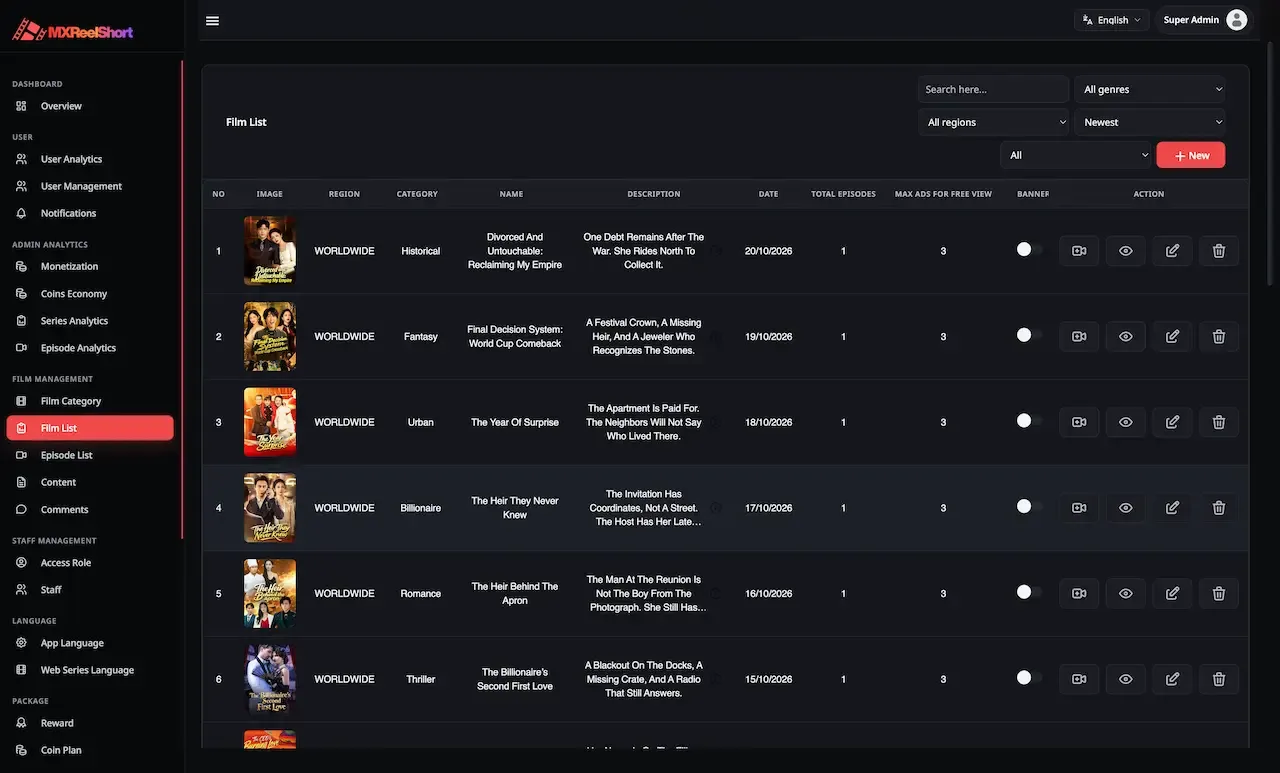
| Clients included | Consumer web app, Flutter app for iOS and Android, operator console |
| Ways to open an episode | Spend coins, watch a rewarded ad or hold a VIP window, plus auto-unlock to open what is left of a title |
| Price | $3,999 one time, no revenue share |
| Launch time | 6 working days from kickoff |
| Source code | Full source code for web, console, API and mobile |
| Hosting | Your own server, with media on any of eight storage providers, such as local disk, AWS S3 or DigitalOcean Spaces |
| Payment gateways | PayPlus hosted checkout, Stripe, Razorpay, Flutterwave and Google Play billing |
| Languages | Five locales (English, Spanish, Hindi, Hebrew and Arabic), the last two laid out right to left, with series and episode titles in all five |
| Support and updates | 60 days of technical support, bug fixes prioritized through month six, then ReelShort clone updates free for a year |
A ReelShort clone is a micro drama streaming platform built from the same working parts as the app people search for by that name: a vertical player, categories of titles cut into numbered episodes, and a coin wallet that settles whether the following episode plays. It is short drama OTT built around the episode, not a video library with a subscription switch added later. Sold under your own name, it becomes a white label micro drama app, and buyers comparing apps like ReelShort usually want these working pieces in one place.
Here the lock sits on the episode itself. Whether an episode may play for a given viewer is worked out when the request arrives, using four inputs: the lock flag in the catalog, the free window, any running VIP window, and a per-user unlock record. Coins, a rewarded ad and auto-unlock all write that same record, so an episode owned on the web is owned in the store app too. If you want an app like ReelShort under your own name, every piece here is included. Think of it as a platform like ReelShort that you operate yourself.
You launch it as your own service. The branding, locales, currency, coin packs, plans and reward tables are runtime settings, and you license or produce the catalog yourself. We deliver the code, deploy it to your hosting and connect your own accounts for payments, ads and push notifications. It works as a ReelShort alternative under your name. You receive the ReelShort clone source code.
ReelShort is a consumer app known for vertical short drama: stories cut into brief numbered episodes, with the opening episodes open to everyone and later ones held behind a lock. Viewers open the lock with coins they buy, with rewards they earn, or with a pass. The brand is a catalog and an audience as much as a piece of software, and neither of those can be cloned.
A ReelShort clone, in the sense used on this page, is the software model only: a wallet, an unlock rule, a vertical player and an operator console, delivered under your own name. You bring the stories, the audience and the commercial terms. The practical question is less whether an app can be copied and more whether you can run the economy behind it, which is why the wallet gets the most attention here.
A viewer should reach a paid decision within minutes of arriving and never feel pushed. The path runs from a guest landing on a shelf, through a free run of episodes, to a lock that offers more than one way forward.
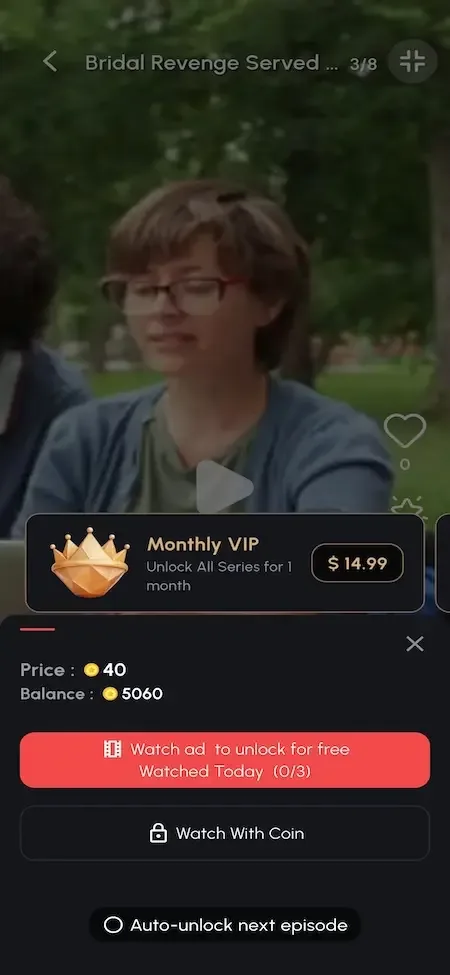
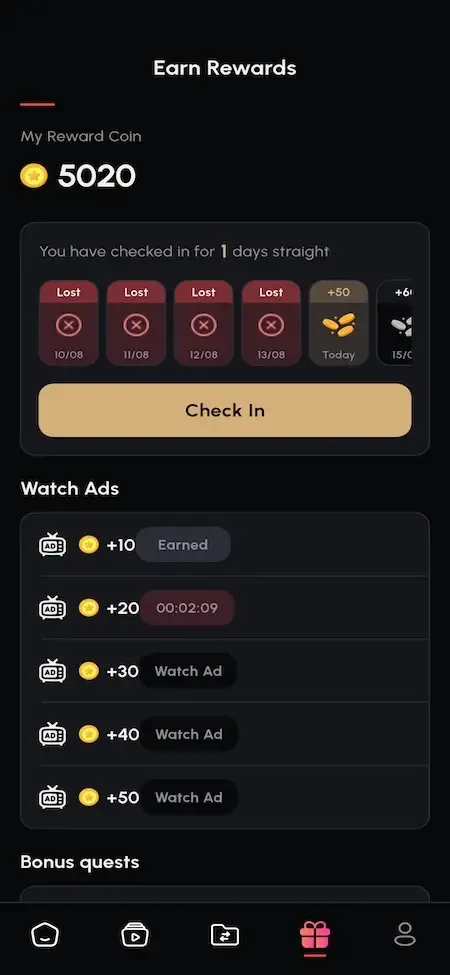
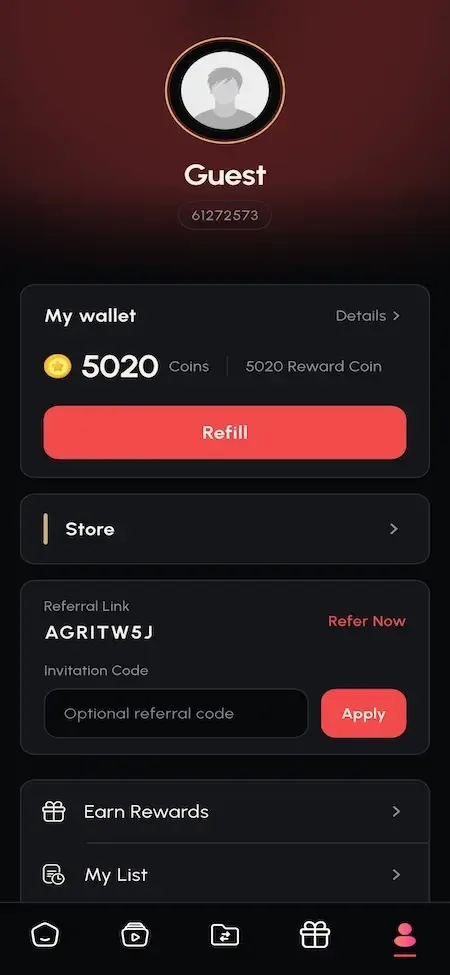
The owner of the service sets the economy. Everything that decides what a viewer pays, how long a free run lasts and which rewards are given lives in the console as data, so pricing becomes a weekly experiment and not a development ticket.
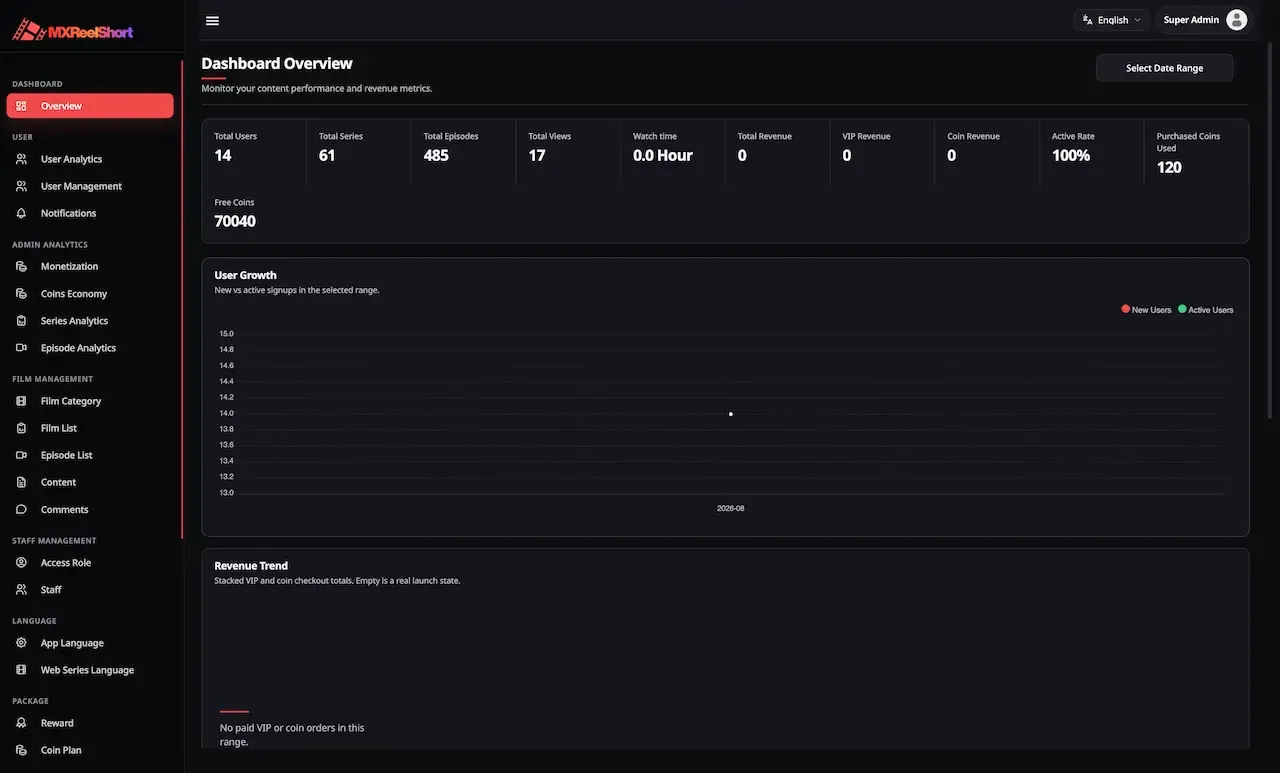
Day-to-day running is split between people with different permissions. A moderator clears reports, a campaign manager schedules messages, a catalog editor reorders episodes, and each sees only the part of the console their role covers.
The store app carries the same wallet and catalog as the web, with the extras that only a phone offers: native screenshot blocking, a live ad network, device push and a binary that already speaks five languages.
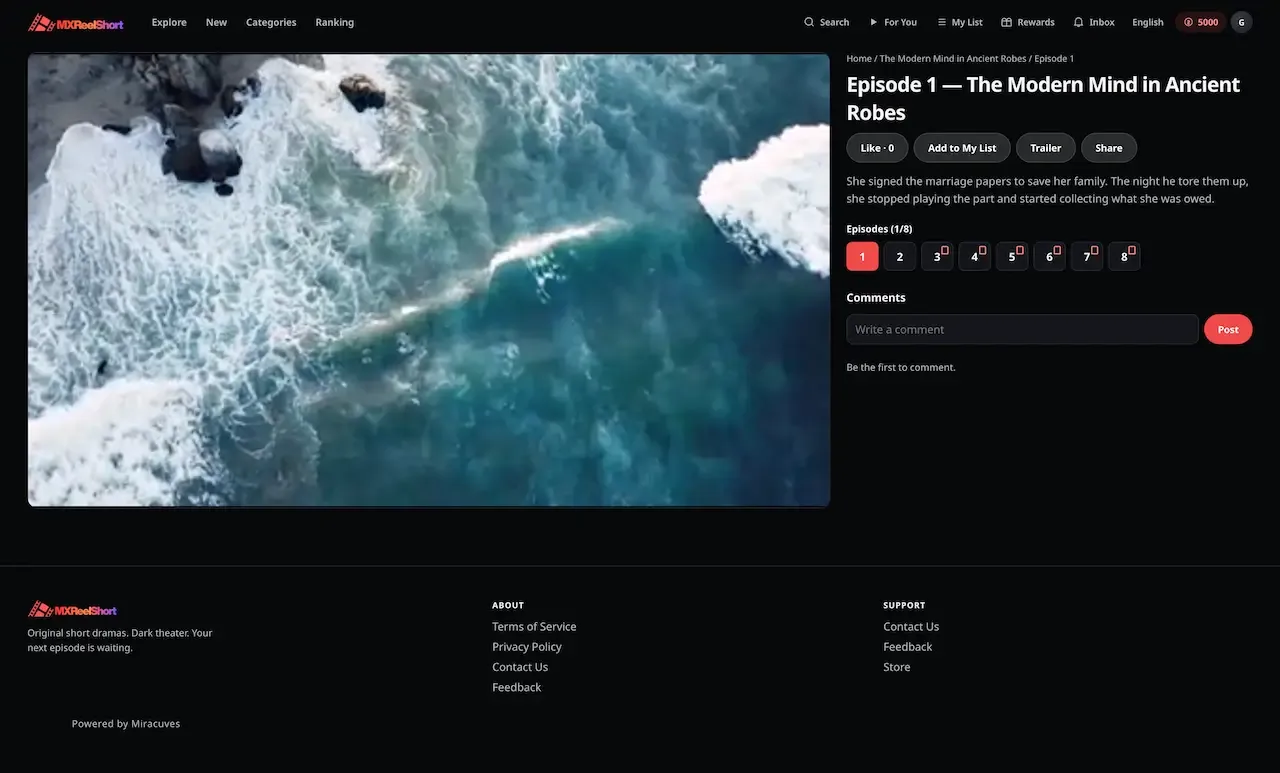
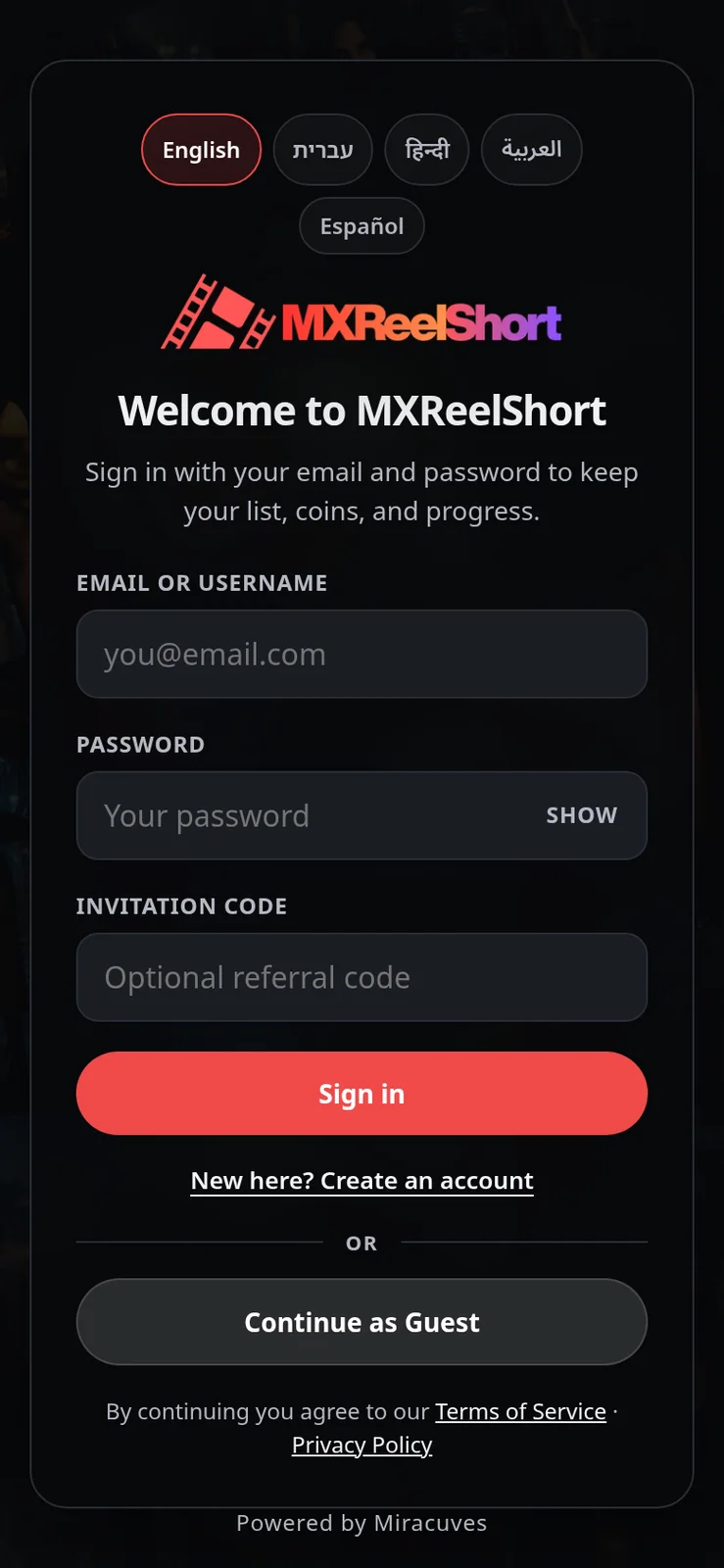
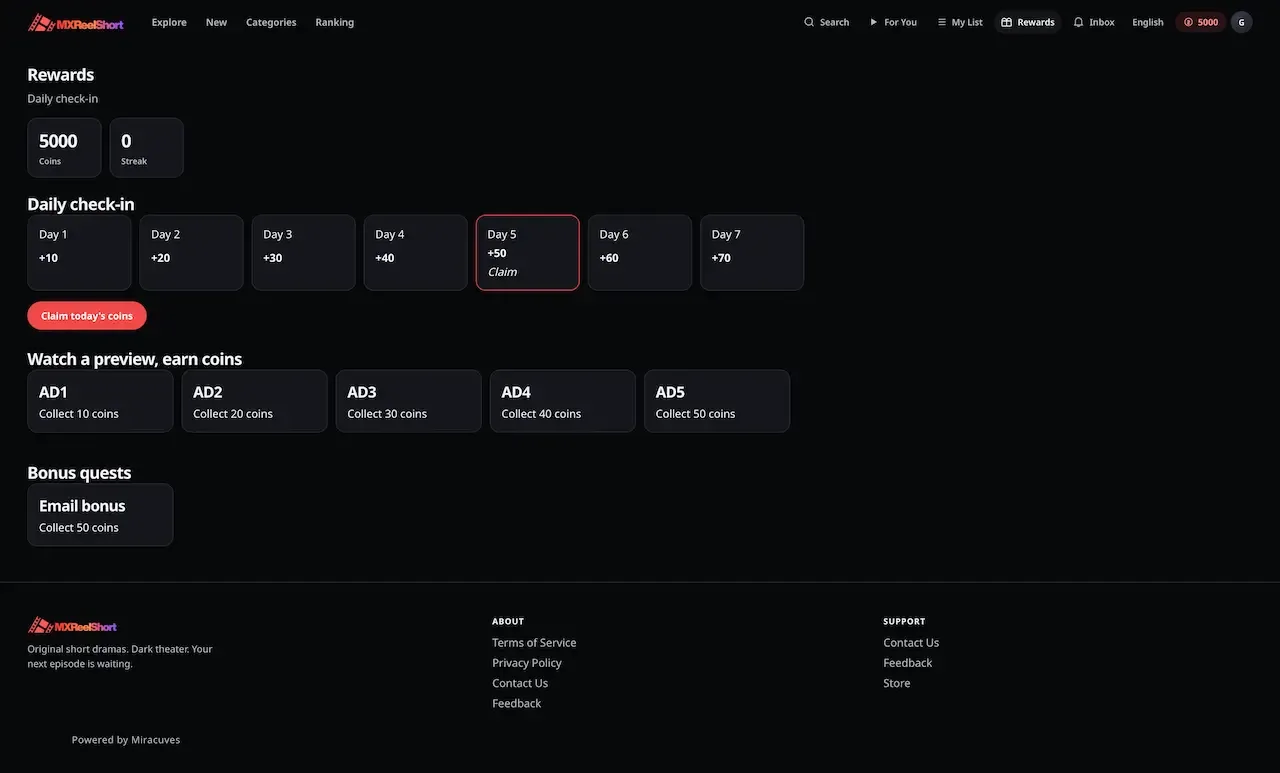
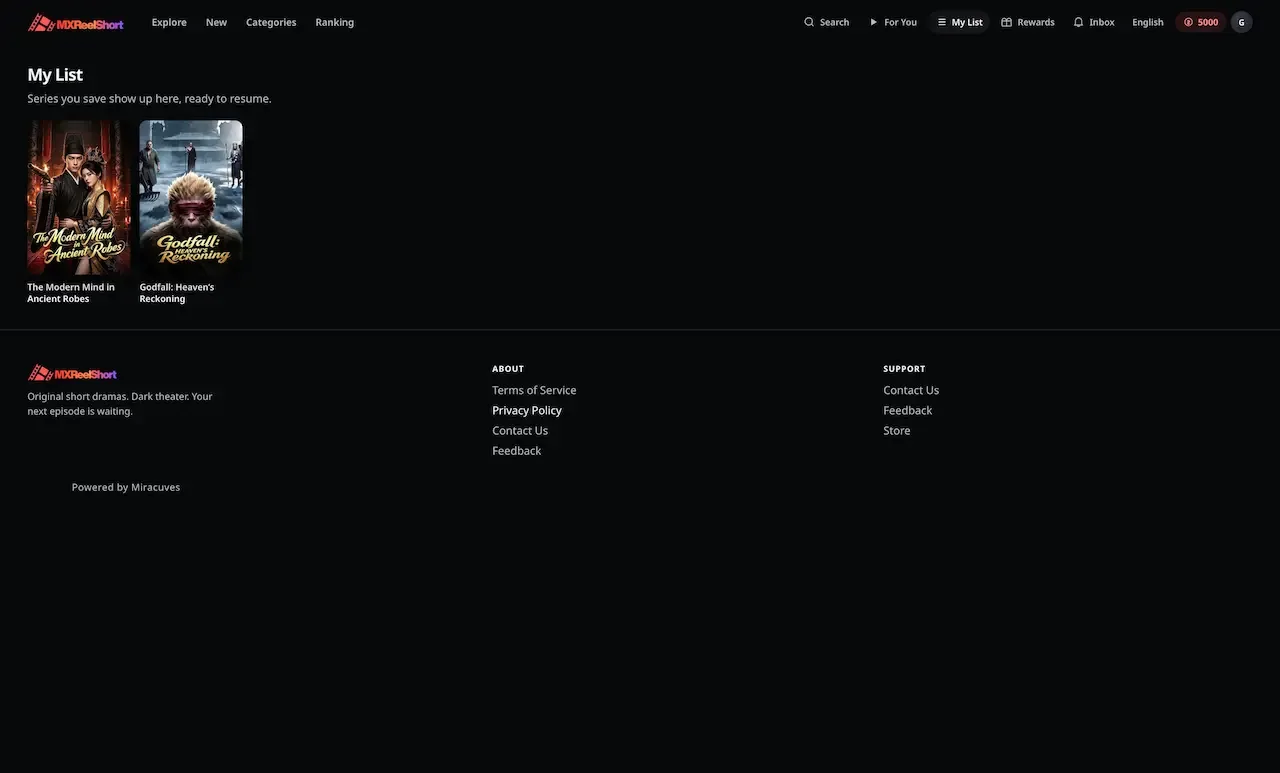
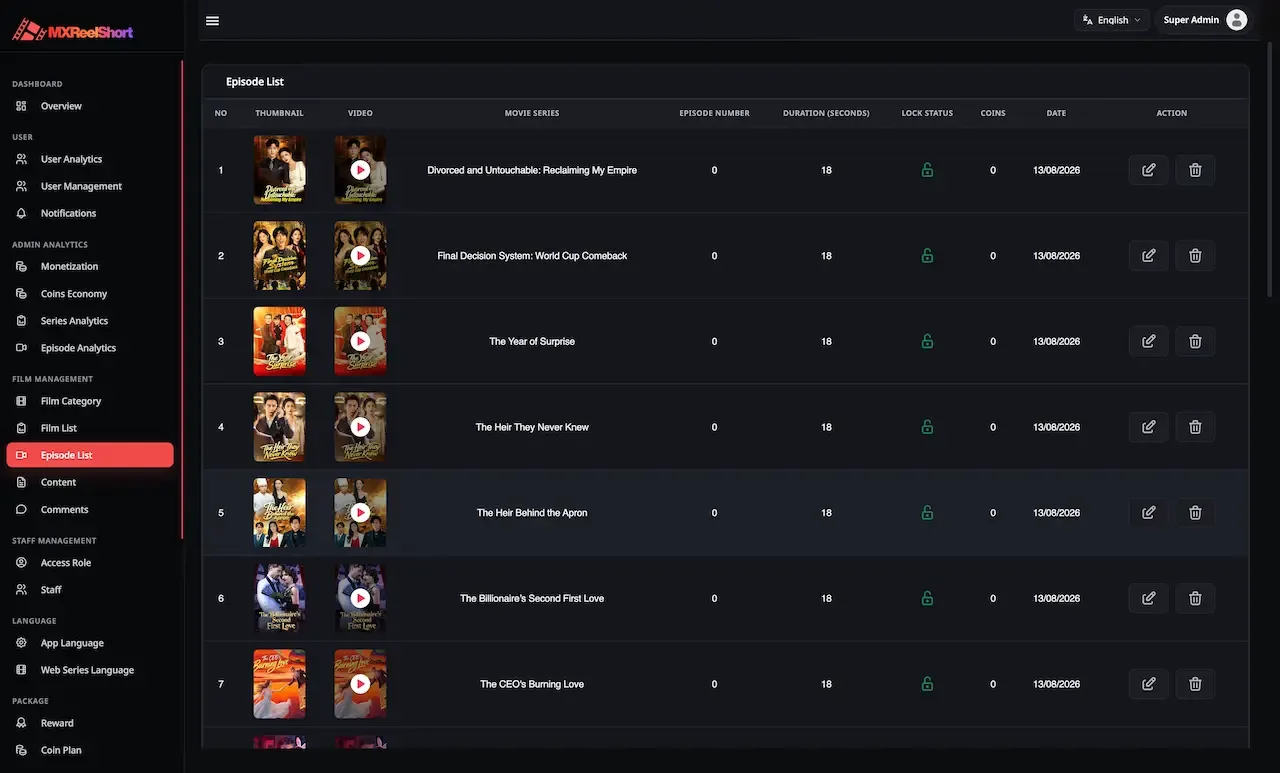
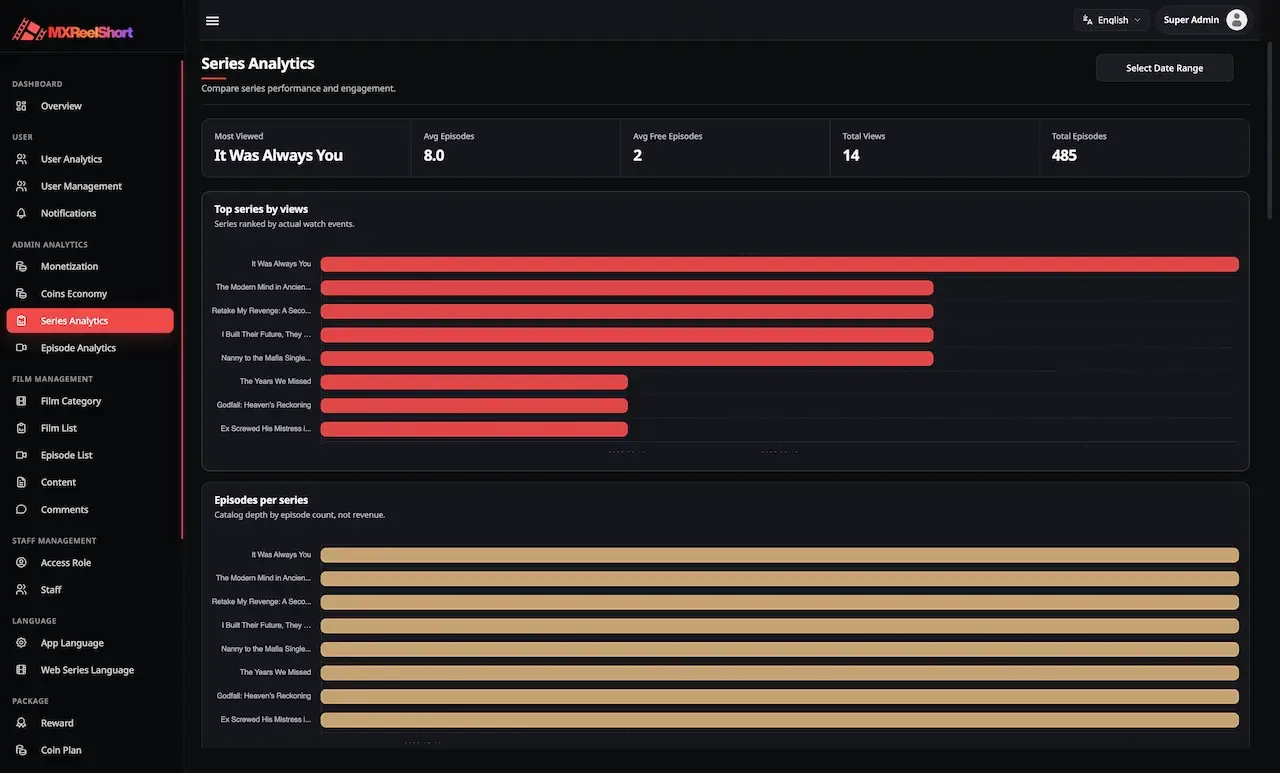
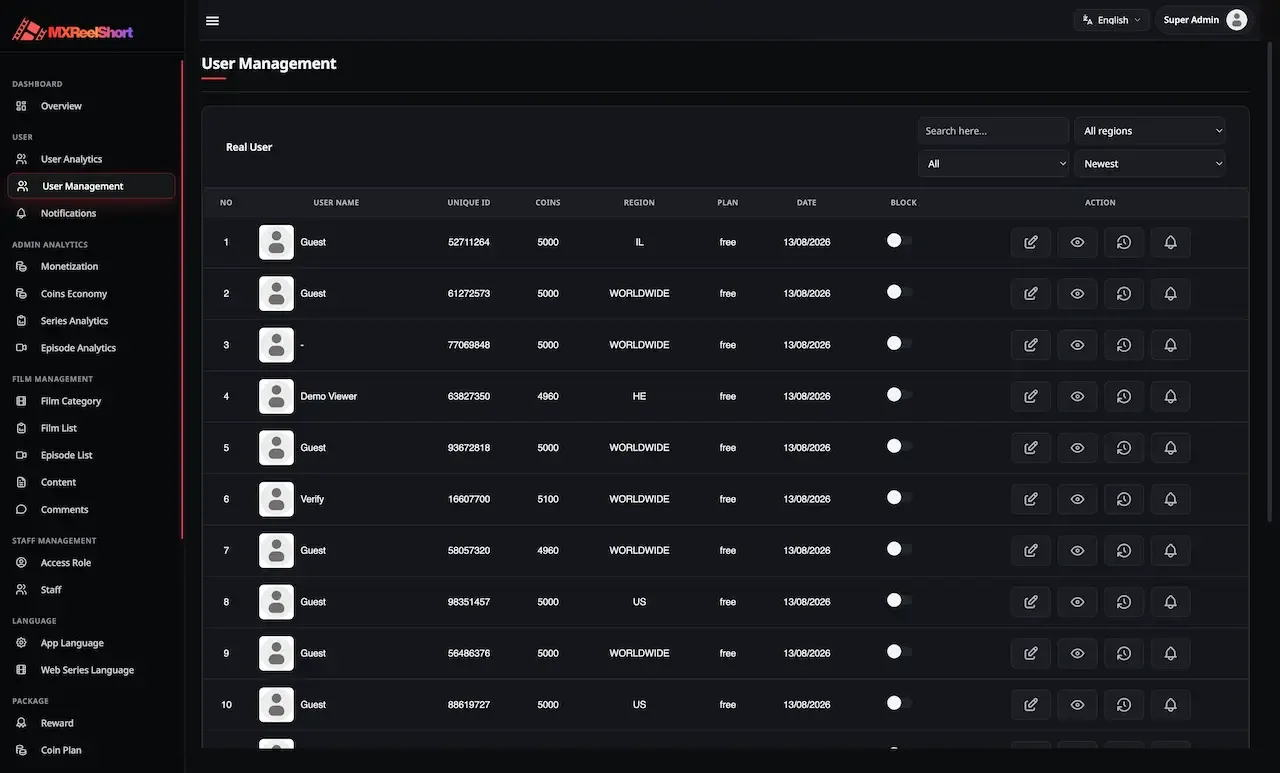
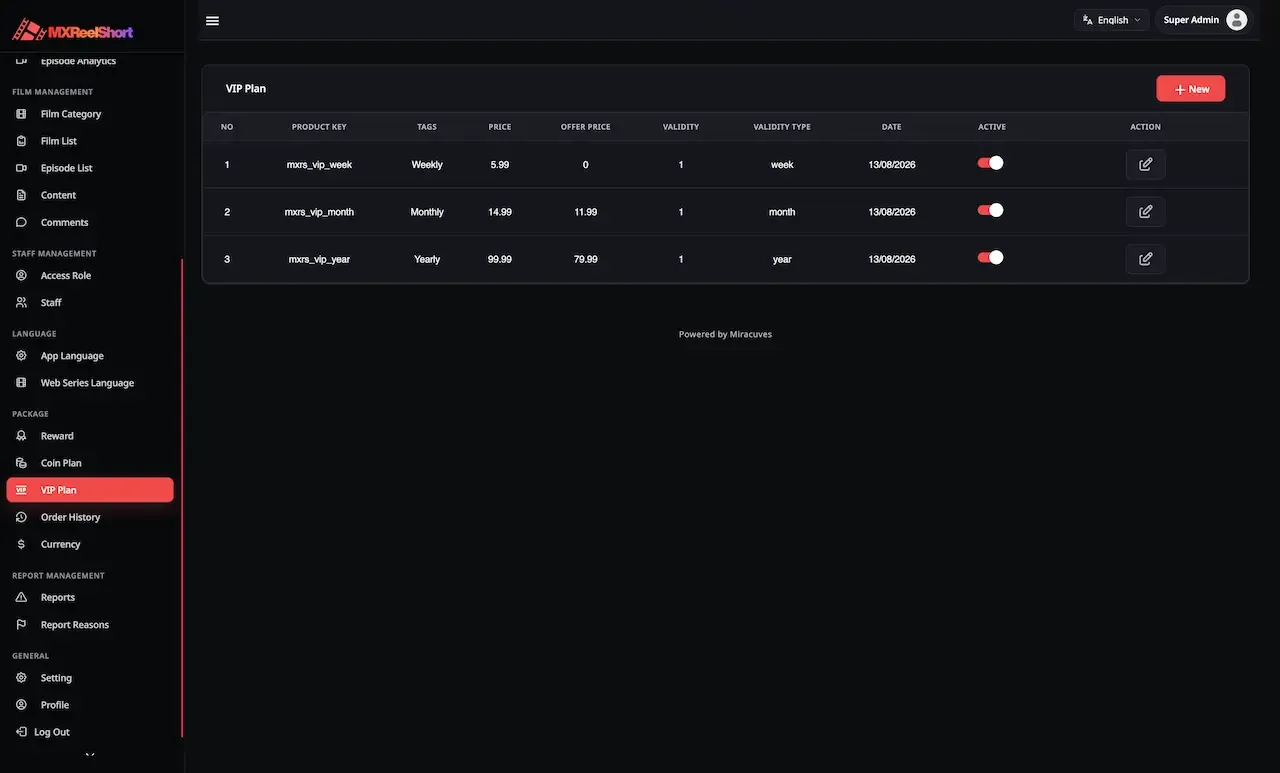
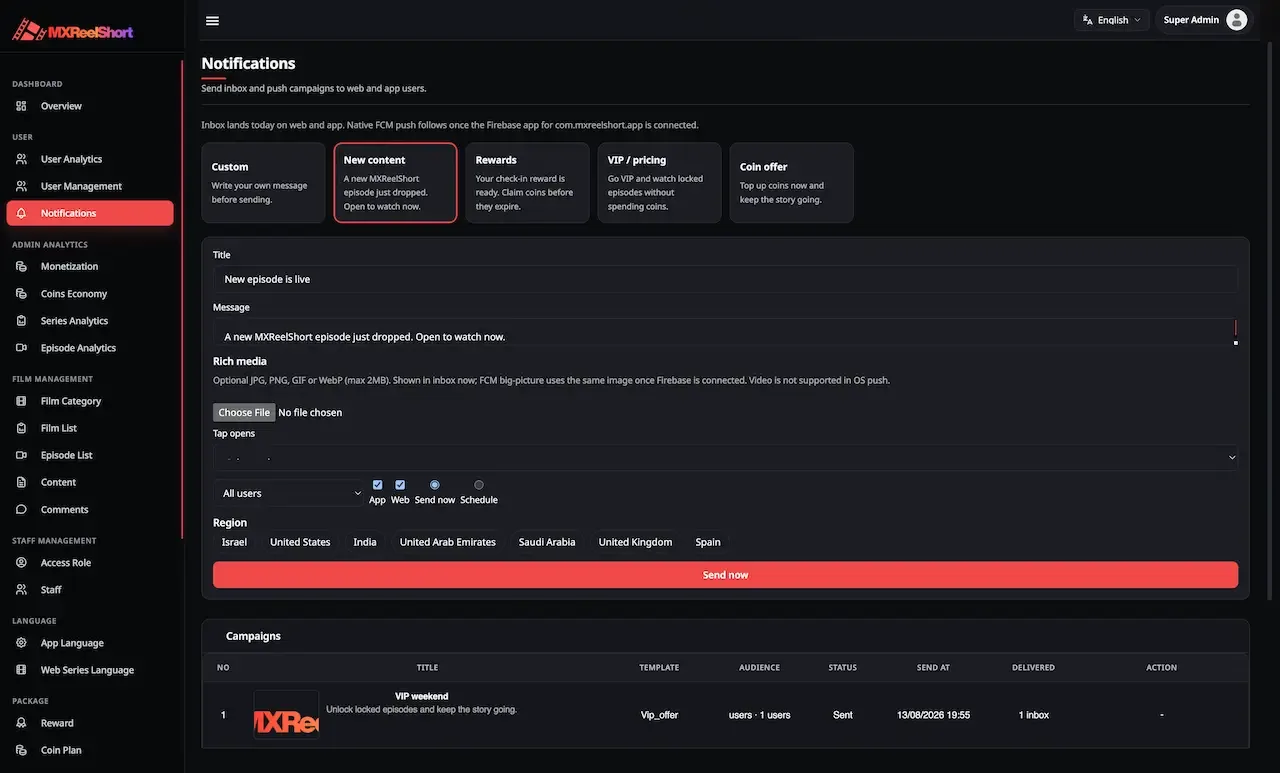
The demo runs the product end to end: a viewer app on the web and on Android, plus a view-only operator console. It carries our demo branding and a seed catalog of royalty-free stills, so use it to judge the unlock flow, the wallet and the console, not the content.
webuser@demo.comUser_$321admin@demo.comAdmin_$321webuser@demo.comUser_$32148 features across 4 roles.
A visitor without an account still gets a durable identity, so coins earned and titles saved are not lost when sign-up happens later.
Email and password registration works on both the web app and the store app, alongside guest entry.
A trailer lives inside the title as episode zero, so it plays, orders and targets exactly like any other episode.
Unreleased titles show an announce date on their own shelf and are kept out of every other rail until release.
A viewer can ask to be reminded about a title that has not released, which gives launch day a ready audience.
Dedicated browse tabs for Anime, Fandom and Interactive sit beside the main rails for viewers who search by taste.
An episode can branch on viewer choices, and a Choice Pass option sits alongside the auto-unlock that opens everything left in a title.
Several subtitle tracks and selectable audio tracks play from the files stored against each episode.
Higher quality playback is reserved for VIP members, which gives the pass a visible benefit beyond unlocking.
Gems are a second currency spent on gem-priced items, tracked apart from coins with their own history.
A Premium plan sits beside VIP plans and is defined the same way, by validity window and validity type.
A viewer can enter a redeem code that grants coins or VIP days, issued by the operator for campaigns.
Episode comments are limited to 400 characters, with likes and report buttons on every thread.
Each title is typed as a movie or a web series, which changes how its episodes and shelves behave.
Poster, banner and an auto-animated hero are switched on per title, along with trending, coming soon and active flags.
Region chips and dated license windows sit on each title, which makes catalog targeting part of the record itself.
Playback links are signed and expire, with geo rules applied, which limits casual sharing of raw file addresses.
VTT and SRT files upload against a single episode, with the language and format recorded beside them.
Dragging an episode to a new position renumbers the run and reapplies locks, so a re-cut never strands a viewer.
Each coin pack carries a store product key, tying the console record to the in-app purchase it represents.
Coin and VIP purchases each keep an order history the operator can review and reconcile.
Rewarded ad rewards are capped per title per day, and a midnight job resets the counters automatically.
Date-bounded counts, user and revenue charts and a paid revenue trend read straight from live operating data.
User lists and analytics can be filtered by country, which shows how each market behaves.
Revenue by series, top revenue episodes and coin figures are tied to the seven ledger codes behind every movement.
Tabs for general options, storage, payments, ads, languages, currency and the operator profile hold settings that would otherwise sit in files.
Policy pages and store links are managed as content in the console and rendered by the web app.
A role is a list of modules and actions, so an editor can create episodes without ever seeing the economy screens.
Each staff account is attached to exactly one named role, which keeps responsibility traceable.
Menu entries a role cannot use are removed, so staff are not shown screens that will refuse them.
The console signs a user out after one hour, which limits the exposure of an unattended screen.
The reasons a viewer can pick when reporting are written by the operator and appear in the app report sheet.
Marking a report solved sends a notice to the person who filed it, closing the loop without manual email.
Campaign templates are written once and reused, with the audience chosen separately at send time.
A job that runs every minute sends any campaign that has come due, inside the API process.
Each campaign shows what was sent and delivered, so message timing can be judged on evidence.
An inbox row is created for every targeted viewer, and device push is added only if you connect Firebase.
Staff can export an account, anonymize it or remove it permanently to answer a data request.
The store app plays episodes in an immersive fullscreen view designed for one-handed vertical watching.
Comments open in a sheet over the player so a viewer can read and reply without leaving the episode.
AdMob rewarded video runs on your own unit IDs, giving a viewer without coins a way to open an episode.
Purchases in the store app are charged and recorded on the server, and not by trusting the device.
A viewer can see who joined through their code and what each referral paid.
Daily and weekly quests list their progress and give a claim button when the target is reached.
Campaign messages arrive in an inbox inside the app, readable whether or not push is enabled.
A reminder set on a coming soon title is kept with the account and shown in the app.
Release builds block screenshots natively, a basic guard for catalogs under license.
The same build carries all five locales, so a language change needs no separate release.
A guest lands on rails, trailers and search without signing up, so discovery never waits on registration.
The first few episodes run with no charge. The window length is one operator setting and is the first number most owners test.
When the free window ends, the player lists every way forward: a rewarded ad, a VIP pass, or coins.
Each route writes the same unlock record. Coin spend draws reward coins before purchased ones, and the ledger records the movement.
An empty wallet leads to coin packs or VIP plans at hosted checkout, and the check-in ladder gives a reason to come back tomorrow.
| Revenue model | How it works | Who pays | How you earn |
|---|---|---|---|
| Coin packs | Viewers buy packs with bonus coins at hosted checkout or through store billing, credited to a balance that never expires. | Viewer | Margin on every pack, tuned through pack size, bonus and offer price |
| Episode unlocks | Coins are spent episode by episode, with the price attached to each episode, which lets a finale cost more than an opener. | Viewer | Coin spend recognized as the viewer opens each locked episode |
| VIP and Premium windows | A plan with a validity window opens locked episodes while it runs and unlocks HD playback for the member. | Viewer | Plan price for each window, repeated as members renew |
| Rewarded ads | Someone with an empty wallet can sit through a rewarded ad to open one episode, up to a daily limit set per title. | Advertiser, through your ad network account | Ad network payout per completed reward view |
| Gem items | Gem-priced items are bought with a separate balance, kept apart from coins in the wallet and the ledger. | Viewer | Spend on a second currency that you price independently |
| Coupons and codes | Redeem codes grant coins or VIP days and are issued for partnerships, promotions and win-back. | Operator, as a promotional cost | Reactivated viewers who then buy packs or plans |
| White-label licensing | Branding, plans and reward tables are settings, so one deployment model can be handed to another operator. | Licensed operator | License income that you negotiate with each operator |
Money enters the product as coin pack and plan purchases, and leaves the wallet as episode unlocks. With hosted checkout the processor collects the card, store billing covers in-app purchases where the platforms require it, and a typed ledger records every credit and debit. Reward coins are spent before purchased coins, so promotional balance is consumed first. Merchant accounts are yours, and we connect them to the gateway switches during delivery.
| Gateway | What it covers |
|---|---|
| Card | |
| PayPlus | Hosted checkout and the primary path, so no card number is written to your database. |
| Stripe | The server checks card purchases with the processor first, and only then are coins or VIP days credited. |
| Regional | |
| Razorpay | Regional gateway confirmed on the server in the same way before any credit is applied. |
| Flutterwave | Switch available in the console for markets where this processor is the local choice. |
| Other | |
| Google Play billing | Store billing switch for in-app coin purchases where store rules require their own billing. |
On the hosted checkout path the card is entered on the processor page, so no card number reaches your MongoDB. Stripe and Razorpay purchases are confirmed on the server first. You still need to complete each processor onboarding and keep your own merchant account in good standing, which is slower than most founders expect.
Uploads are judged by their first bytes, not their extension, and only image, video and subtitle formats are accepted. An executable, archive, PDF or markup file given a harmless-looking name is rejected before any handler processes it. This protects the server from careless uploads by staff, though it does not replace a review of what your editors publish.
The demo catalog is seed material with royalty-free stills, and nothing in it is licensed drama. Every title you stream is supplied or licensed by you, and rights in each market where you sell are your responsibility. Region chips and dated license windows help you enforce what the contract allows, but the contract itself is yours to negotiate.
Viewers file reports against comments using reasons you write, staff work the queue, and solving a report notifies the reporter. Comments can be hidden and accounts blocked from the console. Decide before launch who reads the queue, how fast, and what you do about content you are legally bound to remove.
The console can export an account, anonymize it or delete it permanently, which gives you a working path for access and erasure requests. Publish your own privacy and terms pages through the legal content editor. Which laws apply to you depends on where you operate, and we do not provide legal advice.
Apple and Google each ask for an age rating questionnaire, and answering it for your catalog is your call as the operator. Inside the app, a maturity label or content warning per title is configured with us. When a viewer flags a scene, the report queue, comment hiding, account blocks and region chips give staff a quick way to act on a takedown.
Staff permissions are checked on the admin API as well as in the menu, and an origin allow-list is in place. The product documentation still names stronger password hashing, request rate limiting, a persistent audit collection and a health endpoint as items to close. Ask for the current security reference and agree which to finish before launch, with scope confirmed with us at kickoff.
| Layer | Built with | Hosting note |
|---|---|---|
| Consumer web app | Vite, React, React Router | Shipped as static files that nginx serves itself, which keeps browsing and playback away from the API.One Node.js and Express service behind nginx under PM2, serving both the viewer and admin routers. |
| Operator console | Next.js 14, Redux, ApexCharts | A Next.js 14 application on its own subdomain, with charts drawn in the browser. |
| API | Node.js, Express, Mongoose | |
| Database | MongoDB | MongoDB with indexes on active titles, release date, ledger timelines and the unlock lookups. |
| Mobile apps | Flutter, GetX (iOS and Android) | |
| Server and jobs | nginx, PM2, node-cron | Node cron inside the API process resets ad counters at midnight and dispatches due campaigns every minute. |
| File storage | Eight providers, one active at a time, including local disk, AWS S3, DigitalOcean Spaces, Cloudflare R2, Wasabi and Bunny Storage | One active storage target chosen in settings: local disk, AWS S3 or DigitalOcean Spaces, among eight supported providers.Placed in front of your bucket as a deployment decision, since episode delivery is mostly bandwidth. |
| Proxy rules | The proxy answers not found for sensitive paths such as environment and repository files. | |
Each operator gets a single-tenant deployment: one database, one settings document, one pair of domains and one store binary. The stack is conventional Node, MongoDB and static web hosting, so any competent sysadmin can run it, and adding capacity means adding processes and bandwidth and not redesigning anything.
Selling a virtual currency inside a store app triggers the store billing rules, and those rules differ by platform, region and date. Treat the table as a planning aid rather than legal advice. Check the current policy of each store before you set prices, because the exact terms change and are theirs to decide.
| Where the sale happens | What to know | What the build gives you |
|---|---|---|
| Browser checkout on your web app | Outside the stores, so store billing does not apply, and your margin is set by the gateway fees alone. | Hosted checkout with several gateway switches, confirmed server-side before coins are credited. |
| Android store app | Digital goods consumed in the app generally need Google Play billing, with regional exceptions that change over time. | A Google Play billing switch ships ready, and a store product key is attached to each coin pack. |
| iOS store app | Apple generally expects in-app purchase for digital goods used inside the app, with limited and region-specific exceptions. | Apple in-app purchase comes with the iOS app, and the store products are set up together with you during delivery. |
| Coins bought on web, spent in app | The wallet is shared, so a balance can cross clients, but store policy may still limit how you advertise the web route inside the app. | One ledger and one unlock record serve every client, so ownership is identical everywhere. |
| Subscriptions and passes | A recurring pass sold inside the app is usually a store subscription, with its own review and renewal rules. | VIP plans by validity window exist, so confirm with us how each plan maps to a store product. |
| Store commission on sales | Where store billing is required, the store keeps a share of each in-app sale, which changes pack pricing. | You set pack prices and offer prices freely, so you can price the app and the web differently. |
| Account approval and review | Developer accounts, listings and reviews run on the store timeline, not ours, and a listing can be rejected. | Builds are prepared and submission help is provided, but acceptance is never guaranteed. |
Paid episodes are a target for copying, and no single control stops it. The honest approach is layers, each one raising the effort needed to copy, plus clear terms with licensors. Here is what ships, what we set up as a module, and what is left to you.
Buyers often ask whether AI can be added. Dubbing with translated subtitles is now a Plus module, while the other ideas below stay tailored work. We scope each one with you, and each depends on a provider you choose and pay.
| Idea | What it would do | What it depends on |
|---|---|---|
| Episode recommendations | Suggest the next title from watch history, replacing hand-composed shelves. | Enough viewing data and a ranking approach we scope with you. |
| Subtitle generation | Draft a subtitle file from the episode audio for staff to review. | A speech provider account, plus a human review step before publishing. |
| Dubbing and translated subtitles | Dubbed audio and translated subtitles can be offered for each episode, giving every character one voice while keeping the original. | The AI Dubbing + Subtitles module, with voice and translation vendors connected during delivery and a reviewer for chosen languages. |
| Comment moderation | Flag abusive comments before staff see them in the queue. | A moderation provider, and clear policy on what counts as abuse. |
| Search assistant | Answer a viewer description of a story with matching titles. | A language model provider and a clean catalog of plots and tags. |
Ready-made, one-time
$3,999
Live in 6 working days from kickoff
Playback quality adjusts to each viewer's connection, so phones on weak networks begin sooner and buffer less. Mux or Cloudflare Stream does the encoding on an account you hold, which we wire up during delivery.
Confirm with usPuts a license request ahead of each packaged stream for catalogs whose contracts demand it, after re-checking the lock, VIP status and region. We connect your Widevine or FairPlay provider during delivery.
Confirm with usPolls on which title earns another season, with free daily votes, extra votes for VIP members and purchasable vote props beyond the cap.
Confirm with usScheduled import of licensed titles from partner APIs, with imported series behaving like any other title in unlocks and analytics. Source priority and field mapping are set during delivery.
Confirm with usCreators you invite submit series in a web portal, and your staff approve every title and set each episode's coin price and commission. Earnings wait out a chargeback window, then pay weekly.
Confirm with usEach country can see its own prices and currency on coin packs, VIP and Premium plans, billed on the server through PayPlus, Stripe or Razorpay. We set up country detection during delivery.
Confirm with usFor each episode and language, a dubbed track and translated subtitles are produced, keeping one voice per character and leaving the original audio in place. Languages you flag wait for a reviewer, within a monthly spending cap.
Confirm with usRewarded video in the store app runs through AdMob under your unit IDs. We set the units, daily caps and reward sizes during delivery.
Confirm with usThe schema already models withdrawal methods, minimum thresholds and request records. We build the viewer request screen, a payout desk for operators and your bank connection during delivery.
Confirm with usCampaigns and the in-app inbox need no outside service. Notifications to devices go through a Firebase project you own, which we hook up during delivery.
Confirm with usBuyers of this category usually compare package tiers. This product has one package at $3,999, with most of the platform shipping ready and the rest set up around your plan, so the useful comparison is a plain matrix. Each row says whether the capability ships ready or is set up for you.
The count of open episodes is a console setting you can change without a release.
Every episode has its own coin price and lock, which allows a finale to be priced above an opener.
Coins, a pass or a rewarded ad open one lock, and auto-unlock covers the rest of a title.
Purchased coins and reward coins are tracked separately, and only the reward side expires.
Packs carry bonus coins, an offer price and a store product key.
Plans by validity period open locked episodes while the window runs.
A seven day ladder plus daily and weekly quests, all paid in coins you issue.
A second currency for gem-priced items and redeem codes for campaigns.
Episodes can branch on viewer choices, with a choice pass beside auto-unlock.
Sequential playback, comments, likes, subtitle tracks and selectable audio tracks.
The same wallet and catalog serve the browser and the store builds.
Scheduled messages reach an in-app inbox whether or not push is configured.
Role permissions checked on the admin API, a report queue and a view-only demo operator.
Hosted gateways, a Google Play billing switch and Apple in-app purchase ship, connected to your accounts.
A module we install that relies on an encoding service under your own account.
A module we set up that adds a license step, with your own Widevine or FairPlay vendor.
A module we set up for local prices and currencies per country on packs and plans.
A module we set up that pulls titles from licensed partner feeds at set intervals.
A module we set up for community polls on which title gets a next season.
A module for invited creators to upload series, with approvals, weekly payouts and identity checks on your rails.
A module for dubbed audio and translated subtitles per episode, with reviewer approval and a monthly cost cap.
Withdrawal data is modeled, and we build the request flow and payout rails to your market, with scope confirmed with us.
We scope ranking and personalization against the data and provider you choose.
We connect the web ad unlock to a live rewarded ad network of your choice, scoped together before delivery.
The software is the smallest line in a drama service budget. The parts that eat a build budget are a wallet whose balance always reconciles, one unlock rule that every client applies identically, and an operator console, while the player itself is quick to produce. Your real spending lands on catalog rights, encoding and subtitling, bandwidth, merchant accounts, store fees and the people who moderate. When you compare routes, compare what each leaves you to build or buy afterward, and not only the invoice at the start.
| Factor | Scratch build | SaaS | GetFame |
|---|---|---|---|
| Time to launch | Long, because wallet, unlock model and console come before the first viewer | Quick to start, bounded by the plan you rent | 6 working days with this platform |
| Wallet and ledger | Designed and debugged by your team | Provided, but rules are the vendor rules | Two balances and a typed ledger already in place |
| Source code | Yours, since you wrote it | Not available | Full source for all clients |
| Pricing control | Total, once you build the settings | Limited to what the vendor exposes | Free window, episode price and rewards are settings |
| Revenue share | None | Often a fee or share on top of the plan | None to us, with no per-seat fee |
| Store apps | Built and maintained by you | Sometimes a shared or branded app | Flutter app under your listing, with publishing help |
| Exit options | Full control of your stack | Content and users sit with the vendor | Standard MongoDB you can move |
Running costs. Running costs sit outside the price: hosting and bandwidth, payment processing fees, ad network terms, Apple and Google developer accounts and any store commission on in-app coin sales, encoding and subtitling, and the staff who moderate. Catalog rights are the largest variable and are never ours to quote.
The visible parts of a drama app are easy to sketch. The expensive parts are the ones a viewer never sees: an unlock rule that every client agrees on, a ledger that can explain a single spend, and an operator console. Here is how each module compares when you build it and when you start from a finished product.
Build it yourselfA shared access rule across web, mobile and console, tested against refunds, reorders and mixed entitlements. A team effort over many weeks.
Ready-madeOne rule decides access at read time, and every unlock route writes the same record.
Build it yourselfTyped credits and debits, expiry handling and double-charge protection, usually the slowest module to make trustworthy.
Ready-madeTwo balances with a typed history, spending reward coins before purchased coins.
Build it yourselfEach processor needs its own integration, signature checks and server-side confirmation before any credit is issued.
Ready-madeHosted checkout and several gateway switches ship, verified with the processor before coins are credited.
Build it yourselfA swipe-based player with comments, tracks and resume points on both web and mobile, built twice or via a shared framework.
Ready-madeA web player and a Flutter player with subtitle and audio tracks already working.
Build it yourselfForms for categories, titles and numbered episodes, plus a safe reorder that keeps paid unlocks intact.
Ready-madeCatalog modules with drag reorder that renumbers and relocks the episodes.
Build it yourselfStreak logic, caps, midnight resets and referral crediting, each with its own abuse cases to study.
Ready-madeCheck-ins, quests, ad tasks and referral rewards configured in four console tabs.
Build it yourselfRole design, per-module grants and enforcement on the server rather than only in the menu.
Ready-madeNamed roles with grants by module and action, enforced on the admin API, plus a view-only demo operator.
Build it yourselfTemplates, audience selection, a scheduler and an inbox, usually bought as a separate messaging service.
Ready-madeTemplates, scheduling and delivery statistics with an inbox row for every targeted user.
Build it yourselfTwo native codebases or one cross-platform build, plus store accounts and review cycles to manage.
Ready-madeA Flutter build for both stores, with publishing help during delivery.
Build it yourselfExport, anonymize and delete flows, often left until a regulator or a customer asks.
Ready-madeOn request, an account can be exported, anonymized or deleted from the console.
ReelShort is widely known as a vertical drama app where early episodes are free and later ones are paid with coins, with passes and rewards alongside. This table compares that general model with what you receive here. It describes the pattern and not the private workings of any company.
| Aspect | The ReelShort model | This platform |
|---|---|---|
| Who sets the rules | The company that owns the app decides pricing, pacing and policy | You set the free window, coin prices, plans and reward tables |
| Catalog source | Content comes from its own pipeline of productions and licenses | You produce or license the titles and publish them from the console |
| Brand and audience | Viewers sit inside the brand app and its accounts | Viewers sign up under your name, on your domain and store listing |
| Unlock options | Coins, passes and ad-based rewards are common in the model | Three ways into the same episode: coins, a VIP window or a rewarded ad |
| Data and ledger | Held inside the company systems | In your MongoDB, with a typed ledger you can query |
| Customization | Fixed by the owner roadmap | Source code is yours to change or extend |
| Cost to enter | Not available as a product you can buy | One-time platform price of $3,999 plus your own running costs |
Sell your own vertical series by the episode, tune the free window weekly and see which titles convert.
Build a coin-first service for viewers who will pay for the next three episodes but not a monthly plan.
Let viewers without budget open episodes through rewarded ads while buyers still pay in coins.
Ship a store app, web companion and console that agree on what every viewer owns.
Add a vertical drama service with runtime branding, staff roles and legal pages ready.
The same wallet supports quite different businesses. These launch ideas show who pays, what they pay for and which setting to touch first, so that your first week of configuration has a clear purpose.
A production company sells its own vertical series directly instead of licensing them to a larger app. The audience pays per episode or with a pass. Configure the free window first, then tune episode prices by comparing where viewers stop. Keep the first slate small so every title gets a proper trailer and subtitle track.
An operator serves one language community that larger apps treat as an afterthought. Viewers pay in a local currency through a rail they trust. Configure the default locale, currency and gateway first, then add coin packs sized to local spending habits. Right-to-left languages are already supported across clients.
A publisher wants to reach viewers who will not spend yet. They open episodes with rewarded ads on the store app and convert later into coin buyers. Configure the per-title ad cap and the check-in ladder first. Connect your own ad network account, because the web preview does not earn revenue.
An established brand with an audience adds a drama service beside its existing products. The audience already trusts the name, so a pass window may sell better than coins. Configure plan validity periods and the legal pages first, then use the campaign desk to announce releases to existing readers or viewers.
A distributor holds rights to many titles across territories and wants a storefront that respects them. Viewers pay per episode. Configure region chips and dated license windows before publishing anything, so a title never appears where it should not. Add the import module if the library arrives through partner feeds.
An agency deploys branded copies for several clients, each with its own wallet and catalog. The client pays for a ready service instead of an engineering project. Configure branding and plans per deployment first, and agree early who owns the merchant and store accounts for each copy.
People searching for a ReelShort clone are usually choosing between several routes, not only between vendors. The options below differ in who owns the audience, who owns the code and how much of the economy you can change. None is better in the abstract; each fits a different operator.
Consumer drama app
A studio that wants distribution and is content to be one title among many on a large app.
You do not own the audience, the wallet or the pricing rules.
Consumer drama app
Producers who want reach in many languages through an existing multilingual shelf.
Same trade as any aggregator: the brand and the viewer relationship belong to the app.
Consumer drama app
Content owners testing demand before committing to a platform of their own.
Terms, placement and revenue arrangements are set by the app, not by you.
Subscription video SaaS
Creators selling a monthly plan on a hosted site with little technical work.
Built around subscriptions, so per-episode coins and rewards are usually missing.
Bespoke development
Teams with unusual requirements and the budget and calendar to shape every detail.
Slowest route, and the wallet and ledger are the hardest parts to get right.
A white-label platform sits between a hosted builder and a bespoke build. You own the code, the domain and the wallet, you set every price, and you carry the work a consumer app would otherwise do for you: acquiring viewers, licensing stories and running store accounts. It suits operators who would rather own the economy than rent distribution.
Start from the catalog and not from the app. A coin economy only works when there is a story good enough to make a viewer spend at episode four, so line up a small set of titles whose first minutes hook fast and whose rights you can prove. Fifty well-chosen series will teach you more than a thousand uneven ones.
Then set a deliberately simple economy: one free window, one price per episode, two or three coin packs and one VIP plan. Resist adding gems, Premium plans and coupons in week one. Every extra lever makes it harder to see which one moved revenue, and you can switch the others on once you have a baseline.
Finally, plan for the first month of operations as well as the launch. Decide who watches the report queue, who answers purchase disputes from the wallet history, and who reviews series revenue every week. A small team with those three routines will outrun a larger one improvising.
The free window is the first number most owners test, because it controls how many viewers reach the lock and how invested they are when they do. Too short and viewers leave before caring. Too long and the people who would have paid are already satisfied. Begin with a few episodes and move it in small steps.
Price per episode is more flexible than it looks. Because the coin price is stored on each episode, you can charge less for the first locked episodes to ease the first purchase, and more for a season finale where the pull is strongest. Back catalog titles can be discounted without touching new releases.
Change one variable at a time and give each change a few days before judging it. The console reports revenue by series and by episode, so you can see where viewers stop paying. If a title loses people at one specific episode, the answer is usually the story or the price at that point, and not the whole model.
These three routes serve different people. Coins suit the impulse viewer three episodes into a story late at night. VIP suits the heavy watcher who dislikes counting coins. Rewarded ads suit the viewer who will never pay but is still worth something to you. Running only one leaves the other two groups unmonetized.
The risk is cannibalization. A viewer who would have bought a pack may watch an ad instead, so keep the daily cap per title tight at launch and loosen it only when you can see ad income and coin income as separate lines. Plan launch ad income around the store app, and if web viewers matter, have us connect the web unlock to a live network.
Treat reward coins as a marketing budget, not as revenue. They expire on a window you set, they are spent before purchased coins, and they exist to bring someone back tomorrow. Set the expiry window before launch, because changing it later affects balances people already hold and invites complaints.
Ask to see the lock screen working on every client, with real coins moving. A common failure is a web demo and a store app that disagree about what a viewer owns. Here a single unlock record is read by all three clients, so test it: unlock on the web, then open the same episode in the app.
Ask what is still to be set up for your launch and read the answer carefully. For this product the list covers connecting the web ad unlock to a live network, viewer cash-out that we build around your market, and hardening we complete with you, such as password hashing, request rate limiting, an audit collection and a health endpoint. A seller who volunteers these is easier to trust than one who does not.
Finally, check who owns what after delivery. You should receive the full source for every client, the schema, the API collection and the right to deploy anywhere. Confirm the support window, the update term and how tailored work is scoped, then price your own content and running costs, which will dwarf the software.
As published by Miracuves, our parent company.
Miracuves reports 4.8 out of 5 from 78 reviews for its ReelShort Clone App. View rating source on Miracuves.
Coin unlock is the whole business. Viewers who would never take a monthly subscription will happily pay for the next three episodes at midnight.
We ran the free window at three episodes for a month, then five. Being able to move that number from a settings screen rather than a release changed how we test pricing.
The demo console sold it. Handing a prospect a live admin login that physically cannot write anything is not something our previous vendor could do.
Right-to-left was the requirement that eliminated every other option we looked at. Here it was already in the web app, the store build and the console.
v2026.6Oct 2026
v2026.5Sep 2026
v2026.4Sep 2026
v2026.3Sep 2026
v2026.2Aug 2026
The ready-made white-label platform costs $3,999 one time and goes live on your server in about 6 working days. The final quote can shift with the size of your catalog, the gateways you pick, how ads are set up, your storage and CDN, and how much store publishing you want. Tailored work typically takes 2 to 8 weeks depending on what you add.
Four checks run each time an episode is requested: is the episode flagged as locked, is its number within the free window, has the viewer got a VIP window that has not lapsed, and is there already an unlock record for this viewer. Coins, a rewarded ad or the auto-unlock option each create that one record, so ownership matches on every client.
Reward coins come from check-ins, quests, ads, referrals and bonuses, and they expire after a window you configure. Purchased coins come from coin packs and never expire. Spending uses reward coins first, so promotional balances are consumed before money the viewer paid. The app shows a single combined total.
On the Flutter store app, yes, through AdMob with your own unit IDs, which we connect during delivery. On the web app, the ad unlock ships as a timed preview of the flow, and linking it to a live ad network is tailored work, scope confirmed with us.
PayPlus hosted checkout is the primary path, with Stripe and Razorpay also supported and verified on the server before any credit is applied. Flutterwave and store billing switches are present as well. Gateway switches and keys are managed in the console. You provide the merchant accounts, and we connect them during delivery.
Yes. Seven Plus modules are available: adaptive streaming, DRM protection, season voting, content import through partner APIs, regional pricing, creator payout compliance and AI dubbing with subtitles. Scope is confirmed with us at kickoff. None of them is needed to launch: coin unlock, VIP windows, rewarded ads, the rewards ladder and the console all ship ready. They are delivered as their own folders, so your copy contains the modules you choose.
Yes. This is a white label ReelShort clone with source code: you receive the consumer web app, the operator console built on Next.js, the API on Express with its Mongoose models, the Flutter app, the seed script and deployment configuration, with no per-seat fee and no revenue share. You can modify, rebrand and redeploy all of it.
Yes. Building a platform with a similar model is lawful; using ReelShort's name, logo, content or code is not. You launch under your own brand with a catalog you own or license, and the software holds no code, design or content from any existing app. We are not affiliated with ReelShort. Rights and compliance in each market stay with you, so read our disclaimer page at /disclaimer/. This is not legal advice.
Five locales ship: English, Hebrew, Hindi, Arabic and Spanish. Hebrew and Arabic use right-to-left layout across the web app, the store app and the console, and the console includes an editor for client copy so wording changes do not need a rebuild.
An open source ReelShort clone can be a fair starting point for a team that wants to build the missing parts itself, but you assemble hosting, payments, store apps and security on your own, with no one to call. The ready-made ReelShort clone app ships the web app, console, API and Flutter app as one codebase, with 60 days of technical support and 1 year of updates. Choose the ready-made route if you want coin unlocks, VIP windows and the console working on day one.
Yes. The wallet and the unlock record sit in one database that the console, the web app and the store app all read, so coins bought in one place can be spent in another. A viewer who unlocks an episode on the web finds it already open in the mobile app. Store billing rules can still affect where you choose to sell coins.
Reward coins carry an expiry window that you configure, and the wallet applies the expiry before any credit or spend. Purchased coins do not expire. Because spending draws reward coins first, promotional balance is consumed before the money a viewer paid. Choose the window before launch, since changing it later touches balances already issued.
Yes. The consumer web app is a static build that works on its own, and the console and API do not depend on the store app. Many operators validate pricing on the web first and publish the Flutter app later. Rewarded ads earn only through the store app, so that income waits for the app.
Gateway switches and keys are managed in the console for the ones that ship, and a new gateway means an additional switch, keys and a route. That is development work we scope with you. Each processor also needs its own merchant account and approval, which usually takes longer than the code.
Categories are genre buckets, titles belong to them, and episodes belong to titles. Reordering episodes renumbers them and relocks them automatically. Existing unlock records stay attached to the viewer and the episode, so people who already paid keep access after a re-cut.
Shelves are assembled by the operator from banner, trending, new release, coming soon and category rails, and For You trailers are grouped by title. Ranking is editorial today, and we can build personalization as tailored work. The series analytics help you decide which titles deserve front placement.
Version 2026.6, from October 2026, brought two more Plus modules: AI dubbing with translated subtitles, and Creator Payout Compliance. Series and episode titles now carry all five languages with auto-translate, and the mobile app moved to 1.1.4. Earlier waves added five other Plus modules and staff permissions enforced on the admin API. Both new modules are paid, and scope is confirmed with us.
Yes, with the Creator Payout Compliance Plus module. Invited creators upload through a web portal, your team approves each title and sets the coin price and commission per episode, and earnings clear a chargeback window before weekly payouts. Identity checks and payout rails run on your own accounts, connected during delivery. Without the module, your staff publish every title from the console.
The deployment is yours: standard MongoDB, Node services under PM2 and a static web build, with storage you can repoint to another provider. Moving means copying the database and media and updating configuration. Nothing in the code ties it to our infrastructure, and your support and update terms continue.
Not for sales that happen outside the store apps, such as a checkout on your own website. Inside a store app, digital goods like coins generally fall under the store billing rules, with exceptions that vary by region and change over time. Read each store policy before launch, price the app and the web separately if you need to, and take advice for your market.
Yes. The iOS app is delivered with Apple in-app purchase, alongside the Google Play billing switch and a store product key on each coin pack. We create the store products with you during delivery. Apple reviews each app and its purchases, so allow for review time in your launch plan.
Use layers. The access rule checks every request, playback links are signed and expire, titles carry territory and license windows, and release builds block screenshots. DRM and adaptive streaming are modules we set up for catalogs that need them. No control stops a determined copier, so agree realistic expectations with licensors and plan takedown handling.
No. You receive a platform that follows the common drama pattern under your own name, with none of the brand, design assets or content of any existing app. The product is not affiliated with ReelShort. You supply your own catalog, licensed or original, and you are responsible for the rights to every title you publish.
AI dubbing with translated subtitles is already a Plus module, with a review step and a monthly cost cap. Recommendations are tailored work, because you own the source and the stack is ordinary. Each depends on a provider you contract, so cost per use is yours. We confirm scope with you.
Media goes to one of eight supported storage providers, picked in settings and switchable later, among them local disk, Amazon S3, DigitalOcean Spaces, Cloudflare R2, Wasabi and Bunny Storage. The platform plays stored files as they are. If you want adaptive bitrate playback, we set up a streaming module that uses an encoding service on your own account.
Yes. You receive the full source for the web app, console, API and mobile app, so your own engineers or ours can extend it. Optional modules can be switched on and off at runtime without losing their data. Bigger changes are scoped as tailored work, and a year of free updates covers the maintained product.
The decision is small and arrives at a moment of high interest. A coin asks for the next few minutes of a story the viewer already wants to finish, while a subscription asks about next month. That is a behavioral pattern, not a promise of results. Your own free window and price tests will show how your audience responds.
The package includes a consumer web app and a Flutter app for the stores. The release log names an Android build and an iOS TestFlight build, and publishing help is part of delivery. Store acceptance and review timing are decided by Apple and Google, so start the developer accounts early.
It shows a steady run of updates since the first release in August 2026: payment verification and upload checks, then gems, quests and richer subtitles, then mobile builds and Plus modules. The October 2026 release added AI dubbing, creator payout compliance and titles in five languages. It does not promise a roadmap. You receive the current build, and a year of free updates applies to the maintained product after delivery.
Either works, and many operators mix the two. Original series carry no licensor to pay, while licensed titles widen the shelf faster, and region chips with dated license windows keep each one inside the territories its contract allows. The demo titles are seed material only, so every drama you publish is produced or licensed by you.
Yes. Many operators launch a ReelShort alternative by narrowing the idea to one genre, one language market or one audience, with their own catalog and coin prices. The platform treats branding, locales, plans and prices as settings, so a focused alternative is mostly catalog work. You license or produce the titles, and we deploy and brand the platform for you.
→Start here
Share the platform and your market. You get a walkthrough of the live demo, the exact scope of what ships, and a fixed price in writing. First response in under 2 hours, Monday to Saturday, 10:00 to 19:00 IST.
This page uses the name ReelShort to describe a type of platform. The product sold here is separate software, built independently, and ReelShort has no part in it.
"ReelShort clone" is industry shorthand that founders use when searching for software with a comparable business model. It names a category of product, not a copy of ReelShort.
The platform is an original product designed and written by Miracuves. It contains no code, design, graphics or content originating from the ReelShort website or applications, and it ships under your own brand.
ReelShort and its logos are trademarks of their respective owner and are named here for reference only. GetFame is not affiliated with, sponsored by or endorsed by ReelShort. Rights holders can write to legal@miracuves.com.
Operator responsibility. The operator of a launched platform is responsible for legal compliance in the markets it serves. Nothing on this page is legal advice.Read the full disclaimer
First response under 2 hours, Mon-Sat 10:00-19:00 IST
India+91 98300 09649 United States+1 516 202 3950