Ready-made, one-time
$3,999
ShortMax Clone
Live in 6 working days from kickoff
- Full source code
- White-label under your brand
- 60 days of technical support
- 1 year of free updates
- App publishing support
Micro drama app
Win the returning viewer with rewards and campaigns you control
A white-label micro drama app for operators whose hardest number is the cost of getting a viewer to come back. The check-in streak, quests, referral loop and a scheduling campaign desk are built in, and all of them pay out in coins you issue. Viewers still unlock episodes with coins, a rewarded ad or a VIP pass.
The facts a buyer checks first, in one place. Everything on this page is the product as it ships.
| Product type | Micro drama app built around rewards, referrals and campaigns |
|---|---|
| Retention tools | Seven day check-in ladder, quests, referral loop and an in-platform campaign desk |
| Clients included | Viewer web app, Flutter apps for iOS and Android, and an operator console |
| Reward currency | Coins you issue, with expiry on promotional balances |
| Price | $3,999 one time, no revenue share |
| Launch time | 6 working days from kickoff |
| Source code | Full source code, yours to modify and redeploy |
| Messaging | In-app inbox included, device push through your own Firebase project |
| Payment gateways | Hosted PayPlus checkout plus Stripe, Razorpay, Flutterwave and Google Play billing switches |
| Support and updates | 60 days of technical support and 1 year of free updates |
A ShortMax clone is a micro drama streaming platform whose retention tools are shipped modules, not integrations you buy later. A viewer earns coins by checking in, finishing quests, watching ad tasks, following social accounts or inviting friends, then spends them on the next locked episode.
Every earn and spend writes a typed ledger row, which lets the console report an economy and not just a balance. Reward coins expire on a window you set, and spending always uses them before purchased coins, so promotions never eat into money a viewer paid.
The campaign desk covers the other half of retention. You pick a template and an audience, schedule a message, and read delivery stats afterwards, with an in-app inbox row written for every recipient. You provide the catalog and accounts, and we brand, deploy and connect the platform for you.
ShortMax is a consumer short drama app, usually described as one that mixes paid unlocks with ways for viewers to earn access: daily check-ins, watching ads and inviting friends. We describe the pattern in general terms and make no claims about the inner workings of the brand. The common thread is that returning viewers are rewarded in coins the operator creates, so retention is bought with inventory instead of media spend.
A ShortMax clone, as meant here, is a short drama platform built around that retention loop. The reward ladder, the referral credit, the campaign desk and the ledger are the product, and the player and catalog sit around them. It suits operators whose real constraint is the cost of getting a viewer to come back, rather than the cost of making a video play.
Each role works in its own side of the same product. The screens come from the working demo.
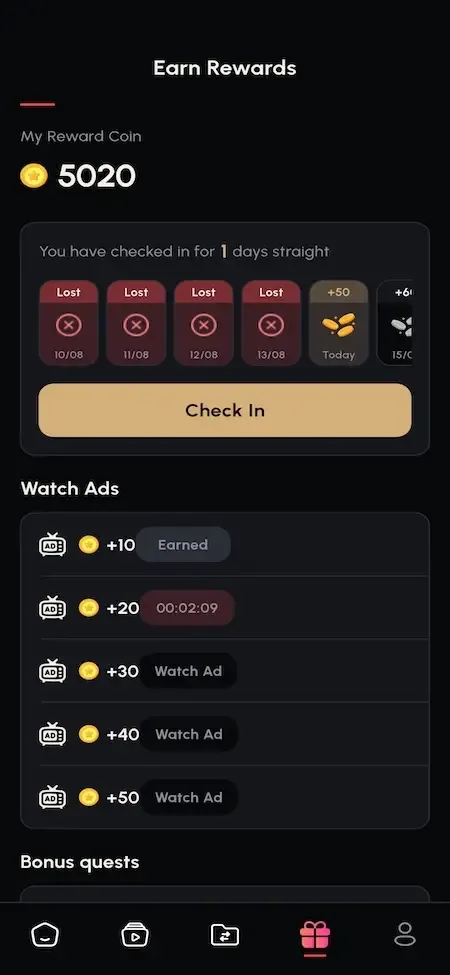
The habit loop is a set of settings, not a marketing project. A viewer checks in, completes a task, invites a friend or follows a social account, and each action pays in coins the operator mints. The console sets what each action is worth.
Bringing people back needs a way to reach them. The campaign desk lets the operator write a message once, choose who receives it, schedule it, and read the results, all inside the platform and with no third-party messaging contract.
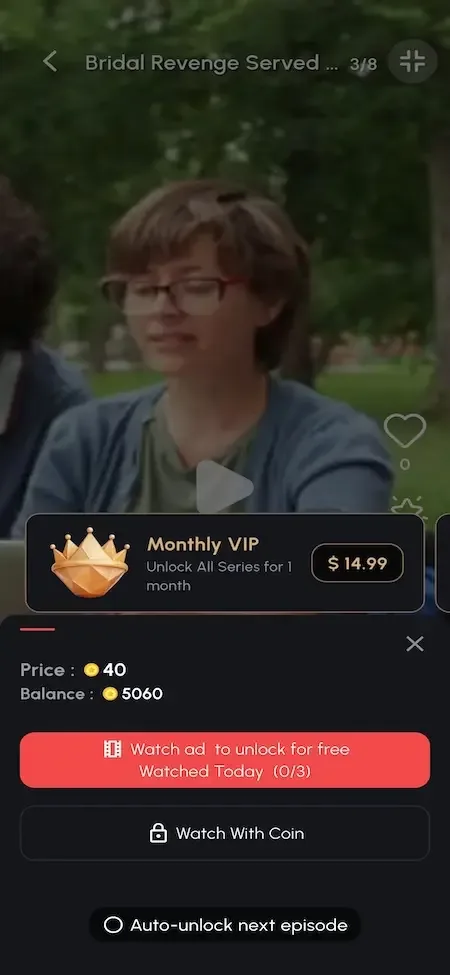
For the viewer, retention features feel like a reason to open the app each day. Between those visits they watch free episodes, hit a lock, and choose between coins earned, coins bought, a rewarded ad or a VIP pass.
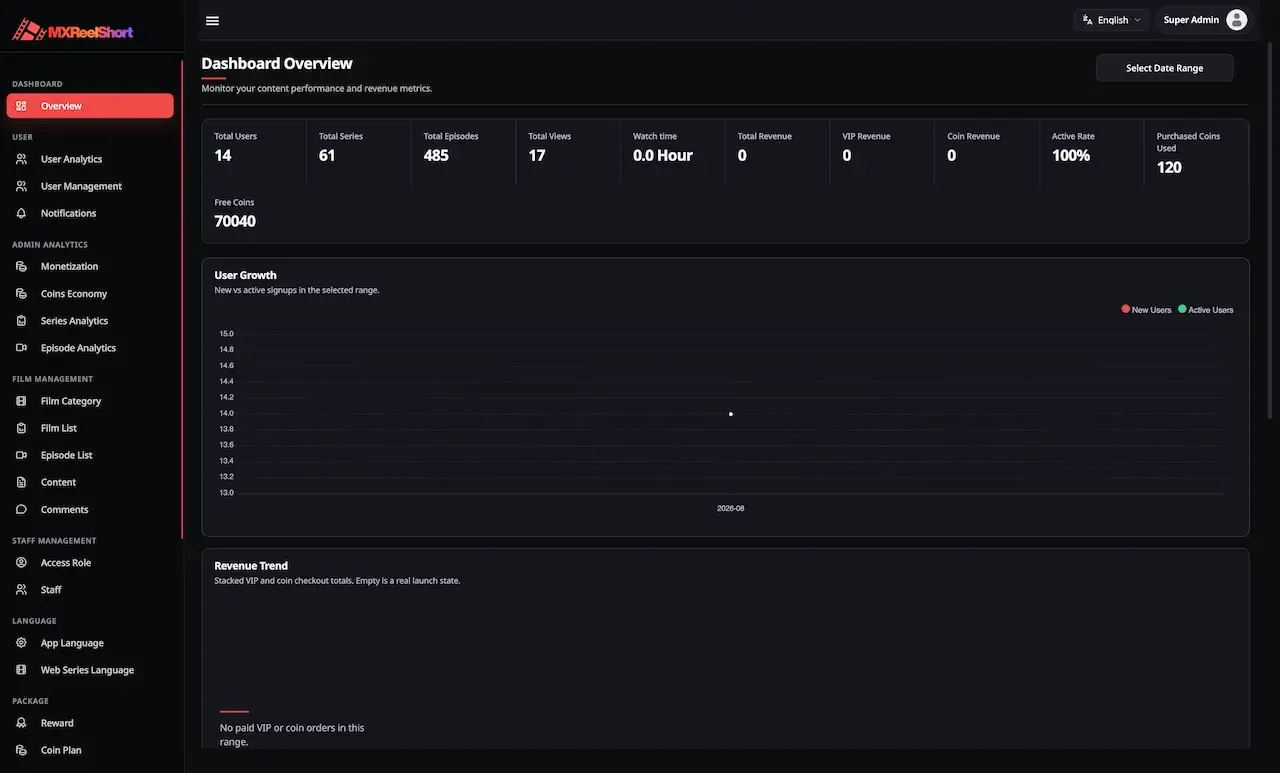
Operators decide how generous the loop is. Four reward tabs hold the numbers, ledger analytics show the cost, and wallet tools let support fix mistakes. Moving a number is a console edit, and the next viewer sees it immediately.
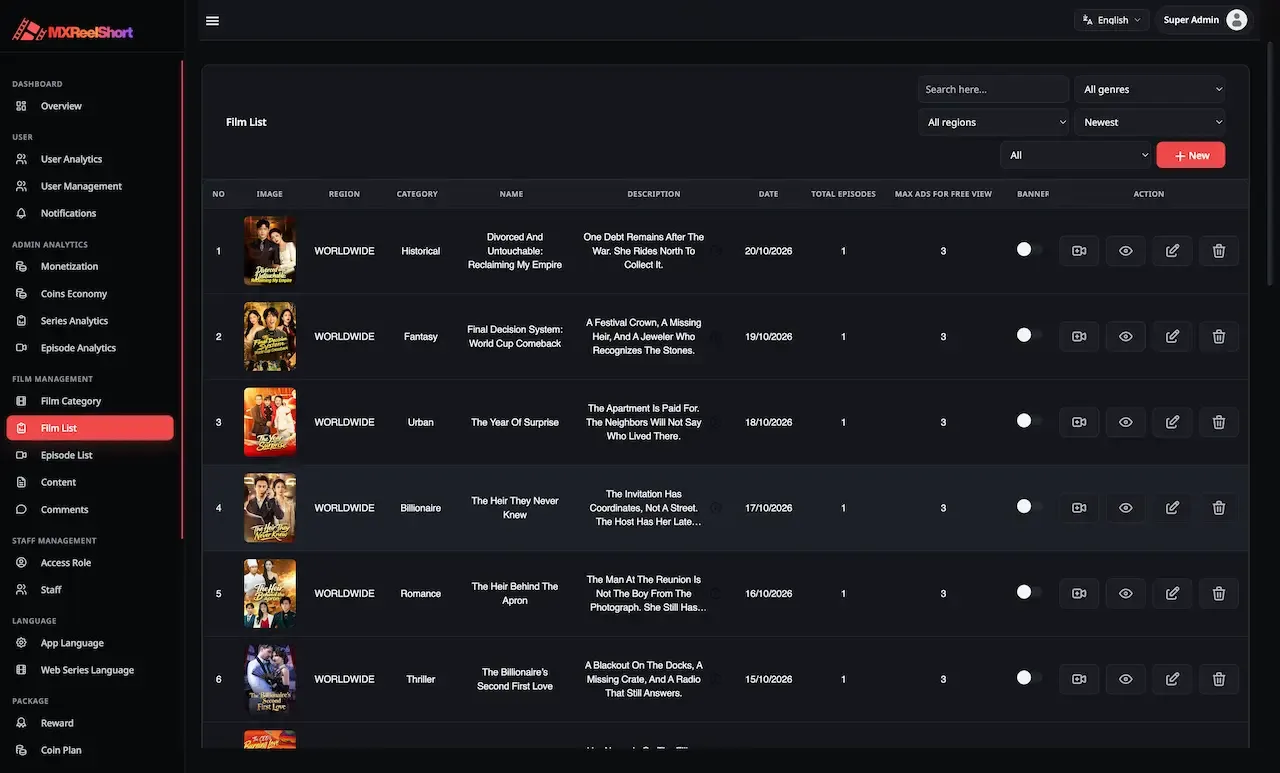
14 screens from the working demo, grouped by where they live. Your platform ships rebranded with your name, logo and colors.
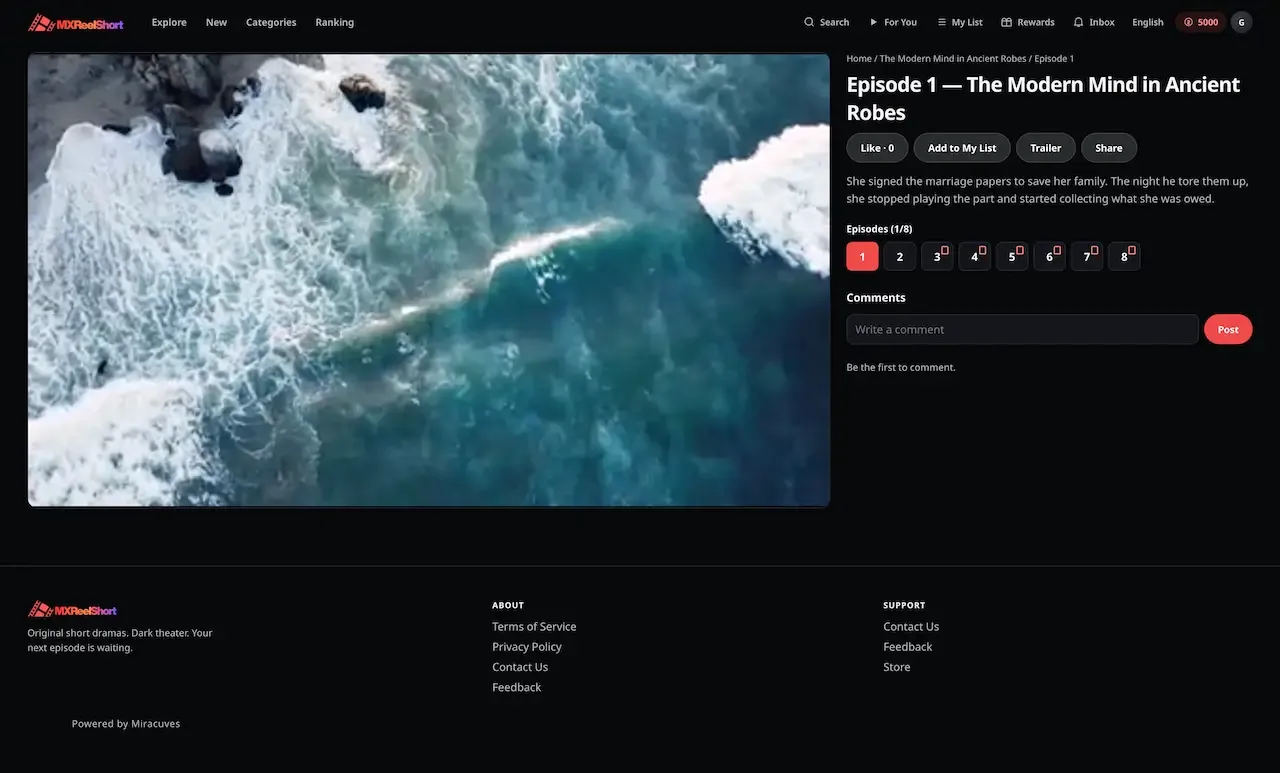
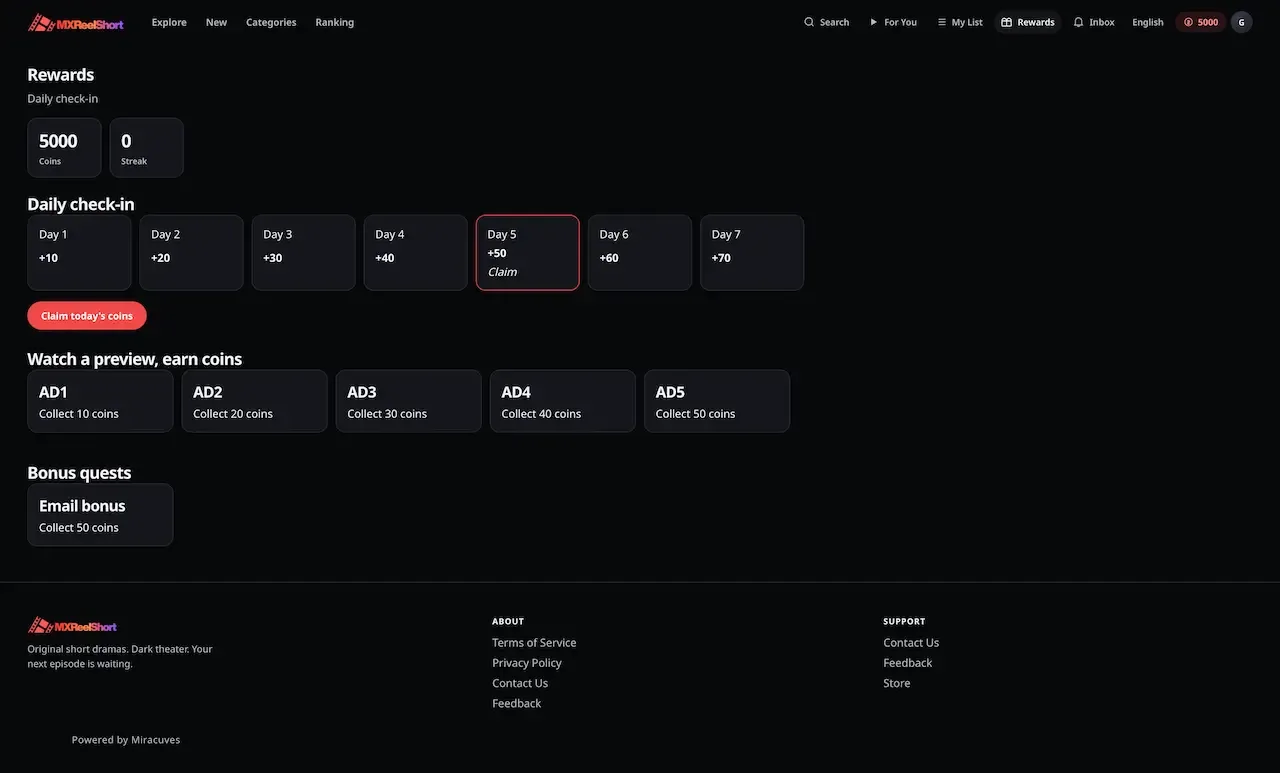
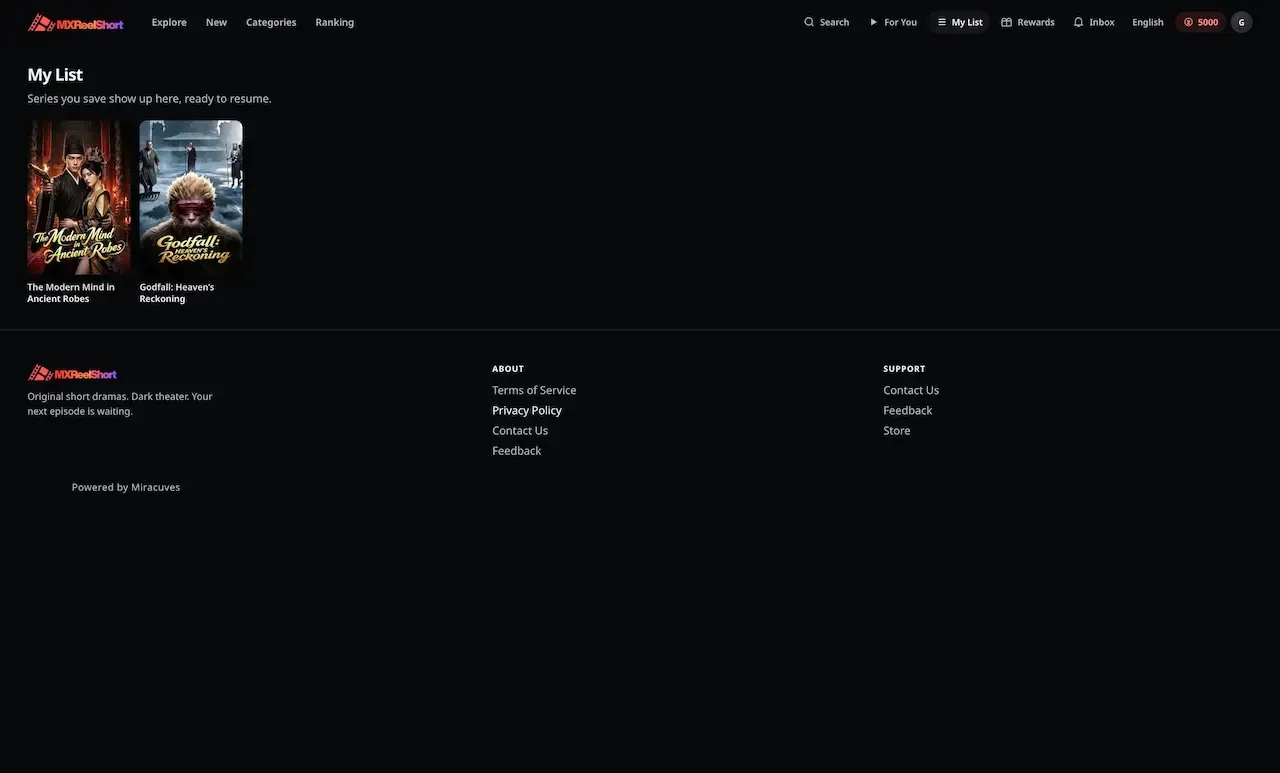
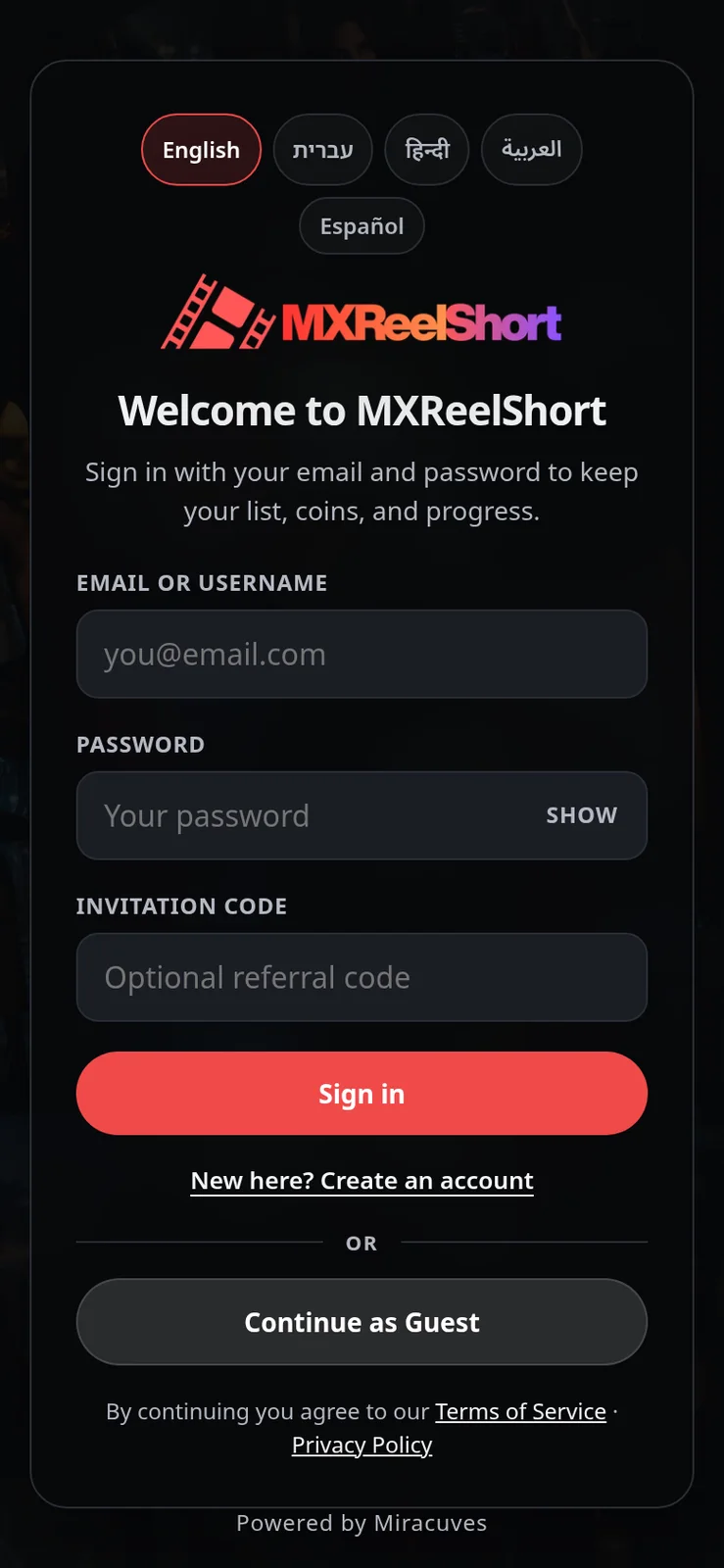
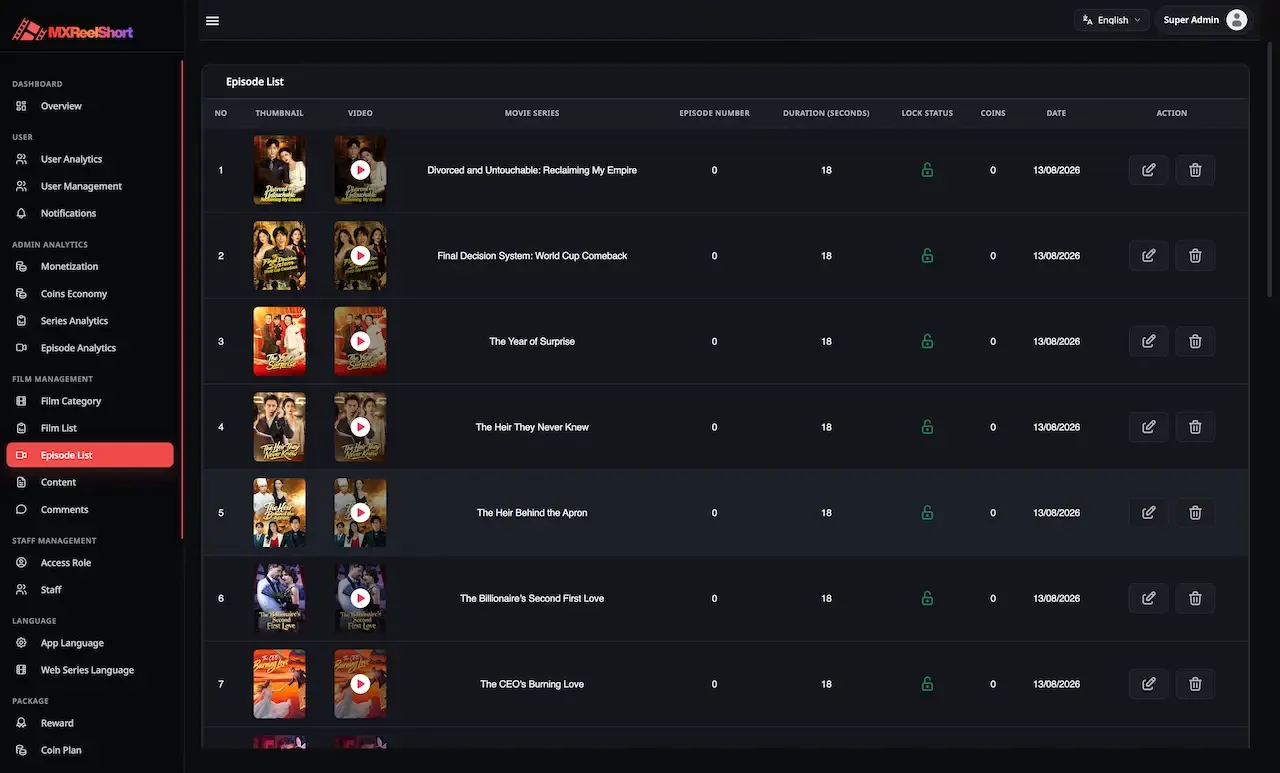
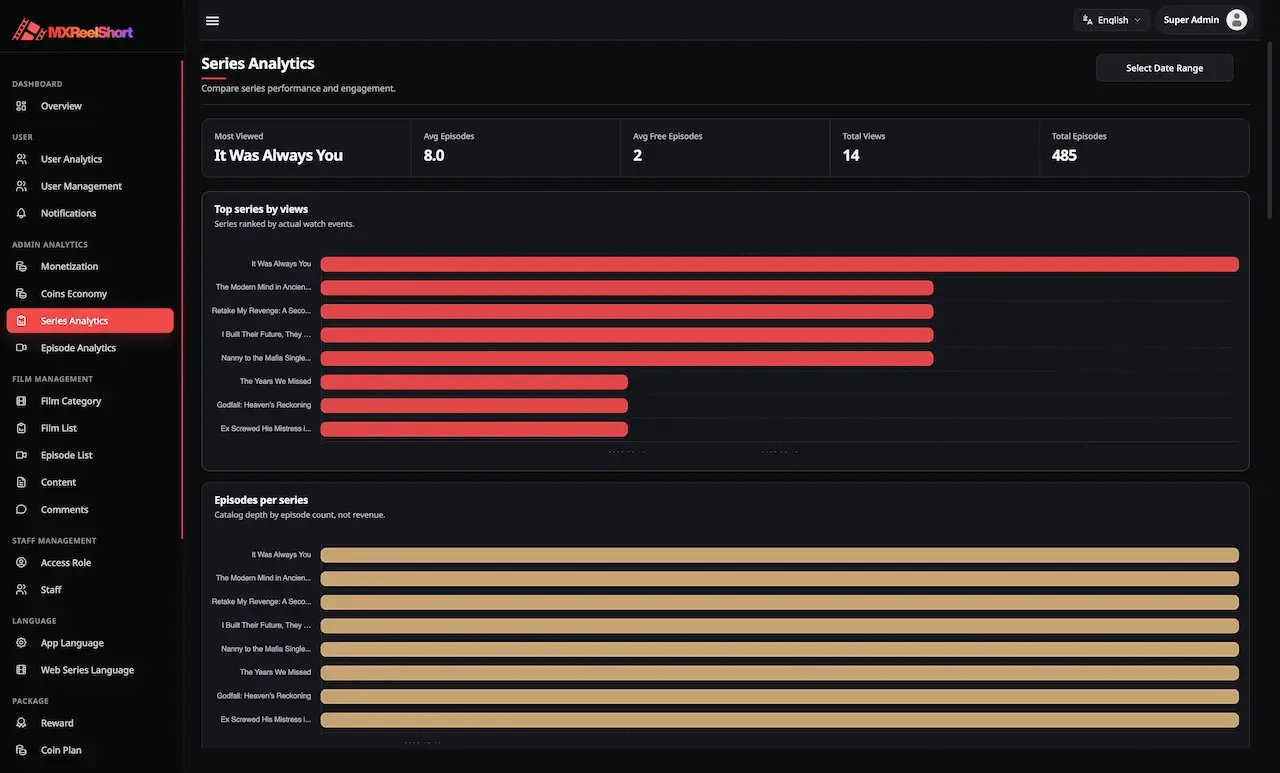
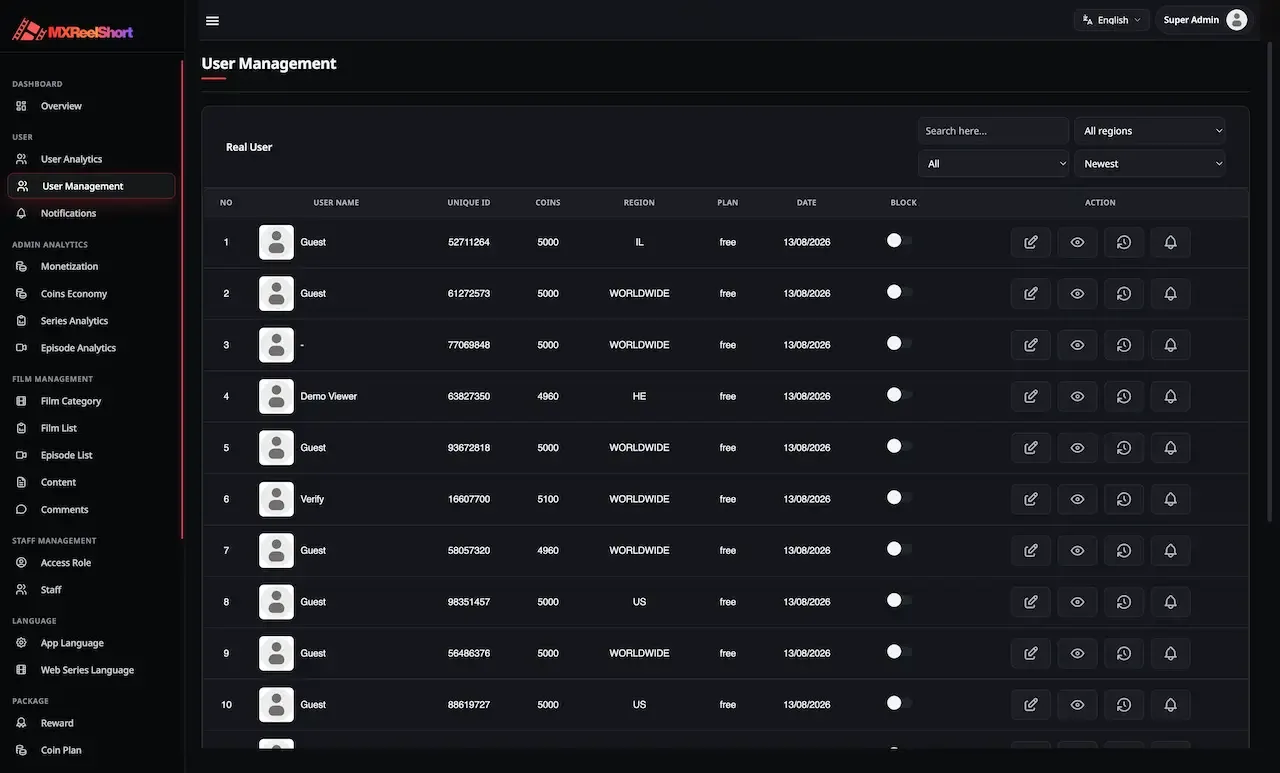
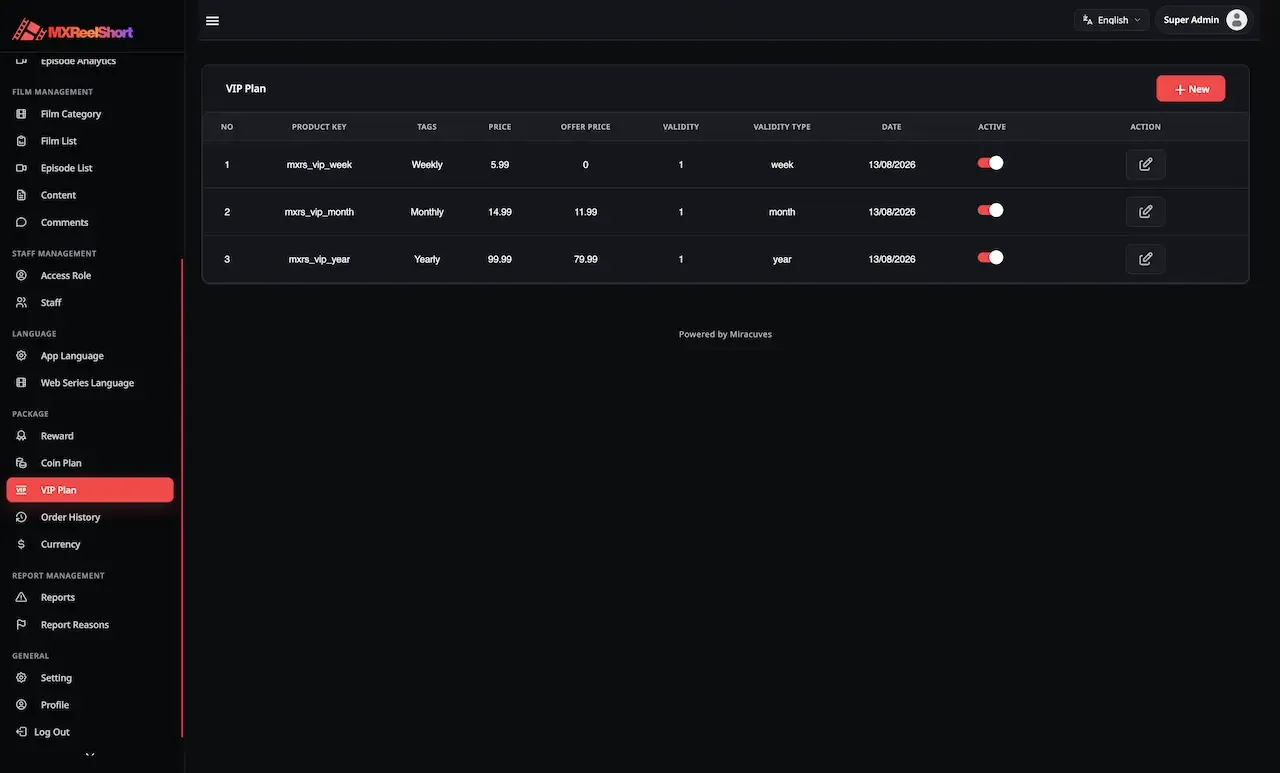
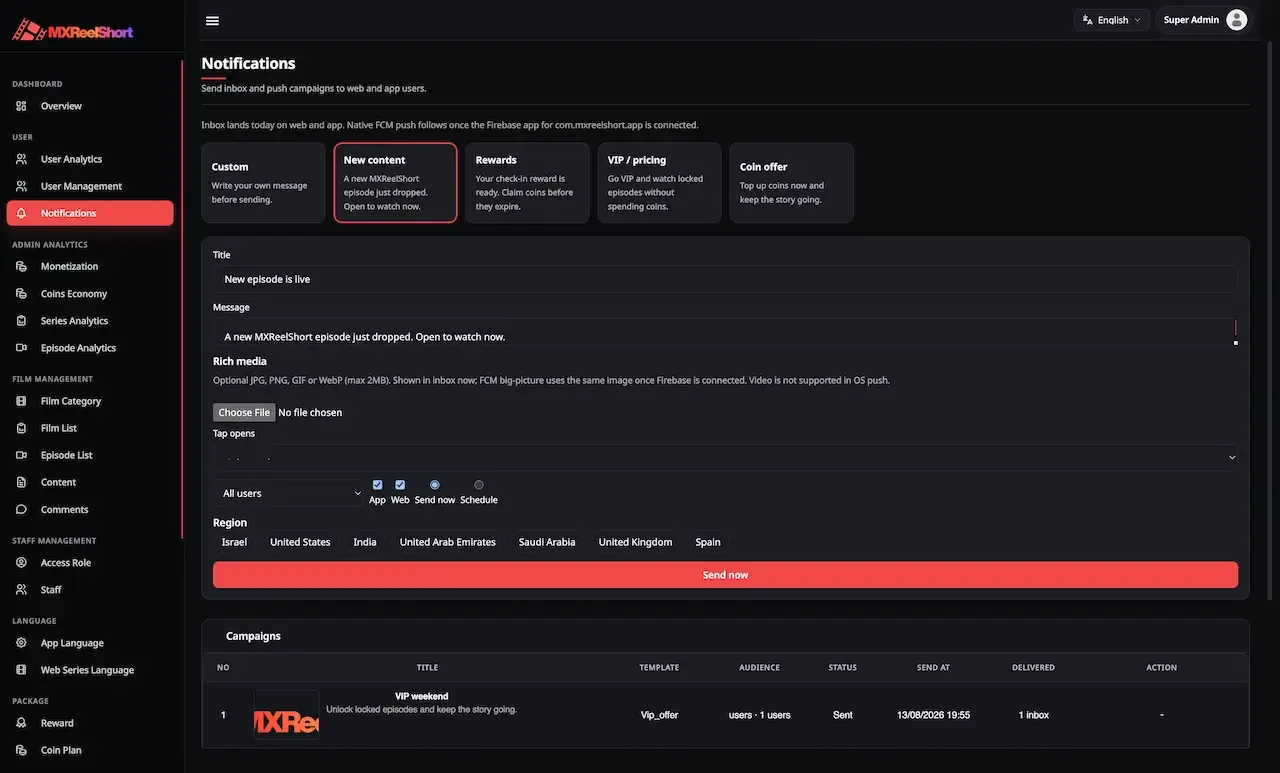
The demo is best used for the growth loop: claim a check-in, watch a reward task credit the wallet, follow the referral link, then schedule a campaign from the console. It carries our demo branding and a seed catalog of royalty-free stills, so judge the mechanics rather than the titles.
webuser@demo.comUser_$321admin@demo.comAdmin_$321webuser@demo.comUser_$32146 features across 4 roles. The first six of each role are here and the full list is one click away. Nothing is held back for a sales call.
Each of the seven days has its own coin reward, set separately in the console and not as a single flat amount.
The streak and its reset behavior are operator-controlled, so you decide how forgiving the ladder is.
A check-in can be claimed once per day per viewer, which keeps the ladder predictable.
Quests list progress and offer a claim button, giving viewers short targets beyond the check-in.
Watching a rewarded task credits coins directly to the wallet under a daily cap that you set.
A scheduled job resets the ad counters at midnight, so caps refresh without staff action.
8 more Retention tools features are in the full list.
Campaign templates are stored and reused, so a weekly message needs only a new date.
Each campaign chooses who receives it, which allows win-back and new-title messages to differ.
A campaign can be set for a future time and cancelled before it dispatches.
A job that runs every minute sends due campaigns from inside the API process, with no queue service.
After sending, the desk shows delivery figures, which lets you compare times and wording.
An inbox row is written for every targeted viewer, whether or not push is configured.
4 more Campaign desk features are in the full list.
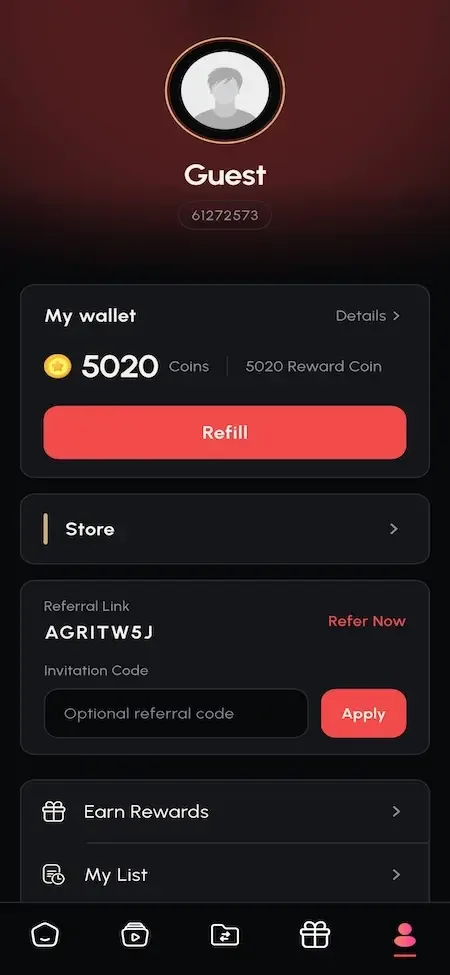
Reward coins and purchased coins are separate, with a single total shown and spending drawn from rewards first.
Every earn and spend appears in a history backed by seven typed ledger codes.
Opening episodes play free, then a lock offers each way forward at the moment of the cliffhanger.
A viewer can unlock the rest of a title in one action instead of paying episode by episode.
A viewer can set a reminder on a coming soon title and return when it releases.
Banner, trending, new release, coming soon and category shelves assemble the front page.
4 more Viewers features are in the full list.
The first reward tab holds the coin value of rewarded ad tasks and their daily cap.
The second tab sets the seven day ladder values day by day.
The third tab holds login and social bonuses, along with the follow addresses for each network.
The fourth tab sets the amount a referrer is paid.
Coin packs with bonus coins and VIP plans by validity are created with order history behind each.
Coin economy analytics are tied to the typed ledger codes, so reward cost can be separated from purchases.
6 more Operators features are in the full list.
The path through the product, in the order it happens for the people using it.
Fill in the four reward tabs: ad coins, the seven daily amounts, login and social bonuses, and the referral credit.
A returning viewer claims the day on the ladder and sees quests and ad tasks waiting beside the wallet.
At a locked episode the viewer spends reward coins first, watches an ad, or uses a VIP pass.
The viewer shares a referral code, a friend signs up, and the referrer is credited in coins.
Schedule a campaign to an audience that stopped opening the app, then read its stats and adjust the next one.
Every earning route built into the product you receive: how it works, who pays and where the operator earns.
| Revenue model | How it works | Who pays | How you earn |
|---|---|---|---|
| Coin pack sales | Packs with bonus coins are bought at hosted checkout or through store billing, giving viewers a clean reason to top up. | Viewer | Pack revenue minus processor and store fees |
| Episode coin price | Coins are spent on locked episodes, with price set per episode so retention rewards flow back into paid unlocks. | Viewer | Coin spend as earned and purchased balances are used |
| VIP and Premium windows | Time-boxed plans open locked episodes for the viewer who would rather not count coins. | Viewer | Plan income per window, renewed as members return |
| Rewarded ads | A viewer without coins watches a rewarded unit under a daily cap and still earns the operator income. | Advertiser, through your ad network | Ad network payout for completed reward views |
| Referral growth | Existing viewers bring in new ones for a reward you set, paid in coins and not in cash. | Operator, as coins issued | New viewers acquired at a cost you control |
| Coupon campaigns | Codes that grant coins or VIP days are sent through the campaign desk to lapsed or new viewers. | Operator, as a promotional cost | Reactivated viewers who then purchase |
| Season voting module | Polls on which title returns give viewers a reason to open the app on a day with nothing new to watch. | Viewer, through vote props beyond the free cap | Vote prop sales and more frequent app visits |
The flow of money, the gateways you can connect and how payouts are handled.
In a rewards-led service two currencies move at once: money from viewers and coins that you issue for free. The wallet keeps them apart, spends rewards first and records both in a typed ledger, so you can see what retention cost and what purchases earned. Gateway switches handle the money side, and we connect your merchant accounts during delivery.
| Gateway | What it covers |
|---|---|
| Card | |
| PayPlus | Hosted checkout, so the processor takes the card and your database does not store it. |
| Stripe | Purchases are confirmed with the processor on the server before coins are credited. |
| Regional | |
| Razorpay | Regional gateway verified on the server before any credit. |
| Flutterwave | Additional regional switch for markets where it is the usual rail. |
| Other | |
| Google Play billing | Store billing switch for in-app coin purchases where the store requires it. |
You operate the platform, so legal compliance in each market you serve is yours. This is the tooling that ships in the product. It is not legal advice.
Any system that pays for actions attracts people who farm it. The ladder is claimable once per day, social and email bonuses once each, and ad tasks are capped per day, which limits the damage. Review wallets of unusual accounts and block abusers from the console. Do not rely on caps alone.
Reward coins carry an expiry window you set, and spending uses them before purchased coins. Purchased coins do not expire. Settle the expiry rule before launch and state it in your terms, because changing it later affects balances people already hold and, in some markets, attracts attention from regulators.
Campaigns reach every targeted viewer through the inbox, and device push needs your Firebase project and valid tokens. Which messages you may send, and to whom, depends on the law where your viewers live. Write consent and opt-out into your terms. We provide the tooling and not legal advice.
Hosted checkout takes the card on the processor side, so card numbers do not reach your database, and card and regional purchases are confirmed on the server before credit. Start merchant applications early, since your coin purchases depend on at least one live gateway.
Viewers can report comments with reasons you define, staff clear them from a queue, and a solved report notifies the reporter. You can hide comments and block users. A growing referral base brings more comments, so assign someone to the queue before launching a referral push.
The product documentation lists open items such as stronger password hashing, request rate limiting and wider enforcement of staff permissions. Rate limiting matters most for check-in and referral endpoints. Ask for the security reference and agree what to close before go-live, with the scope confirmed with us.
Hosted checkout takes card details on the processor side, and no card number is stored in your database on that path.
The layers of the product as delivered. You receive the full source code for every one of them.
| Layer | Built with | Hosting note |
|---|---|---|
| Store app | Flutter, GetX (iOS and Android) | Express under PM2 behind nginx, handling check-ins, claims, unlocks and campaign dispatch. |
| API | Node.js, Express, Mongoose | |
| Scheduled jobs | node-cron (midnight ad counter reset, minute campaign dispatch) | Node cron resets ad counters at midnight and dispatches due campaigns every minute. |
| Operator console | Next.js 14, Redux, ApexCharts | Next.js 14 on its own subdomain, where rewards, campaigns and analytics are managed. |
| Database | MongoDB with a typed coin ledger | MongoDB with unlock rows, wallets and the typed ledger, indexed on the paths used most. |
| Consumer web app | Vite, React, React Router | A static React build served by the proxy, which absorbs campaign traffic without touching the API. |
| Media storage | Local disk, AWS S3 or DigitalOcean Spaces, among eight supported providers.Runs on your own Firebase project and is optional, since the inbox works without it. | |
Retention features add background work and bursts of traffic after a campaign goes out, but not new infrastructure. Scheduled jobs run inside the API process, the inbox lives in your database, and push is optional. Your hosting choices are the usual ones for a Node service with media storage behind it.
Rewards are paid in coins you create, which makes them cheap to issue and easy to overspend. The table lists each lever in the product, the cost it creates and the control that bounds it. It describes mechanics, not expected results, because your viewers and your prices will decide what works.
| Lever | What it costs you | Control and watch-out |
|---|---|---|
| Daily check-in | Coins given for returning, whether or not the viewer ever buys. | Set amounts per day, and keep early days modest so the streak is a habit and not a handout. |
| Quests | Coins for completing tasks, which shifts viewing toward whatever the quest rewards. | Choose tasks that match your goals, and avoid quests that pay for actions you do not value. |
| Ad reward tasks | Coins given against ad views, offset by ad network income on the store build. | Set a per-title daily cap. Web ad tasks are previews and earn nothing. |
| Social follow bonus | One-time coins for visiting a profile link. | Each bonus can be claimed once, so size it as a small welcome rather than a growth plan. |
| Referral credit | Coins given to the referrer for each invited viewer. | Keep the reward below the value of a new viewer, and review history for clustered accounts. |
| Game promos and coupons | Coins or pass days given by code for a campaign or partner. | Issue codes with a clear purpose and an end date, so promotions do not run indefinitely. |
| Reward expiry | Lowers the liability from unspent promotional coins. | Choose a window long enough to feel fair and short enough to keep the balance honest. |
| Pass and HD benefits | Passes grant access and HD playback to members. | Test whether rewards reduce pass sales before widening any payouts. |
A growth-led product touches three external rule sets at once: ad networks, store billing and content rights. None of them is ours to decide, and the product page is direct about what is and is not built. These points help you plan before promising anything to viewers or licensors.
Operators sometimes ask whether AI can improve retention. The ideas below are tailored work, and the page does not describe any of them as built. We scope each with you, and each depends on data you collect and a provider you choose, and each should be tested before it touches the wallet.
| Idea | What it would do | What it depends on |
|---|---|---|
| Next-episode suggestions | Recommend titles from what a viewer has watched, instead of hand-built shelves. | Enough viewing history and a ranking approach scoped with you. |
| Personalized reward timing | Offer a reward when a viewer is most likely to stop watching. | Behavior data and careful limits so the offer does not train viewers to wait. |
| Churn warnings | Flag viewers who have gone quiet so a campaign can reach them. | Behavior-based audience rules, which we scope with you. |
| Message drafting | Draft campaign wording for staff to review before sending. | A language model provider and a human check on every message. |
| Subtitle drafting | Produce draft subtitles to speed up new titles. | A speech provider account and review by a fluent reader. |
One fixed price for the ready-made platform, published here so you can plan before you talk to us.
Ready-made, one-time
$3,999
Live in 6 working days from kickoff
The engineers who deploy your platform stay with it once it is live.
Need more? We tailor the platform to your plan, typically in 2-8 weeks, and confirm the scope with you before work starts. App store review times are set by Apple and Google.
Everything here is available around the ready-made ShortMax clone. We confirm the scope with you before any price is agreed.
Community polls on which title earns a new season, with free daily votes, extra votes for VIP members and vote props beyond the cap.
Confirm with usLocal prices and currencies for coin, VIP and Premium plans per country, charged on the server.
Confirm with usAdaptive bitrate playback so weaker networks start faster, with encoding on Mux or Cloudflare Stream under your account.
Confirm with usA licence step in front of packaged streams for catalogs whose rights require it, using your Widevine or FairPlay vendor.
Confirm with usScheduled import of licensed titles from partner APIs, so the shelves stay stocked while the loop brings people back.
Confirm with usWe can add UTM tracking, deep linking, cohort analysis or A/B testing around the platform if you need them.
Confirm with usRequest throttling on check-in, claim and unlock endpoints, scoped as part of hardening before launch.
Confirm with usMost of the platform ships ready and the rest is set up around your plan. A reward-led product lives or dies on the details around payouts, caps and abuse, so this matrix lists them one by one. Each row states whether the capability ships ready or is set up for you, and nothing is marked as included unless the product page describes it as shipped.
A streak with a coin amount per day, configured in the console and claimable once daily.
Quests pay coins and sit beside the wallet on the store app.
Tasks pay coins under a daily cap, with a midnight reset of the counters.
Operator-set profile links, with each bonus claimable once.
One-time rewards for completing a profile step or signing in.
The referrer is credited in coins, with a referral history on the store app.
Promotional items and redeem codes grant coins or pass days for campaigns.
Promotional coins expire on a window you set, so unspent rewards do not pile up.
Every credit and debit carries a typed code, so one claim can be traced.
Templates, audiences, scheduling, cancellation and delivery statistics.
An inbox row is written for every targeted user whether or not push is set up.
Runs on your own Firebase project, connected during delivery.
Three routes at the lock, plus auto-unlock for the rest of a title.
Guest, email and further login options all lead to the same wallet.
Monetization views and top revenue episodes tied to the typed ledger.
Staff can open a wallet, adjust a balance or block an account.
A module we set up that gives viewers a reason to open the app on a quiet day.
A module we set up for local prices and currencies per country.
Modules we set up for connection-aware playback and licensed stream protection.
We wire a provider through the referral and campaign surfaces, with the scope confirmed with us.
Audience selection exists, but rules driven by viewing behavior are built with the scope confirmed with us.
We set this up for your build, and on a reward economy it should cover login, check-in and unlock first.
Withdrawal data is modeled, and we build the request flow and payout rails to your market, with the scope confirmed with us.
Four pages go deeper on the questions buyers ask most about the ShortMax Clone. This page stays the overview.
The costly number in short drama is the price of bringing a viewer back.
See the full breakdownWith a retention-led product, the figure that matters most after launch is not the software.
See exact pricingA growth-led drama service earns in a particular order.
See the playbookA reward system looks simple in a demo and becomes expensive when it leaks.
Compare optionsFrom kickoff to a live ShortMax clone under your brand: what we do each day, and what we need from you.
1Day 1
2Day 2
3Day 3
4Day 4
5Day 5
6Day 6
The expensive part of a rewards-led drama service is not the software but the cost of getting viewers and keeping them. Paid acquisition is priced by someone else, while the retention loop costs you inventory: coins that you issue. That is why the build choice matters. If the loop and the messaging are part of the product, retention spend stays inside your own margin. If they sit with outside vendors, each becomes a contract, an integration and a recurring fee. The comparison shows what each route leaves you to buy.
| Factor | Build from scratch | Rent a SaaS | Own it with GetFame |
|---|---|---|---|
| Check-in and quests | Designed and built from scratch | Present only if the vendor offers it | Ladder, quests and ad tasks configured in the console |
| Referral program | Needs tracking and crediting logic | Often a separate paid tool | Referral credit built in, paid in coins |
| Messaging | A vendor contract or your own service | Another subscription | Campaign desk and inbox included, push via your Firebase |
| Cost of a returning viewer | Depends on what you build | Cash for each service used | Coins you issue, with expiry on promotional balance |
| Factor | Build from scratch | Rent a SaaS | Own it with GetFame |
|---|---|---|---|
| Analytics depth | As deep as you build | Often richer attribution | Operational counts and ledger views, not attribution |
| Ownership | Yours | Held by the vendor | Full source code and your database |
Running costs. Outside the platform price you will pay for the things any drama service needs: hosting and bandwidth, processor and store fees, a Firebase project if you want push, ad network terms, encoding and subtitles, moderation staff and, above all, catalog rights. If you need attribution or cohort analysis, we can add them around the platform, or you can pair a separate analytics tool.
Retention features look small on a roadmap and turn out large in practice, because every reward is also an opportunity for abuse and a liability on the balance sheet. This comparison shows what each piece involves when you build it and what the ready-made product already handles.
Build it yourselfDay counting across time zones, a rule for missed days and a once-per-day guard that cannot be bypassed.
Ready-madeA seven day ladder with a streak and one claim per day, with amounts set in the console.
Build it yourselfA per-title daily counter, a scheduled reset and a rewarded ad integration on each client.
Ready-madeCaps and a midnight reset exist, and the store build uses your own ad network units.
Build it yourselfCrediting the right account, preventing self-referral and recording history for support questions.
Ready-madeThe referrer is credited in coins, with history shown beside the wallet.
Build it yourselfTyped entries, separate promotional and purchased balances, and expiry applied before any credit or spend.
Ready-madeTwo balances with a single displayed total and typed codes behind every movement.
Build it yourselfTemplates, audience rules, timed dispatch, cancellation and statistics, often bought from a messaging vendor.
Ready-madeTemplates, scheduling, cancellation and delivery numbers are inside the console.
Build it yourselfA message store, read states and a screen on each client, independent of push delivery.
Ready-madeAn inbox row is written for every targeted user, with or without push.
Build it yourselfAdmin screens so values can change without a release, plus rules for what happens to coins already issued.
Ready-madeFour console tabs cover ads, daily rewards, login and social bonuses, and referral.
Build it yourselfClaim constraints, wallet inspection and a way to freeze an account when farming is traced.
Ready-madeClaim limits sit in the model, and staff can adjust a balance or block an account.
Build it yourselfReports that separate earned revenue from given coins so rewards are not mistaken for income.
Ready-madeMonetization analytics are tied to ledger codes, separating purchases from rewards.
Build it yourselfA cross-platform build plus store accounts, review cycles and ad network setup.
Ready-madeA Flutter build for the stores, with publishing help during delivery.
ShortMax belongs to the same vertical drama category as its rivals, and apps of this type commonly lean on rewards, daily bonuses and invitations. This table compares that general pattern with the controls you get here, without claims about any company internal numbers.
| Aspect | The ShortMax model | This platform |
|---|---|---|
| Who sets reward values | The company that owns the app | You, in four reward tabs |
| Invite programs | Run to the owner terms | Referral amount and credit are yours to set |
| Messaging to viewers | Through its own systems | Campaign desk, inbox and optional push on your Firebase |
| Reward currency | Controlled by the owner | Coins you issue, with expiry you choose |
| Ad-based rewards | Common in the category | Rewarded ads through your AdMob units, capped per title per day |
| Audience ownership | Viewer accounts and history stay with the brand owner | Viewers join your service on your domain |
| Source access | Not offered | Full source code you can modify |
The founders and teams this product fits most directly, one line each. The launch ideas that follow turn these audiences into a first-week plan.
Build a habit loop out of streaks, quests and reminders and pay for it in coins.
Grow through invitations credited to the referrer instead of a paid acquisition budget.
Let viewers earn episodes through ad tasks while paying viewers buy coins or a pass.
Schedule campaigns to lapsed audiences and measure what each send brought back.
Run marketing, moderation and pricing from one console with no separate messaging vendor to start.
A reward-heavy product works only when the loop matches the audience. These ideas describe who is being rewarded, what they do to earn coins and which values to set before the first campaign goes out, so that the economy starts small and stays measurable.
An operator builds a daily habit with a check-in ladder and short quests, so viewers open the app even without a new release. Coins earned this way fund the first episodes of the next story. Configure the ladder values and the expiry window first, and keep early payouts modest until you see how viewers behave.
A small operator cannot outspend large apps on advertising, so existing viewers bring in friends and are paid in coins. Configure the referral amount first and keep it below what a new viewer is worth to you. Watch the referral history for accounts that appear in clusters, and block those that farm rewards.
A publisher reaches viewers who will not pay yet by letting them earn episodes through rewarded ads on the store app. Configure the per-title daily cap and your own ad network units first. Remember that the web ad task is a preview, so measure ad revenue only from the store build.
A studio announces each new episode batch through the campaign desk and the in-app inbox, reminding viewers who left mid-story. Configure two or three templates and a schedule first. Keep volume low, because a viewer who is over-messaged stops opening the inbox and ignores every notice after that.
An acquisition-minded operator pays for installs and wants the reward loop to turn them into repeat viewers. Configure the first-day rewards and a purchase prompt at the first lock. We add an attribution provider so you can tell which campaign drove an install.
An agency deploys branded copies for partners, each with its own reward values and caps. The partner pays for a working service instead of an engineering project. Configure reward tabs per deployment first, and agree early who carries the cost of coins that partners hand out.
Operators asking for a ShortMax clone are often really choosing how to keep viewers returning. The options below trade control against effort. Each description is deliberately general, because the commercial terms of other products are theirs to state and change.
Consumer drama app
Studios that prefer distribution through an established app to running a service of their own.
You do not set the reward rules, the pricing or own the viewer data.
Consumer drama app
Content owners placing titles where a large audience already watches.
The wallet and retention tools belong to the app, not to you.
Consumer drama app
Producers testing how stories perform before building a platform.
Terms and placement are decided by the app operator.
Marketing software
Teams that already have a video product and want rewards bolted on.
Rewards live outside the wallet, so ledger, unlock and reporting do not agree.
Bespoke development
Operators with unusual loop designs and the calendar to test them.
Abuse cases and ledger correctness consume most of the effort.
A white-label platform with the reward loop already built suits operators who want the reward amounts, the referral value and the ad caps to be their own numbers. You own the code and the ledger, you issue the coins and you can read exactly what a returning viewer cost. You also own the tuning, the abuse watch and the content.
Longer answers to the questions buyers of this model ask before they commit.
A check-in ladder is a promise that tomorrow is worth opening the app. Make day one small and the end of the week meaningful, so that a viewer who misses a day feels the loss. Because each day has its own value in the console, you can shape the curve instead of paying a flat amount.
Link the ladder to your price. If a locked episode costs a certain number of coins, work out how many days of check-in it takes to earn one. Too fast and nobody buys a pack, too slow and the ladder feels pointless. Start generous, then tighten as you see purchases rise or stall.
Decide how forgiving the streak is before launch, since reset behavior is yours to set. A strict streak drives daily habits but frustrates casual viewers, while a loose one keeps more people but weakens the daily pull. Pick one and watch the check-in claims for a few weeks.
A referral reward is paid in coins you issue, so a new viewer costs you inventory and not cash. That changes the maths of growth. Set the reward high enough to be worth a message to a friend and low enough that a purchased coin is still worth more than a free one.
Watch for quality, not volume. The referral history shows who joined through whom, and the ledger shows what those viewers did next. If invited viewers claim the bonus and never reach a locked episode, the reward is attracting the wrong behavior and needs rethinking.
Keep the rules simple enough to state in one sentence on the referral screen. Complicated conditions generate support questions and disputes. Because the referrer is credited at signup, explain clearly when the credit lands, and make sure your terms say what happens to coins from accounts you block for abuse.
The campaign desk works best on a calendar and not on impulse. Plan a weekly rhythm: a new title message, a reminder for upcoming releases, a win-back note for viewers who have not opened the app in a while and a promotion that uses a coupon code. Templates make each one a few minutes of work.
Remember what each channel does. The inbox reaches every targeted viewer inside the app and needs nothing external. Device push needs your Firebase project and valid tokens, so it reaches fewer people, but it can pull a lapsed viewer back. Use the inbox as the base and push for messages that deserve a nudge.
Read the statistics after every send and keep notes on timing and wording. You are not running a formal test, since the platform has no A/B module, but a simple record of what you sent and what happened will show which kinds of message earn a return visit.
Not every returning viewer is a good one. Some accounts exist to claim bonuses and leave. The signal is in the ledger: healthy accounts earn coins and then spend them on episodes or buy packs, while farming accounts earn and stop. The coin economy view lets you compare the two groups.
Use caps and expiry as design tools. Daily caps on ad tasks and once-only bonuses limit what any account can take. Expiry on promotional coins keeps balances from piling up unused. If you find a pattern of abuse, inspect the wallets involved and block the accounts from the console.
Finally, judge the loop by what it adds to paid unlocks and not by how many check-ins it records. A modest ladder that sends viewers to locked episodes is worth more than a generous one that nobody spends. Keep the revenue by series view open beside the reward settings.
Projects and comments as published by our parent company, Miracuves, with the release notes as printed there.
The check-in ladder is the cheapest retention we have. It pays in coins we issue, so a returning viewer costs us inventory rather than media spend.
Referral crediting the referrer changed our acquisition mix. Our existing viewers bring people in at a cost we set from a settings screen.
Being able to schedule a campaign and see the stats afterwards, without buying a messaging vendor first, was not something we expected at this price.
Top revenue episodes is the report we open first. Knowing which episode people actually paid at tells us where to spend on production.
v2026.1Sep 2026
The ready-made white-label platform is $3,999 one time and launches on your server in about 6 working days. Final scope depends on catalog size, gateway choice, ad network setup, storage and CDN, and store publishing. Tailored additions run 2 to 8 weeks, and extra modules are confirmed with us.
Coins come from the seven-day check-in, daily and weekly quests, ad reward tasks, watch-time tiers, social follow and email bonuses, login bonuses and referrals. Amounts are set in four reward tabs in the console, so you decide how generous each source is.
Yes. Reward coins carry an expiry window that you configure, and spending always uses them before purchased coins. Purchased coins do not expire. Together they show as one total in the app, while the console can still tell the two apart in the ledger.
Each viewer has a referral code. When a friend signs up with it, the referrer is credited the amount you set in the rewards settings, and referral history appears in the app. The credit is paid in coins, so acquisition spends virtual inventory in place of cash.
Not to start. The campaign desk handles templates, audiences, scheduling, cancellation and stats, and writes an in-app inbox row for each targeted user. Device push needs your own Firebase project, which we connect during delivery. The in-app inbox works even when device push is not configured.
On the Flutter store app, yes, through AdMob with your own unit IDs, set up during delivery. On the web app the ad unlock is a simulated timed preview that shows the flow without a live ad network, so the web version does not produce ad revenue.
Yes. Season voting is one of five Plus modules, along with adaptive streaming, DRM, content import and regional pricing. We set up the ones you choose and confirm the scope with you, and each arrives as its own folder in your copy.
Yes. You receive the Flutter app, the web app, the Next.js console, the Express API with its Mongoose models, a seed script and the deployment configuration. There is no per-seat fee and no revenue share, and you may modify, rebrand and redeploy everything.
You operate under your own brand with a catalog you own or license. The software follows common micro drama patterns and holds no code, design or content from any existing app. We are not affiliated with ShortMax. Reward and marketing rules vary by country, so check them yourself. This is not legal advice.
Yes. The four reward tabs in the console hold the ad reward, the seven day ladder, the login and social bonuses and the referral amount, and edits apply to later claims. Balances already issued are not rewritten, and expiry applies to existing reward coins, so announce meaningful changes to viewers.
The check-in is claimable once per day, and the social, email and login bonuses are each claimable once. Ad reward tasks are capped per day, with the counters reset at midnight by a scheduled job. These limits reduce abuse, though you should still review unusual accounts.
No. Campaigns write an inbox row for every targeted viewer with no external service. Device push is optional and runs on your own Firebase project, needing valid device tokens. The minute-by-minute dispatcher runs inside the API process, so there is no separate queue to operate.
Not directly. The desk reports delivery statistics, and the console reports revenue, series and ledger activity, but UTM tracking, deep linking, cohort analysis and A/B testing are added around the platform. You can compare timing yourself, and we can set up attribution tooling or you can use a separate analytics product.
The platform supports five login types, and guest entry lets a first visit begin without an account, with rewards collected on a durable guest identity. Which sign-in options you show can be agreed with us during delivery, depending on the accounts you connect.
The platform limits claims with once-only bonuses and daily caps, and it gives you wallet inspection and blocking to act on abuse. Rate limiting and device checks are set up around it as part of the hardening work we scope with you before go-live.
Yes. Season Voting is a Plus module that we set up for your build, with the scope confirmed with us. It adds polls with free daily votes, extra votes for VIP members and vote props beyond the cap. It is delivered as its own folder, so your copy contains it when you choose it.
On the web app the ad unlock is a simulated timed preview that shows the flow without a live ad network, so it earns no ad revenue. Live rewarded video runs on the Flutter store app through AdMob with your own unit IDs. Plan your ad income around the store app.
ShortMax is a consumer short drama app. In general terms, apps of this kind earn from viewers who buy coins or passes, and from ads shown to viewers who earn access instead of paying. We make no claims about the internals of the brand. A clone of the model lets you run the same kind of economy under your own name.
Beyond the platform price of $3,999, expect hosting and bandwidth, storage, payment processing fees, store developer accounts and commission where store billing applies, ad network terms, push provider usage, moderation and support staff, and the titles themselves. Rewards add a cost in coins you issue. These bills are contracted directly by you.
Consumer apps such as ReelShort, DramaBox, ShortMax and GoodShort are widely mentioned, though popularity changes quickly and we publish no rankings. They are apps to watch on rather than platforms to own. A white-label clone is for operators who want their own brand, catalog and prices.
Reward coins carry an expiry window you configure, and expiry is applied before any credit or spend. Purchased coins do not expire. Spending uses reward coins first, so a viewer consumes promotional value before money they paid. Tell viewers about the window clearly, to avoid support disputes.
You control the values and caps that bound each lever: ladder amounts, ad task caps, referral amounts and expiry. A single monthly ceiling across all rewards is something we can set up if you need one. Reading the ledger regularly shows how much has been issued.
Start with modest referral values, since farming pays only when the reward is large. Claim limits sit in the data model, staff can inspect a wallet and block an account, and referral history shows clusters. We set up request rate limiting at the proxy, and stronger abuse controls are tailored work.
Campaign statistics show delivery, and the typed ledger shows what a viewer bought and when. Install attribution and deep links are set up for you, so tracing a purchase to an advertising source goes through an attribution provider we wire in. Plan for that if you buy paid traffic.
Rewarded ad formats exist on the major ad networks, and each network sets rules on how they may be used. Store policies also apply to the app as a whole. Read both before designing tasks, and use your own ad network account, which is connected during delivery.
The platform stores and plays files as they are. Signed links, adaptive bitrate and DRM are deployment decisions or modules we set up, and release builds block screenshots on mobile. No control stops every copier. Agree what protection your licensors expect before you sign for any titles.
Yes, as tailored work, because you own the source. Ideas include recommendations, churn warnings and message drafting. Each needs data and a provider you pay for, and each should be tested before it touches the wallet. Begin with the retention problem you can measure today.
→Start here
Share the platform and your market. You get a walkthrough of the live demo, the exact scope of what ships, and a fixed price in writing. First response in under 2 hours, Monday to Saturday, 10:00 to 19:00 IST.
This page uses the name ShortMax to describe a type of platform. The product sold here is separate software, built independently, and ShortMax has no part in it.
"ShortMax clone" is industry shorthand that founders use when searching for software with a comparable business model. It names a category of product, not a copy of ShortMax.
The platform is an original product designed and written by Miracuves. It contains no code, design, graphics or content originating from the ShortMax website or applications, and it ships under your own brand.
ShortMax and its logos are trademarks of their respective owner and are named here for reference only. GetFame is not affiliated with, sponsored by or endorsed by ShortMax. Rights holders can write to legal@miracuves.com.
Operator responsibility. The operator of a launched platform is responsible for legal compliance in the markets it serves. Nothing on this page is legal advice.Read the full disclaimer
First response under 2 hours, Mon-Sat 10:00-19:00 IST
India+91 98300 09649 United States+1 516 202 3950