Coins, gifts and wallets
How a Coin Economy Works and How to Design One
How a coin economy works in an app: users buy coins, spend them on unlocks or gifts, and creators cash out. Learn pricing, ledgers and store rules.
Short answer
How a coin economy works comes down to a ledger of in-app currency. Users buy coins with real money, spend them on unlocks or gifts, and sometimes earn a few free. Platforms use coins to sell small amounts, bundle store purchases and keep paid and promotional balances separate. Good design sets pack pricing, expiry, sinks, creator conversion and an auditable ledger.
Key takeaways
- A coin is a ledger entry, so the economy is only as sound as its record of every credit and debit.
- Keep purchased coins and earned or bonus coins in separate balances, because they differ on expiry, refunds and accounting.
- Apple's guidelines bar expiry on credits bought through in-app purchase, so only eligible, separately granted promotional coins should carry a disclosed expiry.
- The store fee is taken from the pack price, so the real value of a coin is its price net of fees, not its face price.
- Fraud, refunds and chargebacks can push a balance below zero, so the ledger must be able to hold a debt.
On this page 10 sections
- Why do platforms use coins instead of cash prices?
- How a coin economy works, part by part
- Two balances: paid coins and earned coins
- Pricing the packs: the logic of the ladder
- Example: one user from first reward to chargeback
- Gifts and creator conversion
- Expiry and the rules that touch coins
- A starter economy sheet for a first launch
- Keeping the ledger honest
- Where app coin systems leak money
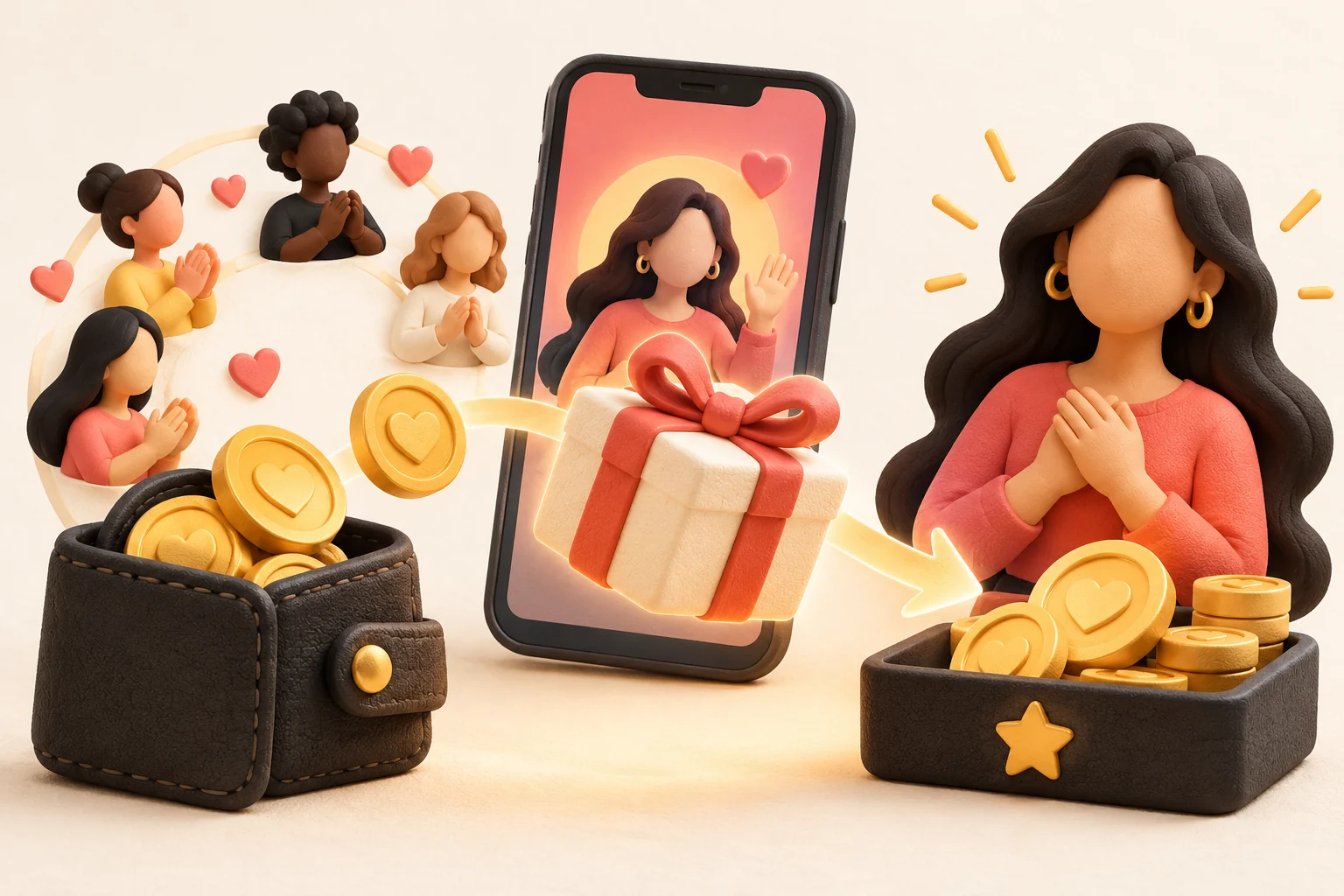
A coin economy works as an in-app currency kept in a ledger. Users buy coins with real money in a few packs, spend them on small things such as an episode unlock or a live gift, and sometimes earn a few free ones for coming back. The platform sells in coins because small prices are easier to accept, one store purchase can fund many spends, and the operator gets one place to see and control everything users spend.
This post is the general explainer. It covers what a coin economy is made of, how to keep balances honest, and where the money goes between the user's card and the creator's payout. If you plan a drama app, our ReelShort clone is built around this wallet; the brand-specific pricing method is the subject of pricing coins in a micro drama app, and the live-gifting version is in how TikTok gifts and coins work. Here we stay on the design that sits under both.
Why do platforms use coins instead of cash prices?
A coin economy is more work than charging cash at each action, so there has to be a reason. There are four.
- Granularity. An episode may cost the equivalent of a few cents. A card processor cannot economically handle a payment that small, but a coin spend inside the app costs nothing to process.
- Bundling. One purchase of a pack funds many later actions, so the fixed fee on the payment is spread over many spends. This matters on both app stores and card gateways.
- One currency for many actions. The same coin can open an episode, send a gift and unlock a chapter, so the user learns one balance, and you can move prices without changing the pack the user holds.
- Control. Because spends are your ledger entries, you can run promotions, give rewards, apply limits and cap risk without calling a payment provider.
There are costs. Users treat coins as less than money, which is the intent, but regulators and app stores watch for confusing pricing. Users also build up balances that you must account for, and the system invites fraud. A coin model fits products with many small paid actions and a reason to top up. If your product has one large purchase per user, a plain price is simpler.
How a coin economy works, part by part
Economists who design game currencies describe an economy as sources, sinks and a stock. The same words work for a creator app.
| Part | What it is | Micro drama example | Live gifting example |
|---|---|---|---|
| Source: purchase | Real money in, coins credited | Coin pack at checkout | Coin pack in the live room |
| Source: reward | Free coins you issue | Daily check-in, quests, referral | Welcome bonus, event promotions |
| Sink: unlock | Coins spent for access | Per-episode price | Paid replay or room entry |
| Sink: gift | Coins spent to give value to another user | Rare | Virtual gifts to a creator |
| Sink: expiry | Coins removed by rule | Reward coins past their window | Promotional coins past their window |
| Conversion | Value passed to a creator | Revenue share to a studio, off-ledger | Gift value turned into creator earnings |
| Stock | Coins held but not yet spent | Unspent balances | Unspent balances |
The stock is the number to watch. Coins outstanding are an obligation: users paid for them and expect to spend them. Ask your accountant how to record that obligation, since treatment depends on your jurisdiction. Operationally, track the stock by balance type, the age of the oldest paid coins and the ratio of coins sold to coins spent in a month. A stock that grows faster than spending means users are hoarding or have lost interest, and it will come back as a refund request.
Two balances: paid coins and earned coins
The most useful design decision is to keep two balances, not one. Paid coins were bought with real money. Earned coins were granted separately as a reward. A bonus bundled with a paid pack needs separate classification; do not assume it may expire. Merging them into one number looks simpler and creates problems later.
| Rule | Paid (purchased) coins | Earned (reward and bonus) coins |
|---|---|---|
| Origin | Card, web checkout or store billing | Check-ins, quests, referral, bonus on packs, coupons |
| Expiry | Should not expire where store rules apply | May expire only where permitted and disclosed |
| Refund and chargeback | Reversible, must be recoverable | Nothing to refund; can be revoked for abuse |
| Spend order | Spent second | Spent first |
| Reporting | Counts toward obligations to users | Counts toward promotion cost |
| Cash-out | Never converts to money | Never converts to money |
The spend order matters. Spending earned coins first uses up the promotional balance before it expires and keeps the purchased balance, which has no deadline, for later. It is also the order that users find least surprising, since free coins are visibly used. Our white-label ReelShort clone works this way: it tracks reward coins and purchased coins separately, the console shows both, and a spend draws reward coins first. The ReelShort clone features page describes the wallet and the reward ladder.
Some platforms add a third unit, often called gems, diamonds or points, for items you do not want to price in coins, such as a premium cosmetic or a creator earning unit. A third unit is justified only when it follows different rules from coins. Otherwise it is one more thing for users to misunderstand.
Pricing the packs: the logic of the ladder
A pack ladder is the list of packs on the top-up screen, from a small impulse pack to a large one. We cover the step-by-step method, including episode price and bonus tuning, in the coin pricing post, so here is only the logic you need to design the economy.
- Fix a base value. Decide what one coin is worth in the smallest pack. Every other pack is a discount from that base, so the base is the anchor for all comparisons.
- Make each step visible. A user should see why a bigger pack is a better deal, typically through bonus coins rather than a lower price per coin on the label.
- Offer a first-purchase pack. A one-time offer lowers the barrier to the first payment, and the first payment is the hardest conversion.
- Check the top of the ladder after fees. A bonus that looks small to the user can be large to you. Run the net revenue per coin through every channel before publishing.
The net revenue per coin is the figure that drives the whole economy. The next sections show how to compute it.
Example: one user from first reward to chargeback
These figures are illustrative. Say one coin has a base value of 0.01 and a pack of 500 coins costs 5.00 with 50 bonus coins. A user opens the app, earns a reward, buys the pack, watches several episodes at 30 coins each, sends a gift and later disputes the purchase. The ledger records each event as an entry with a type, an amount and a balance after.
| Step | Entry | Earned balance | Paid balance | Note |
|---|---|---|---|---|
| 1 | Check-in reward +20 | 20 | 0 | Source: reward |
| 2 | Pack bought: +500 paid, +50 bonus | 70 | 500 | Source: purchase, 5.00 charged |
| 3 | Unlock episode, -30 | 40 | 500 | Earned spent first |
| 4 | Unlock episode, -30 | 10 | 500 | Earned spent first |
| 5 | Expiry sweep, -10 earned | 0 | 500 | Promotional window ended |
| 6 | Unlock episode, -30 | 0 | 470 | Paid spent |
| 7 | Gift sent, -100 | 0 | 370 | Sink: gift, creator credited |
| 8 | Chargeback reverses the pack, -500 paid | 0 | -130 | Debt of 130 coins, account blocked |
Four things stand out. First, every row is a new entry, and no row edits an earlier one. Second, the balance after the chargeback is negative, because the user had already spent 130 purchased coins. The ledger has to represent that debt, block further spending and let support clear it. Third, the 100-coin gift at step 7 had already credited a creator, so the creator-side entry needs a reversal rule, which is covered below. Fourth, the earned coins expired without any effect on what the user paid.
From face value to platform revenue
Now compute what the platform keeps. The user paid 5.00 for the pack. Channel costs come out first. Apple's Small Business Program page says the standard commission is 30%, dropping to 15% for developers whose proceeds were 1 million USD or less in the prior calendar year, as of October 2026. Google Play's service fees page describes tiered fees that also reach a 15% tier on the first 1 million USD of annual revenue, with other rates by transaction type. For a web checkout we assume 5% as an example.
| Channel (example rate) | Fee on 5.00 | Net to platform | Net per coin credited (550 coins) | Gift of 100 coins, creator share 50% of face |
|---|---|---|---|---|
| Store at 30% | 1.50 | 3.50 | 0.0064 | Face 1.00, creator 0.50, platform keeps about 0.14 |
| Store at 15% | 0.75 | 4.25 | 0.0077 | Face 1.00, creator 0.50, platform keeps about 0.27 |
| Web checkout at 5% | 0.25 | 4.75 | 0.0086 | Face 1.00, creator 0.50, platform keeps about 0.36 |
The last column treats a gift as costing 100 coins at the net value of the channel the coins came through, then subtracts a creator payment set at half of face value (1.00 times 50%). It shows why a platform that pays creators by face value must watch its channel mix: at a 30% store fee, the platform's remainder is under a third of the creator's share, and any extra cost, such as moderation or a chargeback, moves it toward zero. The point generalizes: set creator payouts against net revenue per coin, not against the price on the pack.
Gifts and creator conversion
In a drama app, the sink is an unlock, and the money flow to creators is usually a contract with a studio outside the ledger. In live gifting, the sink is a gift, and the conversion to a creator is part of the ledger itself. This is where the second unit appears.
TikTok's regional Virtual Items Policy separates Coins, Gifts and Diamonds. Diamonds recognize creator popularity and do not automatically entitle the creator to a reward payment. Reward eligibility and payment depend on the applicable program and region. Do not model a fixed coin-to-cash conversion from this terminology. Preserve statutory, store and payment-provider refund rights when designing reversals.
- Separate the unit the fan buys from the unit the creator earns. This blocks any path from a fan balance to a cash withdrawal, which is where laundering and fraud usually look for a gap.
- Set the conversion rate as an operator setting. You will tune it, and it is a promise to creators, so announce changes.
- Write down who bears a reversal. If a gift is reversed after the creator earned it, say whether you claw it back from the creator's balance or absorb it.
- Add a minimum withdrawal. Tiny payouts cost more to send than they are worth.
The gift catalog design, the room dynamics and the margin by gift tier are in the TikTok gifts post. A TikTok clone carries that gift economy, with earned value landing in a creator wallet and withdrawals approved in the admin panel. The same mechanics also fit a fan platform: the OnlyFans clone includes a wallet that fans top up for tips and gifts.
Expiry and the rules that touch coins
Expiry is the most disputed part of coin design, and it is partly decided by the stores, not you.
Apple's App Review Guidelines, section 3.1.1, state that credits or in-game currencies bought via in-app purchase must not expire, and that apps need a restore mechanism for restorable purchases. They also allow apps to use in-app purchase currencies for customer tips to developers or digital content providers, and limit gifts of purchasable items to refunds to the original purchaser, with no exchanges.
Those are published guidelines as of October 2026, and they can change, so read the live page before you ship. For the Google side and the detail of how billing works for drama coins, see app store billing for drama coins and Apple and Google's in-app purchase rules.
The practical rule follows from the two-balance design:
- Purchased coins do not expire while the account is active.
- Separately granted promotional coins may expire only where law and store rules permit, with a visible deadline. Paid-pack bonuses need separate review.
- Account closure is a separate rule. Account closure can affect access to virtual items, subject to the applicable policy and mandatory rights. State a lawful closure, appeal and refund process plainly.
Where allowed by applicable rules, expiring genuinely promotional coins does two jobs. It stops free balances accumulating into a liability, and gives users a reason to come back before the deadline. It also creates a trust risk if the window is hidden, so show the date. This is not legal advice; consumer rules on virtual currency differ by country, so ask counsel before you set expiry terms for any market.
A starter economy sheet for a first launch
Before any code or store setup, put the whole economy on one page. The sample figures in this sheet are placeholders picked to show how the parts fit, and every one of them is a setting you will revise after real data arrives.
| Setting | Illustrative starting value | What it controls |
|---|---|---|
| Base coin value | 0.01 per coin in the smallest pack | The anchor for every price comparison |
| Pack ladder | Four packs, each with a bonus that grows by step | Which pack a typical buyer chooses |
| First-purchase offer | One time only, shown after a free taste of content | Conversion of the first payment |
| Price per unlock | A small, round coin amount per episode or chapter | How many unlocks one pack funds |
| Daily reward | A few coins for coming back, with a cap | Return visits, and the promotional stock |
| Reward expiry | A visible window for promotional coins only | The size of the free-balance liability |
| Creator conversion | A rate set against net revenue per coin | Whether gifting is profitable by channel |
| Minimum withdrawal | A threshold above the cost of sending money | Payout cost per creator |
Checks to run on the sheet
- Packs funded per unlock. Divide the smallest pack by the unlock price. If a user can finish a whole story on the cheapest pack, the ladder above it has nothing to sell. If one pack buys only a couple of unlocks, the first payment feels like a bad deal.
- Reward share. Add the coins a daily user can earn in a month and compare it with the paid coins you hope to sell per buyer. If free coins cover most viewing, conversion will stay low.
- Net per coin in the worst channel. Recompute creator payouts at the highest fee you pay, since that is the channel where margins vanish first.
- Liability at the end of a month. Estimate unspent paid coins and unexpired promotional coins. If the number grows month on month with no matching rise in sales, users are hoarding.
Signals that tell you to change a setting
Review the sheet weekly for the first two months. A high share of users who open the top-up screen and leave suggests the smallest pack or first-purchase offer is wrong. Many purchases followed by few unlocks suggests a content problem, not a pricing one. Refund requests that cluster after promotions suggest the bonus coins are confusing the purchase terms. And a creator who stops gifting after a conversion change is telling you the rate was a promise. Change one setting at a time and note the date, so the effect can be read.
The ReelShort clone features page covers the wallet, reward ladder and typed ledger that these settings run on, and the ReelShort clone business model page sets out where coin sales, passes and ads sit in the revenue mix.
Keeping the ledger honest
The economy is a bookkeeping system with a user interface. If the books are wrong, every other part fails. These rules are standard for any balance system.
- Append only. Never edit or delete a ledger row. A correction is a new row that references the one it fixes. Balances are derived from entries or reconciled against them.
- Typed entries. Each row carries a type code: purchase, reward, unlock, gift, expiry, refund, adjustment. Typed rows are what make the analytics trustworthy, since revenue by episode or by gift is a query, not an estimate.
- Idempotent writes. A store callback or a button double-tap should never credit twice. Give each external event a unique key and refuse to apply it again.
- Atomic spends. Checking the balance and debiting it must be one operation, or two simultaneous unlocks can overspend.
- Daily reconciliation. Compare coins sold in the ledger with settled payments from the stores and gateways, and compare the sum of balances with the sum of entries. Investigate any difference the same day.
- Audited adjustments. When an admin credits or removes coins, the row records who did it and why.
Fraud patterns to design against
- Reward farming. Many accounts claiming check-in or referral rewards. Limit by device, verify referrals on a first purchase and cap daily earnings.
- Chargeback after spend. The user buys, spends and disputes, as in step 8 above. Hold new users to low limits and block accounts with a negative balance.
- Stolen cards used for gifting. A stolen card funds gifts to a colluding creator, who then withdraws. Delay withdrawals on new accounts and review large gift flows to new creators.
- Restore abuse. A replayed store receipt credits coins twice. Verify each receipt once with the store and record it.
- Insider adjustments. Require two roles for large manual credits.
The ReelShort clone ships a typed ledger, a wallet inspection tool and the ability to block an account or adjust a balance, and the operator console reports revenue by the typed codes. How these revenue lines connect is laid out on the ReelShort clone business model page.
Where app coin systems leak money
Most coin economies that leak money do so for one of these reasons.
- A single merged balance. You cannot expire promotional coins without touching purchased ones, and you cannot report the two separately.
- Pricing from face value. A large pack with a generous bonus looks fine at face value and loses money through a 30% store fee.
- Rewards that outrun purchases. If the free coins let users watch everything, nobody buys. Tune the reward ladder against paid conversion.
- No sink for the stock. Coins that nothing useful can buy sit idle and turn into refund claims. Keep adding things worth spending on.
- Hidden expiry or unclear refund terms. Users forgive a rule they saw and resent one they discovered.
- No negative balances. A ledger that cannot hold a debt will be gamed by chargebacks.
- Creator payouts set from pack price. Always set them from net revenue per coin.
Here is what to settle before launch: your base coin value, your two balances and their rules, the ladder and its first-purchase offer, the sinks users will spend on, the conversion rate to creators if gifts exist, the expiry window and its disclosure, and the reconciliation routine. Then price the result in each billing channel with real fees. If you are weighing coins against other revenue types, our overview of how creator platforms make money compares the five engines side by side, and the ReelShort clone demo lets you run through the wallet, ledger and gift flow yourself. Pricing shows what the platform costs to own, and contact us to confirm how your coin values and expiry rules would be set up.
Questions and answers
Should coins expire?
Apple forbids expiry of credits or in-game currency bought through in-app purchase. A separately granted promotional reward may have disclosed expiry only where store rules and local law permit. Do not assume a bonus bundled with a paid purchase can expire; verify its classification before setting a deadline.
Can users cash coins out?
A fan coin balance is usually a spending entitlement, not a cash withdrawal account. TikTok distinguishes Diamonds from Coins and does not promise automatic reward payments for Diamonds. If creators earn money on your platform, define a separate earning ledger, program eligibility and payout rules.
What is the difference between coins and a wallet?
A wallet is the container and coins are one thing inside it. A wallet can hold cash balances, coins, bonus coins and gems, each with its own rules. Some platforms call a stored cash balance a wallet, while others use the word for the coin balance itself. Define each balance and its rules in your terms.
Can you explain how a coin economy works step by step?
A user buys a pack of coins through a store or card, and the ledger credits a paid balance. The user spends coins on unlocks or gifts, and each spend writes a debit entry. Gifts can credit a creator's earned balance at a conversion rate, which is paid out later. Promotional coins sit in a separate balance. Every step writes an entry, so balances can be audited and refunds traced.
Why do coin packs include bonus coins?
Bonus coins can make larger packs more attractive and spread fixed transaction fees. They also reduce net revenue per spendable coin. Disclose the full pack value and do not assume a purchased-pack bonus is an expirable promotional giveaway.
How do refunds work for coins?
Refund eligibility depends on local law, storefront and provider terms as well as your policy. Record reversals in the ledger, trace spent coins and adjust creator earnings under disclosed rules. Handle a negative balance and an appeal path without claiming all gifts or unused coins are universally non-refundable.
Sources
- Apple, in-app currency rules in the store review guidelines
- TikTok Virtual Items Terms
- Apple Small Business Program
- Google Play Console Help: Service fees
Checked in October 2026. Rules, fees and programme terms change; confirm on the source before you rely on them.