Security and scaling
Can You Actually Leave Your Creator Platform? Run an Export Drill
Test creator platform data exports with a small fixture, a manifest and a neutral import. Find missing relationships before planning a migration.
Short answer
A creator platform data export test checks whether another system can reconstruct a small synthetic creator, member, media and access fixture. Verify stable IDs, relationships, media bytes and entitlement decisions against a manifest, then introduce deliberate errors to confirm the checks fail. Keep payment migration, rights and communication permissions outside any result you have not verified.
Key takeaways
- An export is useful when another team can reconstruct its meaning, not merely open the file.
- Use synthetic current, expired and non-purchasing members to test both allowed and denied access.
- Check media bytes and relationships separately; a matching hash does not establish rights or consent.
- Keep payment migration and communication permissions as separate decisions.
- The reference kit validates a synthetic package, not a vendor's production migration.
On this page 9 sections
- What should a creator platform data export test prove?
- Build a fixture small enough to inspect by hand
- Ask for a manifest, not an explanation delivered from memory
- How do you verify the files and relationships?
- How should paid access be reconstructed?
- Reconstruct the fixture in a neutral environment
- Keep payment migration on a separate track
- Turn the result into a decision record
- Take these questions into the supplier conversation

A creator platform data export test can start with one creator, three members, two media files and two access records. That small fixture can reveal more about portability than thousands of unexplained rows: another system must reconstruct the relationships and apply the right access rules.
A successful download does not answer that question. Neither does a contract that says you own your data. The practical evidence is an export that can be understood, checked and used independently of the application that produced it.
This guide gives you a small creator platform data export test, a manifest structure and acceptance checks. Its accompanying kit uses synthetic records and two harmless SVG media fixtures. It is a reference exercise, not a report that GetFame or another vendor has passed a production migration.
The goal is a decision: can you proceed with migration planning, do you need a corrected export, or should a missing dependency stop the discussion? Answer that before an old account closes or a supplier relationship becomes difficult. For a membership project, use it when reviewing a white-label Patreon clone; an agreed test is more useful than assuming portability from a feature list.
What should a creator platform data export test prove?
An archive for recordkeeping and a package for running a service elsewhere have different requirements. A financial archive may preserve transaction history without creating active memberships. A service migration may need media, access periods and stable references between members and purchases.
Write the intended destination on the first page of your test. For example: reconstruct one creator's public catalogue and show which synthetic member may open the protected item at a stated time. That is narrow enough to verify and useful enough to expose structural gaps.
Keep a separate list of exclusions. This drill does not transfer payment credentials, establish permission to contact members, renew contracts or reproduce the original application's recommendation system. An export can be technically usable while some business relationships remain non-transferable.
If you are still deciding who should control the database, storage and hosting account, begin with our data ownership and hosting guide. The exercise here starts after those responsibilities have been identified and asks whether the resulting package actually works.
Build a fixture small enough to inspect by hand
Use synthetic identities in a test environment you are authorized to operate. A member address ending in .invalid makes its fictional status obvious. Do not use real names, payment details, identification documents or a copied production database simply because the test is small.
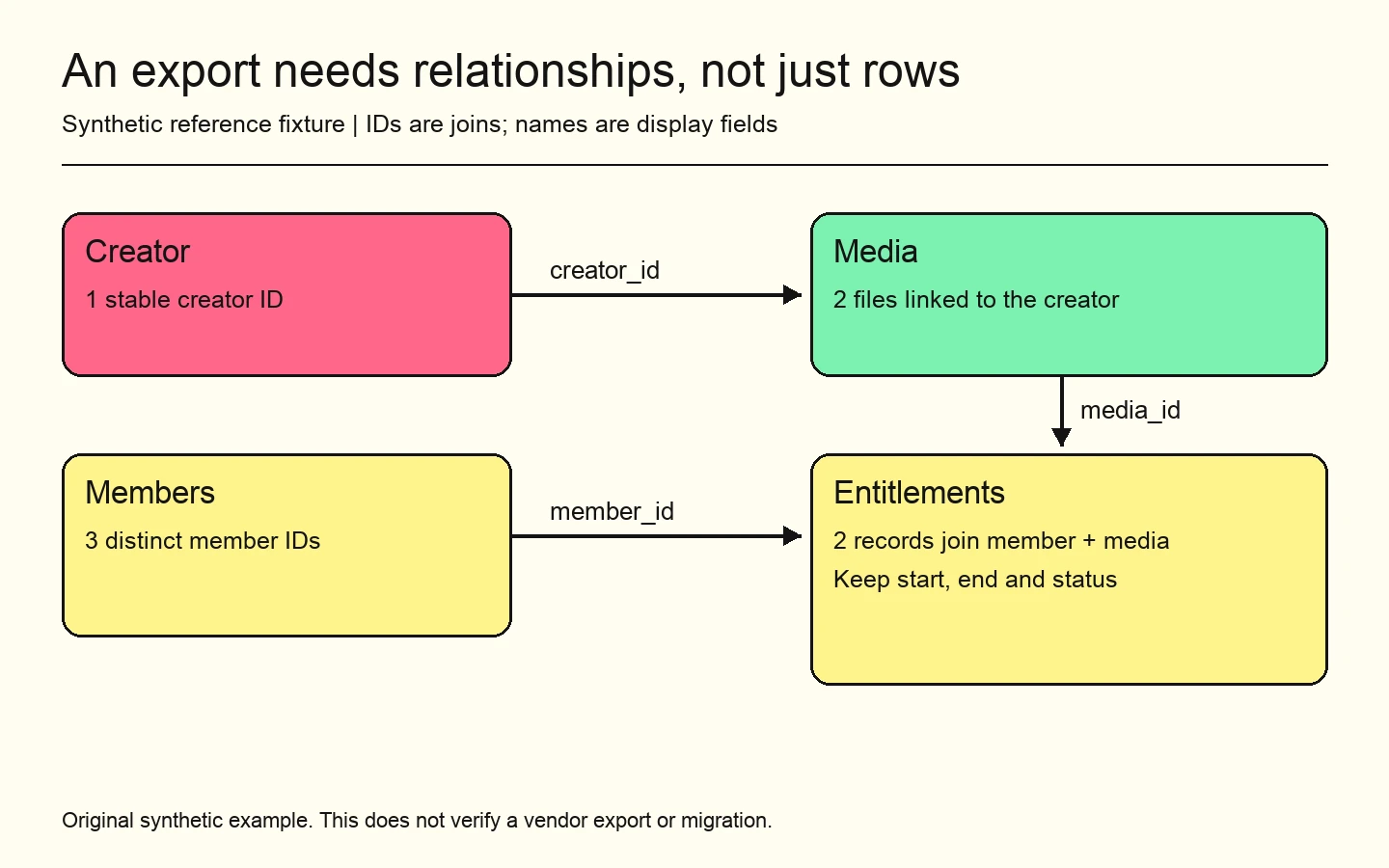
Create one creator with a stable identifier. Add three members: one with current access, one without a purchase, and one whose access has expired. Add two media objects, one public and one protected. Connect the current member to the protected object through an explicit entitlement record.
The contrast matters. A test with only an active purchaser can succeed even if the importer grants access to everyone. A non-purchaser and an expired entitlement give you negative cases: the destination must know when to refuse access as well as when to allow it.
Record the fixture before exporting. Note the expected creator count, member count, media count and entitlement count, along with the evaluation timestamp. These are your independent expectations. If you derive them only from the downloaded files, an incomplete export can validate itself.
Ask for a manifest, not an explanation delivered from memory
A manifest is a small description of what the package contains and how to interpret it. It should travel with the data. A vendor's verbal explanation can help resolve a question, but it should not be the only place the field definitions exist.
Include the package version, export timestamp, time zone, file list, expected record counts and a description of each table. For every file, identify its format, character encoding and the field that uniquely identifies a record. For media, record the relative path, byte count and a content hash.
| File | Minimum information to explain |
|---|---|
| Creator records | Stable creator ID and display name |
| Member records | Stable member ID and clearly scoped contact fields |
| Media records | Media ID, creator ID, relative file path and visibility |
| Entitlements | Member ID, media ID, start, end and status |
| Manifest | Version, timestamps, counts, file sizes and hashes |
Treat this as a specification for the test, not a universal export standard. Your actual platform may use different entities. What matters is that the relationships and interpretation rules are explicit enough for another team to reproduce.
How do you verify the files and relationships?
Display names are poor join keys. Two creators may use the same name, and one creator may change a name after publishing. Email addresses can change too. A destination needs stable source identifiers and a documented mapping to any new identifiers it creates.
Keep those mappings in the import report. A source creator such as creator_demo_01 might become an internal destination record with a completely different number. That is acceptable if every linked media record and entitlement still resolves to the intended entity.
Test uniqueness within each entity type. Then test references between types. Every media row should point to an existing creator. Every entitlement should point to an existing member and media object. A package can contain the right number of rows while those connections are wrong.
Do not silently repair missing references by assigning everything to the first creator or by creating anonymous placeholder members. Such behaviour hides the defect. Reject the affected record, explain the missing relationship and preserve enough detail for the export owner to correct it.
Check the bytes as well as the media links
A catalogue row containing a video URL is not necessarily a copy of the video. The address might require an old login, expire shortly after export or depend on storage that will disappear when the previous service ends.
WordPress illustrates why export scope needs checking. Its export documentation describes a WXR XML content export. The official WP-CLI export reference separately notes that WXR does not contain site configuration or the attachment files themselves. That does not make WXR defective; it makes it important to understand what the format is intended to carry.
For this drill, require the two harmless media fixtures to exist inside the package. Calculate their byte counts and SHA-256 hashes independently, then compare them with the manifest. If a file changes, the check should fail rather than quietly accepting a different object with the same filename.
An equal hash establishes that the compared bytes match. It does not establish ownership, consent, decoding quality or permission to publish. Keep rights evidence and media-quality checks separate from file-integrity checks.
How should paid access be reconstructed?
The hardest record may be the one explaining access. A member's presence in a file does not establish a current right to view protected content. A payment record alone may not explain whether access was cancelled, refunded, delayed or limited to a particular period.
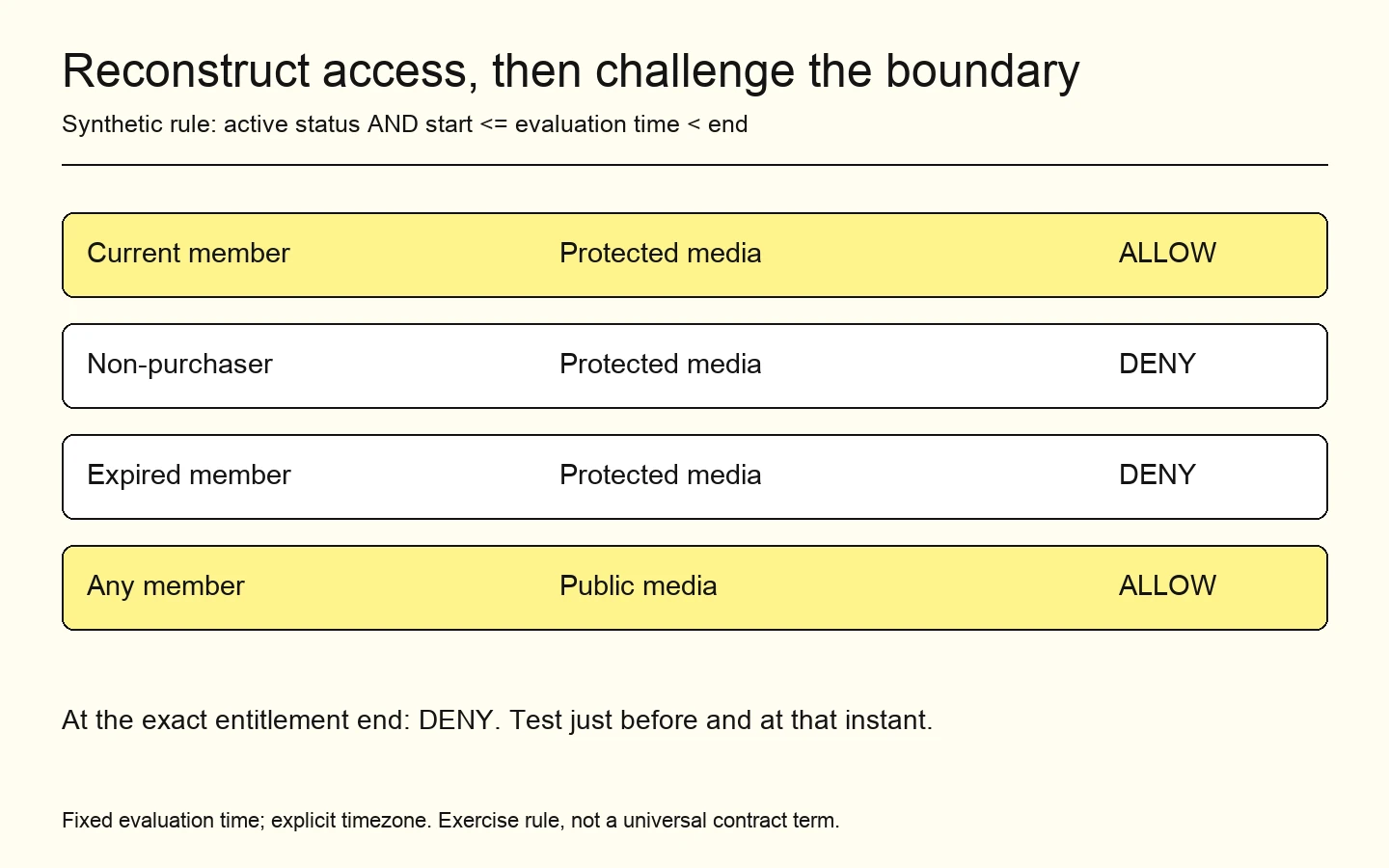
For the reference kit, define an entitlement as active only when its status permits access, its start time has arrived and its end time has not. State that the end boundary is exclusive: at the exact end timestamp, access is no longer active. That is a rule for this exercise, not a claim about every membership contract.
Use the same evaluation timestamp for both systems. Otherwise, an entitlement near expiry can appear inconsistent simply because one check ran later. Preserve time-zone information and avoid converting a timestamp into an ambiguous calendar date.
Make the three expected decisions explicit: the current member can open the protected fixture; the non-purchaser cannot; the expired member cannot. Also verify that the public fixture remains public. These checks distinguish identity import, catalogue import and access reconstruction instead of combining them into one vague success result.
Understand which exports are filtered
Before comparing record totals, check the export settings. A tool may export only a selected audience, period or status. An apparently missing record can be a deliberate filter rather than a storage problem; either way, the receiving team needs to know.
For example, Patreon's Relationship manager documentation says its member CSV reflects the current filters. That is a specific reason to record the filter state alongside the downloaded file. It is not evidence that the CSV can recreate a whole membership service.
Ask the exporter to identify whether inactive, deleted, refunded and expired records are included. You may not need every historic record at the destination, but you need an intentional scope. Otherwise, a migration can accidentally treat a subset as the entire audience.
When comparing Patreon clone features, record export scope as a workflow with inputs and expected results. The development-company handover discussion should also establish who prepares the package, documents the mapping and resolves a failed check.
Preserve an evidence note containing the selected settings, operator, timestamp and package identifier. Redact private information before sharing it beyond the authorized team. A screenshot can document settings, while the manifest explains their meaning in a form that does not depend on someone interpreting the screenshot correctly.
Reconstruct the fixture in a neutral environment
The receiving environment should be independent enough to test the package's usability. For the small reference exercise, a temporary local database is sufficient. You do not need to deploy a replacement commercial platform or connect a payment provider.
Load the records, enforce unique identifiers and check every reference. Open the two media fixtures from the package rather than following the original service's links. Evaluate the access rules using the fixed timestamp and compare each outcome with the expectations you wrote before exporting.
Keep a record of every manual intervention. Renaming a column once may be a documented transformation. Looking up missing dates in the old dashboard for each member is a dependency that changes the effort and risk of migration. Both should appear in the result rather than disappear inside the word "imported."
The kit includes a local checker that loads the synthetic records into an in-memory database and verifies the relationships, media hashes and expected access decisions. Passing that checker validates the supplied reference package only. An actual vendor export still needs to be adapted and checked against its own documented semantics.
Make the checker fail on purpose
A green result is more credible when the checker has demonstrated that it notices relevant defects. After validating the untouched fixture, make controlled copies and introduce one fault at a time. Never alter your only original package.
Change a media file without updating its hash. Remove the referenced creator. Duplicate a member identifier. Point an entitlement to an unknown media object. Each case should produce a clear failure associated with the specific defect, rather than a generic crash or a successful import with missing data.
Then test an access-boundary case. Evaluate the expired entitlement just before its end and at its end. If your business rule uses an exclusive end boundary, the result should change at that point. Document the rule so another engineer can repeat the check.
These negative checks do not establish that the entire platform is secure. Their purpose is narrower: to show that this acceptance procedure distinguishes a valid package from several plausible broken packages. Add further cases when the real export introduces additional entities or business rules.
Keep payment migration on a separate track
Do not put raw card information into this export fixture. A general customer-data package and a payment-data migration are different processes, with different access controls and service-provider requirements.
Stripe's migration guide describes coordinated processor migration and remapping work. It is a useful counterexample to the idea that a spreadsheet containing customer IDs automatically makes recurring billing portable. Check the actual providers, contracts and applicable requirements before deciding what can move.
Your drill can preserve a non-sensitive reference to an order or entitlement without attempting to move the underlying payment credential. Mark that boundary in the result. For example, "historical access reconstructed; future billing not tested" is a meaningful outcome if it accurately describes the work.
The same discipline applies to communications. An exported address is a data field, not by itself a complete answer about what messages a new operator may send. Identify the applicable permissions and responsibilities separately instead of using the technical import as approval for a mailing campaign.
Turn the result into a decision record
Avoid a single pass percentage. A missing thumbnail and a missing entitlement start date do not have the same consequence. Classify the findings by the decision they prevent, and record the evidence that supports the classification.
| Outcome | Meaning for the next step |
|---|---|
| Reference checks pass | This fixture can be reconstructed under the stated rules |
| Documented transformation needed | Another team can repeat the mapping, with known effort |
| Required relationship missing | Request a corrected export before planning a full move |
| External dependency unresolved | Keep that workflow outside the claimed migration scope |
Give every unresolved item an owner and a retest condition. "Supplier investigating" is less useful than "export owner to provide explicit entitlement end timestamps, then rerun cases two and three." The condition makes progress observable.
The minimum result package contains:
- The untouched synthetic export and its manifest.
- The destination mapping and any documented transformations.
- The positive and negative access decisions at the agreed time.
- The checks that failed after deliberate fixture corruption.
- The unresolved dependencies, their owners and retest conditions.
Record the build, export version, environment and completion date. A later product change may invalidate an earlier result. Keep the earlier evidence rather than silently replacing it, so the team can distinguish a capability that regressed from one that was never tested.
Account for changes while an export is running
A small fixture is deliberately static. A real platform is usually still receiving uploads, purchases and cancellations while records are being collected. An export can be individually valid and still represent an inconsistent moment across several tables.
Ask whether the package represents one coherent snapshot or several files produced at different times. Consider a purchase created after the member table was collected but before the entitlement table was collected. Without an agreed boundary, the destination might receive an access record whose member appears to be missing.
For the initial drill, stop changes to the synthetic fixture and record the evaluation time. For later migration planning, ask the teams to describe the snapshot boundary, any follow-up changes and the final comparison. Do not prescribe a production freeze before the impact and implementation have been agreed.
Keep export time, purchase time and access time as separate fields. Replacing them with a single imported date destroys information that can explain a discrepancy. Preserve the original package read-only so a later transformation can be compared with the same source.
Also record who can obtain the package and when temporary copies should be removed. The goal is portability with appropriate control, not spreading private records across laptops and shared folders. A useful public demonstration can use the synthetic fixture while the real package remains within the authorized migration team.
Trace a mismatched identifier through the correction record
Consider a separate fictional import in which member member_17 should receive access to media media_42. The destination creates member 208 and media 915. Its member mapping correctly records member_17 -> 208, but the media transformation accidentally reads the row number and records media_42 -> 914. Both destination media records exist. A foreign-key check therefore passes even though the entitlement points to the wrong work.
This is why a valid reference is weaker evidence than a correct relationship. Before import, give the protected fixture a recognizable harmless description and record its source identifier in the expected-access sheet. After import, inspect which object member 208 can actually request. Checking only that one entitlement exists would miss the error. Checking the expected object and the unrelated neighboring object exposes both the missing permission and the accidental grant.
The correction record should identify the package version, transformation version, affected source record and incorrect destination reference. Preserve the failed result. Explain that the source media identifier was replaced with a positional reference during transformation; do not describe the repair as a harmless filename cleanup. A relationship error changes who can access what.
Create a corrected mapping from the source identifier, then repeat the import into a clean temporary destination. If the team instead repairs an existing destination, document the exact removal and replacement of the erroneous access record. Otherwise, adding the correct entitlement can leave the incorrect one active, producing a superficially successful retest with an extra permission.
Retest the current purchaser, the expired member and the non-purchaser against both objects. Confirm the expected public access separately. Preserve the resulting mapping alongside the untouched package so another engineer can reproduce the repair without knowing the original operator's reasoning. A correction that depends on recognizing a title by eye is still an undocumented manual dependency.
Finally, search the transformation for the same positional assumption in other relationships. A single failed media join may reveal a shared rule that also affects creator ownership or entitlement targets. Keep the conclusion proportional: the corrected fixture can demonstrate that this particular mapping now behaves as specified. It cannot establish that every historical package has been repaired or that an unseen production export contains no similar defects.
Take these questions into the supplier conversation
Ask for the export schema before committing to a migration date. Ask which identifiers remain stable, whether media bytes are included and how expired or refunded access is represented. Request a sample package built from agreed synthetic cases, not a screenshot of a download button.
Ask the receiving engineer what can be reproduced without the old vendor's involvement. A well-documented transformation is manageable. An undocumented dependency on a private API, a manually maintained spreadsheet or a disappearing storage address needs a separate plan.
Finally, agree on what the exercise cannot establish. A small fixture does not prove production throughput, complete legal portability, recovery time or every historical edge case. Its value is finding structural problems early, while the cost of correction is still limited.
Use the reference kit to prepare your acceptance criteria, then apply them to a permitted sample from the platform you are evaluating. Our live-demo evaluation guide provides the wider buyer checklist. Keep this drill's result attached to the export itself: that is the evidence another team will need when "we own the data" becomes an operational question.
If you are evaluating our Patreon clone platform, bring that same fixture and decision record to the project discussion. Define the required evidence before choosing a migration date, then keep the result specific to the build and package actually examined.
Download the companion files
Download the companion kits and worksheets. Worked examples are labeled synthetic, public-source registers retain their references, and unrun protocols are identified. Read each kit's method and limits before using it.
Questions and answers
How do I run a creator platform data export test?
Build a small synthetic fixture with known relationships, export it with a manifest and reconstruct it in an independent test environment. Compare record counts, stable identifiers, media hashes and allowed or denied access decisions. Then introduce selected faults to verify that the procedure detects them. Record the build, time boundary and untested dependencies.
Is a member CSV enough to move a creator platform?
A member CSV may support one part of a move, but it does not necessarily contain media, entitlement periods, transaction relationships or application configuration. Inspect the actual fields and filters before deciding its scope. Treat a usable contact export, a reconstructed service and future billing as separate acceptance decisions.
Does a file hash prove I can publish the media?
A matching hash shows that the compared bytes match. It does not establish ownership, consent, licensing or whether a file can be decoded correctly. Record rights and permitted uses separately, and perform an appropriate media-quality check before publishing or promising a complete catalogue migration.
Can I move recurring payments with the export?
Do not assume that a general data export makes recurring payments portable. The actual providers, contracts, permissions and migration process determine what is possible. Keep sensitive payment information out of the synthetic drill, and describe historical access reconstruction separately from any future billing workflow that has not been verified.
What does passing the synthetic export checker establish?
It establishes that the supplied fixture can be reconstructed under its stated schema, time rule and access expectations, and that the tested corruptions are rejected. It does not establish a vendor's production export quality, complete legal portability, migration throughput or recovery time. An actual package needs its own documented mapping and acceptance checks.
Sources
- WordPress: Tools Export screen
- WP-CLI: WXR export scope
- Patreon: Relationship manager and filtered member exports
- Stripe: customer and payment data migration
Source review dates are recorded in the article and companion material. Draft modification dates do not establish a new source check. Rules, fees and programme terms change; confirm on the source before you rely on them.