App store rules
Delete Account, Cancel Billing: Test Both Paths
Test account deletion and subscription cancellation separately across web and app-store purchases. Check access, billing messages and retained records.
Short answer
An account deletion subscription cancellation test checks identity, renewal and paid access as separate outcomes. Identify the billing owner, define the expected state changes and verify each against independent evidence. Include failed requests, external-store purchases, delayed notifications and the route available after the app is removed. The supplied matrix is a proposed protocol, not an observed platform test.
Key takeaways
- A missing account does not prove that an external recurring agreement has ended.
- Show requested, confirmed and completed actions as different states when they differ.
- Test access and downstream data handling instead of relying on a disappearing profile.
- Keep refund, renewal cancellation and account deletion as separate decisions.
- All ten reference cases are proposed and unrun; no store or production result is invented.
On this page 10 sections
- What should an account deletion subscription cancellation test prove?
- Identify who owns each billing agreement
- Draw account, renewal and access as separate records
- How should the exit screen explain the choice?
- Build a matrix that includes incomplete journeys
- Verify the billing event instead of trusting the button
- What should happen to access and data after deletion?
- Test the journey after the app is gone
- Turn ambiguous results into specific fixes
- Approve the exit journey with a state record

An account deletion subscription cancellation test needs two results: what happens to the account and what happens to the next payment. A missing profile is not evidence that a recurring billing agreement has ended. A cancellation confirmation is not evidence that the account's associated data has been deleted.
Start with a synthetic member who has paid for access through the end of a stated period. Ask to cancel renewal, request immediate account deletion and request deletion after access expires as separate cases. Record the intended account, billing and access outcomes before touching the interface.
This guide supplies a proposed test matrix, example confirmation language and an evidence checklist. It does not report a test of a production platform or a store sandbox. The reference records are fictional, and the local checks validate the worksheet's structure, not whether an application satisfies every policy or legal requirement.
Use the same criteria when evaluating a white-label Patreon clone or another paid-community product. The useful question is whether someone can finish the exit journey with an accurate explanation of their account, payments and remaining access.
What should an account deletion subscription cancellation test prove?
The journey should make three answers independently visible: whether the person can still sign in, whether the billing owner has accepted a change to renewal, and whether protected content remains available. Those answers may change at different times under the applicable arrangement.
Define the intended outcome for each action. A renewal cancellation might leave the account and paid access active until an agreed end. An account-deletion request might start a documented process, while an external billing agreement still needs attention. Neither result should be hidden behind a single label such as "closed."
Keep the policy boundary visible. This is an operational test design, not legal advice. The actual retention, cancellation, refund and consumer-rights decisions depend on the service, transaction and applicable requirements. Have the responsible policy owner document those decisions before treating the expected-result column as an instruction to engineers.
Our app-store rules for creator subscription apps guide explains the broader submission context. The narrower task here is to connect an exit action with observable states and truthful messages. It remains useful even when the app's purchasing route changes.
Identify who owns each billing agreement
Create a synthetic purchase inventory before drawing the screens. Give each agreement a non-sensitive reference, billing owner, product, renewal setting, paid-through timestamp and environment. An email address or the device currently in use is not enough to establish where a purchase was made.
A member can use a phone to access something bought on the web. Another can sign into the website using an account whose purchase was managed by a store. The exit journey should identify the agreement behind the access rather than infer billing ownership from the current screen.
For each permitted billing route, document the supported management destination and the evidence of a completed change. If the application can only provide directions to an external owner, say so accurately. Do not show "subscription cancelled" merely because the person opened a management page.
Google Play's subscription help explicitly distinguishes uninstalling an app from cancelling its subscription. Include uninstall as a negative-control case in the worksheet: it must not be used as your evidence that billing has ended.
Also test the member with no recurring agreement. That person should not be sent through irrelevant cancellation instructions or shown an invented next payment. A useful exit flow is specific about what exists, what was changed and what remains unknown.
Draw account, renewal and access as separate records
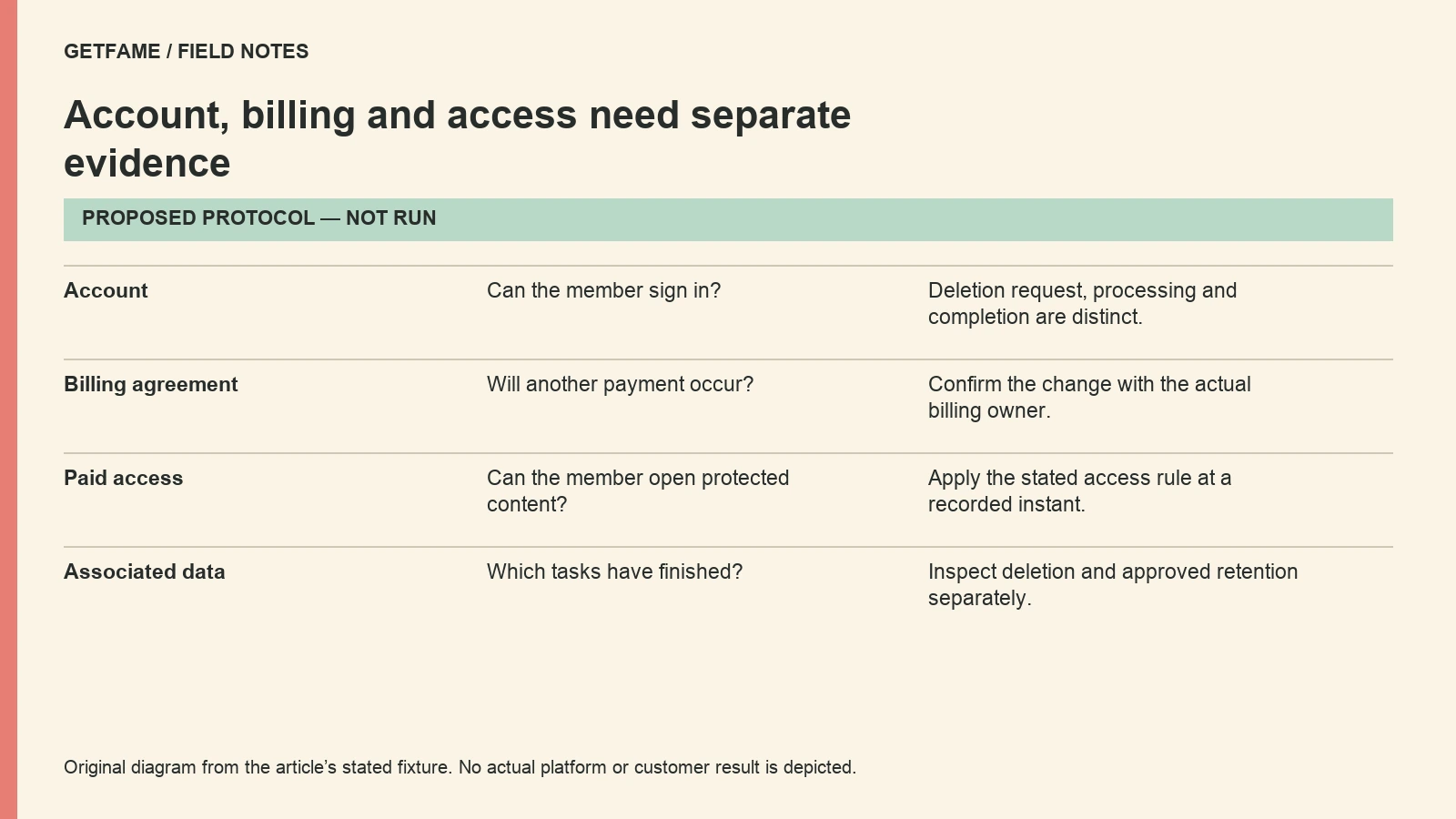
The example below uses descriptive states for a proposed test. They are worksheet labels, not a claim that every provider exposes these exact statuses. Map the actual application's records onto the meanings before running a real case.
| Record | Example state before the action | Evidence to inspect afterwards |
|---|---|---|
| Account | Active identity | Request accepted, deletion processing or deletion completed |
| Billing agreement | Renewal enabled | Owner-confirmed renewal change or a documented unresolved action |
| Access | Paid through an agreed instant | Authorized access or denial under the stated rule |
| Data handling | Records associated with the member | Deletion and approved retention tasks with their own completion evidence |
Keep a request identifier that connects these records without exposing credentials. The support team needs to explain a delayed task, but it should not need a screenshot containing a full payment instrument or an administrator token.
For the reference matrix, an end-of-period cancellation leaves access active until its stated end. At that exact end, the example's access rule denies entry. Immediate deletion closes sign-in when the fictional process completes; the worksheet does not promise that an external recurring agreement changed as a side effect.
Do not let those illustrative rules silently become your contract. Record the actual policy, effective time and owner next to each expected transition. When a rule changes, keep the older test version so a changed expectation is not confused with a software regression.
How should the exit screen explain the choice?
A useful confirmation identifies the action, its effective time and anything outside that action. The language can be concise without compressing three different outcomes into "everything is cancelled." Write the copy from the verified states, not from the label on the button.
For a fictional end-of-period cancellation, proposed copy could say: "Renewal is off. Your current access ends at the time shown below. Your account remains available." The displayed end must come from the relevant record, and the wording should appear only after the billing owner confirms the change.
For a fictional external-store agreement, proposed copy could say: "Account deletion does not confirm that this store-managed subscription has stopped renewing. Open the subscription manager to check its status." Adapt the route and wording to the actual owner; a generic help-page link may not complete the task.
Apple's account-deletion guidance requires clear handling of account deletion and explains the separate subscription issue. It also permits a later deletion option aligned with subscription expiry when immediate deletion remains available. Check the current guidance for the actual app and transaction.
Treat these sample messages as editorial examples, not approved legal text. During testing, compare every assertion in the message with recorded evidence. If the system only knows that a request was submitted, the message should say "requested," not "completed."
Build a matrix that includes incomplete journeys
A test consisting of one successful web cancellation leaves most of the exit journey unexplored. Add cases that force the application to distinguish purchase ownership, effective time, retry behaviour and missing confirmation. Use test identities whose expected states are known beforehand.
The reference worksheet includes web cancellation, immediate deletion, store-managed deletion instructions, deferred deletion, a member without a subscription and an app uninstall. It also includes a failed cancellation request, a repeated deletion request, a delayed billing notification and a refund whose effect on future renewal must be verified separately.
For every case, capture the following fields:
- Starting account, billing and access states.
- The exact action and the identity authorized to perform it.
- Expected transitions and their effective times.
- Required confirmation evidence and its source.
- Observed result, evidence reference and unresolved issue.
Leave the observed-result field blank until an authorized application test occurs. The supplied matrix contains proposed expectations, not fabricated screenshots or completed store results. A local worksheet check can reject missing fields and contradictory labels without proving the underlying journey works.
Use fresh synthetic identities or a documented reset between cases. Otherwise, a cancellation performed in the first test can make a later case appear successful even though its button did nothing. The starting state is part of the evidence, not just preparation.
Verify the billing event instead of trusting the button
A button click shows intent. A successful application response may show that an internal request was accepted. The billing owner's state and the resulting access decision provide different evidence. Record the entire chain needed for your specific route rather than declare success at the earliest green indicator.
Stripe's cancellation documentation distinguishes immediate cancellation from cancellation at the current period's end. It also treats pausing payment collection as different from changing subscription status. Use that as a provider-specific reason to map your actual fields carefully, rather than treating any paused-looking record as a cancelled agreement.
Test a failure before confirmation. In the proposed matrix, the application must preserve the unresolved billing task and show a truthful message. Closing the dialog or deleting the local profile must not transform a failed request into evidence of owner-confirmed cancellation.
Next, deliver a duplicate or delayed test notification through the mechanism your environment supports. Check that the same event does not create a second task, restore renewal accidentally or overwrite a newer confirmed state. These are acceptance questions for a permitted test, not results established by this article.
Keep the billing reference available to the authorized operations team while minimizing the personal information retained with it. The precise retention basis needs its own policy decision. Do not preserve an entire customer profile simply because a small reconciliation reference is useful.
What should happen to access and data after deletion?
Choose observations that reveal incomplete work. Try signing in with the deleted test identity, refreshing a previously open session and requesting protected content through a saved link. A hidden profile card does not establish that an old authenticated session has stopped working.
Test public content separately from member-only content. A public article remaining visible is different from a private purchase staying accessible under an old authorization token. Record which content and identity were used so the result cannot be misread as a general statement about all data.
For data handling, list the systems that hold associated records and the task expected in each. Separate identity storage, uploaded content, support records and external service requests. Avoid a universal "deleted everywhere" message until the scope and supporting evidence justify it.
Google Play's account-deletion requirements describe both an in-app path and a web resource, along with disclosures around legitimate retention. Use the actual policy and appropriate advice to define your service's scope; the worksheet does not establish a universal retention period.
Where deletion runs asynchronously, show the request, progress and completion evidence as different states. An operations queue with a pending task is evidence that work exists, not evidence that it finished. Give failures an owner and a next check rather than repeatedly resetting the visible completion date.
Record retention decisions without keeping an unnecessary profile
A retention decision needs more detail than "keep for compliance." In the proposed worksheet, add the record category, responsible system, approved reason, access restriction and next review condition. The task owner should be able to explain which information is needed without automatically preserving every field collected during sign-up.
Keep the policy decision separate from technical completion. An approved decision to retain a limited transaction reference does not prove that unrelated profile fields were removed. Likewise, a deletion job returning success does not establish that every downstream system received its own request.
Inspect a permitted example of the retained record after the synthetic deletion. Compare its fields with the approved scope and confirm which roles can read it. A support operator who needs a request status may not need access to the original member's full message history. The exact access decision belongs to the responsible team, but the test should reveal what the implemented role can actually see.
Add a retest condition when a downstream service is unavailable. Keep its unresolved task visible and avoid claiming complete erasure while the process is still waiting. Do not invent a universal completion deadline or retention period to fill a blank in the matrix. Record the applicable decision and supporting reference for the actual service.
Test the journey after the app is gone
A person may remove the application before asking for help. Walk the external deletion and subscription-management routes without relying on a logged-in app session. Check that instructions identify the service and do not send the person around a loop between a store listing and a missing settings screen.
Use a signed-out browser for the discovery part, then follow the supported verification process with the synthetic identity. Appropriate identity checks protect the account; an inaccessible requirement to open a deleted app can prevent a legitimate request. Document the difference in the issue report.
Preserve a usable support reference for an incomplete exit. It should allow the authorized team to locate the request without asking the person to send passwords or full payment details. Check that confirmation messages still have a valid destination under the agreed handling process.
Test a later sign-up with the same fictional email address as a separate case. It must not be used as proof that the earlier account was never deleted, nor should it silently restore old permissions. Document how the application distinguishes a new identity from a retained transaction reference.
Our subscriber churn guide addresses why people leave. This exercise should not turn cancellation or deletion into a retention obstacle. Diagnose the reason separately while keeping the requested exit accurate and understandable.
Turn ambiguous results into specific fixes
Classify an issue by what the person was told and what actually happened. "Deletion broken" is too broad when the real defect is a management link opening the wrong destination, an unresolved billing request being marked completed, or an old session retaining protected access.
For each discrepancy, attach the case identifier, starting state, observed message and independent evidence. Explain the consequence in concrete terms. A misleading cancellation confirmation can change a person's payment expectations even if the profile deletion itself finished correctly.
Prioritize contradictions before cosmetic changes. A grammatical improvement is useful, but it should not consume the review while a message still claims a failed billing request succeeded. Keep the intended behaviour and observed behaviour side by side so the fix can be retested.
The Patreon clone features discussion can help scope the relevant member journeys, while the Patreon clone development-company guide covers delivery responsibilities. Attach your exit matrix to that conversation and agree who owns billing verification, access testing and completion messages.
Avoid making the report a list of unexplained screenshots. A screenshot can preserve a message, but the case record explains what should have happened and why. Redact sensitive details and retain the reference needed to find the authorized test evidence.
Follow an unfinished deletion across the second device
Use a fictional member with an active session on a phone and another session in a desktop browser. The member submits an immediate deletion request on the phone. The application accepts the request, but a separate billing-cancellation task receives no confirmation. This case should remain visibly unfinished even if the phone returns to its signed-out screen.
Before running a permitted test, write the intended sequence. Identify when the account should stop authenticating, what should happen to existing sessions, which evidence confirms the billing change and how the member receives an update. A policy owner must supply the expected rules. The test should not invent a retention period or cancellation effect merely to complete the worksheet.
For the desktop observation, keep the browser session open before submitting deletion. Afterwards, request a fresh protected resource rather than relying on content already displayed on the screen. Record the response and the time. A page that was loaded earlier may remain visible without proving that the server still grants access; a successful new protected request raises a different question. Preserve those observations separately.
Next, try a session refresh and a new sign-in using the synthetic identity through the supported route. Record whether the application rejects the request, shows deletion in progress or creates an unexpected new identity. Do not repeatedly retry in a way that changes the starting state without documenting it. The evidence should show which operation was attempted against which account record.
Meanwhile, the billing task needs its own owner and next check. If the application has only submitted a cancellation request, the status should remain cancellation requested or confirmation pending under the team's chosen terminology. Neither the removed profile nor the invalid desktop session supplies the missing billing evidence. A support view should connect the unresolved agreement reference to the deletion request without reopening the deleted member's access.
For this fictional case, assume an approved retention decision permits a minimal transaction reference, deletion request identifier and task status for a stated purpose. The acceptance record should compare the retained fields with that approved scope. It should also identify who can read them and what review or removal condition applies. This assumption does not authorize retaining message history, uploaded documents or a complete profile for convenience.
When the billing owner later confirms the cancellation, attach that evidence to the same request. Check that a delayed confirmation cannot reactivate the deleted account or replace a newer status with an older one. If confirmation never arrives, close only the portions supported by evidence and keep the unresolved agreement explicit. The member-facing explanation and the operations record should agree about what finished and what still needs attention.
The resulting review is more useful than a single screenshot of a successful deletion dialog. It can distinguish a completed account action, a second-device authorization defect, a pending external action and a limited retained record. Those are different fixes with different acceptance evidence, even when one member encountered them during the same exit journey.
Approve the exit journey with a state record
An exit review is complete when the team can explain the tested account, billing and access outcomes without inferring them from a disappearing screen. Keep the matrix, relevant policy version, observed evidence and unresolved tasks together. A later app release can then be checked against the same expectations.
Have the reviewer inspect a failed request and an external-billing route as well as the clean success case. If no store sandbox was available, state that limitation and leave those observations uncompleted. Documentation review cannot fill in a missing application test.
Make the decision specific: ready for the tested routes, ready after a named correction, or not evaluated for an excluded route. Do not convert a few passing cases into a compliance badge covering every region, agreement or data processor.
Before approving the build, ask for an evidence package another person can read: the test identity reference, starting states, actions, resulting messages, owner-confirmed billing state and access observations. Include the person responsible for any remaining downstream deletion task and the condition that will close it.
For a Patreon clone platform evaluation, bring that same matrix to the demonstration. An honest result distinguishes what was requested, what was confirmed and what still requires work. That distinction is the foundation of an exit experience a member can understand.
Download the companion files
Download the companion kits and worksheets. Worked examples are labeled synthetic, public-source registers retain their references, and unrun protocols are identified. Read each kit's method and limits before using it.
Questions and answers
Is deleting an account the same as cancelling a subscription?
Treat them as separate actions unless the actual billing arrangement and implementation establish their relationship. Record the account state, the billing owner's confirmed renewal state and the access outcome independently. A deleted profile or a submitted request is not enough evidence that future billing has changed.
What should the exit test matrix contain?
Include the starting identity, billing owner, access period, requested action, expected transitions, policy reference and evidence required for each result. Leave observations blank until a permitted test occurs. Add failed requests, external billing, delayed updates and repeated actions so the matrix does more than describe one successful cancellation.
Should cancellation always remove access immediately?
Do not prescribe one universal outcome. The intended access rule depends on the actual agreement and effective time. The reference exercise includes a fictional end-of-period cancellation whose access continues until its stated end, but the service owner must document and verify the rule used for the real journey.
Can a refund be used as evidence that renewal stopped?
Do not infer the renewal state from a refund alone. Inspect the actual agreement and the billing owner's confirmed state, then apply the agreed access treatment. Keep the refund reference and cancellation evidence separate so a successful change to one record cannot hide an unresolved action in another.
Has this guide tested a store account or certified compliance?
No. The supplied matrix is an original proposed protocol using synthetic expected states. Local checks validate required fields and reject selected contradictions. No production account, store sandbox, real subscription or customer deletion was exercised, and the guide does not replace appropriate policy or legal advice for the actual service.
Sources
- Apple: account deletion and subscription handling
- Google Play: account deletion requirements
- Google Play: managing and cancelling subscriptions
- Stripe: subscription cancellation and effective time
Source review dates are recorded in the article and companion material. Draft modification dates do not establish a new source check. Rules, fees and programme terms change; confirm on the source before you rely on them.