Ready-made, one-time
$3,999
Instagram Clone
Live in 6 working days from kickoff
- Full source code
- White-label under your brand
- 60 days of technical support
- 1 year of free updates
- App publishing support
Photo and reels social app
Posts, reels, stories and a shop, all under your name
A finished visual social platform for web, Android and iOS: multi-format publishing, direct messages, live broadcasting, a native shop, five creator revenue lines and a twelve-panel admin console. Privacy rules live in the database, and you get the whole codebase.
The facts a buyer checks first, in one place. Everything on this page is the product as it ships.
| Product type | Visual social network with posts, reels, stories, live, a native shop and a wallet |
|---|---|
| Surfaces | Web app, Android app and iOS app from one codebase, plus a twelve-panel admin console |
| Platform price | $3,999 one-time, deployed on your own infrastructure |
| Launch time | 6 working days from kickoff; items that need your credentials set the pace |
| Source code | Full React, TypeScript and Vite source, database schema and migrations, no per-seat fee |
| Stack | React 18, TypeScript 5, Vite 5, PostgreSQL 14, Supabase Auth, Capacitor 8, Deno edge functions |
| Data model | 55 tables with Row-Level Security on every table and an append-only wallet ledger |
| Payment gateways | Stripe, Razorpay, PayPal, Apple Pay or Google Pay, connected with your own merchant credentials |
| Revenue lines | Verified profiles, creator tiers, gifts, self-serve ads and shop commission |
| Support and updates | 60 days technical support, 1 year free updates, app publishing support |
An Instagram clone is a ready-made visual social platform. It reproduces the parts of a photo and video network that take longest to build: a publishing engine for posts, carousels, reels and stories, an engagement graph, private messaging, live broadcasting, and the monetization and governance layers underneath them. This one is a working product, not a front-end theme.
What you receive is the application source, the database and the documentation around it. The web app, Android app and iOS app ship from a single TypeScript bundle, and the Postgres schema carries identity, social graph, content, messaging, commerce, live and a typed wallet ledger. There is no runtime license, per-seat fee or dependency on our roadmap.
Each capability is labeled as included, configuration required or integration required, so you know what needs your own credentials. Payment capture, email, SMS and push delivery connect through documented integration points. Beyond that, features can be enabled, disabled or extended to fit your model.
Instagram is a visual social network from Meta. Its core is a follow graph with photo and short video posts, carousels, expiring stories, saved highlights, reels, direct messages and live video, with shopping tags and creator subscriptions layered on top. People use it to show a life, a craft or a product, and brands use it to reach customers where they already look at pictures.
An Instagram clone is a ready-made platform with the same family of formats, which you launch as your own network. It has no connection to the original service or its members. The practical appeal is control over a smaller space: a niche, a community or a brand audience where you set the privacy rules, keep the data, define how creators earn and add commerce without depending on a host network.
Each role works in its own side of the same product. The screens come from the working demo.
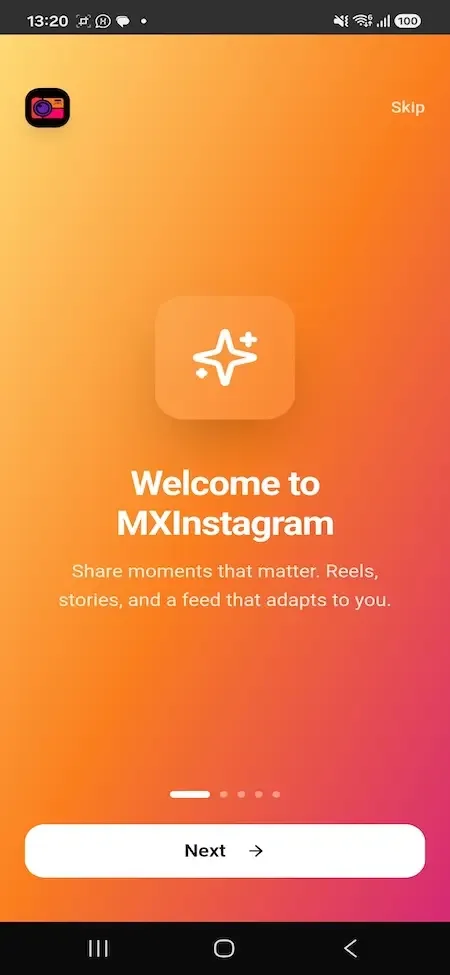
A member signs up, picks an account type and starts following people and topics. From there the app behaves like any visual network, with posts, reels and stories in the feed, messages in the inbox and a shop one tap away. Privacy settings apply everywhere, not just on the profile page.


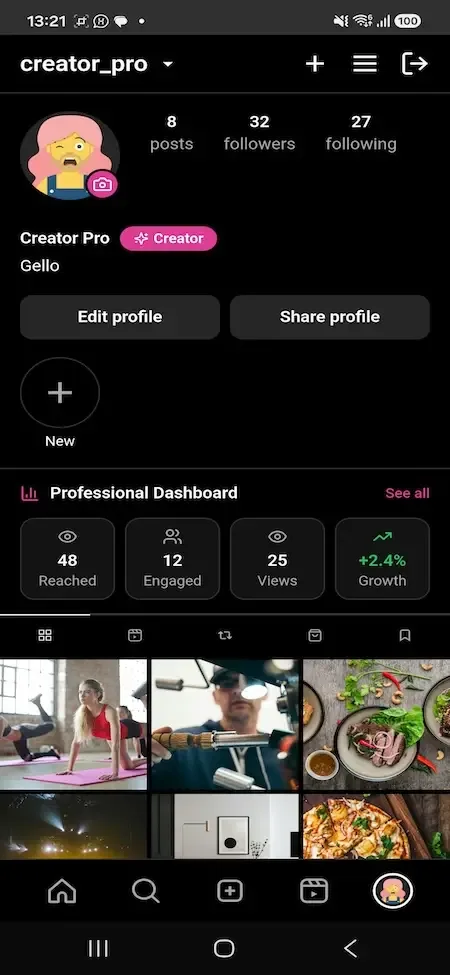
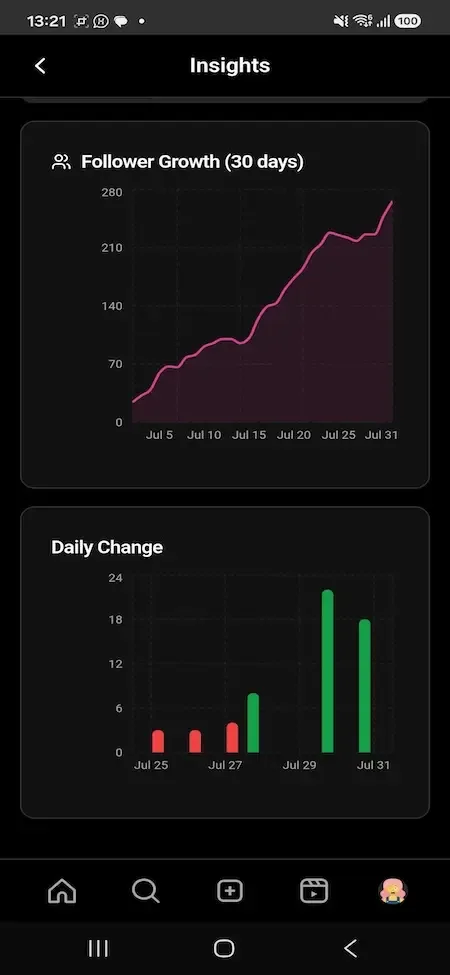
Creators publish in every format from one composer and then decide how to earn. They can run subscription tiers, accept gifts, go live, promote posts and tag products, and a single analytics screen shows what each line produced over the last thirty days.

Sellers list products inside the same app where buyers already spend time. Listings connect to content through tags, orders run through a defined lifecycle and refunds go back to the buyer wallet, which keeps the books straight.
Operators work from a twelve-panel console with a split between moderators and administrators. Destructive actions can be reversed within a recovery window, and every privileged action writes to an audit log that cannot be edited from the interface.
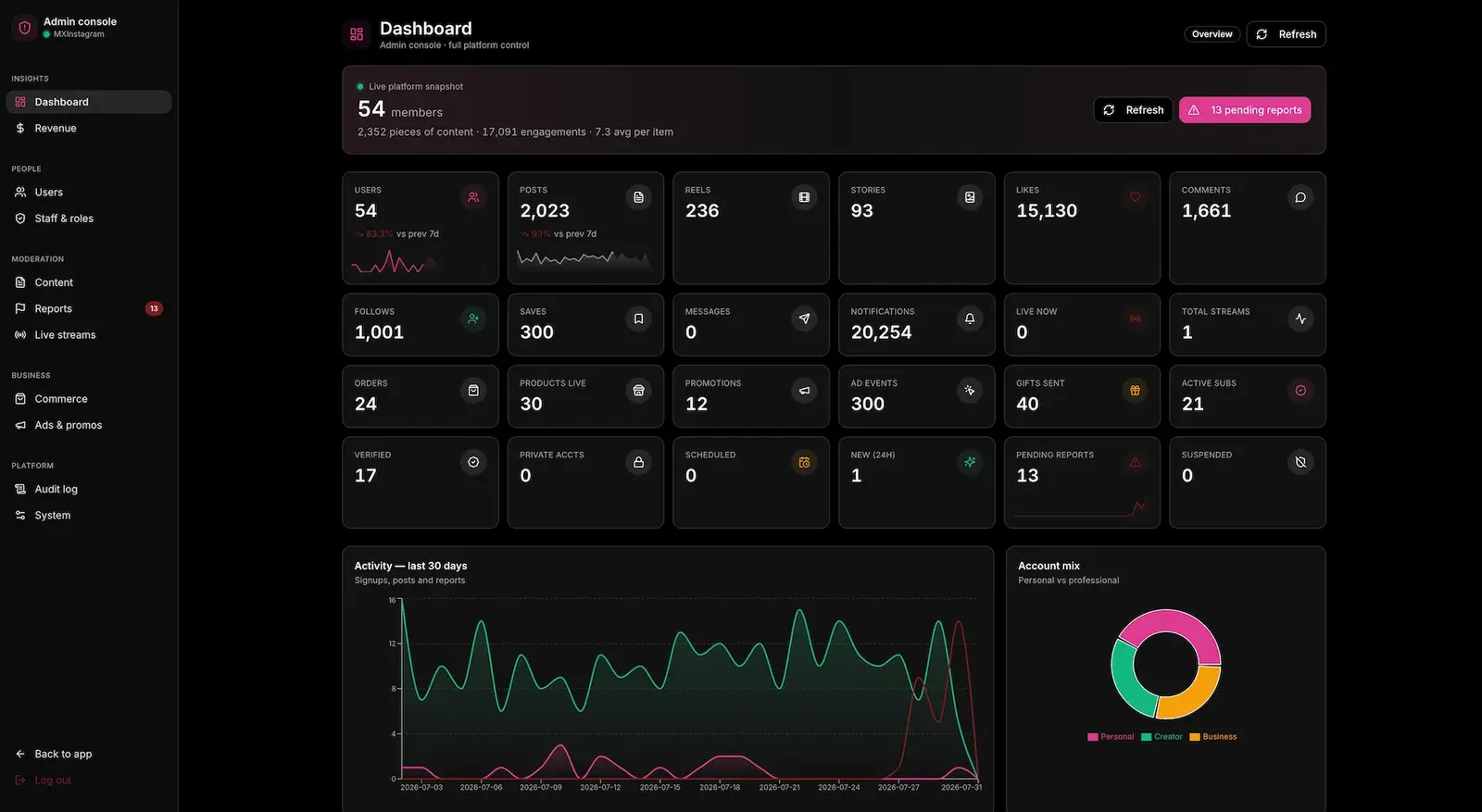
17 screens from the working demo, grouped by where they live. Your platform ships rebranded with your name, logo and colors.
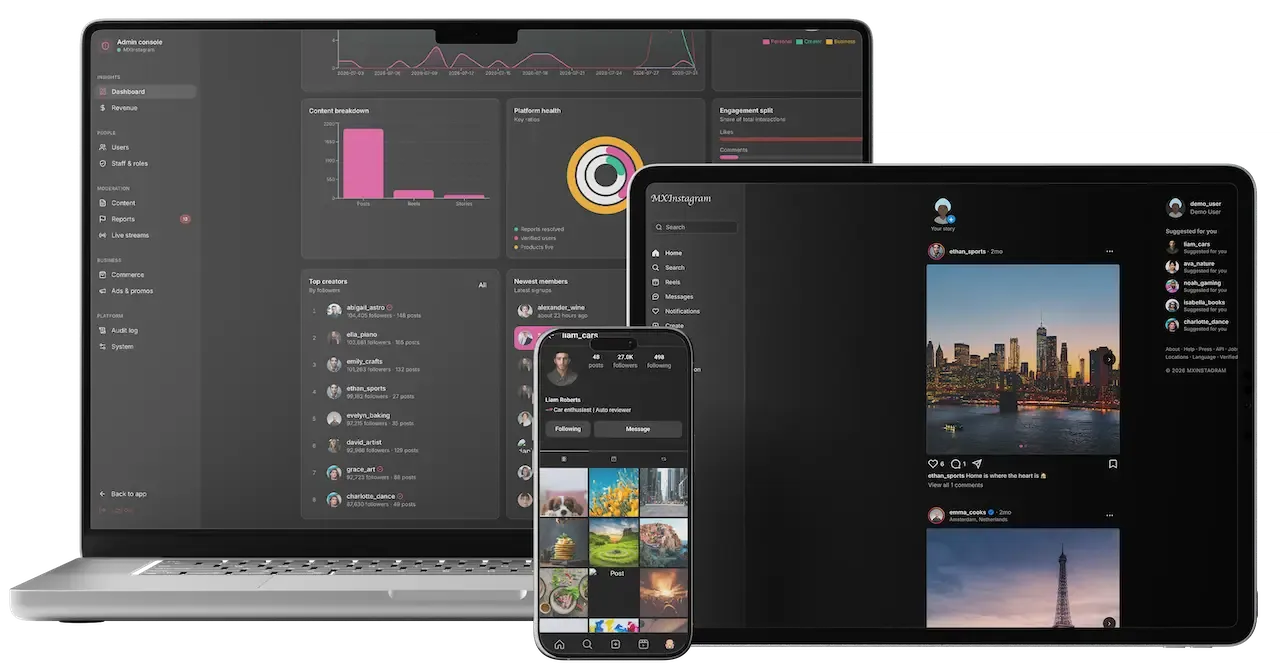

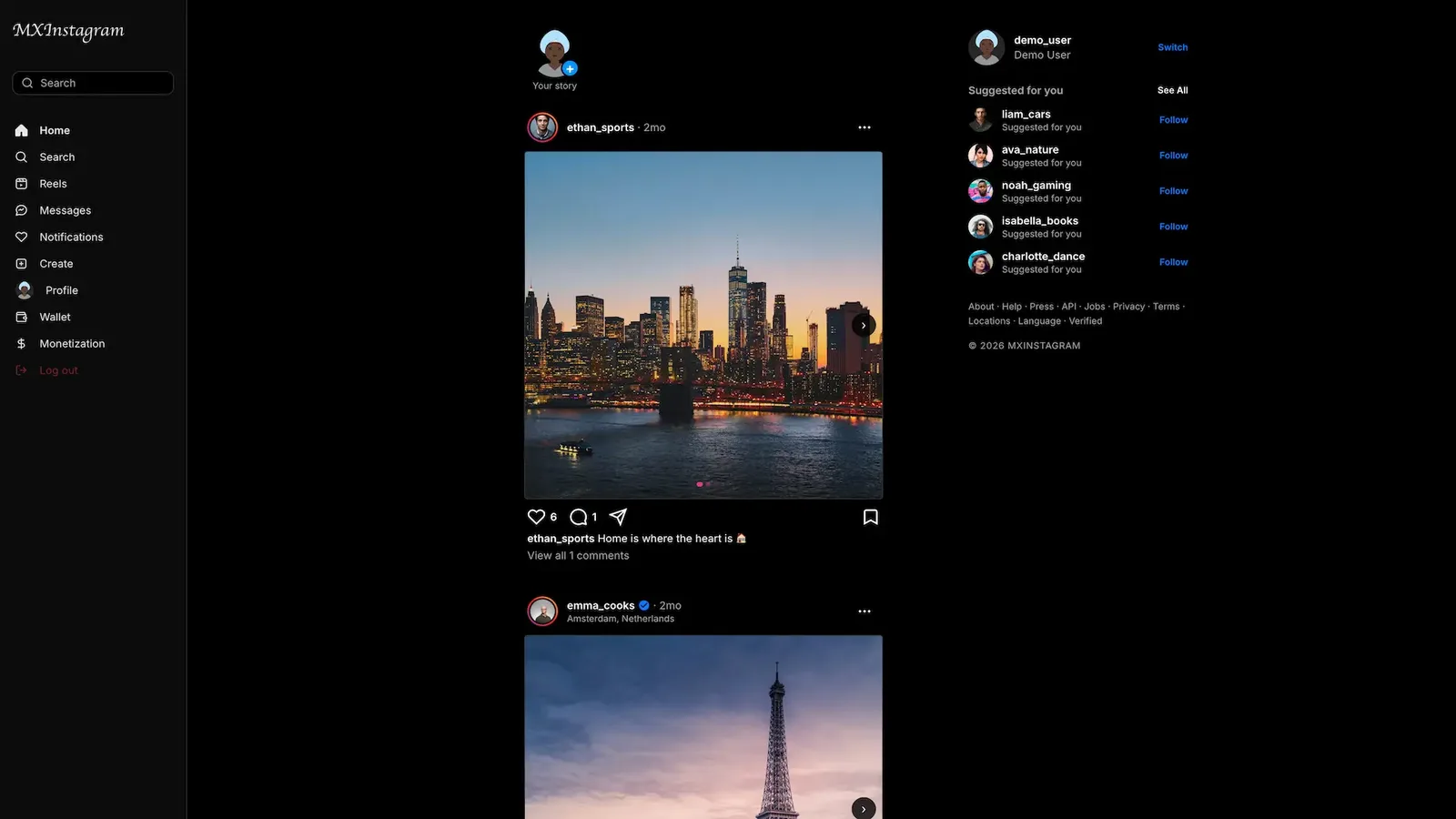


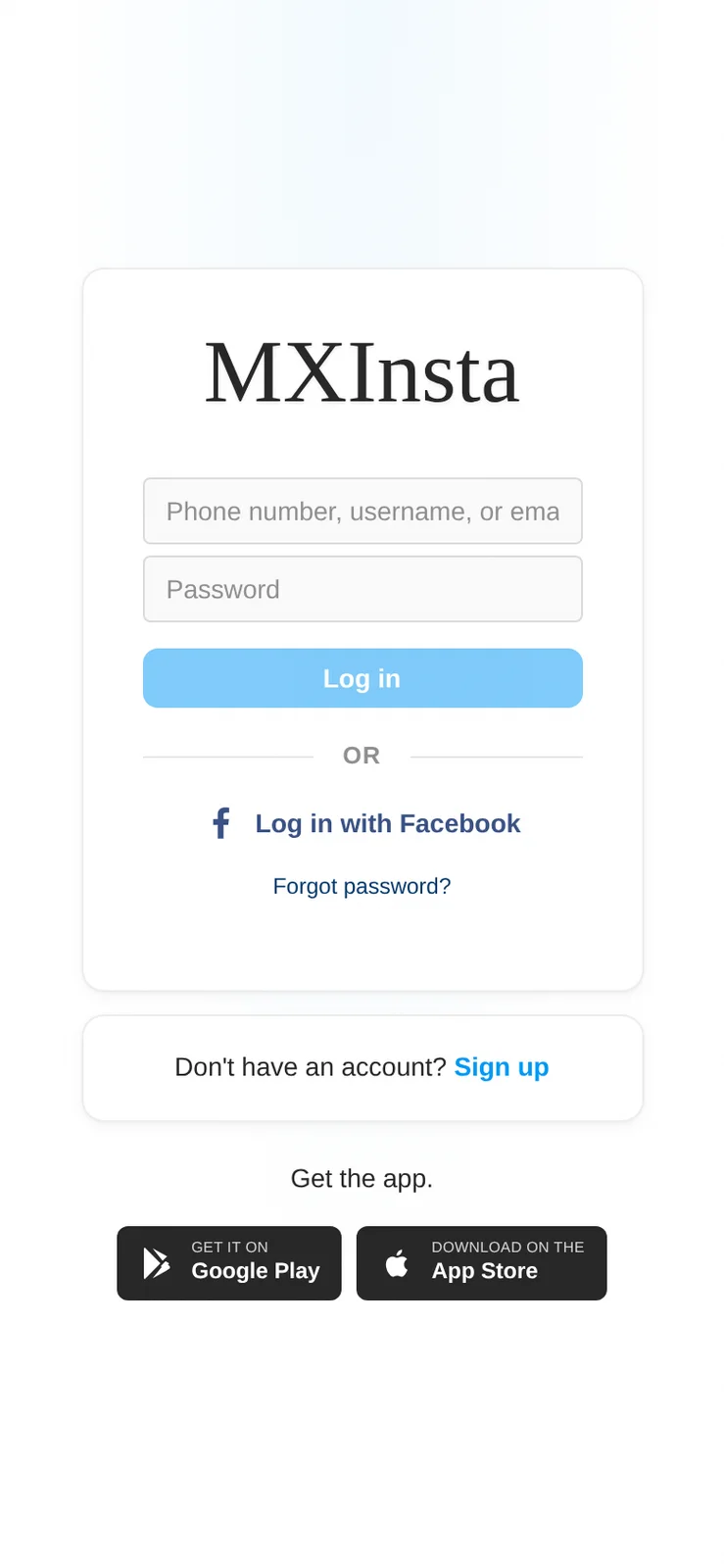
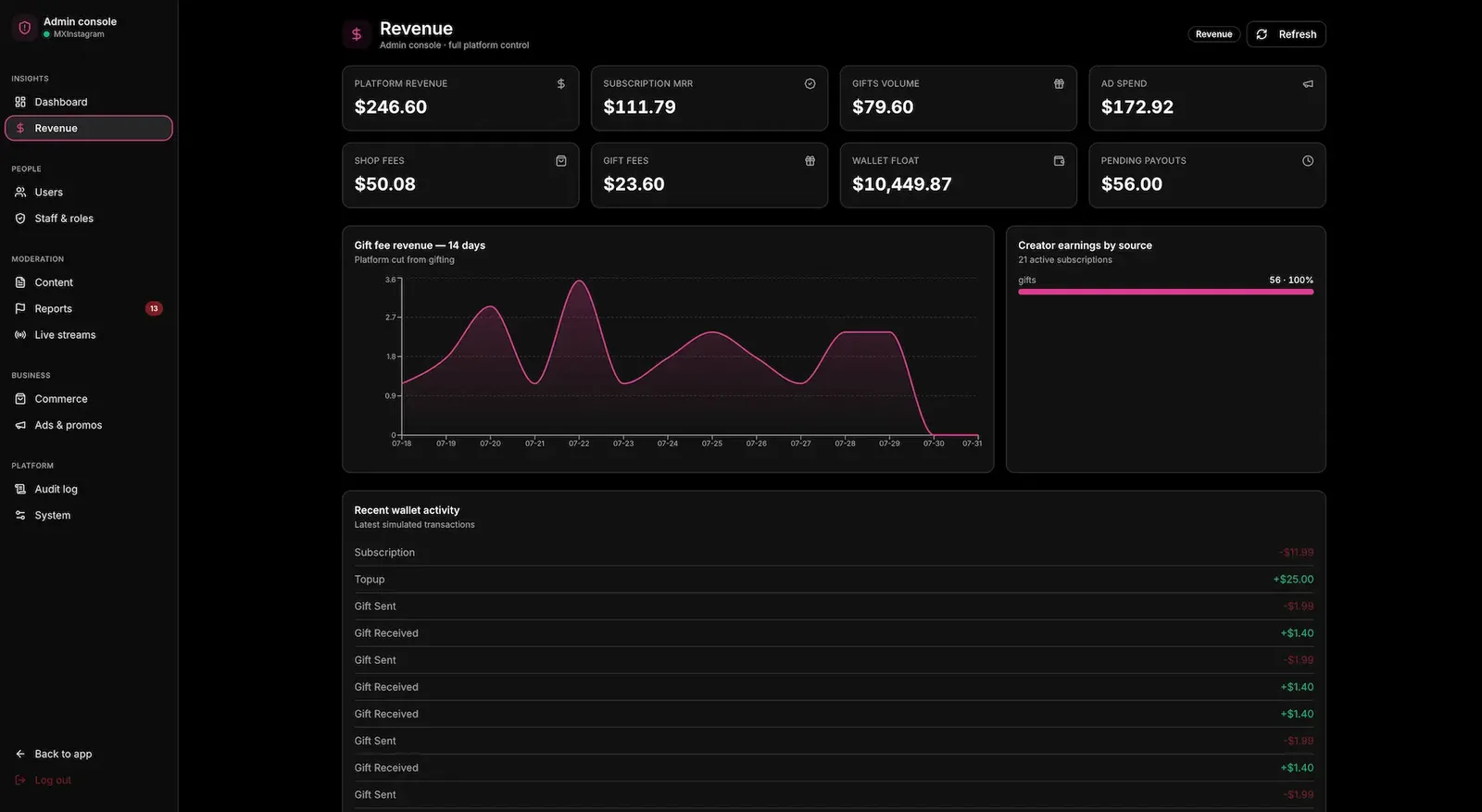
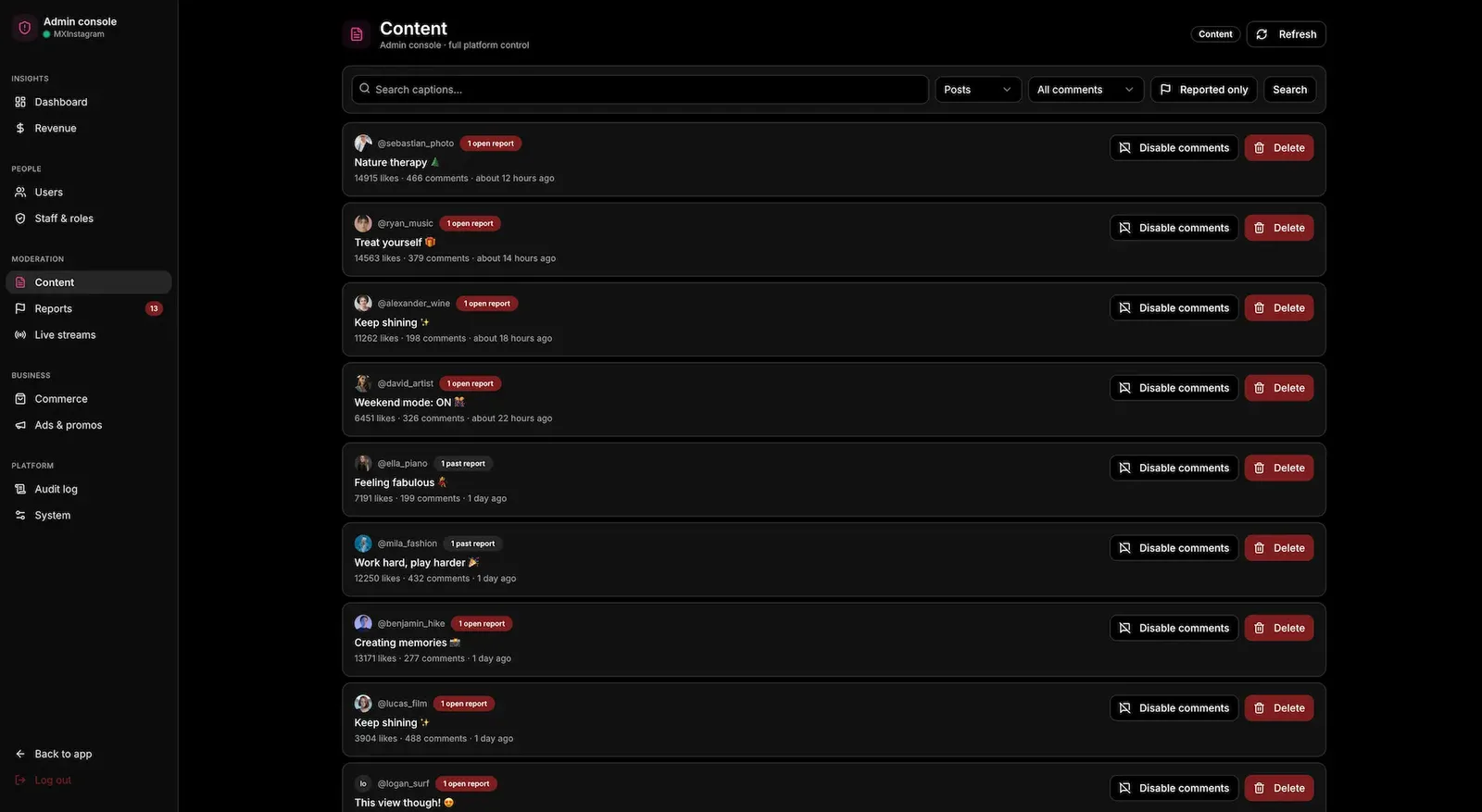
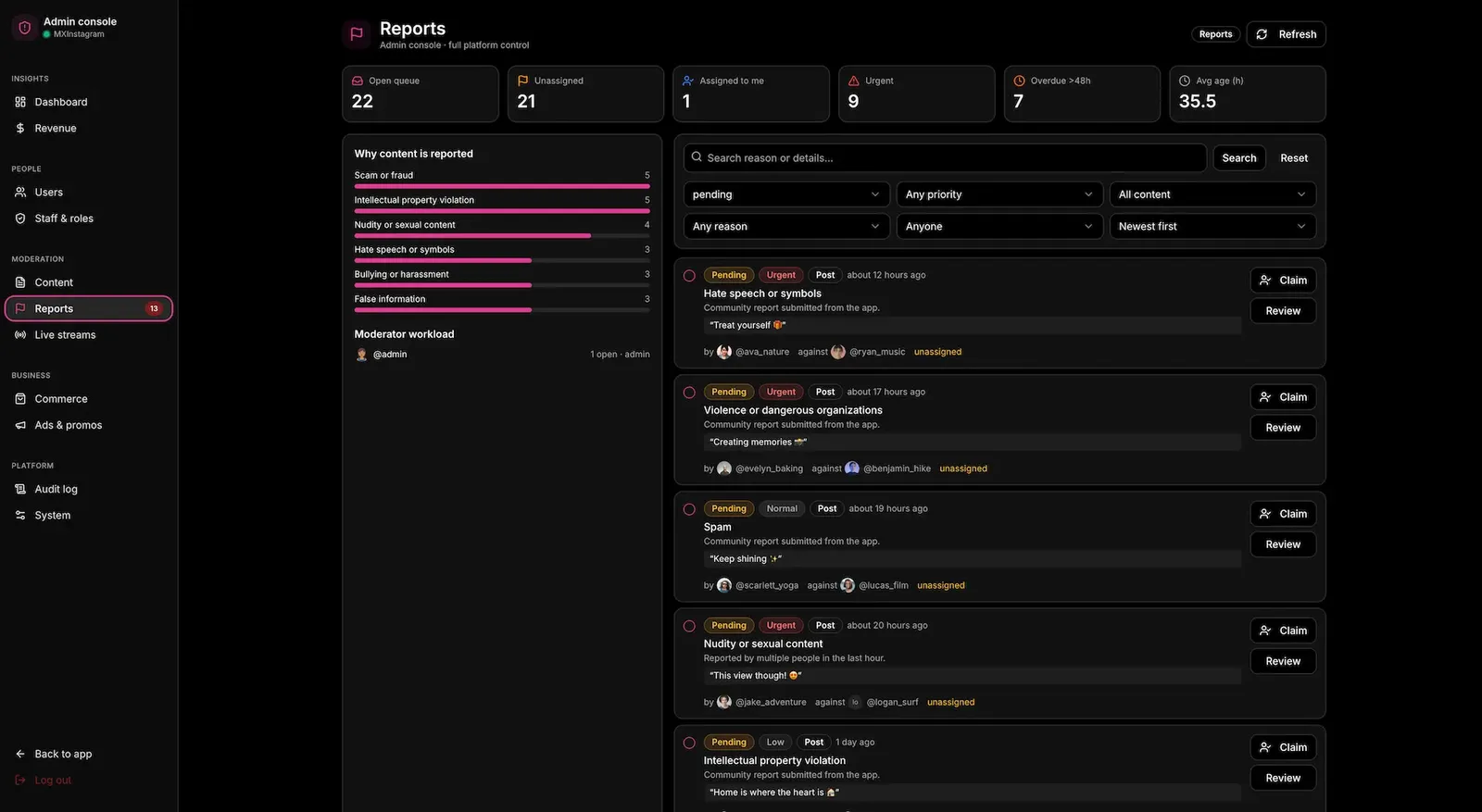
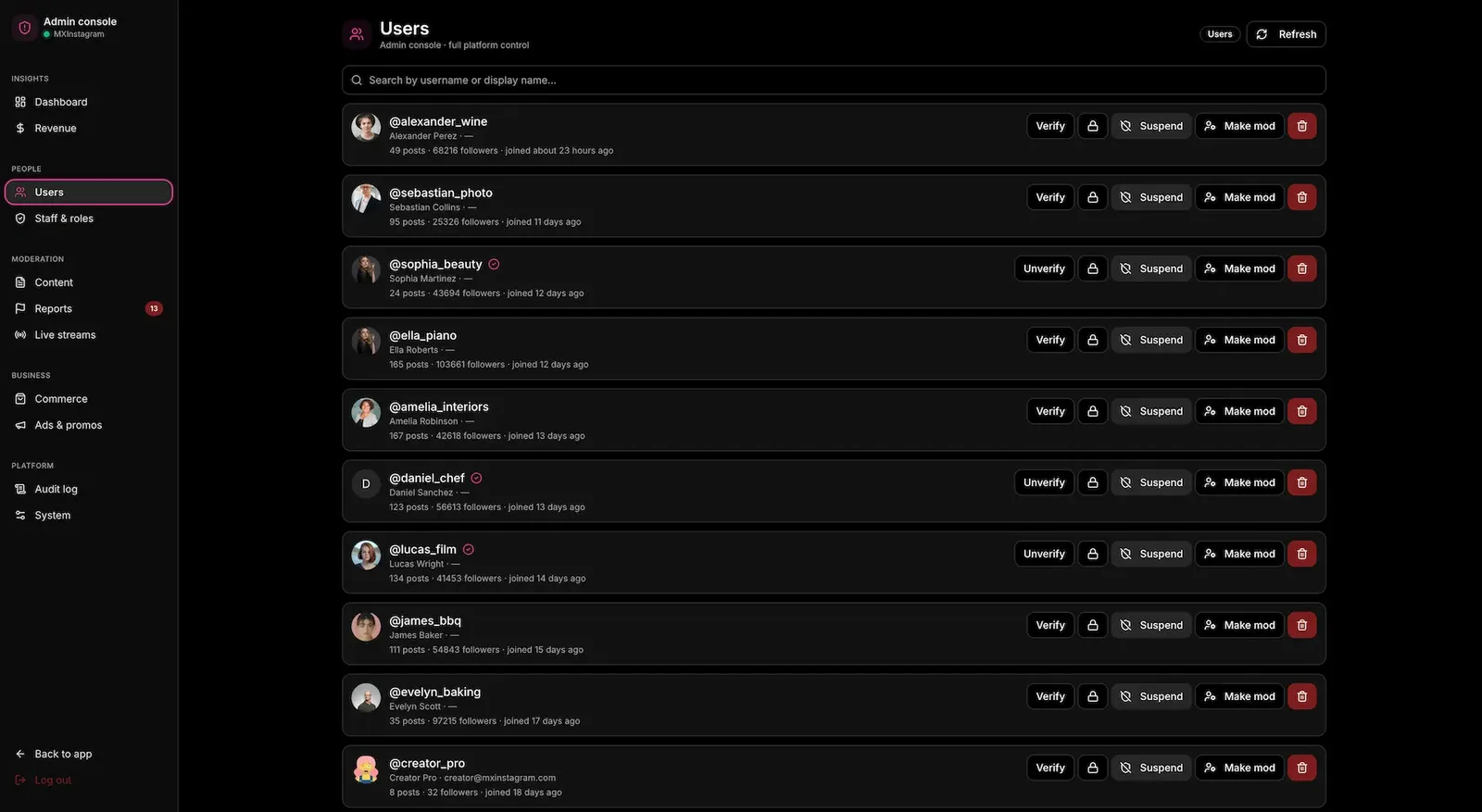
The Instagram-style demo is a running copy of the product with our demo branding, with a separate public login for each role. Sign in as a member to publish and browse, as a creator to see subscriptions, gifts and insights, or as an operator to open the console, and install the Android build if you want the native wrapper.
demo@mxinsta.comdemo123creator@mxinsta.comcreator123admin@mxinsta.comadmin123demo@mxinsta.comdemo12346 features across 4 roles. The first six of each role are here and the full list is one click away. Nothing is held back for a sales call.
Single images, carousels, reels, 24-hour stories and highlights are published through the same engine.
Images are cropped in the composer, so the shape a member chooses is the shape everyone sees.
Posts can be dated for later, and a queue promotes them when their time comes.
Reels can use tracks from a browsable audio library, and a remix keeps a link back to the original.
Likes and saves work across posts and reels, with saves visible only to the member who made them.
Replies nest under the comment they answer, and each comment can be reported on its own.
7 more Members features are in the full list.
Members buy a badge on a plan the operator names and prices, or apply free through review.
Each creator defines tiers with named perks and prices, and subscribers unlock what each tier promises.
Posts can be limited to subscribers or to a minimum tier, with the check enforced by the database.
Fans send gifts from an operator-managed catalogue, paid from wallet balance.
WebRTC streaming with real-time chat lets creators go live from the app.
Hosts can ban a viewer from chat, and the ban is applied by a database trigger rather than the interface.
6 more Creators features are in the full list.
Sellers publish products with galleries of several images and details.
Buyers add items to a cart that groups them by seller for checkout.
Orders move through defined states, so sellers and buyers share one view of progress.
A seller features products during a live stream, and viewers buy from the same catalogue.
Prices are looked up on the server, so a forged request cannot change what a buyer pays.
Order totals are rebuilt from their items, and the order record is locked against later tampering.
3 more Sellers features are in the full list.
Platform KPIs with a thirty-day trend load through an edge function so the dashboard stays quick.
Search accounts, suspend or restore them and soft-delete with a recovery window.
Moderators and administrators have different powers, and the admin grant itself is done outside the interface.
Applications with legal name, category, country and documents are reviewed in their own queue.
Verification plans can be added, renamed, repriced, reordered and switched off.
Hiding and deleting posts, reels, comments and messages can be undone, and each action is attributed.
6 more Operators features are in the full list.
The path through the product, in the order it happens for the people using it.
Accounts start on a public, private or follower-gated footing, and one database rule decides every later visibility check.
Members post images, carousels, reels and stories, optionally scheduled, and highlights keep stories after they expire.
Likes, saves, comments and direct messages write to shared tables, and notifications fire from database triggers.
Tagged products and live drops reference the same catalogue, and orders pass through a per-seller cart.
Each money event runs as an atomic function against the wallet ledger, and each operator action writes an audit row.
Every earning route built into the product you receive: how it works, who pays and where the operator earns.
| Revenue model | How it works | Who pays | How you earn |
|---|---|---|---|
| Verified profiles | Members pay for a badge on a plan you name and price. The build seeds monthly, annual and business examples, and a free review route runs alongside. | Member | Plan fees, set entirely by you |
| Per-creator tiers | Creators sell tiers with perks, and subscribers unlock gated posts. An atomic function settles each subscription so a member is never billed twice. | Subscriber | Your share of each subscription; 70/30 in the creator favor by default |
| Gift catalogue | Fans buy gifts from wallet balance for posts and live sessions. Debit, credit and ledger entry happen in one transaction. | Fan | Platform share of each gift, adjustable |
| Self-serve advertising | Creators and businesses promote posts and reels on CPC or CPM pricing with daily caps, and campaigns pause when the budget runs out. | Advertiser | Ad spend recorded per event |
| Shop commission | A platform fee is applied to delivered orders and written as its own row for each order. | Seller | Fee per delivered order; 5% by default, adjustable |
| Wallet top-ups | Members add balance through a bounded top-up path that every other line then draws on. | Member | No fee of its own unless you set one; it funds every other lever |
| Fundraiser posts | Posts with a goal and deadline collect contributions toward a creator cause. | Supporter | Any platform share you choose to set |
The flow of money, the gateways you can connect and how payouts are handled.
Everything money-related runs through a wallet backed by an append-only ledger. A top-up adds balance, and subscriptions, gifts and shop orders draw it down in single atomic steps that lock the wallet row until commit, so balance cannot be created by concurrent requests. The wallet and every settlement function are complete. Real-money capture needs a payment provider, which you connect with your own merchant credentials.
| Gateway | What it covers |
|---|---|
| Card | |
| Stripe | Card capture for wallet top-ups, connected through your own Stripe credentials. |
| Regional | |
| Razorpay | A regional option for markets it serves, wired in as an integration with your merchant account. |
| Wallet | |
| PayPal | Wallet payments for members who prefer to pay from an existing account. |
| Apple Pay | One-tap payment for Apple device users once connected with your credentials. |
| Google Pay | One-tap payment on Android and the web after you connect your merchant details. |
You operate the platform, so legal compliance in each market you serve is yours. This is the tooling that ships in the product. It is not legal advice.
Every table has Row-Level Security with a default-deny policy, and one SQL function decides every content visibility question, including private accounts, follows and blocks. Storage buckets use the same rule. A mistake in the interface cannot expose a private post because the database refuses the read. That is what a security reviewer will test first.
No monetary operation is trusted to the client. Each runs in a function that locks the wallet row and writes a ledger entry, top-ups are bounded and self-gifting is rejected at the database. These controls reduce the chance of balance errors, but they do not replace your own reconciliation and fraud monitoring once real money flows.
Reports can be filed against posts, reels, comments, messages and users, and operators move them through five states with four priority levels, assignment and internal notes. Deletes are soft with a recovery window. Hiring and training reviewers, and writing community rules, remain your job.
Sign-in uses email and password with optional TOTP two-factor authentication. Personal information is stored in a private profile table apart from public data. Granting administrator rights requires a direct database action, which removes an escalation path from the interface. Restrict who holds that access.
Members can export their data or delete their account, and deletion cascades through every referencing table. An append-only audit log records privileged actions with actor, target and time. Publish a privacy notice that matches this behavior, and follow the data rules of each market you serve.
The documentation includes a production checklist and security handbook, a VAPT posture document and an OWASP-oriented control mapping. Production secrets, network policy and provider credentials are governed by your deployment, not shipped. We supply tooling and documentation, not legal advice or a compliance certificate.
The layers of the product as delivered. You receive the full source code for every one of them.
| Layer | Built with | Hosting note |
|---|---|---|
| Frontend | React 18, TypeScript 5, Vite 5 and SWC, with Radix primitives and Tailwind CSS 3 | |
| Data and forms | TanStack Query 5, react-hook-form and zod | |
| Database | PostgreSQL 14 with Row-Level Security on every table | PostgreSQL 14 holds 55 tables with Row-Level Security, 23 functions and 49 ordered migrations. |
| Identity | Supabase Auth with optional TOTP MFA | Supabase Auth manages sessions, with optional TOTP second factor and profile data kept apart from public fields. |
| Mobile and edge | Capacitor 8 for Android and iOS, plus Deno edge functions | Five Deno functions handle admin statistics, privileged user actions, scheduled publishing, demo seeding and account bootstrap.Capacitor 8 builds Android and iOS from the same bundle, with native camera, haptics and storage. |
| Real-time | Postgres change data capture and presence channels | Postgres change data capture and presence channels power typing, presence and live chat under the same security rules. |
| Storage | Five policy-gated buckets hold media, with public assets served through a CDN and private ones through signed, time-limited URLs.WebRTC peer streaming carries broadcasts, with replays stored in a private bucket. | |
| Scaling levers | Read replicas, point-in-time recovery and CDN-fronted public buckets are the documented ways to grow. | |
This build is a thin client over Postgres, real-time channels and edge functions. You deploy it on your own infrastructure with provisioning guidance, and the same architecture serves a pilot and a large audience. What grows is instance size, replicas and CDN posture.
Apple and Google both publish rules that can reject or remove apps. Launching an Instagram-style app is routine when it is clearly its own product, but copycat and spam concerns are real. This table lists the common review risks in plain terms, with what to do. Policies change, so read the current text before each submission.
| Review risk | Why stores care | What an operator does |
|---|---|---|
| Imitating another brand | Store rules oppose impersonation and copycat apps | Use your own name, icon, colors and wording; avoid anything that resembles the original. |
| Template or repetitive app | Stores reject apps that look like mass-produced copies | Give the app a distinct purpose, niche and design, and say so in the listing. |
| User content without safeguards | Apps with user content must let people report and block | Test reporting, blocking and your contact route before you submit. |
| Unfinished or demo content | Reviewers expect a working app with real content | Seed the feed with genuine posts and provide review accounts. |
| Digital goods and payments | Stores usually require their billing for digital items bought in the app | Check how coins, gifts and subscriptions are sold on each store before you integrate payments. |
| Privacy statements | Store listings must describe data collection accurately | Publish a privacy policy that matches the real data handling and account deletion. |
Low-priced source packages exist and suit experiments. The gap shows once real members and money arrive. This table compares what a typical low-cost package leaves to you with what a finished platform provides, framed as questions to ask any seller.
| Question to ask | Typical low-cost package | Finished platform |
|---|---|---|
| Do mobile apps come with it? | Often web only, or apps sold separately | Web, Android and iOS from one bundle, with store submission guidance |
| Who protects private content? | Checks in application code, easy to miss | A database rule decides every read, so interface mistakes cannot expose it |
| How is money handled? | Basic balance fields, with limited audit | A ledger with locked, atomic movements and reconcilable balances |
| What can staff do without a developer? | Often little beyond content deletion | A console for refunds, suspensions, ad pauses and reversible actions |
| What is documented? | A short readme | Schema guide, security handbook and API collection |
| Who answers after purchase? | Unclear or paid per question | A defined support window and a year of updates |
The product labels each capability as included, configuration required or integration required, and the labels are worth taking seriously. Money capture, transactional email, text messages and push delivery connect through documented integration points, using your own merchant, email and notification accounts. The wallet and ledger are ready, but real money enters only after you connect a payment provider.
Plan this before launch rather than after. Open the provider accounts early, since approval can take time, and decide which store billing rules apply to coins, gifts and subscriptions. Hardening that depends on your deployment, such as production secrets and network policy, follows a documented checklist you complete. None of this is hidden; it simply cannot be done by the vendor on your behalf.
One fixed price for the ready-made platform, published here so you can plan before you talk to us.
Ready-made, one-time
$3,999
Live in 6 working days from kickoff
The engineers who deploy your platform stay with it once it is live.
Need more? We tailor the platform to your plan, typically in 2-8 weeks, and confirm the scope with you before work starts. App store review times are set by Apple and Google.
Everything here is available around the ready-made Instagram clone. We confirm the scope with you before any price is agreed.
Connect Stripe, Razorpay, PayPal, Apple Pay or Google Pay so wallet top-ups take real money, using your merchant credentials.
Confirm with usAutomated classification of images, video and captions ahead of the human reports queue, for operators whose volume outgrows manual triage.
Confirm with usLarger groups with roles, admin controls and message retention policy, building on the small-group chat already in the product.
Confirm with usSearch across captions and comments, beyond the user and hashtag search that ships ready.
Confirm with usWire APNs and Firebase Cloud Messaging with your credentials so alerts reach members off the app.
Confirm with usExport creator and admin analytics to your own warehouse for cohort, retention and lifetime-value analysis.
Confirm with usToken-gated communities, live drops and wallet-linked identity built through edge functions.
Confirm with usSingle sign-on, data residency selection, extended retention policy and custom service levels for procurement-led deployments.
Confirm with usBuyers usually compare Instagram-style apps by format names, yet the real difference is how finished each part is. This matrix starts with the formats people expect from the brand, then moves to money and operations. Most of the platform ships ready, and the rest is set up around your plan; it also shows what needs your own provider credentials.
Single images and multi-image carousels with cropping before upload.
Vertical video through the same engine, with a browsable audio library and remixes.
Twenty-four hour stories that persist as highlights after they expire.
Future-dated posts held in a queue and published on time.
Follow requests, blocks and a close friends list for selective stories.
Plus reposts with notes, hashtag following and people tags on images.
One-to-one and small group chat with presence, typing, requests and vanish mode.
WebRTC streams with chat, host bans, featured products, gifts and private replays.
Catalog, tags on posts and reels, per-seller cart, orders and operator refunds.
Plans you rename and reprice, plus a free application route with a review queue.
Creators set tiers with perks; premium posts unlock for subscribers.
Operator-managed gifts settled atomically against an append-only wallet ledger.
Promoted posts on cost per click or per thousand views, with daily caps.
Impressions, engagement, reach, top content and earnings charts.
Moderation workflow, commerce, promotions, revenue and an append-only audit trail.
Optional time-based codes on member and staff accounts.
Connecting Stripe, Razorpay, PayPal, Apple Pay or Google Pay with your merchant credentials; we set it up for your build.
Wiring APNs and Firebase delivery with your own credentials; we set it up for your build.
Automated classification of images, video and captions ahead of the human queue; we set it up for your build.
User and hashtag search ship; we add caption and comment search with indexing work.
Enterprise controls we tailor to your compliance obligations, with scope confirmed with us.
Four pages go deeper on the questions buyers ask most about the Instagram Clone. This page stays the overview.
The surface of a visual social app is easy to copy.
See the full breakdownA social commerce platform has a build cost and a running cost, and they are paid to different people.
See exact pricingA visual social network can earn from the people who create, the people who follow and the businesses that want both.
See the playbookAnyone can build a feed.
Compare optionsFrom kickoff to a live Instagram clone under your brand: what we do each day, and what we need from you.
1Day 1
2Day 2
3Day 3
4Day 4
5Day 5
6Day 6
An Instagram-style product costs more than it looks because the visible part, a feed and a profile, is the smallest piece. Privacy rules, a wallet, live broadcasting, a shop and an operator console each become their own project when you build from scratch, and monetization often slips to a later phase. Buying a ready-made platform brings those pieces in at once. What you still pay for is operation: hosting, payment fees, moderation and the work of recruiting creators and sellers.
| Factor | Build from scratch | Rent a SaaS | Own it with GetFame |
|---|---|---|---|
| Time to live | Many months before posting, messaging and shop all work together | Quick, but inside a closed product | 6 working days for the ready-made build |
| Privacy model | Often interface-level, and tested late | Handled by the vendor | Database-enforced, with default-deny policies on every table |
| Wallet and money | Ledger and concurrency logic to design and test | Vendor payment rules | Typed wallet ledger with atomic settlement |
| Commerce | A separate workstream from social | Limited or vendor-controlled | Native shop, tags, cart, orders and refunds included |
| Factor | Build from scratch | Rent a SaaS | Own it with GetFame |
|---|---|---|---|
| Mobile apps | Two more builds or one hybrid build | Usually provided | Android and iOS from one bundle, both included |
| Operator tooling | Often raw database access | Vendor dashboard | Twelve-panel console with audit log |
| Ownership | Yours once built | Not yours | Full source and data, with no per-seat fee |
Running costs. Running costs fall outside the platform price. Plan for database and hosting, media storage and CDN, payment gateway fees, transactional email and SMS services, push delivery, error monitoring, moderation staff or an AI service and developer accounts for both app stores. A pilot and a large audience use the same architecture, so growth shows up as bigger instances and more replicas rather than a rebuild.
An Instagram-style app is mostly invisible work: who can see what, where the money goes and how staff can step in. This table goes through the major parts in turn, with effort words rather than figures, so you can see what a ground-up team has to design and what you hold on day one.
Build it yourselfSeparate pipelines for images, carousels, video and expiring stories, plus cropping and scheduling.
Ready-madeOne engine handles posts, reels, stories and scheduled content.
Build it yourselfPublic, private, follower-only and blocked cases written into every query and every screen, then tested.
Ready-madeOne database rule decides every visibility question, applied to content and storage alike.
Build it yourselfFollows, requests, likes, saves, comments and mentions across several content types.
Ready-madeShared tables serve posts and reels, with threaded comments and per-item reporting.
Build it yourselfPresence, typing signals, requests and group threads that behave under load.
Ready-madeMessaging with presence and typing sits on the same security model as the rest.
Build it yourselfA streaming layer, moderated chat, gifting and replay storage as a specialist integration.
Ready-madeWebRTC broadcasting, trigger-enforced chat bans, gifts and signed replay links.
Build it yourselfCatalog, tagging, carts, orders, refunds and seller payouts designed with the feed.
Ready-madeA native shop with tags on posts and reels and operator-driven refunds.
Build it yourselfRecurring billing, tier access rules and protection against double charging.
Ready-madeVerified plans and creator tiers settle through atomic database functions.
Build it yourselfA reconcilable ledger where concurrent writes cannot create or lose balance.
Ready-madeA wallet with an append-only ledger and row-locked money movement.
Build it yourselfCampaigns, budgets, event logging, caps and pause rules, which advertisers will audit.
Ready-madeSelf-serve promotion with budget caps, an event ledger and operator force-pause.
Build it yourselfA staff console with roles, reversible actions and an uneditable action log, often built last.
Ready-madeTwelve panels with a moderator and administrator split and an audit log.
Build it yourselfThree front ends or a cross-platform effort, plus store packaging and native features.
Ready-madeOne bundle ships all three, with camera and haptics through Capacitor.
The original photo and video network is a closed, advertising-led service. This platform copies the interaction patterns but gives the operator control over privacy rules, creator economics and commerce. Points below describe the widely known model, not any company results.
| Aspect | The Instagram model | This platform |
|---|---|---|
| Main revenue | Advertising sold against a very large audience | Five levers you choose from, with advertising treated as a later stage |
| Verification | Run by the company under its own criteria | Plans and review rules defined by you |
| Creator terms | Set by the platform | Splits configured per lever by the operator |
| Shopping | Controlled by the company and its partners | Native shop where you set the fee and handle refunds |
| Operator tooling | None, you are a user | Moderation, commerce, revenue and audit panels |
| Audience and data | Held by the company | Stored in your database and exportable |
| Code access | Closed | Full source code and migrations |
| Focus | Mass-market social | Can be a niche, a brand community or a creator network |
The founders and teams this product fits most directly, one line each. The launch ideas that follow turn these audiences into a first-week plan.
Tag catalogue products on posts and reels so discovery and checkout share one surface.
Recurring income through verified plans and creator tiers, with premium posts gated at the database.
A private surface for members, students or partners, with follow approval and blocks enforced uniformly.
Featured products, chat moderation and gifting during a broadcast, with the replay kept as an asset.
Beauty, fitness, gaming, food or travel communities configured through theme tokens and the gift catalogue.
Scheduled lessons, tier-gated content and highlights that keep reference material reachable.
A general photo network cannot beat the incumbents, but a specific one can win a corner. These ideas pick audiences that care about images and commerce, and each names the first thing to configure so the feed has a clear reason to exist.
Photographers and illustrators show work in carousels, collect saves and sell prints through tagged items. Income is subscriptions for behind-the-scenes posts and shop fees. Configure carousels, creator tiers and the shop first, and set up the verification route so genuine artists stand apart from reposters.
Stylists and small labels post outfits, tag each piece and let followers buy in place. Revenue is shop commission and promoted posts. Configure shoppable tags, seller onboarding and refunds before launch, because returns are the first operational issue a fashion shop faces.
Restaurants, salons and studios in one city share photos and short reels, with locals following favorites. Income is promoted posts and verified business plans. Configure the verified plan catalog and self-serve ads, and recruit businesses in one neighborhood at a time so the feed feels dense.
An artist, team or show runs an official network with tiers, gifts and live events. Fans pay for closer access. Configure tiers with named perks, live sessions with gifts and a moderation team, since a fan space attracts both devotion and abuse.
Schools, clubs and professional groups keep a private network where members share photos, stories and events. Revenue is membership plans. Configure private accounts, follow approval and close friends first, and decide who may invite whom.
Craft sellers announce limited releases through stories and live shopping, and buyers check out from the feed. Revenue is a platform fee on delivered orders. Configure the shop, scheduled posts and live featured products, then agree seller terms on shipping and refunds.
Few founders want to rebuild Instagram. They want a place for pictures, products or people that they control. These are the routes they usually weigh against a white-label platform, described neutrally so you can match each to the thing you are actually trying to do.
Closed global visual network
Brands and creators who want the largest ready audience and accept platform rules.
Reach, features, data and monetization terms are set by the owner.
Open-source federated photo sharing
Technical teams who want to self-host a photo network and join a wider federation.
Commerce, wallets, ads and a native mobile commercial layer are not its focus.
Visual discovery and inspiration network
Brands whose customers browse boards and ideas before they buy.
It is organized around saving ideas, not around a follow-based social graph you own.
Hosted community software
Creators and educators who want memberships and discussion without hosting anything.
You rent the product, and a visual feed with stories and reels is not its core.
Marketplace code packages
Learners and prototypers testing an idea with minimal budget.
Support, mobile apps, security review and money handling are often thin or left to you.
A white-label platform you own sits between a hosted network and a code package. It is finished enough to launch, with apps, a console and money handled, yet it is source you can read, host and extend. It suits operators with a niche, a brand or a marketplace who want to own the audience relationship rather than borrow it.
Longer answers to the questions buyers of this model ask before they commit.
Start by choosing who the network is for. A general photo network competes with giants, while a community around one interest, one region or one brand has a real chance. Define the niche, list the kinds of creators and sellers you want and decide what a good first week looks like.
Invite sellers and creators together. Sellers bring products and a reason to visit, creators bring content that sells them, and each needs the other. Use shoppable tags and live drops to link them, and keep the first catalogue small and curated so the shop feels trustworthy.
Open the revenue levers in a sensible order. Verified profiles and shop commission need only a price and a payment provider, so they come first. Creator tiers follow when creators have followings worth gating. Gifts need activity to gift against, and advertising needs inventory and review staff.
Most social products fail their first security review in the same two places: who can see what, and how money moves. Ask where the visibility rule lives. If it lives in the interface, any bug or direct request can bypass it. If it lives in the database, every route to the data passes through it.
Ask the same question about money. Where is the balance calculated, what stops two simultaneous purchases from spending the same funds, and can a client change a price? The answers you want are server-side functions with row locks, an append-only ledger and prices looked up on the server.
Then ask for evidence: a schema guide, a security handbook and a testable description of the controls. Here the documentation set covers those items. Whatever you buy, run your own tests before real money and real members arrive, because documentation is not a substitute for verification.
All five levers ship, but they do not all earn at once. Verified subscriptions and shop commission are the quickest, because each needs just a price and a payment provider. Neither needs a large audience to be worth switching on, which makes them suitable for a pilot.
Creator tiers need creators with something worth gating, and gifts need enough live and social activity to gift against. Introduce both after your first creators have regulars. Self-serve advertising comes last, since it needs inventory to sell and people to review campaigns.
Set splits before creators join. Defaults of 70/30 for subscriptions in the creator favor and 5% on delivered orders are shipped values and can be changed. Whatever you choose, tell creators and sellers in writing, and avoid changes after money has started to flow.
The platform is built to be live in six working days, but the calendar stretches when credentials arrive late. Prepare your payment provider account, transactional email service, SMS provider and push credentials before kickoff, and open Apple and Google developer accounts early because both involve checks that take time.
Decide how real money will enter the wallet. Stripe, Razorpay, PayPal, Apple Pay and Google Pay are the named options, and each needs your own merchant details. Check which of them accept your business type and country, and confirm store billing rules for any digital items sold inside the apps.
Plan the first month of operations too: who moderates, who approves verification, who handles refunds and who watches the revenue panel. A short document of roles and escalation steps will save you more time than any later feature.
Projects and comments as published by our parent company, Miracuves, with the release notes as printed there.
We needed creator subscriptions, a shop and a mobile app at the same time. Getting all three in one data model rather than three integrations is what made the timeline realistic.
Our security review focused on whether one user could see another user's private content. Being able to point at a single SQL function that every policy references ended that conversation quickly.
The admin console was the surprise. Refunds, suspensions and ad pauses are things our ops team does without opening a ticket with engineering.
One codebase to web, Android and iOS meant we shipped mobile in the same sprint as web instead of a quarter later.
A client in India, name withheld under NDA, launched a branded social commerce platform with creator subscriptions and a native shop live from the start. Web, Android and iOS shipped from a single TypeScript bundle, and database-enforced privacy passed the client security review. The page reports 3 surfaces from one codebase and about 6 weeks from brief to go-live.
v2026.1Jul 2026
The ready-made white-label package is $3,999 one time, running on your own server. A rebranded launch takes about 6 working days, and client inputs such as store accounts can extend that. Tailored work, such as extra integrations or modules, is confirmed with us at kickoff and typically runs 2 to 8 weeks.
Single images, multi-image carousels with pre-upload cropping, vertical reels, 24-hour stories, persistent highlights and future-dated scheduled posts. Premium gating and product tags can be applied across formats, and reels can be remixed with a link back to the original clip.
Through five lines: platform verified subscriptions, per-creator tiers, gifts, self-serve ads and commission-bearing sales in the native shop. All settle through one wallet ledger. Splits are configurable per line, with a 70/30 creator share and a 5 percent order fee as the shipped defaults.
The wallet, ledger, subscription, gift, ad and order-fee logic are complete. Real-money capture requires connecting a payment provider such as Stripe, Razorpay, PayPal, Apple Pay or Google Pay with your own merchant credentials. Email, SMS and push delivery connect the same way.
Yes, both Android and iOS are included at no extra cost. They are packaged from the same React bundle through Capacitor 8, with native camera, haptics and storage, at full feature parity with the web app including admin panels. Store submission guidance is part of delivery.
Every table has Row-Level Security with a default-deny policy, and a single SQL function decides each visibility question for public accounts, private accounts, follows and blocks. Storage buckets reference the same rule, so a bug in the interface cannot reveal a private profile.
Yes. You receive the full application source, the schema and migrations, with no obfuscation, license server, per-seat fee or revenue share. Export is a Postgres dump away, and your team can extend the product with ordinary React, TypeScript and SQL work.
Twelve panels: overview, users, staff, content, commerce, promotions, revenue, system, verification, plans, live and moderation. Destructive actions are soft deletes with a recovery window, and every privileged action is written to an append-only audit log. Beyond that, features can be enabled, disabled or extended to fit your model.
You launch under your own brand, assets and content policy, and set your own terms. We are an independent software company with no affiliation to Instagram. You remain responsible for legal compliance in your markets, including privacy law, content rules and payments. We supply tooling, not legal advice.
Yes. The defaults, a 70/30 creator-platform split on subscriptions and gifts and a 5% fee on delivered orders, are shipped values rather than limits. Each lever is a separate settlement function writing its own ledger rows, so you can change one split without disturbing the others.
You define plans, their names and prices in an admin catalogue. The build seeds monthly, annual and business examples that you can rename, reprice, reorder or switch off. Members can also apply free by submitting documents, which go to a separate reviewer queue, so you can mix paid and reviewed verification.
Refunds are an operator action in the commerce panel and are credited to the buyer wallet, which avoids manual reconciliation. The platform fee is stored as its own ledger row for each order, so revenue and refunds can be traced per order.
You receive an entity-relationship diagram, a schema guide, an API collection, a developer security handbook and a VAPT and compliance posture document. The set is intended to support a procurement or security review, though your own reviewers should still test the deployed system.
The platform is deployed on your own infrastructure, with your database and your provider accounts. PostgreSQL runs through Supabase underneath, and we give provisioning guidance and environment configuration. Confirm the exact hosting arrangement and any provider plan costs with us before you commit.
The architecture is deliberately conventional, using React, TypeScript and Postgres, so extending it is ordinary work. Adding a feature usually means a migration and a page rather than a new backend service. Your own developers can do this, or we can build it as tailored work.
Yes. Live payment capture, AI content moderation, large group messaging, full-text search across captions and comments, native push wiring, warehouse export, token gating and enterprise controls such as single sign-on are available, and we set them up around your plan. Tax engines and multi-warehouse logistics connect as integrations.
It is designed so a single well-indexed Postgres instance with real-time fan-out serves everything from a pilot to a large audience. Growth levers are read replicas, point-in-time recovery, CDN-fronted public buckets and more real-time capacity. We do not publish concurrency figures, so test with your own traffic.
Not because of the format. Stores reject apps that imitate another brand, look like mass-produced templates or lack safeguards for user content. Use your own name and design, state a clear niche, test reporting and blocking, seed real content and supply review accounts. Outcomes depend on the reviewer, so allow time for resubmission.
Inexpensive scripts usually give you a web app and leave mobile apps, security review, money handling and support to you. This platform ships web, Android and iOS from one bundle, enforces privacy and money rules in the database, includes an admin console and comes with documentation and a support window.
The stack is chosen so privacy and money rules live in the database and one codebase reaches three surfaces. It uses mainstream, widely hired technology, so most web developers can extend it. Adding a feature is usually a migration and a page. If your team strongly prefers another stack, discuss it before buying.
The system panel can seed demo content and provision demo accounts, which helps for review and demonstrations. For a public launch, invite real creators in advance, ask each to publish several posts, and review the first uploads. Genuine content persuades both new members and store reviewers better than placeholders.
Yes, as tailored work. Because you hold the schema and the source, a developer can write an import into the same tables. Passwords and media usually need careful handling, and you should tell members what is moving. Scope the data volume and formats with us before committing to a date.
You own the deployment, with the database, storage and accounts under your control. We provide provisioning guidance and an environment checklist, and the app packages with the documentation your hosting team needs. Export is a standard database dump away, so you are not locked to us or to one host.
Sellers list products with images, then tag them at positions on posts and reels. A viewer taps a tag, adds the item to a per-seller cart and checks out. Orders move through a lifecycle that operators can see, and refunds credit the buyer wallet. Real card capture needs your payment provider connected.
Small group conversations are included, with presence, typing signals and per-message reporting. Larger groups with roles, admin controls and message retention policies are available, since they need more design; we set them up for your build. Decide early whether chat is a core feature of your network or a convenience.
Pick a narrow audience, recruit a handful of respected creators, seed the feed, and give members a reason to invite friends, such as a challenge or a launch event. Use verified plans and tiers to reward early supporters. Judge progress by how many members return weekly, not by raw signups.
Inputs from your side: brand assets, store accounts, provider credentials for payments, email and push, and decisions on fees and plans. Tailored work and store review rounds add more. Preparing those items in advance is the most reliable way to keep the calendar short.
→Start here
Share the platform and your market. You get a walkthrough of the live demo, the exact scope of what ships, and a fixed price in writing. First response in under 2 hours, Monday to Saturday, 10:00 to 19:00 IST.
This page uses the name Instagram to describe a type of platform. The product sold here is separate software, built independently, and Instagram has no part in it.
"Instagram clone" is industry shorthand that founders use when searching for software with a comparable business model. It names a category of product, not a copy of Instagram.
The platform is an original product designed and written by Miracuves. It contains no code, design, graphics or content originating from the Instagram website or applications, and it ships under your own brand.
Instagram and its logos are trademarks of their respective owner and are named here for reference only. GetFame is not affiliated with, sponsored by or endorsed by Instagram. Rights holders can write to legal@miracuves.com.
Operator responsibility. The operator of a launched platform is responsible for legal compliance in the markets it serves. Nothing on this page is legal advice.Read the full disclaimer
First response under 2 hours, Mon-Sat 10:00-19:00 IST
India+91 98300 09649 United States+1 516 202 3950