Ads and sponsorship
Branded Hashtag Challenge Pricing: Packages and Rules
Branded hashtag challenge pricing for a short video operator: package tiers, pricing models, measurement and the FTC and ASCI disclosure rules to follow.
Short answer
Branded hashtag challenge pricing is set by what the sponsor receives: banner time, a seeded creator group, entries and measured results. Most operators sell two or three packages, each priced as a flat fee, a fee per thousand views, or a fee plus a performance bonus. Publish a rate card, define each metric before sale, and require disclosure on every sponsored entry.
Key takeaways
- Price a challenge as a package of defined deliverables, not as a bag of views you cannot promise.
- Flat fee, cost per thousand views and hybrid pricing each shift risk between operator and sponsor in a different way.
- Agree metric definitions in writing before the sale: participants, entries, views, completion and clicks all mean something specific.
- Seeded creators who are paid or gifted must disclose, and the brand stays responsible for what endorsers do for it.
- Your price list should rest on your own audience data; the figures in this guide are illustrative only.
On this page 11 sections
- What a sponsor is actually buying
- Branded hashtag challenge pricing starts with three packages
- Pricing models and who carries the risk
- Define what you measure before you sell
- Disclosure rules for paid and gifted entries
- Deriving your own unit before the first quote
- Questions to expect on the sponsor call
- Approvals, refused categories and brand safety
- Running the challenge and writing the report
- When the audience is moving: pricing during a migration
- How the platform handles sponsorship
Branded hashtag challenge pricing is the question that decides whether a media brand's short video feed earns anything from sponsors. A studio, label or advertiser wants a theme, a banner and a crowd of entries. You, as operator, own the feed and the audience, and you have to put a number on that combination without a rate card from anyone else to copy.
This guide is for the person who will write that rate card. It covers what a challenge consists of, how to turn it into two or three packages, the pricing models and what each does to risk, what to measure and report, and the disclosure rules from the FTC and ASCI that apply when creators are paid or gifted. Sponsored challenges are the first revenue line on the MX TakaTak clone because a media brand already owns attention that sponsors want. This is not legal advice.
What a sponsor is actually buying
A branded challenge looks like one product from the outside and is several from the inside. When you price it, list the parts, because each has its own cost and its own value.
- Placement. A promotional strip across the home feed and explore screen while the challenge runs, plus a hashtag page with the sponsor's brief.
- A creative theme. The prompt members respond to, such as a dance, a scene recreation, a reveal or a question. Good prompts are simple to film in under a minute.
- Seeding. A group of creators or talent who post first, so the page does not look empty on day one.
- Participation. Entries from ordinary members, which you can influence but not promise.
- A sound or effect. A branded sound, sticker or lens that makes the entry easy to produce and easy to recognize.
- Measurement. A report that ties the activity to the sponsor's goal.
The first three are deliverables you control. The fourth is an outcome you can only forecast. The central rule of challenge pricing is to charge firmly for what you control and share risk on what you do not.
Branded hashtag challenge pricing starts with three packages
A blank quote invites a long negotiation. A menu of three packages shortens it, because the sponsor chooses a level instead of describing one. The table shows a structure; the figures are illustrative placeholders for you to replace with your own, not market prices.
| Package | Placement | Seeding | Extras | Illustrative fee |
|---|---|---|---|---|
| Spotlight | Explore-tab banner and hashtag page for 7 days | 5 seeded creators | Basic report | 1 unit |
| Feature | Feed and explore banner for 14 days, featured hashtag | 15 seeded creators, talent clip | Branded sound, mid-run recap | 3 units |
| Season | Banner, featured slot and a sponsored feed placement for 21 days | 30 seeded creators, talent live room | Branded effect, sponsor tag on winners, full report | 7 units |
Read the "unit" column as a ratio, not a price. If your Spotlight price is one unit, the Feature at three units tells the sponsor that it gets about three times the reach and the extras. Set your unit from your own cost and audience size, not from what another platform charges. Two or three campaigns of your own data will tell you if the ratios are right.
Keep packages honest
Do not promise entries or views in the package. Promise placement days, seeded creators, a sound or effect, and a report. Then tell the sponsor how many entries and views similar activity produced on your feed, with dates, and say it is history, not a guarantee. Sponsors who feel they were promised a number and did not get it do not come back.
Pricing models and who carries the risk
Once the package is defined, there are four common ways to put a price on it. They shift risk between you and the sponsor.
| Model | How it works | Operator risk | Sponsor risk | Best when |
|---|---|---|---|---|
| Flat fee | One price for the package | Low | High | Your history is short and the audience is small |
| Cost per thousand views | Sponsor pays for counted views of challenge entries | High | Low | You have stable reach data and a long audience history |
| Cost per entry | Sponsor pays for entries above a floor | Medium | Medium | The prompt is simple and the goal is participation |
| Hybrid | Base fee for placement and seeding plus a bonus above an entry or view threshold | Medium | Medium | You want the sponsor to share upside without carrying all the risk |
A worked example with illustrative numbers
Say a hybrid contract sets a base fee of 3 units for the Feature package, and a bonus of 0.5 unit for every 1,000 entries above 2,000, capped at 2 units. If the challenge produces 3,500 entries, the bonus is 0.5 unit for each full thousand above 2,000, which is one thousand, so 0.5 unit, and the sponsor pays 3.5 units. If it produces 6,000 entries, the bonus would be 2 units and the cap holds. These figures are illustrative only and should be replaced with your own. The point is the shape: a base that covers your cost, a bonus that rewards the sponsor's choice of a good prompt, and a cap that keeps the invoice predictable.
Which one to start with
New feeds usually start with flat fees, since reach history is thin and a per-view model hands the risk to you. Move to hybrid once you can forecast views within a range you trust. Pure per-view deals make sense only when you have many campaigns of data and the sponsor insists on them.
Define what you measure before you sell
Disputes at invoice time almost always trace back to a metric defined after the fact. Write definitions into the contract.
| Metric | Define it as | Watch for |
|---|---|---|
| Participants | Unique members who posted at least one entry with the hashtag | Count seeded creators separately |
| Entries | Published clips using the hashtag or sound, after moderation | Exclude removed clips |
| Views | Plays of entries, with the minimum watch time stated | One-second views and full plays differ widely |
| Watch time | Total seconds watched across entries | Long clips inflate it |
| Tap-throughs | Taps on the sponsor link, banner or tag | State whether banner and entry taps are combined |
| Sponsor outcome | An agreed action, such as a title start or a shop visit | Needs a link to the sponsor's own data |
The campaign builder in the control panel shows goal, budget, views, clicks and spend for a campaign, and a campaign can be paused. One analytics dashboard shows active members by day and month, plus watch time and earnings. Use both to produce the sponsor report. For outcomes beyond the feed, such as a catalog start after a clip, the connection back to your streaming product matters; that planning is in our guide to adding short video to an OTT app.
Disclosure rules for paid and gifted entries
If a sponsor pays or gifts creators to enter, those entries are advertising. Two sets of rules from sources we checked show what regulators expect. Both can change, so confirm the current text before you publish your brief.
United States: the FTC
The FTC's guidance for influencers says anyone with a financial, employment, personal or family relationship with a brand must disclose it. A financial relationship is not limited to cash; free or discounted products and other perks count. The disclosure should sit next to the endorsement where it is hard to miss, not in a bio, at the end of a video, in a hashtag cluster or behind a "more" button. In video it should appear in both audio and visuals, and in live streams it should be repeated. Plain wording such as "ad" or "sponsored" works; vague shorthand does not. The FTC also notes that platform disclosure tools can be used but should not replace the creator's own clear disclosure. See the FTC Disclosures 101 guide.
On responsibility, the FTC's question-and-answer page for businesses says the brand is ultimately responsible for what others do on its behalf, and that outsourcing does not move that responsibility. It recommends a reasonable program to train and monitor endorsers, and suggests pre-approval for ephemeral content. See the FTC Endorsement Guides questions.
India: ASCI
ASCI's disclosure guidelines list approved labels: Ad, Advertisement, Sponsored, Collaboration, Partnership, Employee, Free gift and Affiliate, plus platform tags such as Instagram's Paid Partnership and YouTube's Includes Paid Promotion. On pictures and video the label sits over the content for long enough to be noticed, and in live streams it is made at the start and again at the end. Both the advertiser and the influencer are responsible, and advertisers can require edits or removal of posts where the disclosure is missing or unclear. See the ASCI social media disclosure guidelines. The ASCI Code's chapter on social media advertising also requires ads on a media company's handles to be clearly distinguishable from editorial content, with the disclosure at the start of the post (ASCI Code).
What to put in your challenge brief
- A sentence that says seeded and paid entries must carry a clear label in the clip itself, in the creator's language.
- A named label from your list, and an instruction not to bury it in the caption or hashtags.
- A rule that gifted products count, with a log of who received what.
- A brand approval step before the challenge opens, with the brief and sample clips.
- A removal path for entries that lack the label, using the report queue and enforcement log.
Deriving your own unit before the first quote
The unit in the package table needs an owner. These steps give a first number from your own costs and audience, which you then adjust with experience. Every figure in the example is an illustrative placeholder.
- Count staff hours. A Spotlight challenge needs a brief, a banner, a hashtag page, seeding outreach, daily checks and a report. Estimate the hours for each role and multiply by an internal hourly cost.
- Add seeding cost. If you pay seeded creators, add what you pay them. If you offer them featured placement instead, count the placement as a cost only if you could have sold it.
- Add the opportunity cost of placement. A banner on the explore screen is not free if another sponsor or one of your own titles could have used the space. Estimate what the slot would earn at your current rate.
- Add a margin you can defend. Pick a percentage that covers risk and overhead. Put the three costs and the margin together, and you have a floor for the smallest package.
- Test against audience size. Divide the floor by the number of weekly active members who will see the banner. If the fee per thousand members looks far out of line with what a sponsor pays for comparable social placements, adjust the package content rather than hiding the gap.
- Set the ratios. Scale the other two packages by the extra placement days, seeded creators and extras they contain, as in the table above.
Write the floor down and do not go below it for a first-time sponsor. A discount on the first campaign becomes the reference price for every later one.
Worked check: does the floor survive a bad week?
Suppose, for illustration only, that your floor for Spotlight is 100 currency units and a sponsor negotiates it down to 80. Ask what you would have to cut: a seeded creator, a day of placement, the report? Each cut has a cost you can name. If the answer is that you would cut the daily entry checks, refuse the discount, because unchecked entries are how a sponsor ends up beside a post it never approved. Writing the trade-off on paper before the call keeps you from conceding it on the call.
Also keep a record of discounts granted. After three campaigns, look at whether discounted deals renewed more often than full-price ones. If they did not, the discount bought nothing, and the next rate card can hold firm.
Finally, agree how and when the sponsor pays. A deposit at signing and the balance at the report date protects you if a sponsor cancels after seeding has started, because seeded creators have already given their time. Put the cancellation terms in writing: what is refundable before the banner goes live, and what is not once creators have been briefed.
Questions to expect on the sponsor call
Prepare short, honest answers. Sponsors read hesitation as a signal.
"How many entries will we get?"
Give history, not a promise: entries and non-seeded entries from your last comparable campaigns, with dates and the size of the audience at the time. If you have no history, say so and offer a smaller first package with a renewal option.
"Who owns the entries?"
This belongs in the contract. Members keep rights in their own videos and give you a license through your terms. A sponsor that wants to reuse entries in its own ads needs separate permission from each member, and you should not promise it. Offer reposting on your own channels, with credit, as the simpler route.
"Can we approve every entry before it shows?"
Possible for a small, invited challenge, costly for an open one. Offer a review window for seeded creators' clips and a report-based removal path for open entries, with a named moderator and a response time.
"What if a creator says something we dislike?"
Explain the brief, the refusal list and the removal rule. A sponsor cannot control what members say, and promising otherwise creates a dispute. What you can offer is fast removal of posts that break the brief or the law.
"What do we get if the numbers fall short?"
Decide your answer before the call. A common choice is extra placement days at no charge, which costs you attention rather than cash. If you instead offer refunds, define the trigger in the contract so that it cannot be argued later.
"Can you share the audience's age and region?"
Share what you hold, in ranges, and say how it was collected. Do not give individual-level data. If you do not collect age, say that plainly.
Approvals, refused categories and brand safety
Pricing without a refusal list is incomplete. Sponsors of a challenge appear next to members' faces and your editors' names, so decide what you will not run. Publish a list of declined categories and apply it to everyone. Common candidates are products that are illegal in your market, claims you cannot substantiate and anything aimed at minors that your policy does not allow. Add a rule that no challenge asks for dangerous stunts, since a theme that invites harm creates reports faster than any banner creates revenue.
Approve three things before opening: the brief, the sound or effect, and any claim in the banner. Keep the approval record with the contract. The same moderation process that handles reports also protects sponsors from sitting beside harmful clips, which advertisers ask about. We cover those questions in our wider piece, when ads and sponsorship pay on a creator platform.
Running the challenge and writing the report
Before opening
- Seed creators briefed on the prompt, the label and the dates.
- Banner, hashtag page, sound and effect tested on both phone platforms.
- A moderator named for the challenge, with a short list of what to remove.
During the run
- Check entries daily for off-brief or unlabeled posts.
- Feature the best entries on the hashtag page, which gives members a reason to try.
- Offer the sponsor a mid-run note, short and factual, with entries and views so far.
After the close
- Send the report within a week, using the definitions in the contract.
- Show both counts: all entries and non-seeded entries.
- Add what you would change, such as a simpler prompt or a longer window.
An honest report with a clear next step does more to renew a sponsor than a larger number with unclear definitions. If the entries fell short of your history, say so and explain what you saw.
Renewals and the second campaign
The second campaign is where pricing becomes real. Offer returning sponsors a choice: repeat the same package at the same fee, or step up a tier with the seeding group enlarged. Keep a one-page summary of each sponsor's result next to its contract, so the renewal call starts with their own numbers. If a sponsor asks for a discount for a smaller audience on a weak week, offer extra placement days instead, which costs you attention but not revenue. Resist custom packages for every sponsor, because each one creates a new report format your team must produce by hand.
When the audience is moving: pricing during a migration
If your feed is about to merge with another or take in a new audience, hold sponsor pricing steady and sell a single flat package until the combined audience data settles. Changing the audience under a per-view contract creates arguments. The merger guide, how to merge two social apps, covers the member side of that period.
How the platform handles sponsorship
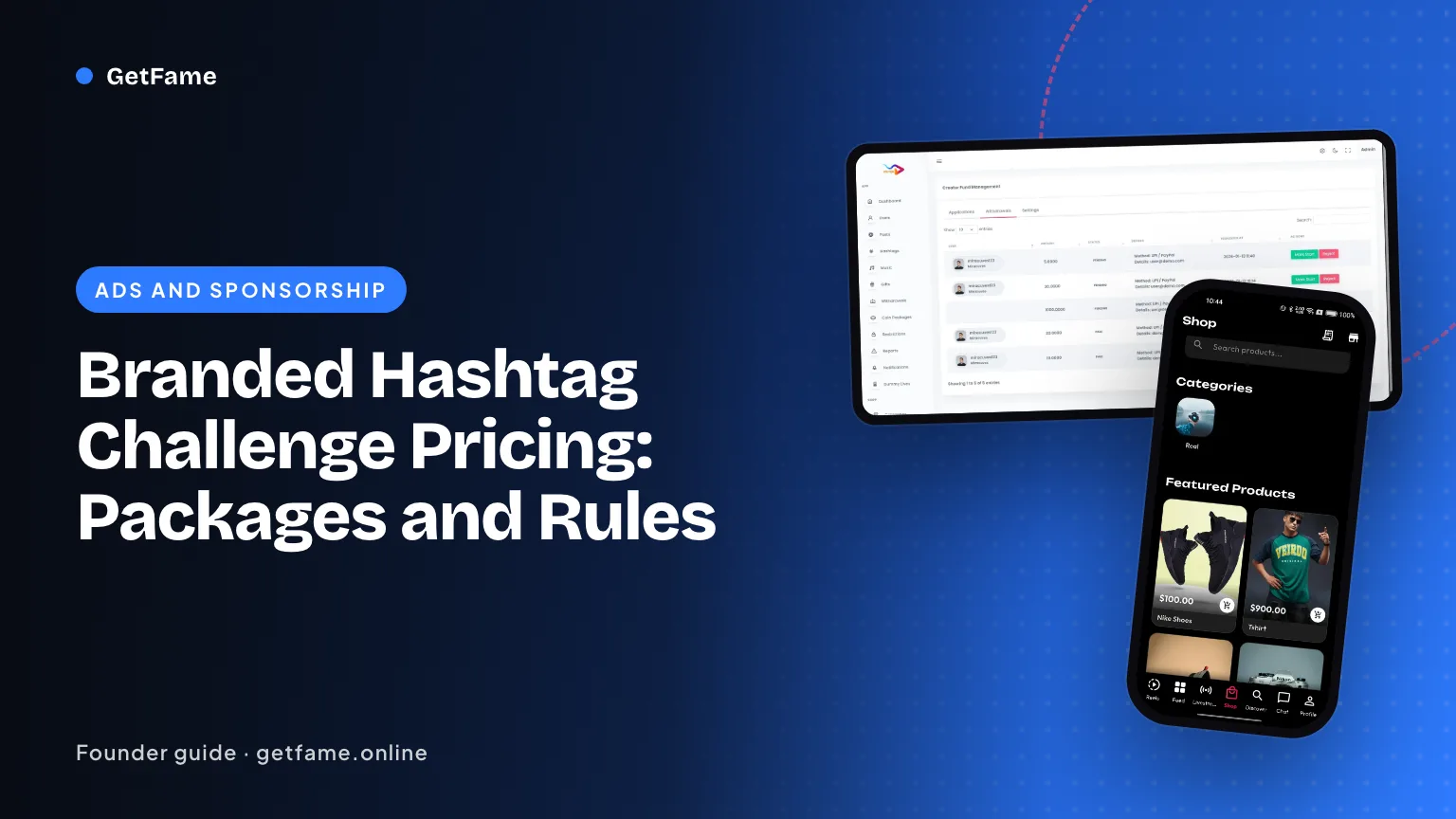
The short video product includes sponsored challenges promoted by a strip across the feed and explore screen, sponsored slots as managed placements in the feed, and a campaign builder that sets each campaign's goal and budget against views, clicks and money spent, pausable from the panel. Advertising extends to creator-bought campaigns, banner slots and rewarded video ads, each enabled in the panel. You set the prices, the approval rules and the categories you refuse. The commercial side, including how a media owner combines these lines, is on the MX TakaTak clone business model page, and every tool is itemized under MX TakaTak clone features.
Billing, contracts and tax with sponsors are yours to manage. Sponsor-specific tailored work, such as a special effect pack for one campaign, we set up for your build, with scope confirmed at kickoff. Technical support lasts 60 days, bug fixes are a separate 6 months, and updates continue for 12 months.
To see how a challenge banner and hashtag page look to members, try the live demo linked from the short video platform for media brands, see pricing for what the platform costs, and send us your audience size, sponsor types and launch region so we can help you plan a first rate card.
Questions and answers
How should I price my first branded hashtag challenge?
Price from your own audience, not from another platform's numbers. Estimate the entries and views you can deliver from banner placement and seeded creators, and sell a modest fixed fee for defined deliverables. Offer an early-partner rate with a pre-agreed report. Once you have two or three campaigns of data, replace the guess with a rate card.
Flat fee or cost per thousand views?
A flat fee protects your revenue and suits new feeds with limited history. A fee per thousand views shares risk with the sponsor and suits feeds with stable reach data. Many operators use a hybrid: a base fee for the banner and seeding plus a bonus tied to entries. Choose based on how reliably you can forecast reach.
Which metrics should the sponsor receive?
Participants, entries, views, watch time, shares and tap-throughs to the sponsor's destination. Define each in the contract. For example, say whether a view counts at one second or after a full play, and whether entries from paid seeded creators are reported separately. Clear definitions avoid disputes at invoice time.
Do sponsored challenge entries need disclosure?
Yes where a material connection exists. The FTC says influencers who have a financial or other relationship with a brand must disclose it clearly, next to the endorsement, and the brand is ultimately responsible for what others do for it. In India, ASCI requires a prominent label such as Ad or Sponsored. Add the rule to your challenge brief.
Does a gifted product count as a connection that needs disclosure?
Yes. The FTC says free or discounted products and other perks count as a financial relationship, even if the creator was not asked to post. ASCI also includes non-monetary relationships and lists Free gift as a label. Brief creators on this before they receive anything, and keep a record of who received what.
Can I run a branded hashtag challenge in my own app without an ad network?
Yes. In a build that includes branded challenges, a sponsor pays you directly for a themed challenge promoted by a strip across the feed and explore screen. You set the price, approval rules and refused categories. The campaign builder shows goal, budget, views, clicks and spend. Contracts and billing stay between you and the sponsor.
How long should a challenge run?
Most operators plan a one to three week window, with the first days for seeding and the last for a recap. Tie it to a real event such as a release, match or festival date. A shorter run fits a small audience, since attention fades quickly. Give the sponsor a result report within a week of the end.
What can I refuse to run?
Anything your policy or the law does not allow. Publish a list of categories you decline, such as tobacco, gambling where unlicensed, or health claims you cannot support, and apply it to every sponsor. The FTC and ASCI both place responsibility on the advertiser as well as the endorser, so approve briefs before the challenge opens.
Sources
- FTC: Disclosures 101 for Social Media Influencers
- FTC: The Endorsement Guides, what people are asking
- ASCI: Social media disclosure guidelines
- ASCI Code, chapter I (social media advertising)
Checked in October 2026. Rules, fees and programme terms change; confirm on the source before you rely on them.