Content rights and licensing
Do Content Credentials Survive Your Video Upload Pipeline?
Test whether Content Credentials survive video uploads, transcodes and downloads. Separate provenance validation from truth, identity and consent.
Short answer
A content credentials video upload test inspects provenance separately on the original, stored file, playable derivatives and download. Record the tool, trust inputs, transformation and exact artifact before interpreting each report. Keep absent credentials, failed validation and unavailable inspection distinct. The supplied matrix is an unrun protocol, and provenance evidence does not establish truth, consent or every right to publish.
Key takeaways
- The artifact delivered to the viewer needs evidence appropriate to that artifact.
- Ordinary byte hashes and C2PA validation answer different questions.
- Missing credentials do not establish that media is false.
- A successful technical result is not proof of consent or publication rights.
- The matrix is unrun; no signed sample or cryptographic test is claimed.
On this page 10 sections
- What should a content credentials video upload test establish?
- Choose a controlled sample without borrowing a person's identity
- Freeze the validator and its interpretation settings
- Inspect the original, storage copy and every derivative
- Why is byte equality different from provenance continuity?
- Keep absence, failure and unavailable inspection separate
- Challenge a copy before trusting the reporting process
- Test the label on the actual viewer surface
- Preserve permission and privacy as independent evidence
- Publish a capability statement that matches the tested chain

A content credentials video upload test should inspect the file people actually receive, not only the original file a creator submitted. The stored original, a transcoded video, a thumbnail and a downloaded copy are different artifacts. A provenance result from one should not silently become a claim about all of them.
Start with a harmless sample whose production history you control, a documented validation tool and a clear statement of what you intend to verify. Record each transformation and inspect each output independently. Keep missing provenance, failed validation and an unavailable inspection method as separate outcomes.
This guide supplies an original test protocol and a blank preservation matrix. It does not include a newly signed media fixture or report completed C2PA validation. No GetFame upload pipeline was tested, and no credential is presented as proof that a depiction is true or a person consented to its use.
For an AI video platform such as a HeyGen clone, the exercise helps define an evidence-based provenance statement. That statement belongs beside, rather than in place of, the platform's consent and misuse policies.
What should a content credentials video upload test establish?
Write the claim before selecting the tool. "The uploaded original retains an inspectable credential" is narrower than "every viewer can verify every rendition." Both are different from asserting that the video depicts a real event or that its use is authorized.
The C2PA explainer describes provenance information and explicitly distinguishes it from a determination that depicted content is true. Use that boundary when designing labels and deciding what a successful technical check would establish.
For this proposed protocol, success means that the team can identify an artifact, locate the relevant provenance information using a supported method and interpret the validation report under recorded settings. The exact acceptance result depends on the artifact and the transformation applied.
Keep signing identity, asset integrity, declared edits and permission as separate questions. A system can preserve an assertion while the operator still lacks the documents needed for a particular commercial use. Technical provenance should not become a shortcut around those responsibilities.
Our AI-avatar consent and likeness guide covers the policy side. The task here is to inspect what happens to evidence as files move through a media pipeline. It should produce a reproducible record, not a new truth badge.
Choose a controlled sample without borrowing a person's identity
Use a short, non-sensitive clip made for the test, such as original geometric animation with a documented creation history. Do not use a customer's private video, a copied celebrity likeness or an unlicensed clip merely because it is convenient to download.
Record the source format, duration, creation tool and permitted use. If the actual test requires signing, identify the signing tool, supported format and approved test identity before producing the signed sample. Keep private signing material outside public fixtures and editorial downloads.
The sample should be small enough for another authorized tester to inspect without expensive processing. Its purpose is to expose a preservation boundary, not to benchmark a large catalog or prove every format the service can accept.
Keep an untouched original and record its file hash. That ordinary integrity hash is useful for identifying which bytes were tested, but it is not by itself a Content Credential or a C2PA validation result. Give the two records different labels in the worksheet.
The supplied matrix leaves the actual sample reference and tool version unresolved until a permitted run occurs. It is better to show that preparation work remains than to distribute a placeholder file whose name suggests it has been signed and validated when it has not.
Freeze the validator and its interpretation settings
Record the inspection tool and version, relevant specification version, trust configuration and execution date. Two reports can differ because their tools support different formats or apply different trust inputs, not because a media pipeline necessarily changed the file.
The official C2PA Tool repository documents capabilities for reading manifest reports and adding manifests to supported assets. It is a research lead for a real test. This article does not claim to have installed it, signed a fixture or run its validator.
Retain the report in a form another tester can review. A green screenshot without the artifact reference, tool version or relevant status details is weak evidence. A raw report with unexplained failures is incomplete communication. Keep both the underlying report and a short interpretation tied to the intended claim.
Document what the chosen inspection method cannot see. A tool lacking support for a particular output is an unavailable observation, not proof that the output has no provenance. An unreachable external reference also needs a distinct explanation rather than an invented successful result.
Do not casually broaden trust settings merely to make the example pass. The settings are part of what the result means. A change should be named and justified, and the resulting report should remain distinguishable from the earlier one.
Inspect the original, storage copy and every derivative
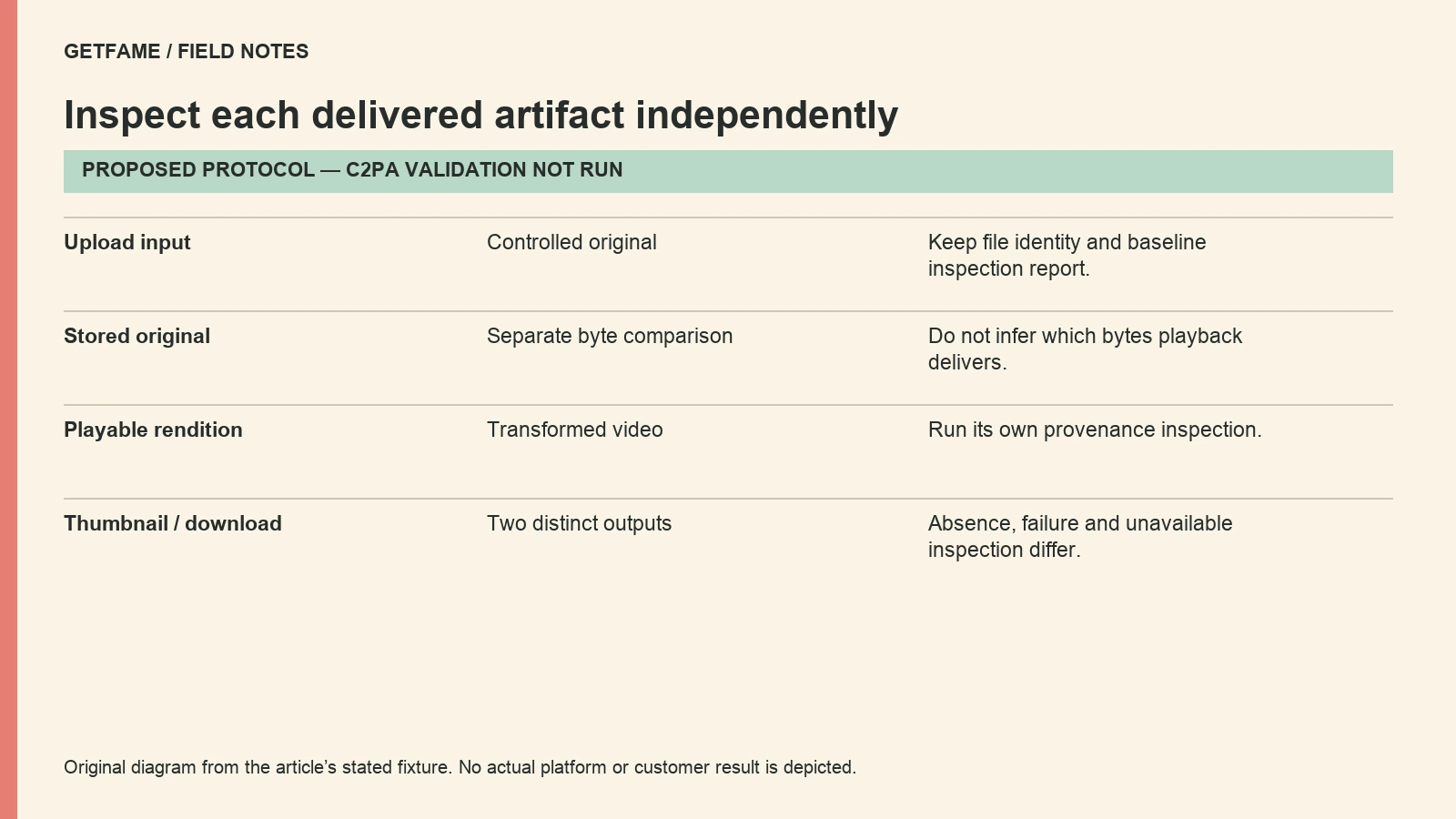
Map the actual pipeline before testing it. The reference matrix provides rows for upload input, stored original, playable rendition, thumbnail and downloaded output. Add or remove rows to match the permitted implementation rather than claim that every platform follows these five stages.
| Artifact | What to record | What not to infer |
|---|---|---|
| Upload input | Original identity, format and baseline report | That every later output shares its result |
| Stored original | Whether bytes and available provenance match expectations | That playback uses these exact bytes |
| Playable rendition | Transformation and its own inspection result | That a smaller file inherited every assertion correctly |
| Thumbnail | Separate output identity and provenance scope | That a video report validates a still image |
| Download | Exact delivered file and inspection method | That a saved dashboard preview represents the download |
Keep the relationship between inputs and outputs explicit. An output may have a new identifier, format and hash. That is not automatically an error: the test needs to understand the intended transformation before interpreting the difference.
The transcoding and adaptive-bitrate guide explains why one upload can generate several playback artifacts. The provenance test adds a different question at each boundary: what inspectable history and validation evidence accompanies the artifact now being delivered?
Why is byte equality different from provenance continuity?
An ordinary copy can preserve the same bytes, while transcoding creates a different representation. Comparing file hashes can reveal byte changes, but it cannot alone explain whether a changed output has an appropriate provenance history or whether the relevant assertions remain meaningful.
The C2PA technical specification defines content bindings and validation relationships between manifests and assets. A binding result must be interpreted for the asset and mechanism actually examined; it should not be reduced to "the filename stayed the same."
In the proposed protocol, preserve three separate references: the input artifact, the transformation record and the resulting output artifact. Then attach the actual validation evidence to the output. This makes it possible to distinguish an expected derivative from an unexplained replacement.
A pipeline that deliberately produces new credentials needs evidence of that process and the relationship it asserts. A pipeline that preserves only the original needs a narrower capability statement. Neither should be described using results copied from the other.
Avoid manually copying credential-looking metadata onto a changed file to make the interface appear consistent. The relevant relationship has to be evaluated by the actual supported provenance mechanism. A copied text field in a database is not equivalent to a validated association between a credential and delivered media.
Keep absence, failure and unavailable inspection separate
Use states that describe what the test actually observed. The reference worksheet offers categories for not run, no credential located by the specified method, a reported validation failure, a supported inspection with recorded results and an unavailable inspection. These are editorial reporting categories, not a replacement for a validator's formal status vocabulary.
For each result, retain the tool's detailed codes or report reference. A summary can help a reader, but it should not destroy the distinction between an asset-binding issue, a trust issue and a parser that could not inspect the format.
Do not call unsigned or uninspected media fake. A missing credential is missing provenance evidence under the method used, not a finding about whether the depicted event occurred. Likewise, a validation failure needs explanation before anyone assigns a motive to the creator.
Design the user-facing wording around the narrower result. "No provenance information was located with this check" communicates something different from "This video is false." The latter assertion requires evidence this test does not supply.
The matrix's local checker rejects an invented successful observation in a row still marked not run. It also requires an artifact reference and report reference before a completed-result row can be accepted. These checks protect the record's honesty; they do not implement C2PA cryptographic validation.
Challenge a copy before trusting the reporting process
After a real authorized baseline succeeds, design controlled negative cases using copies. Change one part at a time and record the intended fault. Preserve the untouched original and baseline report so the investigation can distinguish a deliberate mutation from accidental fixture damage.
Possible cases include a changed media artifact, an output from a transformation whose provenance handling is unknown and an inspection attempt using an unsupported format. The expected result must follow the actual tool's behaviour and documented mechanism; do not promise a particular error code without running that case.
Keep an unsigned sample as a comparison. The interface should distinguish the absence of inspectable credentials from a failed check on a credential-bearing asset. Otherwise, a useful signal can turn into a misleading binary label for all uploaded media.
Repeat the original baseline after testing the changed copies. A modified trust configuration or a damaged original can invalidate later comparisons. Record any tool or environment changes before interpreting an apparent regression.
Do not mutate a production upload or expose private signing material to create the negative case. This protocol can be performed with an authorized original test clip and carefully controlled copies. The small scope is an advantage because another tester can inspect the relationship without handling a real person's identity or confidential media.
Test the label on the actual viewer surface
Inspect where the viewer encounters the claim. A validation report in an administrator dashboard does not establish that a mobile viewer sees the same information, can open its explanation or receives the same artifact as a desktop download.
Record the label, the artifact it refers to and the route to additional information. If the label describes only the uploaded original, say that clearly. Avoid displaying it beside a transformed rendition in a way that implies the rendition itself was checked when it was not.
Test the information path with the permitted viewer role. A provenance explanation that depends on an administrator session may be unavailable to the person the label is supposed to help. Keep that usability issue separate from the underlying technical result.
The HeyGen clone features discussion can identify the relevant generation and delivery surfaces, while the HeyGen clone development-company guide helps assign responsibility for an acceptance test. Ask for the actual file, report and viewer explanation rather than infer a capability from a feature name.
Retain accessibility in the label's meaning. Color or a small seal alone should not carry the entire status. A plain-language description can preserve the difference between absent, failed and unavailable evidence for people who cannot interpret the visual treatment.
Preserve permission and privacy as independent evidence
A technically inspectable history does not settle every right to publish, transform or advertise with an asset. Keep the permission documents and allowed uses associated with the relevant content workflow rather than replace them with a provenance status.
The same applies to identity. An assertion about a creator or tool should be interpreted within the mechanism and trust relationship that supports it. Do not turn a successful technical check into a claim that an operator independently verified every named person.
Consider what information the provenance record itself reveals before sharing a fixture or report. A test intended to improve transparency should not accidentally disclose a private location, a real person's identity or an internal service address. Use the non-sensitive sample and approved test identity from the preparation stage.
If a permitted redaction or transformation changes the evidence, record the new artifact and inspect it under the appropriate method. Keep the original restricted as needed. Publicly deleting a sensitive field in a copied report is not proof that the delivered media's complete provenance record no longer contains it.
This is an operational review protocol, not legal advice or a full privacy assessment. Assign the policy decisions to the responsible team and make the technical report answer the narrower questions it can actually support.
Keep the inspection record reproducible across revisions
A later reviewer needs to know which artifact an old report described. Preserve identifiers that distinguish a new transcode from a previously inspected output, even when the public filename or download button remains unchanged. The visible title of a video is not a reliable reference for its bytes.
For each actual inspection, retain:
- A non-sensitive sample reference and artifact hash.
- The transformation and output format.
- The validator version and relevant trust inputs.
- The report location and observation time.
- The plain-language claim the report is intended to support.
If the output changes, create a new observation row rather than attach the old green status to the new artifact. That rule applies to ordinary configuration revisions as well as obvious editing. The question is whether the current delivered file has evidence appropriate to it.
Keep invalid and unavailable reports for diagnosis under the approved retention policy. Deleting every unsuccessful report can make a later summary look complete while removing the evidence of what the pipeline could not inspect. An engineering review needs those boundaries to select the next test.
The local matrix includes a separate test status so planned work cannot accidentally appear as completed evidence. It deliberately refuses to treat a row labelled not run as a successful validation. Before a real run, confirm the sample, permission and supported tool; after it, record the result without broadening its meaning into a statement about the entire catalog.
Compare the thumbnail, transcode and export as separate deliverables
Consider a proposed comparison using one controlled animation and three outputs: a small thumbnail, a playable transcode and an export containing the stored original. Assign each output its own artifact reference before inspecting anything. The comparison is about evidence attached to those deliverables, not a presumption that the pipeline produces a particular provenance result.
For the thumbnail, record which frame or rendering process produced it and how the viewer reaches it. Its dimensions and file format can differ from the video, and its relationship to the input needs documentation. If the selected inspector cannot examine that format, mark inspection unavailable with the reason. Do not borrow the video's report to fill the empty result field.
For the transcode, retain the transformation configuration and the actual delivered file reference. A change of resolution or encoding normally changes the bytes being compared; the meaningful acceptance question is which provenance relationship the implementation intends to establish and what the supported inspection reports. The test must discover that result. A changed hash alone does not answer it.
For the export, first check which object the download contains. A button labeled original might deliver a stored original, a prepared derivative or an archive with several files. Open the permitted package and inventory its contents before choosing the claim to test. Otherwise, a correct report can become misleading because the reviewer inspected a different file from the one the customer received.
Keep an ordinary integrity check beside each row. If two independently obtained copies have equal hashes under the chosen algorithm, that supports byte equality between those copies. It does not establish a valid credential, a trusted signer or an authorized use. Conversely, two derivatives having different hashes is not automatically evidence that either has failed provenance validation. The questions require different tools and records.
The public label needs the same precision. If only the exported original has an applicable inspection report, a label beside the thumbnail should identify that scope and direct the viewer to the relevant evidence. A generic seal covering the entire player can imply that every rendition has the same result. Test the label's meaning with the actual viewer route as well as its visual placement.
Give each unresolved row a next action that can close it. Unsupported inspection may require selecting a supported tool; a missing output reference requires obtaining the exact artifact; a report with a failure needs interpretation of its recorded details. None can be closed by copying another row's green status. Until an authorized run supplies artifacts and reports, this comparison remains a practical acceptance plan, with no completed C2PA validation implied.
Also retain the delivery selection that produced the file. If a download menu offers several formats, the chosen option belongs in the artifact record. A report for one option cannot be attached to another after a menu default changes. Repeating the comparison should start by obtaining the current output through the same documented selection, then checking whether its identity and applicable evidence still match the capability statement under review.
Keep the output's retrieval time beside its reference so a later replacement remains distinguishable.
Publish a capability statement that matches the tested chain
The outcome should name the sample, build, artifact stages, tool settings and observations. "We inspected these outputs under these conditions" is useful evidence. "Every upload is verified true" is a different claim that this exercise cannot establish.
Use the blank matrix to review the scope before any application test begins. Mark unavailable stages and unresolved ownership explicitly. A row that remains not run is a visible task, not a reason to invent a successful output to finish the table.
For a later real run, retain the original and output references, transformation descriptions, reports, trust inputs and viewer-label observations together. Give failures an owner and a retest condition. Recheck the statement after a material pipeline or tooling change.
When evaluating a HeyGen clone platform, bring that matrix alongside the wider consent policy. Decide which evidence the actual project needs to preserve and which public statement the resulting observations justify. The practical value of provenance is an explainable chain, with its limits visible to the person using it.
Download the companion files
Download the companion kits and worksheets. Worked examples are labeled synthetic, public-source registers retain their references, and unrun protocols are identified. Read each kit's method and limits before using it.
Questions and answers
Does a Content Credential prove that a video depicts the truth?
No. Provenance can provide evidence about an asset and its declared history under the relevant mechanism. It does not replace factual verification of what the video depicts. Keep the technical report, creator assertions, permissions and any independent editorial investigation separate when explaining the result to a viewer.
What should the preservation matrix inspect?
Record the upload input, stored original, playable rendition, thumbnail and downloaded output where those stages exist. Identify every artifact and transformation separately. Attach the actual inspection method and report to the artifact examined, rather than copy an original-file result onto all later outputs.
Is a missing credential the same as failed validation?
No. A method that locates no credential, a validator reporting a failure and an unsupported inspection are different observations. Retain the detailed report or limitation behind the summary. Do not label unsigned media fake or invent a successful result when the inspection method could not evaluate the file.
Has this draft signed or validated a test video?
No. It supplies a proposed protocol and a blank observation matrix. Local checks validate the reporting rules and reject contradictory entries, but no signing key, signed fixture, cryptographic validation or actual upload-pipeline run was created. A permitted implementation test remains separate from the editorial research.
What makes a public provenance statement defensible?
Name the artifact stages, tool settings, observation date and actual results supporting the statement. Explain unresolved or unavailable observations and retain permission evidence separately. Avoid broadening a successful check on one original into a guarantee covering every derivative, every creator or the truth of the depicted content.
Sources
- C2PA 2.4: technical specification
- C2PA 2.4: provenance explainer
- Content Authenticity Initiative: official C2PA Tool repository
Source review dates are recorded in the article and companion material. Draft modification dates do not establish a new source check. Rules, fees and programme terms change; confirm on the source before you rely on them.