Short video and live
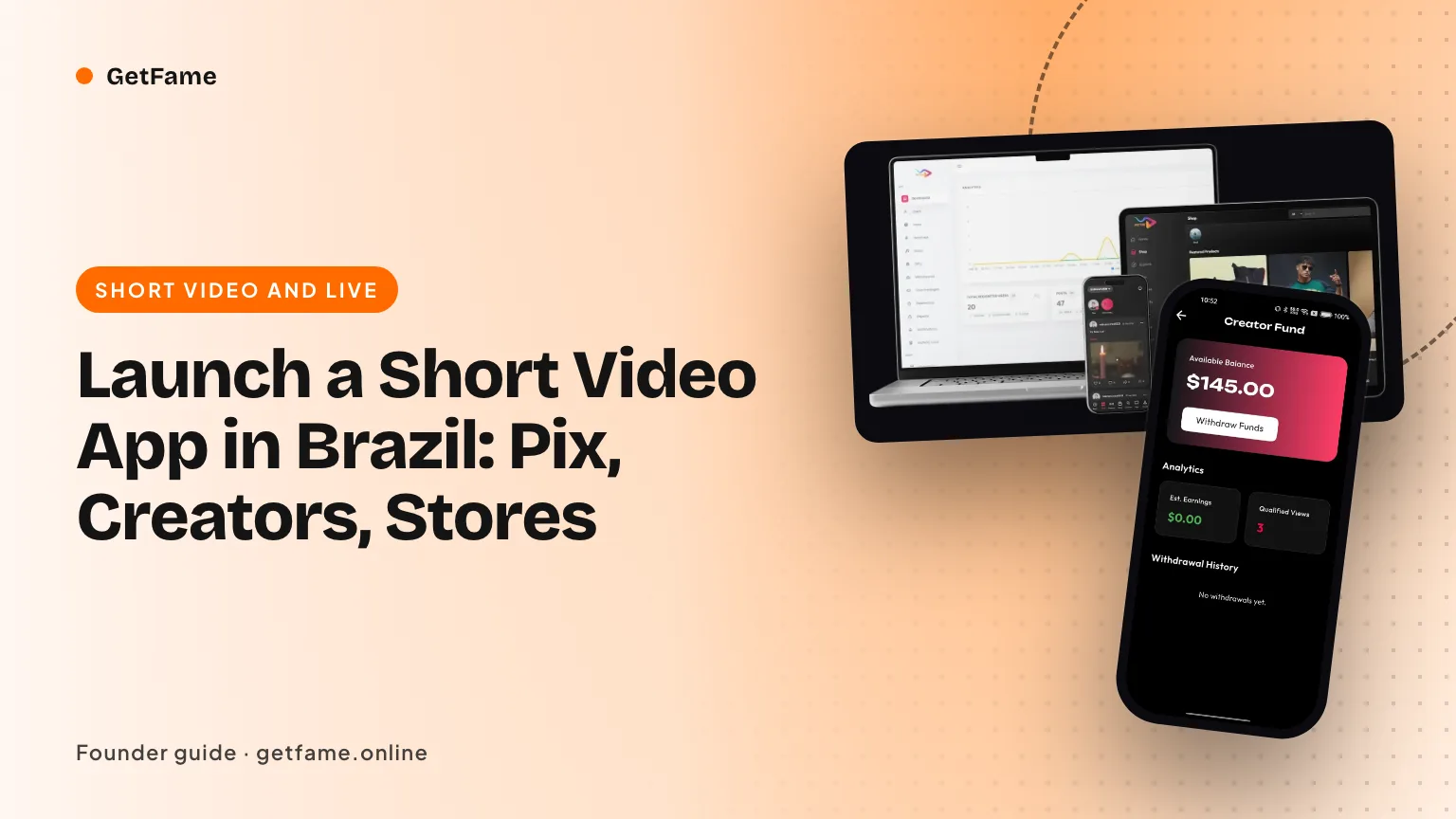
Launch a Short Video App in Brazil: Pix, Creators, Stores
How to launch a short video app in Brazil: choose your audience, take Pix and card payments, price in reais, find local creators and moderate Portuguese.
Short answer
To launch a short video app in Brazil, pick the audience first, then build around local payments: Pix, cards and wallets, with prices set in reais in each store. Recruit Brazilian creators in Portuguese, staff Portuguese-speaking moderators from day one, and settle privacy and reward rules with local advice before you open sign-ups.
Key takeaways
- Brazil is not one audience; the reporting we cite contrasts a blue-collar, northeastern Kwai base with a younger, wealthier TikTok base, so choose yours before you choose features.
- Pix is an instant payment system run by the central bank, and Google Play lists it for Brazilian buyers, but your own withdrawals still need a gateway and merchant accounts that you open.
- Set coin prices in reais through each store's pricing tools, because Google Play supports BRL pricing and BRL payouts only for Brazil-based accounts.
- Recruit creators in Portuguese and budget separately for them, since talent agencies and small earnings shape who can afford to post.
- Both app stores expect reporting, blocking and filtering for user content, and those tools only work if someone who reads Brazilian Portuguese answers the queue.
On this page 11 sections
- How do you launch a short video app in Brazil?
- Which Brazilians are you building for?
- How do Pix and the other payment methods fit together?
- How should you price coins and subscriptions in reais?
- Where do the first Brazilian creators come from?
- How do you moderate in Portuguese?
- What local law do you need to settle before sign-ups?
- What should the Portuguese product itself get right?
- What does a realistic first 90 days look like?
- How do you know when to widen beyond the first region?
- Your first month, in order
If you want to launch a short video app in Brazil, the work that decides the outcome is mostly not the video player. It is whom you are building for, how those people pay, what the stores let you charge in reais, which creators will post in Portuguese, and who reads the report queue at night. The software is the smaller part of that list, and you can have it running quickly.
This guide goes through the five local decisions in the order we would take them, with the sources we could check. A white-label Kwai-style app gives you the feed, the coin wallet, referral rules and the admin panel; the Brazilian decisions are yours to make, and we say below where our platform helps. This is not legal or tax advice; store and payment rules move, so read each linked page again before you commit.
How do you launch a short video app in Brazil?
Treat the launch as five parallel tracks with one owner each, and start the slow ones first.
| Track | Question to answer | Usually the slowest part |
|---|---|---|
| Audience | Which Brazilians are you building for, and why would they switch? | Deciding to exclude people |
| Payments | How do members buy coins and how do you pay out? | Gateway and merchant approval |
| Stores | What do you charge in reais and how do you pass review? | Review and account setup |
| Creators | Who posts the first two thousand clips? | Trust and first earnings |
| Safety | Who moderates in Portuguese and how fast? | Hiring and training reviewers |
The country-neutral sequence lives in our step-by-step short video app plan. The rest of this guide covers what changes when the country is Brazil.
Which Brazilians are you building for?
Brazil is large and unequal, and a short video app that tries to serve everyone will serve nobody well. The reporting by Rest of World in March 2022 is useful because it shows two audiences side by side. It says Kwai drew many blue-collar workers, including app drivers, bus drivers and food delivery workers, and quotes a researcher saying the app reaches people in historically marginalized northeastern states, while TikTok focuses more on younger users in the richer southeast. By the company's own account, Kwai ranked third among Brazilian app downloads for 2021 and had over 45 million monthly users; those are company figures reported in 2022.
What that means for you is not "copy Kwai". It means your first decision is a person, not a feature. A driver on a break wants short clips that load on a weak connection, a reason to come back tomorrow, and maybe a small reward. A teenager in a large city wants sounds, filters and a creator community. Those users want different feeds, different reward economics and different creators.
Questions that pick the audience
- Which region, age group and income band will you target first, and which will you leave out?
- Do they use Wi-Fi or mobile data, and how much data can a session use?
- What do they already do with video: watch novelas, share football clips, follow local comedians?
- What would make them tell a friend: a reward, a creator, a local event?
If rewards are part of your answer, work out their cost before launch with the framework in watch to earn app economics. A reward that is generous to a driver in the northeast must still pay back in your numbers.
How do Pix and the other payment methods fit together?
Pix is Brazil's instant payment system, created and run by the Banco Central do Brasil. In a June 2020 speech, the bank's president said Pix would launch in November of that year, that 980 institutions had committed to offering it, and that it aimed to make payments and transfers available instantly at any hour of any day. For an app owner the practical consequence is that Brazilians are used to paying by Pix from their bank app, and a payment screen without it will feel incomplete.
Google Play's help page for Brazil lists the methods a Brazilian buyer can use in its store. They include cards from American Express, Elo, Mastercard and Visa, Google Play balance and gift cards, PayPal, PicPay and Mercado Pago, and Pix. The page says Pix can buy apps, digital content and subscriptions, that the buyer scans or copies a payment code, that the code expires after five minutes, and that it can take up to ten minutes for the item to become available. It also says the buyer's bank must have joined Pix and Google Play must be version 8.9 or later.
Two payment flows you must keep apart
| Flow | What happens | Who handles it |
|---|---|---|
| Coin purchase through the store | Member buys a coin bundle with the store's payment method | The store collects, takes its fee and pays you |
| Purchase or payout outside store billing | Member pays by Pix or card through your gateway, or a creator withdraws earnings | Your gateway, your merchant account, your compliance |
The first flow is simple for you but earns less per sale. The second gives you more control and brings the work of identity checks, reconciliation and tax. Which purchases may use which route is set by each store's policy and by the kind of item sold, so read the current store rules before you design the checkout. The principle is set out in our summary of the two stores' billing policies.
On our side, the platform lets a creator request a withdrawal from the wallet, an admin approves it from a payout queue, and every decision is logged. Pick the methods and a gateway that fit Brazil, then link merchant accounts you hold, using the API layer. Optional creator verification with KYC is available for payout checks. The accounts, fees and approvals with the gateway are between you and the gateway.
Test the payment edge cases before launch
Payment screens fail at the edges, and members judge you by the edges. Before the beta, run each of these by hand on real devices: a Pix code that expires before the member pays, a member who pays after the code has lapsed, a card that is declined and retried, a purchase that is made twice by a double tap, a refund request, and a payout to an account whose holder name does not match the creator profile. For each case write down what the member sees, what the ledger records and what support should say. The aim is that no case leaves a member charged without coins, or holding coins that no payment backs.
Keep a daily reconciliation in the first month: gateway report on one side, wallet transactions on the other, and a short list of mismatches with an owner for each. Small mismatches are normal; unexplained ones that grow are the early sign of a bug or of abuse.
How should you price coins and subscriptions in reais?
Price in the currency your buyers carry. Google's Play Console help says Brazilian real is supported, so you can set prices and offer paid items in BRL. It also says earnings can be paid out in BRL, but that this requires a bank account located in Brazil, and that new Brazilian developer accounts default to BRL while Brazil-based accounts in US dollars are no longer supported. If a developer in Brazil does not use BRL by default, the page says Brazilian withholding taxes apply to earnings from sales to Brazilian customers. Ask your accountant what these lines mean for your company structure.
For Apple, App Store Connect lets you set prices for each storefront from the price points Apple offers. We could not open Apple's current price-point table for Brazil, so we will not quote a figure: check the Brazilian storefront in your own account and design bundles around the points it shows.
Rules for a first price sheet
- Build bundles in round reais that feel normal at the checkout, not converted dollars.
- Keep one small first-purchase bundle, because a first purchase is a habit-forming step more than a revenue line.
- Do not let a purchased coin and a free reward coin share a balance; the accounting and store rules differ, as reward coin liability accounting explains.
- Test price points per country before you apply one table everywhere; the logic is in regional pricing and local payments.
Our admin panel changes coin pricing and commission without a code release, and region-based rules let you run an offer in one country without opening it elsewhere. The wider cost picture, including store fees and hosting, is on the Kwai clone development cost page.
Where do the first Brazilian creators come from?
A feed with no local creators is a feed of someone else's culture. Rest of World reports that talent agencies often cover creators' costs in hopes of future earnings, and that a 2021 survey of 5,000 Brazilian influencers found that about half earned under $100 monthly from posting, and half of those earned nothing. Read that as a market signal: most creators are doing this on tiny incomes, so a clear first-month earning path is a real offer.
- List 30 to 50 creators at the size where a new app matters to them, not the largest names.
- Write the offer in Portuguese: commission rate, payout day, minimum balance, what you will promote.
- Give each a setup call and a first challenge, such as a hashtag with a small sponsor.
- Pay the first earnings on time and publish how it worked.
The commission, gift and payout levers are explained in creator recruitment for a new short video network. Our platform includes hashtag challenges, a creator earnings view and gift commission settings, so each step above has a screen behind it. Talent agencies can be partners, but write down who owns the creator account and who gets paid.
What the creator offer should spell out
Small creators read offers closely because the money matters to them. A one-page message in Portuguese should state the commission on gifts, the day of the month earnings are paid, the smallest balance that can be withdrawn, how long an approval takes, and who to write to when a payout is late. Add what you will do for them: a feature in a challenge, a profile badge if you offer one, a named contact. Do not promise reach, because you cannot control it. Do promise the things you can check, such as paying on the stated day. A creator who is paid on time in month one tells others; one who is paid late tells more.
Ask for something back that is easy to give: a minimum of posts per week for the first month, and an agreement to use the app's hashtag. Keep the arrangement non-exclusive. Exclusivity is a heavy ask from a platform nobody has heard of, and most small creators will say no.
How do you moderate in Portuguese?
Apple's guideline 1.2 on user-generated content says apps that let users create and share content must include a method for filtering objectionable material, a reporting route for offensive content that gets timely replies, a way to block abusive accounts, with contact details you publish. Those requirements describe tools, but tools need a reader.
Brazilian Portuguese carries regional vocabulary, slang that changes quickly and humor that depends on context. A reviewer who does not live in the language will miss harassment dressed as a joke and over-remove ordinary banter. Plan staffing around the language, not only the volume.
| Piece | What to set |
|---|---|
| Rules | Community rules written in Portuguese, short enough to read on a phone |
| Queue | One report queue with warnings, strikes and bans, answered within a stated time |
| Reviewers | Portuguese-fluent staff, with a second reader for borderline calls |
| Escalation | A named person for threats, minors and legal requests |
| Contact | A published address or form members can use |
The platform has a single abuse queue with warnings, strikes and bans, staff roles and rate limits, and the setup is explained step by step in a step-by-step moderation setup for short video. Policy wording and a store submission checklist are in passing store review with user content. Automatic captions and tighter age checks for Brazil are tailored work that we price once the scope is clear.
What local law do you need to settle before sign-ups?
Three topics need a Brazilian lawyer before you open the app. The first is personal data: Brazil's data protection law, the LGPD, sets rules for how you collect, store and share member data. We summarize it, with citations to the law and the regulator, in LGPD compliance for social apps. The second is the reward program: cash rewards often carry their own limits by country, and the legal responsibility for your rules stays with the operator. The third is minors, because a video app attracts young users and the law gives children's data specific protection.
For privacy work, the build ships consent prompts, account removal, a data export and adjustable retention, and the sign-up flow has optional age and region fields. Those are tools for your LGPD work, not a replacement for it.
What should the Portuguese product itself get right?
Translation is the smallest part. Members read sign-up screens, reward rules, error messages and withdrawal terms in Portuguese, and a confusing sentence about money costs more trust than a clumsy caption. Have a native writer edit every screen that mentions coins, balances, holds or fees, and keep the wording consistent between the app, the rules page and your support replies.
Our apps show labels in several languages, come in light and dark themes, and recommend by region, so a Portuguese interface and a feed biased to Brazilian creators are configuration choices rather than rebuilds. Sounds are a separate matter: a clip with a popular Brazilian song needs music rights, which the music licensing guide explains. The Kwai clone features list shows the recording, filter, duet, gift and live tools that new creators will use in their first week.
Consider data cost too. Members on limited mobile plans notice every extra megabyte, so test the feed on a modest phone and a slow connection before launch, and keep a first session short enough to reach a reward or a laugh without a long load. Read the Kwai clone business model page to decide which revenue lines fund that experience.
What does a realistic first 90 days look like?
| Period | Work | Done when |
|---|---|---|
| Days 1 to 7 | Platform live on your cloud account, rebrand, Portuguese interface text, store accounts opened | Staging app runs on real devices |
| Weeks 2 to 4 | Gateway applications, price sheets in reais, moderation rules and reviewers, creator outreach | Test purchase and test payout both complete |
| Weeks 5 to 8 | Store review, closed beta with 100 to 500 members, first creator challenge | Report queue answered in the time you promised |
| Weeks 9 to 12 | Open sign-ups in one region, read retention and reward cost weekly | You can state cost per retained member |
The build itself goes live in 6 working days, while tailored work such as reward tasks, regional offers or stricter age checks takes 2 to 8 weeks, and the rest of the table is outside software. Run a closed beta to learn how long store review and gateway approval take in practice. Do not announce a launch date until a test purchase and a test payout have both completed.
Signals to hold the launch
Set the stop conditions before the beta begins, so nobody argues about them in week eight. Hold the open sign-up date if any of these is true: a test payout has not reached a real bank account, the report queue has a backlog older than the time you published, store review has an unresolved rejection, or fewer than half of the creators you signed have posted in the last week. Each of these is cheap to fix before opening and expensive to fix afterward, because new members arrive faster than staff can repair a broken process.
How do you know when to widen beyond the first region?
Opening one region first is a way of keeping mistakes small. Widening is the next decision, and it should follow numbers, not enthusiasm. Read four of them for at least four straight weeks before you add a second region or a second audience.
- Return rate by cohort. Members who joined four weeks ago should still be coming back at a rate you can fund. If each weekly cohort returns less than the one before, adding more members adds to the problem.
- Cost per retained member. Everything you spent on installs, bonuses and referrals, divided by the members still active after thirty days. The method is the same as in the reward budget guide linked earlier.
- Creator posting rate. The share of signed creators who posted this week. A feed fed by a shrinking group of creators will go stale before the audience grows.
- Payout and report timing. Median hours from a withdrawal request to a decision, and from a report to a reply. These are promises to members, and they get harder to keep as volume rises.
When all four hold, widen in one dimension only. Adding a state, a new creator niche or a new payment method are three separate experiments, and doing them together hides which one worked. Keep the first region running as your control, and compare the new one against it. If the second region needs a different price sheet or a different reward level, treat it as a new launch with its own beta, not as an extension.
The reverse decision matters too. If the four numbers are weak after twelve weeks, narrowing the audience further is usually better than widening. A smaller group of drivers, students or fans of one local sport, served well, gives you cleaner learning than a thin spread across the country.
Your first month, in order
Pick one audience and one region. Open the store and gateway accounts the same week, since both involve waiting. Set the coin price sheet in reais and write your Portuguese rules. Sign a small first cohort of creators on a plain earning offer, and staff the report queue before anyone is invited.
To see the wallet, feed and admin panel in action, open the live web demo. The Kwai clone page lists the full scope, pricing shows the published price, and the terms in short are 60 days of technical support, bug fixes as their own 6-month item, and a year of updates. For Portuguese copy, regional offers or local reward rules shaped around your plan, describe your market on contact and we will come back with a scope.
Questions and answers
Do I need a Brazilian company to launch a short video app in Brazil?
Not to publish, but several things get easier with one. Google Play states that only Brazil-based developer accounts can use BRL, and that payouts in reais need a Brazilian bank account. Payment gateways and tax advisers also ask for local registration. Ask a Brazilian accountant and lawyer what applies to your structure before you commit.
Can members pay with Pix inside my app?
Google Play lists Pix for buying apps, digital content and subscriptions by Brazilian users, with a payment code that expires after five minutes. Outside store billing, you accept Pix through a gateway and merchant account of your own, which our platform connects through its API layer. Which route you may use for which purchase depends on store policy.
How should I price coin bundles for Brazil?
Price in reais, using the store pricing tools for each market, and test two or three bundle sizes against local income instead of converting dollar prices. Keep a low entry bundle for first purchases. Our guide on regional pricing and local payments covers the mechanics and the arithmetic of store fees.
What language should moderation use?
Brazilian Portuguese, read by people who understand local slang, regional terms and the references your creators use. Automated filters help with volume, but a report on a clip needs a human who can judge context. Staff the queue before launch and publish a way to reach you, as Apple's rules for user content expect.
How fast can I go live?
Expect a working build in 6 working days; Portuguese copy, reward rules or regional offers are tailored work of about two to eight weeks, scope permitting. Store review, gateway approval and creator recruitment run in parallel and often take longer than the build, so start those first.
Sources
- Rest of World, March 2022 report on Kwai in Brazil
- Google Play Help: Accepted payment methods on Google Play (Brazil)
- Play Console Help: Currency support for Brazilian Real and required taxes
- Banco Central do Brasil: President's speech at the 9th plenary of the Instant Payments Forum, 22 June 2020
- Apple Developer: App Review Guidelines, user-generated content rules
Checked in October 2026. Rules, fees and programme terms change; confirm on the source before you rely on them.