Retention and engagement
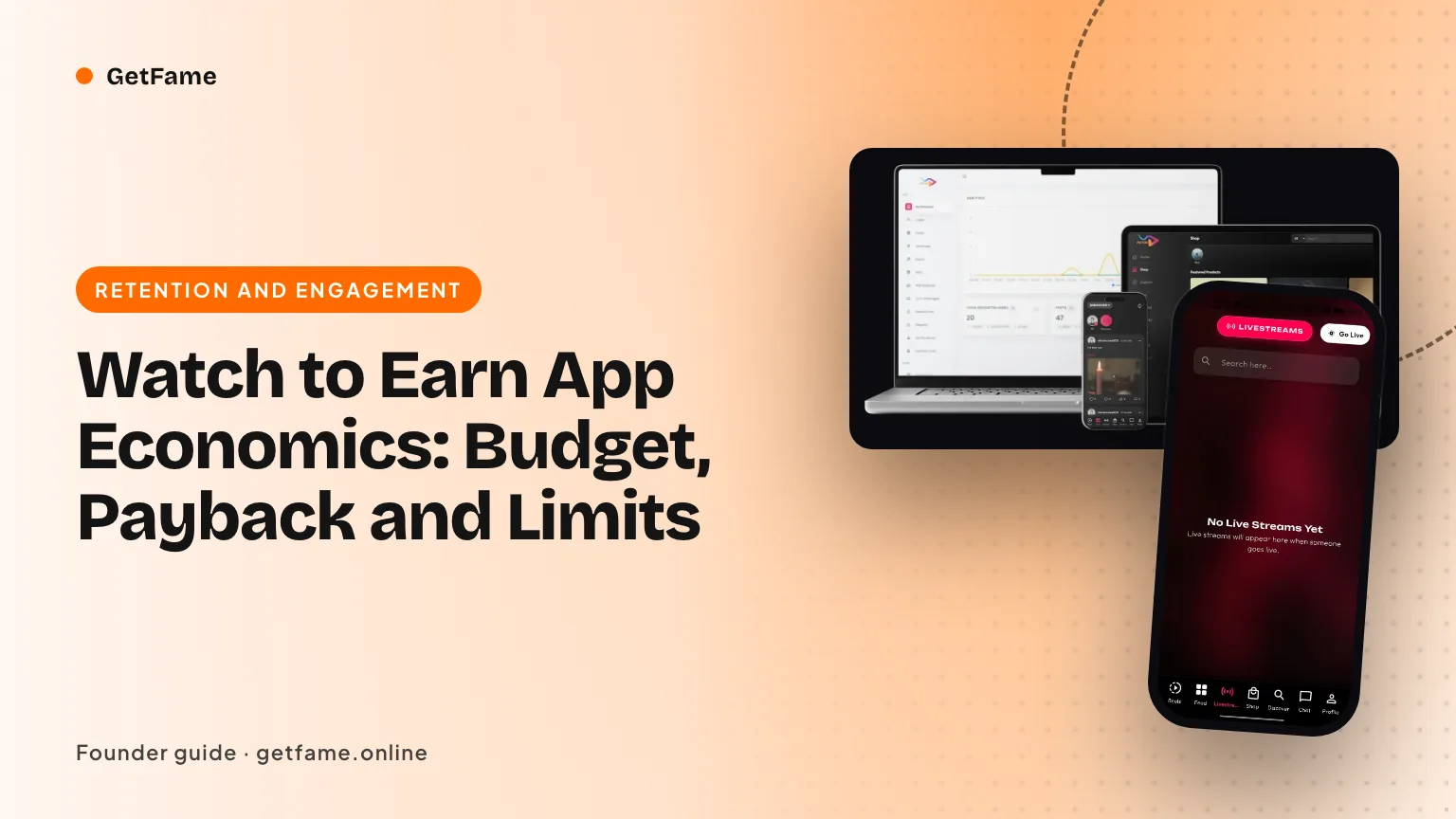
Watch to Earn App Economics: Budget, Payback and Limits
A watch to earn app lives or dies on its reward budget per user, payback period and caps. Learn the math, the limits and the signs the model has stopped.
Short answer
A watch to earn app works only when the coins it hands out cost less than the revenue and growth they buy. Set a reward budget per active user per day, cap it, measure payback in active days against what each install cost you, and cut or stop rewards when payback stretches beyond the point your cash can carry.
Key takeaways
- Think in reward cost per active user-day, because that is the number you can cap, test and compare with revenue per active user-day.
- Payback is acquisition cost divided by contribution per active day after rewards, so a small reward cut can shorten payback far more than it feels like it should.
- Daily caps, lifetime caps, decaying rates and withdrawal thresholds turn an open-ended promise into a budget you can state in advance.
- Rewarded ads and store rules limit what you may pay out, so settle the form of the reward before you design the loop.
- The model stops working when reward-chasers outnumber viewers who would have stayed anyway; watch retention without rewards, not just with them.
On this page 11 sections
- How does a watch to earn app pay for itself?
- What is the reward budget per user?
- How long until the rewards pay back?
- Which caps keep the budget finite?
- What form may the reward take?
- When does watch to earn stop working?
- What does Kwai's Brazilian growth show about rewards?
- How do you test reward levels in the first six weeks?
- How does the platform handle reward controls?
- Which numbers should you read every week?
- Setting your first reward budget
A watch to earn app pays people in coins for time and attention, and that makes it a budgeting problem before it is a product problem. Every coin is a promise that you fund later from ads, coin sales or the money you raised. The founders who survive are the ones who can say, before launch, how many coins a day one member may earn, what that costs, and how many days of use it takes to earn the money back.
This guide gives you the arithmetic, the caps that make the budget finite, the outside rules on what you may pay, and the signs that the model has stopped working. Written for the owner of a white-label rewards short video app, where a coin wallet, referral rules and a payout queue sit behind the feed. Where a figure is not from a cited source it is an illustration, labeled as one, for you to replace with your own numbers.
How does a watch to earn app pay for itself?
A reward is cheap only when it changes behavior you would otherwise pay more to buy. A coin credited to a new member for finishing their first five clips buys activation. A coin for a seven-day streak buys retention. A coin paid to a referrer buys an install without a paid ad. Each of those replaces some other cost, and that replacement is the only honest justification for the spend.
The money to cover it comes from four places. Rewarded ad placements that a member opts into produce ad revenue per view. Coin bundles that members buy for gifts produce direct sales. Sponsored challenges produce brand fees. Gift commission produces a share of what fans send creators. Your Kwai clone business model decides which of these carries the reward bill, and the answer should be written down before the first coin is issued.
Three jobs a reward can do
| Reward job | What it replaces | How to judge it |
|---|---|---|
| Activation | A paid install campaign that still leaves the user cold | Share of new members who reach a first week of use |
| Retention | Re-engagement push campaigns and win-back offers | Return rate of rewarded versus unrewarded cohorts |
| Referral | Cost per install from advertising | Net cost per retained referred member |
A reward that does none of these jobs is a gift, not an investment. It may still be worth giving, but it belongs in a marketing line, not in a model that claims to be self-funding.
What is the reward budget per user?
Work in one unit: reward cost per active user-day. A member who opens the app on a given day is one active user-day. Divide the coins you credited that day, converted to local currency at your redemption rate, by the number of members who were active. That number is the thing you can cap, test and compare with income.
Now write the other side of the ledger in the same unit. Gross revenue per active user-day is ad income plus coin sales plus commission, divided by active members. Subtract delivery, hosting, payment fees and store fees per active user-day. What remains is contribution before rewards. The reward budget must sit below it, or each active day makes the business poorer.
An illustrative day
The figures below are illustrative, not benchmarks; replace them with your own. Say gross revenue per active user-day is R$0.35 and video delivery, hosting and fees take R$0.10, leaving R$0.25 of contribution before rewards. If you credit R$0.20 per active day on average, R$0.05 is left to repay everything else: acquisition, staff, moderation and tax. If you credit R$0.10, R$0.15 is left. The same product earns three times as much per day with half the reward, which is why this number gets more attention than any feature.
- Credit coins at a fixed local-currency value you publish, so liability does not drift.
- Separate coins from sign-up, check-in, watch time, referral and gifting in your ledger so you can see which job costs what.
- Report reward cost per active user-day weekly, split by country, because rewards that work in one market can lose money in another.
How long until the rewards pay back?
Payback is the acquisition cost of a member divided by the contribution that member leaves per active day after rewards. Acquisition cost here is everything you paid to get them: a sign-up bonus, a referral bonus to the inviter, and any ad spend. The result is measured in active days. You then convert active days into calendar days using how often members actually return.
Continue the illustration. A new member costs R$2 in sign-up coins plus R$3 paid to the referrer, so R$5 in all. Contribution before rewards is R$0.25 per active day. The table shows what different daily reward levels do to payback.
| Average reward per active day | Contribution after rewards | Active days to repay R$5 |
|---|---|---|
| R$0.20 | R$0.05 | 100 |
| R$0.15 | R$0.10 | 50 |
| R$0.10 | R$0.15 | about 33 |
| R$0.05 | R$0.20 | 25 |
Halving the reward from R$0.20 to R$0.10 cut payback from 100 active days to about 33. If a typical member gives you 12 active days in the first 90 days, none of these rows repays the average install, and the program is carried by the heavy users. That is not unusual, but you need to know it, and you need to know how many heavy users there are. Read payback per cohort and per acquisition source, never as one blended figure.
Then compare the calendar payback with your cash. A payback of 60 days is a loan to your members that you must fund for two months for every cohort, while the next cohort is already being acquired. Growth multiplies the cash you need, which is the usual way a reward-led app runs dry while its charts look healthy.
Which caps keep the budget finite?
Without limits, a reward is an open-ended liability controlled by the most determined members. With limits, it is a line item. Layer several, because each one closes a different gap.
| Cap | What it limits | Trade-off |
|---|---|---|
| Daily earning cap per member | The most one account can collect in a day | Heavy honest users hit it; set it above a normal day |
| Lifetime cap per member | Total coins from one account, ever | Reduces long-run incentive; pair with ongoing gift income |
| Decaying rate | Rewards fall after the first week or month | Teaches members the program shrinks, so say it up front |
| Global daily budget | The total you will credit across all members in a day | Late joiners on a busy day earn less; show remaining budget |
| Withdrawal threshold | Smallest balance a member may cash out | High thresholds slow payouts and add churn if too high |
| Hold period before payout | Time between request and payment | Slows farmers; honest members wait too, so disclose the delay |
The global daily budget is the one most founders skip, and it is the one that protects the company. If you decide that no more than a set number of reais of coins may be issued in a day, the worst case is known. The cost of this cap is fairness at the edge, which you manage by showing members how much of the day's pool remains.
A decaying rate deserves a note on honesty. A member who joins for large first-week rewards and sees them fall will complain, and the complaint is fair if the fall was a surprise. Put the schedule in the rules screen and the terms. The same guidance applies to referral rewards without fake accounts, where payment on a qualifying action and a hold before payout do much of the protecting.
What form may the reward take?
The form of the reward decides which outside rules apply, so settle it early. There are three broad forms: coins that stay inside the app and are spent on gifts and perks, coins that can be withdrawn as money, and partner offers redeemed outside the app.
Start with rewarded ads. Google's AdMob policy for ad units that offer rewards says direct monetary items, which it defines to include cash, cryptocurrency and gift cards, may not be offered as rewards under any circumstance. Non-monetary items such as loyalty points may be offered when they are redeemable only inside the publisher's own app and are non-transferable. The same policy says the reward and the action required must be disclosed before each rewarded ad, that rewarded ads must be opt-in, and that the publisher must deliver the promised reward. If you run rewarded ads and also let members withdraw cash, take the policy text to whoever reviews your ad setup and ask how the two fit together. This is a reading of a policy that can change, so check the live page.
Next, the app stores. Apple's review guidelines say that if you sell in-game currencies or similar credits through in-app purchase, those credits may not expire. That rule is about purchased credits, not free rewards, but it tells you how the store thinks about wallets: purchased value is protected, and a hidden rule that confiscates it will draw attention. Keep purchased coins and free reward coins in separate balances, so each can follow its own rules. The accounting side of that split is covered in how to treat reward coins as a liability.
Last, cash payouts carry their own legal limits by country. Whether a reward counts as income for the member, whether the program resembles a game of chance, and what identity checks apply are questions for a local lawyer, and this guide is not legal advice. Our platform lets members request a withdrawal and an admin approve it from a logged queue, and optional creator verification is available, so the control points exist. The rules around them are yours to define.
What to ask an ad network and a payment partner first
Rewards touch three outside parties: the ad network that pays you for views, the app stores that carry the app, and the payment provider that moves money out. Each can change terms, and each has its own idea of an acceptable program. Put these questions in writing before you commit the loop.
- To the ad network: Is a rewarded placement allowed when the reward feeds a balance that can later be withdrawn? What disclosure must appear before each ad? How does the network treat traffic from accounts that watch only to collect, and what happens to revenue when it flags that traffic?
- To the payment provider: Which payout methods are open to you in each country? What identity checks apply to the people receiving money? What is the delay between approval and arrival, and what happens to a failed payout?
- To your accountant: How do you record coins that are issued but not yet redeemed, and who signs off the redemption rate you publish? The answer links to the liability treatment in reward coin liability accounting.
- To your lawyer: Does a withdrawable reward change how the program is classed where you operate? Is a minimum age needed for anyone who can withdraw?
Write the answers beside the date you received them. Terms move, and a dated note tells you which assumption to recheck when a network or store updates its rules.
Bad days to rehearse
Walk through three bad days before you launch, and decide who does what on each. On the first, the ad network pauses your account and rewarded revenue drops to zero while coins keep being earned: pause new credits, keep the redemption queue open, and tell members why. On the second, a single device cluster collects a large share of the daily pool: freeze those payouts into the hold queue, review the accounts, and release the honest ones. On the third, a store review asks you to explain the reward program: have the rules page, the disclosure wording and the cap schedule ready as one document. A team that has rehearsed these answers in an hour does not improvise them in a crisis.
When does watch to earn stop working?
The model breaks in recognizable ways, and each shows up in numbers before it shows up in complaints.
- Reward-chasers outnumber viewers. Sessions are short, the watch time per active day is low, and members leave within a day or two of reaching the withdrawal threshold.
- Payback keeps lengthening. Each new cohort needs more active days to repay than the last, usually because organic referrals have given way to paid ones or because the cap leaves too little contribution.
- Fraud becomes the main user base. Many accounts per device, identical timing and balances stopping just below the threshold.
- Revenue per active day falls. Advertisers pay less for audiences that watch only to collect, and rewarded ad networks may count low-quality activity against you.
- Members stop caring about the rewards you can afford. The rate you can pay is below what they will accept, and the loop no longer retains anyone.
The sharpest test is the cohort run at lower rewards. Take a small share of new members, give them half the reward rate, and compare seven-day and thirty-day return with the full-reward group. If retention barely moves, your content and community are holding people and you were overpaying. If it collapses, you rented your audience, and the day you stop paying is the day it leaves.
What does Kwai's Brazilian growth show about rewards?
Rest of World reported in March 2022 that Kwai launched a referral and advertising campaign in 2020 that paid small cash rewards to users who got friends and followers to download the app, and that the company said Kwai became the third most downloaded app in Brazil in 2021 with more than 45 million monthly active users. The article also notes that many of its users are blue-collar workers such as app drivers, bus drivers and delivery workers, and that a researcher contrasted that audience with TikTok's younger, richer southeastern base.
Three lessons follow for a founder, and none of them requires believing the numbers about a company you do not run. First, small payments can work in a market where paid installs are expensive and a friend's recommendation carries weight. Second, the audience matters: a reward means more to a person who spends the working day on a motorbike than to a student, so the same coin buys different behavior in different groups. Third, creator income stayed modest. The same reporting cites a 2021 survey in which roughly half of Brazilian influencers made less than $100 monthly, which suggests that the reward on the viewer side and the earnings on the creator side are separate problems and need separate budgets.
The campaign described there ran in 2020, and the article does not say what Kwai pays today, so treat it as a case study of one market and period, not as a recipe. If you plan to launch in Brazil, the Pix, app store pricing and moderation questions are covered in the Brazil launch guide.
How do you test reward levels in the first six weeks?
A reward rate chosen by instinct is a guess you pay for every day. A small, boring experiment replaces it with evidence, and it fits inside the first six weeks of a soft launch. The figures here are illustrative; the shape of the plan is what to keep.
- Week 1, baseline. Admit a few hundred members with no sign-up coins, only the content. Record how many return on day 1, day 7 and day 14. This is the audience your feed holds on its own.
- Weeks 2 and 3, two reward arms. Split new members at random into a low-reward group and a medium-reward group. Keep the caps identical so only the rate differs. Tag every coin credited to each arm in the ledger.
- Week 4, read the gap. Compare return rates and reward cost per active user-day. If the medium arm returns only a few points more than the low arm but costs twice as much, the extra coins are buying very little.
- Week 5, test the form. Offer one arm in-app perks and another a withdrawable balance. Watch which one is redeemed, and how quickly, since a perk that nobody uses costs less than cash that everybody uses.
- Week 6, set the rule. Pick the arm with the shortest payback that you can fund for ninety days, write down the stop rule, and only then widen sign-ups.
Keep each arm large enough that a handful of heavy users cannot swing the result. If a group is too small to read, say so and extend the test instead of acting on noise. Also record the acquisition source of every member, because referred members and organic members often react differently to the same rate.
Reading a mixed result
Real tests rarely give a clean winner. A common pattern is that the higher reward lifts day-1 return and does nothing by day 14. That means the coin buys a first visit and the content has to buy the second. In that case spend on the first-week rewards, taper hard afterward, and put the saved budget into creator support. Another pattern is that the low arm retains well but grows slowly through referral. Then the rate is right for retention and wrong for growth, and the referral reward should be tested on its own, separate from the watch reward.
How does the platform handle reward controls?
The mechanics sit in the admin panel and the wallet. Each member's wallet adds coins from purchases, gifts and the reward credits you set up. Commission and coin pricing are settings you change without a code release. Staff set up rewarded ad placements next to the in-app ones. Withdrawals start as a request in the wallet; an admin then accepts or rejects it in a single queue that logs every decision. Transaction records let finance staff reconcile purchases, gifts and payouts with gateway reports.
Daily check-ins and watch tasks that pay out coins can be built as tailored work, shaped around your plan and your caps, typically in the two to eight weeks we quote for tailored work. Referral codes are an available module, with credit rules and release conditions agreed with us first. Rate limits on sign-ups, engagement and reports make scripted farming slower, and staff roles give each reviewer only the screens they need, and staff can turn on a second sign-in step. Region rules allow a promotion to run in a single country while others stay closed, and device fingerprinting to link sign-ups to devices is available and scoped with your fraud plan. We confirm the exact scope for your build at kickoff.
The operator controls are listed under Kwai clone features.
Which numbers should you read every week?
- Reward cost per active user-day, by country and by reward type.
- Contribution per active user-day before and after rewards.
- Active days to payback, by cohort and by acquisition source.
- Seven-day and thirty-day return for rewarded and lower-reward cohorts.
- Share of issued coins redeemed within thirty and ninety days, because unredeemed coins are a liability that also needs recording.
- Withdrawal requests approved, declined and held, with the reason for each hold.
- Share of daily reward budget used by the top one percent of earners.
The last item is the quickest fraud signal you have. If a small group of accounts takes a large share of each day's pool, either you have a genuinely devoted user group worth keeping or you have a farm.
Setting your first reward budget
Pick the reward job first, then the cap, then the form of the payout, and only then the amounts. Start with a global daily budget you could carry for ninety days without any revenue, because early revenue is the number you know least. Put a stop rule in writing. Run a lower-reward cohort from week one so you have a baseline for what your content holds without payment.
When you are ready to see how the wallet, ad slots and payout queue behave, open the live web demo, then check Kwai clone development cost and the published price on pricing. Support terms: 60 days of technical support first; bug fixes for 6 months are a separate term; updates run for 12 months. For daily check-ins or watch tasks scoped against your own caps, send your market and budget through contact and we will say what your build needs. The starting point is the Kwai clone product page.
Questions and answers
What is a watch to earn app in plain terms?
A watch to earn app credits members with coins or points for watching clips, checking in or completing small tasks. The coins can be spent on gifts, perks or, where the operator allows and the law permits, withdrawn. The operator funds those coins from ad revenue, coin sales or growth budget, so every reward is a cost that must be planned.
How much should a watch to earn app pay each user?
There is no universal figure. Start from what a retained user earns you per active day after hosting and fees, then pay a fraction of it as rewards and cap the total per day. Test two or three levels on small cohorts and keep the one where payback fits the cash you can afford to wait.
How long can a reward-led app wait for payback?
That depends on cash, not on a rule. Count the active days a typical install needs to repay its bonus and referral cost, convert them to calendar days with your retention curve, and compare the result with the months of runway you hold. If the answer is longer than your runway, reduce rewards or acquisition spend.
Can rewarded ads pay members in cash?
Google's AdMob policy for rewarded ads says direct monetary items, including cash, cryptocurrency and gift cards, may not be offered as rewards under any circumstance. Non-monetary rewards usable inside your own app can be allowed under conditions. Read the current policy before you wire ad placements to a withdrawal balance.
What happens to a watch to earn app when rewards are removed?
Usage usually falls, because some members came only for the payout. The useful test is how much of the audience stays when rewards shrink: run a small cohort with lower rewards and compare their retention with the full-reward group. If the lower-reward cohort keeps enough viewers, the content is doing the work.
Does the platform include watch rewards out of the box?
The coin wallet, rewarded ad slots, gifts, withdrawal approvals and rate limits are part of the platform. Daily check-ins and watch tasks are available with tailored work, scoped with us against your budget and caps. We confirm the exact rules, limits and fraud checks for your build at kickoff.
Sources
- AdMob rewarded ad policy page
- Rest of World (2022): Kwai's Brazil strategy and its referral campaign
- Apple guideline 3.1.1 on in-app purchase currencies
Checked in October 2026. Rules, fees and programme terms change; confirm on the source before you rely on them.