
Coins, gifts and wallets
PK Battle Feature for a Live Streaming App: Rules and Abuse Controls
A PK battle feature for a live streaming app pits two hosts against each other on gifts. Design the timers, scoring, gift economics and abuse controls.
Short answer
A PK battle feature for a live streaming app pairs two hosts for a timed contest in which each audience's gifts add to that host's score. The higher score when the clock stops wins. To design it, set the pairing rules, the timer and overtime, a point formula, a settlement step that credits gifts once, and abuse controls against collusion and fake accounts.
Key takeaways
- Two live rooms share a countdown, gift value becomes the score, and the clock is what creates urgency.
- Point rules shape behavior: multipliers near the end make viewers hold gifts back, and a cap or diminishing score stops one gift deciding every match.
- Gifts sent in a battle are ordinary gift transactions first and score second, so the ledger must credit them exactly once whatever the result.
- Most abuse is predictable: hosts colluding to inflate results, fake accounts feeding gifts, stolen cards buying coins, and disputes over the final seconds.
- Penalties and forfeits need written limits, and both rooms need moderation while they are linked.
- Pilot with one format and a small host group, read the ledger and report data, then add formats.
On this page 10 sections
- What is a PK battle and what does it add to a live room?
- How do hosts get paired, and which formats should you offer?
- What timer and scoring rules should a battle have?
- How do gift economics work inside a battle?
- How do you tell whether battles are healthy?
- How should you tune pairing so battles feel fair?
- What abuse should you expect, and how do you control it?
- What does the ledger need to record?
- How does GetFame support PK battles?
- A four-week pilot for your first battle format
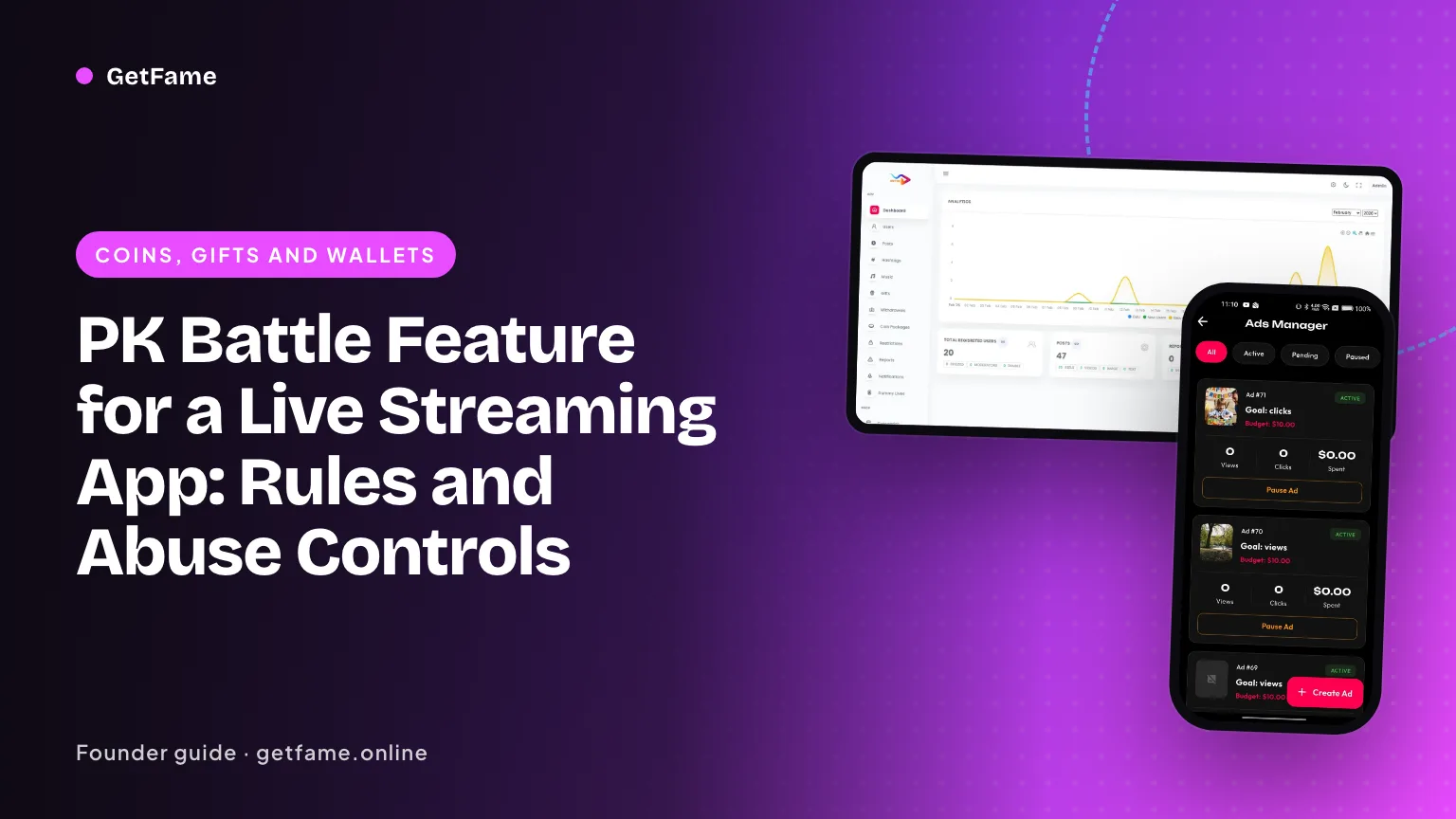
A PK battle feature for a live streaming app turns two ordinary broadcasts into one contest. Two hosts are paired, both rooms are linked for a fixed time, and the audience's gifts become points on a shared scoreboard. When the timer ends, the higher score wins. The mechanic is simple to describe and easy to get wrong, because it joins three things that each need rules: a clock, a score and real money.
This guide is for a founder who is adding battles to a live app, or who runs a camera-first product such as the Likee clone and wants gifting to feel like a game. It covers the pairing options, timer and scoring rules, the gift economics, the abuse you should expect and a small pilot plan. For the basics of how gifts turn into host earnings, read the virtual gifts explainer first; this post stays on the battle layer.
What is a PK battle and what does it add to a live room?
In a normal live room, gifts flow one way: viewer to host. A battle adds a rival and a deadline. Viewers who like a host can see exactly how far behind that host is, and how much one more gift would change the picture. That visibility is the point. A gift in a quiet room is a thank-you; a gift during a close battle is a move in a game.
Three effects explain why operators build it:
- Urgency. The timer gives viewers a reason to act now rather than later.
- Audience exchange. Each host brings their fans into the other room, which exposes both hosts to new viewers.
- Story. A battle has a start, a comeback or a collapse, and a result, which makes clips worth sharing.
The cost is that every flaw in your rules is now visible in public, in real time, with money attached. The sections below set the rules before you ship.
How do hosts get paired, and which formats should you offer?
BIGO LIVE describes three entry routes: a random PK that pairs you automatically with another streamer who is also looking for a match, a friend PK that invites someone from a friends list, and themed or official event PKs run as tournaments. The battle begins once the other side accepts.
| Format | How pairing works | Strength | Risk to manage |
|---|---|---|---|
| Random match | The system pairs two available hosts | Fast, exposes hosts to new audiences | Wildly unequal pairings feel unfair and lose the weaker host |
| Friend or invite | One host invites another by name | Predictable, good for collaborations | Easiest route for collusion and rigged results |
| Event or tournament | You run a bracket with set start times and prizes | Builds a calendar and sponsorship value | Prizes raise stakes, so abuse and disputes cost more |
| Team or multi-room | Several hosts or rooms join one scoreboard | Bigger audience, more social | Harder to moderate and to attribute gifts |
For a first release, offer one format. Random match with skill bands, so that hosts of similar earnings meet, gives the most learning with the least rigging risk. Add friend battles after your abuse monitoring is working, and events after that.
What timer and scoring rules should a battle have?
Write the rules as numbers and states before anyone designs a screen. A battle moves through a few states, and each transition needs an owner in code.
- Invite. A host sends or accepts a request. Set a response window of a few seconds so rooms do not hang.
- Countdown. Both rooms link and show a short countdown, so supporters can get ready.
- Live. The timer runs. Gifts add to the score of the room that received them.
- Closing window. A short period at the end, often marked on screen, where rules may change.
- Result. The timer reaches zero, the score freezes and a winner is declared.
- Cool-down. A brief wind-down in which hosts talk to both audiences before the rooms unlink.
Duration and overtime
BIGO's blog describes the limit as usually a few minutes to over ten minutes, with a timer and a progress bar showing both scores. Pick one length first and measure how many viewers stay to the end. Decide before launch what a tie means: a shared win, a short overtime, or a win for the side whose last gift arrived first. A tie rule that surprises people in public is a source of disputes.
Multipliers and their side effects
BIGO's guide to Multi Room PK names three scoring stages for that mode: double points early, a 1.5 times boost in the middle and a large point gain in the final seconds, with an on-screen banner naming the active multiplier. Multipliers keep battles open, but they teach supporters to hold their largest gifts until a boost window. If your late multiplier is strong, expect a quiet middle and a rush at the end, and design the room for that rhythm. Make the multiplier visible so nobody feels tricked, and apply it on the server so a lagging phone cannot change a result.
A rule that protects fairness
Decide whether one very large gift may decide a battle. If a single purchase can flip every result, spending power becomes the whole game and smaller hosts stop entering. Common controls are a per-supporter cap on points in one battle, diminishing returns above a threshold, or skill-band matching. None is perfect; choose one, state it in the host rules and review it after the pilot.
Worked example: how a cap changes a battle
The figures here are illustrative round numbers to show the mechanics, not a forecast. Imagine a five-minute battle between two similar hosts, with one point per coin. Host A's room receives 900 coins from many small supporters. Host B's room receives 700 coins from many small supporters and one 1,500-coin gift from a single account in the last ten seconds.
| Rule | Host A score | Host B score | Winner |
|---|---|---|---|
| No cap | 900 | 2,200 | Host B, because one gift decided it |
| Cap of 500 points per supporter per battle | 900 | 1,200 | Host B, but the margin shrinks and the crowd still mattered |
| Cap of 300 points per supporter per battle | 900 | 1,000 | Host B, narrowly, and the last-second gift no longer overshadows the room |
The cap changes the shape of the contest without touching the money. Host B still earns the full value of every coin their room received, because the cap lives in the score view, not the ledger. That separation is what lets you tune the game later without rewriting anyone's balance. Publish the cap in the host rule sheet and in the viewer-facing help text, because a cap that nobody knows about reads as a hidden rule.
The host rule sheet
Hosts need one page they can read before their first battle. Cover these points in plain sentences and keep a dated version history.
- How pairing works, and how often the same two hosts may meet in a day.
- The length of a battle, the closing window and the tie rule.
- How points are counted, including any multiplier, cap or minimum account age for gifts to count.
- What each host keeps from gifts received, and what the winner receives.
- What happens on a disconnect, a forced end or a moderator action.
- Prohibited conduct, including begging, coercion, demeaning forfeits and arranged results.
- The penalty ladder: warning, loss of battle access for a period, withheld earnings pending review, and removal.
- How to dispute a result, where to send it and how long a reply takes.
How do gift economics work inside a battle?
The key design choice is to treat a battle gift as an ordinary gift first and a score contribution second. The viewer debits coins, the host earns under your commission rules, and the battle only reads the transaction to add points. That separation keeps the money correct even when the contest is not.
An illustrative example, with illustrative round numbers to show the mechanics and not a forecast: a battle runs for five minutes. Host A's room receives gifts worth 3,000 coins, Host B's room receives 2,400 coins, and your platform commission on gifts is 40 percent. Host A earns 1,800 coins' worth and Host B earns 1,440, because both keep the value of what their audiences sent. Host A wins the badge. The platform keeps 2,160 coins in value across both rooms. If instead you let the loser forfeit its gifts to the winner, you change the incentives completely, and you need hosts to agree before the match. Most operators avoid that.
| Design question | Option A | Option B | What to check |
|---|---|---|---|
| Who keeps gift value? | Each host keeps what their room received | Winner takes a share of the loser's gifts | Option B is harder to explain and to defend with stores and regulators |
| What does winning give? | Badge, frame or featured placement | Cash or coin prize from the platform | Prizes raise abuse incentives and may raise legal questions |
| What counts as score? | Gift value in coins | Gift value plus likes or shares | Anything free to produce is easy to fake |
| What if a host disconnects? | Battle ends, gifts stand, no winner | Remaining host wins by default | A default win rewards a rival for pulling a plug |
BIGO's multi-room guide mentions badges, profile frames and a week of featured placement for champions, which are low-cost rewards that do not create a liability. For store rules on the currency itself, note that Apple's guideline 3.1.1 lets apps use purchased in-app currency for tips to digital content providers and lets users send gifts built from items sold through in-app purchase, adds that refunds go only to the buyer and that gifts cannot be exchanged, and requires odds disclosure for randomized purchases. Google's Payments policy likewise requires Play billing for virtual currencies and odds disclosure for randomized items, and adds that virtual currency bought in an app can be spent only inside that app. A score-based battle fits inside those lines; random prize draws and stake-based side bets are where you need legal advice. For payout and commission design, see the Likee clone business model.
How do you tell whether battles are healthy?
A battle that raises gift value can still be damaging the platform. Read a small dashboard weekly, and look at the ratios rather than the totals, since totals rise with audience size.
| Measure | What a healthy trend looks like | What a warning looks like | First response |
|---|---|---|---|
| Viewers staying to the end | Stable or rising across formats | Falls after the middle of the timer | Shorten the round or soften late multipliers |
| Gift value per battle against an ordinary stream | Higher, with a wide spread of supporters | Higher, but from a handful of accounts | Add or tighten a per-supporter cap |
| Repeat pair rate | Low, with varied opponents | The same pairs, often, with alternating wins | Limit repeat matches and review the pairs |
| New accounts that gift only in battles | Near zero | A visible cluster | Raise the minimum account age for scoring |
| Disputes per hundred battles | Falling after each rule clarification | Rising or concentrated on one rule | Rewrite that rule and the help text |
| Chargebacks on coin purchases tied to battles | Flat | A spike after an event | Delay payout eligibility on fresh earnings |
Look for concentration as well as volume. If five accounts supply most of a host's battle score, the host is exposed to the day those accounts stop, and you are exposed to anything unusual about them. A healthy battle economy has a broad base of small contributions with an occasional large one on top.
How should you tune pairing so battles feel fair?
Pairing is the quiet lever behind everything above. A fair pairing makes the contest worth watching, while an unfair one produces a result the audience could predict before the timer started.
Skill bands
Group hosts into bands by recent average gift value per stream and match inside a band. Keep the bands wide enough that matches form quickly, and move the edges as your base grows. Newer hosts can start in a development band so they meet peers rather than veterans.
Wait times and fallback
A strict band can leave a host waiting. Decide the longest wait you allow, then widen the match range step by step rather than all at once. Tell the host what is happening on screen, because an unexplained wait looks like a broken feature.
Rematches and cooldowns
Allow a rematch only if both hosts accept, and cap how many times the same pair may meet in a day. This helps genuine rivalry and limits arranged results at the same time.
Handling blowouts
When one side leads by a wide margin with most of the clock left, viewers drift away. Options include a visible comeback bonus for the trailing room, a mercy rule that ends the battle early with a clear result, or simply measuring blowout frequency and fixing pairing instead. Try the lightest option first, and judge it by the share of viewers who stay to the end.
What abuse should you expect, and how do you control it?
Any feature that attaches status to spending attracts people who want status without paying, and people who want to move money in unusual ways. Plan for these patterns.
Collusion between hosts
Two hosts agree to pad each other's scores, trade wins to climb a ranking, or split a prize. Watch for the same pair meeting repeatedly, battles where winners alternate, and rooms whose gift sources overlap almost completely. Limit how often the same pair can be matched in a day and review repeated pairs by hand.
Fake supporters and gift loops
Accounts created to gift only inside battles, or a host funding a second account to gift back to themselves, create phantom volume. Controls include a minimum account age before gifting counts toward a score, caps for new accounts, and a check for gifts sent from the same device or payment method as the receiver.
Stolen cards and chargebacks
Stolen cards buy coins, the coins are gifted in a battle, and the card owner later disputes the charge. Delay withdrawal eligibility on fresh earnings, hold payouts when chargeback rates spike and tie battle earnings to the same review that approves cash-outs.
Disputed endings
A gift sent in the last second, a disconnect, a lagging connection or an on-screen glitch can all produce an unhappy loser. The answer is a server-side clock, one timestamp per gift and a rule printed in the host guide, for example that the last gift counts if the server received it before the timer reached zero.
Pressure on hosts and audiences
Battles can push hosts to beg for gifts or to agree to harmful forfeits. BIGO states that it prohibits vulgar, malicious or abusive forfeits and describes quitting mid-battle as highly discouraged, with penalties possible in official events. Write your own limits: no coercion of viewers, no demeaning penalties, no soliciting payment outside the app, and no battles that include minors in ways your age rules do not allow. Moderate both rooms for the whole time they are linked, and the staffing detail sits in live streaming moderation.
What does the ledger need to record?
A battle is a thin layer on top of a ledger. The ledger should be the single source of truth, and the score should be a view calculated from it. Record at least these events, each with a unique ID and a server timestamp:
- Battle created, accepted, started and ended, with both host IDs.
- Each gift: sender, receiver room, coin value, battle ID, and the score points it produced.
- Any multiplier or cap applied, with the rule version.
- Disconnects, forced ends and moderator actions.
- The final result and any manual correction, with the staff member's name.
With that record, a support agent can answer "why did I lose" in minutes, and a finance reviewer can reconcile coins sold, coins gifted and host balances. Without it, every dispute is a guess. If you want to see how a wallet and a payout queue fit around the feature, the explanation in the virtual gifts guide covers the money path.
How does GetFame support PK battles?
The Likee-style product is built around the camera, then the feed, then live rooms with gifts. Live rooms run with chat and reactions, and coins turn into gifts or stickers that viewers send mid-show. The creator wallet shows gifts, subscriptions and withdrawals in one balance, and withdrawal requests sit in a queue until an admin signs off. You set the commission and the payout rules.
Putting several creators in a single live room for joint shows and effect battles is available from us, and we confirm the exact scope of formats, scoring and leaderboards for your build at kickoff. Animated gifts and supporter rankings are available in the same way. A report queue, AI-assisted flagging and role-based admin access are part of the control room, and you decide staffing for live hours. Browse the Likee clone features to see the live and wallet modules.
Effects and battles also reinforce each other: a creator who can switch looks quickly has more to show in a five-minute contest. Our notes on AR filters for a short video app explain what effects can and cannot do during live video on modest phones.
A four-week pilot for your first battle format
Do not launch every format at once. A small pilot answers the questions that matter and gives you real data to tune the rules.
- Week 1: rehearse. Use test hosts and test coins in the live demo. Run twenty battles with different timer lengths. Check that scores match the ledger.
- Week 2: invite. Bring in a small group of real hosts with a written rule sheet covering ties, disconnects, forfeits and prohibited behavior.
- Week 3: watch. Review pairings, gift sources, chargebacks and reports each day. Interview hosts who lost.
- Week 4: adjust. Change one rule at a time: the cap, the length or the multiplier. Publish the updated sheet.
Track four numbers: share of viewers who stay to the end of a battle, gift value per battle compared with gift value per ordinary stream, repeat pair rate, and disputes per hundred battles. If gift value rises but disputes or repeat pairs rise faster, tighten the rules before you scale.
To try the mechanics yourself, open the live demo of the ready-made Likee clone, see the one-time price and delivery steps on the pricing page, and name the battle format you want first so we can settle scope with you. Treat this as general background, not legal advice, and check gifting, payout and prize rules in every market where you operate.
Questions and answers
What does PK mean in live streaming?
PK is a short form used in Asian live apps for a player-versus-player style contest. In a live room it means two hosts are paired for a timed battle, with the audience's gifts counted as points. When the timer ends, the higher score is declared the winner by the system. Apps may add team, multi-room and event formats.
How long should a PK battle last?
Bigo's own guidance describes durations from a few minutes to over ten minutes, with a timer shown once the battle starts. Short rounds keep viewers watching for the result, while longer ones give smaller rooms time to react. Start with one fixed length, measure drop-off, then test a second length rather than letting hosts choose any value.
Do the gifts in a PK battle count as real income for the host?
In most designs yes, because each gift is a normal gift transaction that credits the host's earnings under your commission rules, and the score is a separate display value. The winner may also get a badge or a featured slot. Decide in writing whether losers keep their gifts, and show that rule to hosts before they enter a battle.
How do you stop hosts from rigging PK battles?
Combine rules and monitoring. Cap how much one account can add to a score, flag repeated pairs of hosts who always battle each other, watch for new accounts that gift only during battles, delay withdrawals on suspicious earnings, and keep an audit trail of every gift and score change so reviewers can reconstruct a disputed result.
Is a PK battle gambling?
Not by design, since viewers spend currency on gifts and the host wins a score, not a prize pool. But features that pay randomized rewards or let viewers stake currency on outcomes can raise gambling and loot box rules. Apple and Google require odds disclosure for randomized purchases. Keep battles score-based and ask a lawyer before adding prizes.
Do I need a special wallet for PK battles?
You need a reliable one. Every gift must debit a viewer's coin balance and credit the host once, even if the battle ends in a tie, a disconnect or a dispute. A single ledger with unique transaction IDs is better than a separate score balance. The score can then be recalculated from the ledger if there is a problem.
Can I add a PK battle feature to my own live app?
Yes. Battle modes are available for our live products; we agree the formats and scoring for your build with you at kickoff. Decide which format you want first, the commission on gifts and your abuse rules, then use the live demo to rehearse a battle with test hosts before you open to the public.
Sources
- BIGO LIVE: PK explained, rules, strategy and tips
- BIGO LIVE: Multi Room PK system guide
- Apple: App Store review rules on in-app currency, tips and gifts
- Google Play Payments policy
Checked in October 2026. Rules, fees and programme terms change; confirm on the source before you rely on them.
Keep reading
 Bigo LiveContent moderation
How to Moderate a Live Streaming App: Rules, Tools, Staffing
14 min read LikeeVideo and streaming infrastructure
AR Filters for a Short Video App: Build or Buy the Camera Layer
14 min read Bigo LiveShort video and live