
How the brands make money
How Does Clapper Make Money? Coins, Gifts, Subscriptions
How does Clapper make money? It sells coins in the app and creators earn from gifts and subscriptions. See the model and what a similar app needs.
Short answer
How does Clapper make money? Its App Store listing says the app is free with no ads, sells coins in the app, and lets creators earn through gifts on videos, subscriptions they price themselves and live streaming. Coin sales are the visible payment. How much the company keeps is not stated on the listing, and its finances are not published there.
Key takeaways
- Clapper describes itself as free with no ads, so its own listing points to coins, gifts and subscriptions rather than advertising.
- The US App Store listing offers in-app coin purchases; pack prices and offers vary by storefront and can change.
- Creators are described as earning from gifts on videos, self-priced subscriptions and live streaming; the platform share is not stated on the listing.
- Digital coins generally fall under app store billing policies, subject to storefront rules and permitted alternatives; purchased IAP credits cannot expire on iOS.
- A similar community can add fan clubs, paid sessions, sponsorship and ads, and switch each one on only when the audience can support it.
On this page 11 sections
- What the app is
- How a user spends a session
- How does Clapper make money from coins?
- Revenue levers any app like this can use
- Table: lever, who pays, what the operator controls
- Store rules that shape the margin
- Example: a 100-coin pack, a 15% store fee and a 70% host share
- Money models side by side
- What do we not know about Clapper finances?
- What your own version could earn from
- Before you build a Clapper-style app: two revenue lines and a host share
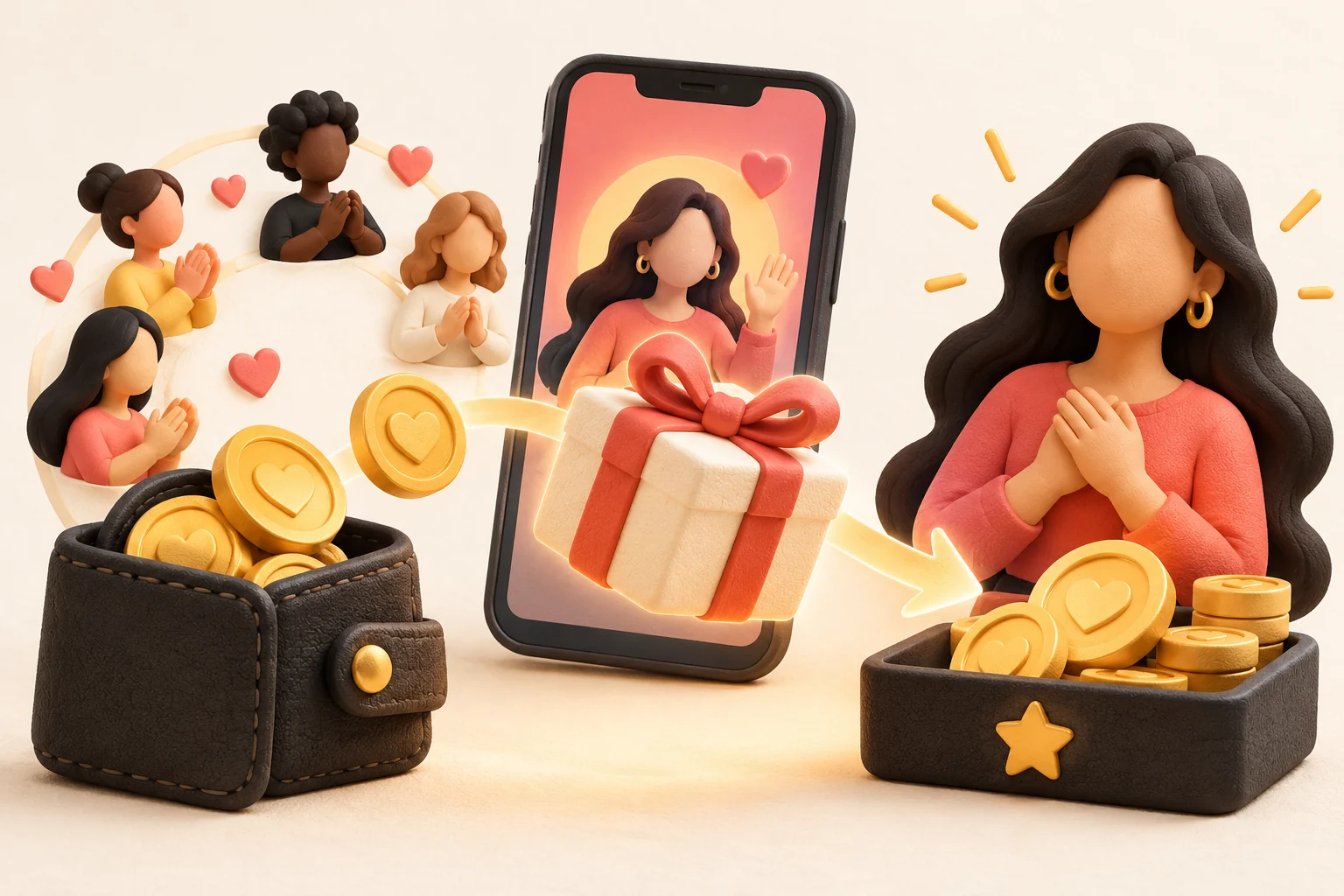
Clapper's own App Store listing describes a free app with no ads. It sells coins inside the app, and it says creators earn through gifts on videos, subscriptions they price themselves and live streaming. So how does Clapper make money? The visible money comes from viewers buying coins, not from advertisers. Clapper coins, gifts and subscriptions are the core of what the listing describes.
That is the short version, and it is also where the public detail ends. This guide explains how a Clapper-style session works, what each revenue lever does, what the listing does and does not say, and what a founder could earn from with a ready-made Clapper clone of their own. Everything about Clapper is taken from its listing as of October 2026 and is the company's own description. We have not tested the product, and we are not affiliated with it.
What the app is
The listing calls Clapper a community-focused social platform for short video, live streaming and chat. It describes these parts:
- Videos of up to three minutes, with tools for text, trimming, music and effects.
- Live streams, including a "duet live" format.
- An audio radio feature supporting as many as 2,000 listeners and 20 speakers.
- Groups, described as a way to connect directly with supporters.
- A feature to vote in support of or opposition to a post.
- Local content.
- An 18+ rating, with user-generated content, messaging and profanity noted among the content types.
The tone is conversation first. The clip is how you meet someone and the live room or group is where you stay. If you want the alternatives to this style of app, our guide to apps like Clapper sorts them by what they put first.
How a user spends a session
The listing does not walk through a session, so what follows is the general pattern of an app built this way, not a claim about Clapper's screens.
- Open the feed. A member sees clips and, usually, a rail of people who are live right now.
- Watch a clip, reply with a clip. A short video reply is the quick way into a discussion.
- Join a live room. The member chats, reacts and, if they like the host, sends a gift.
- Move into a group. Regulars follow the host into a smaller space for direct talk.
- Come back at the next scheduled show. A push alert announces the host is live again.
The money enters at step 3 and step 4. A gift is a payment in the moment of delight; a subscription is a payment to stay close. Each earlier step exists to bring people to that point.
How does Clapper make money from coins?
The listing shows what viewers can buy. As of October 2026 it lists coin packs in six sizes:
| Coins | Price shown | Price per coin (rounded) |
|---|---|---|
| 70 | $0.99 | $0.0141 |
| 350 | $4.99 | $0.0143 |
| 1,400 | $19.99 | $0.0143 |
| 3,500 | $49.99 | $0.0143 |
| 7,000 | $99.99 | $0.0143 |
| 17,500 | $249.99 | $0.0143 |
Two things stand out. The price per coin is almost flat, so a bigger pack gives no real discount, which means the app is not nudging people to buy large. And the top pack is large enough for a fan who wants to make a statement in a live room. We did the per-coin arithmetic ourselves from the listed prices.
The listing does not say what a gift costs in coins or what a coin is worth to the creator who receives it. Those numbers sit in the creator terms inside the app.
Revenue levers any app like this can use
Four levers cover most of what community video apps do. The listing mentions the first three.
Gifts and tips
A viewer spends coins on a gift during a video or a live room. The host receives value, the platform keeps a share. Gifts are impulse payments, so they cluster in live moments: a milestone, a joke that lands, a host answering a question. The model is explained at length in how virtual gifts work in live streaming and, for another brand, how TikTok gifts and coins work.
Subscriptions and fan clubs
The listing says subscriptions have user-set pricing. A creator picks a price, and members pay on a repeating schedule for perks the creator defines, such as private groups or exclusive sessions. This is steadier than gifts. It turns a night of attention into monthly income, and it rewards hosts who tend a community instead of chasing spikes.
Sponsorship
Brands pay a host to feature a product or run a segment. The platform may facilitate it, take a fee, or stay out of it. A defined, loyal audience is worth more to a sponsor than a large anonymous one, which suits niche communities.
Advertising
The listing says Clapper has no ads, so advertising is not the line it describes. For other apps it is common: the platform sells placements in the feed or before live content. An operator who wants ads later can add them without changing the rest of the model.
Why the mix matters
No single lever carries a community app for long. Gifts are volatile: a quiet week can halve a host's income. Subscriptions are steady but need a reason to stay. Sponsorship depends on a defined audience. Ads depend on scale. A healthy operator watches three ratios: the share of viewers who ever buy coins, the share of buyers who return in the next month, and the share of hosts who earn enough to keep streaming. When the third falls, hosts leave, rooms empty and the first two follow. That is why payout reliability is as much a revenue matter as a trust matter.
It also explains why a company can say its app has no ads and still run a business. Coins turn small, emotional payments into income, and a free app lowers the barrier to the first visit. Whether the numbers work for any given company is something only its own accounts could show.
Designing a first gift catalog
A catalog is a small menu, and its shape guides behavior. Three bands are enough to start.
- Small gifts, priced so a casual viewer can send one without thinking. They turn a reaction into a payment and make the host feel noticed.
- Mid gifts, for a moment worth marking, such as a good answer or a milestone. Give them a larger on-screen effect so the room sees them.
- Large gifts, rare and showy, for fans who want to be seen. Cap how often one can fire, so a single display does not drown out the conversation.
Name gifts after things your community cares about, not generic icons, and retire ones nobody sends. Review the catalog monthly with two numbers per gift: how many were sent and what share of host income they produced. A catalog of twenty gifts where three do all the work should be trimmed to those three plus a few seasonal ones.
Table: lever, who pays, what the operator controls
| Lever | Who pays | What triggers it | What the operator controls |
|---|---|---|---|
| Coin sales | Viewer | Wanting to send a gift | Pack sizes, price per coin, bonus offers |
| Gifts | Viewer, through coins | A live moment or a good clip | Gift catalog, coin price of each gift, platform share |
| Subscriptions and fan clubs | Member | Wanting regular access to one host | Allowed price range, perks, platform share |
| Paid sessions and replays | Member | A one-off event worth paying for | Ticket rules, who may sell, platform share |
| Sponsorship | Brand | A host with a defined audience | Disclosure rules, whether you broker deals, your fee |
| Ads | Advertiser | Attention in the feed or around live | Placement, frequency, brand-safety rules |
Store rules that shape the margin
Coins are digital goods, and the app stores have rules for them. Section 3.1.1 of Apple's App Review Guidelines says apps must use in-app purchase to unlock features or sell in-app currency, and allows in-app currencies to be used to tip content providers and to gift purchased items to others. Purchased credits must not expire and must have a restore mechanism. Google Play's Payments policy likewise requires its billing for virtual currencies and limits such currency to use within the app where it was bought.
For an operator this means the store takes its fee on coin purchases before you see the money. The exact rate depends on your store program, so check it at the source. For the options, read how Apple and Google handle in-app purchases. It also explains why many apps keep a web top-up route, where the store rules allow it.
Example: a 100-coin pack, a 15% store fee and a 70% host share
These figures are an illustration, not Clapper's. Say a viewer buys a 100 pack. The store keeps 15%, so the operator receives 85. The operator's rule is that the host receives 70% of the value of gifts sent to them.
- The viewer sends gifts worth the whole 100 in a live show.
- The host's share is 70% of 100, which is 70.
- The store kept 15, the host received 70, and the operator keeps 15 before its own costs.
The operator's margin is thin on gifts, which is why platforms also want subscriptions, where the same arithmetic applies on a smaller commission but with repeating income. Now add costs. Live video delivery, moderation staff, payment handling and support all come out of that 15. An operator who starts with a lower host share may leave more margin, but hosts compare terms, as the commission rate guide explains.
Pricing mistakes to avoid
- Gift prices with no small option. If the cheapest gift costs more than a casual viewer will spend, the room stays quiet. Offer something tiny.
- A host share nobody can compute. Say plainly how many coins equal one unit of payout. Hosts who cannot do the arithmetic assume the worst.
- Coin expiry. Apple's guidelines say purchased credits must not expire, so do not build a model that depends on it.
- Subscription prices set too high. A fan club that costs more than the audience values stays empty. Let hosts experiment inside a range you choose.
- No withdrawal minimum. Tiny payouts cost you more to process than they are worth. Set a minimum and publish it.
A host's month, with illustrative figures
These numbers are round and illustrative, chosen only to show the method. A host streams twelve times in a month and each show brings in 400 of gross gift value, so gifts total 4,800. With a 70% host share the host's gift income is 3,360. Forty fan-club members pay 5 each, 200 in total, and the host keeps 80% of that, which is 160. The month totals 3,520 before the host's own costs.
Now see the sensitivity. If three shows are cancelled, gifts fall by a quarter and the total drops to about 2,680. If the fan club doubles, the total rises by only 160. For this host, showing up on schedule matters more than any subscription tweak. That is the lesson to pass on in onboarding: consistent live shows move income more than anything else on the menu, and a host who can predict twelve shows a month can plan a living around it.
Payout rules a host will ask about
Hosts judge a platform by its withdrawals. Prepare plain answers to these before launch.
- When does a gift become withdrawable? State the hold period and the reason for it.
- What is the minimum balance, and does it roll over if unmet?
- Which payout methods are offered, and who pays the transfer fee?
- Who reviews a first withdrawal, and how long does that take?
- What happens to earnings if a gift is refunded or a chargeback arrives?
Put the answers on one help page, dated, and link it from the wallet screen. A host who finds the rule before asking is a host who stays.
Money models side by side
Clapper's model makes more sense next to others. Each row relies on the service's own listing or help page, current to October 2026.
| Service | What the viewer buys | How the host or creator earns | Platform income visible on the page |
|---|---|---|---|
| Clapper | Coin packs from $0.99 to $249.99 | Gifts, self-priced subscriptions, live streaming | Coin sales; no ads, per the listing |
| Bigo Live | Diamonds, in purchases from $0.29 to $129.99 | Gifts become Beans, which can be withdrawn; host program and agencies | Diamond sales |
| Twitch | Channel subscriptions and Bits | Subscriptions and Bits to the channel | Subscription and Bits sales |
| Clubhouse | A Plus subscription and coins | Not described as the focus on the listing | Subscription and coin sales |
| Discord | Nitro tiers and server boosts | Not a gifting app | Subscription sales |
The common thread is that every service sells something to the audience, and only some pay the person on stage from it. Clapper sits in the group that does. Our TikTok revenue guide shows the same split between advertising income and gift income for a much larger network, and how a coin economy works explains the currency mechanics behind all of them.
What do we not know about Clapper finances?
Much of what readers want is not on a store listing. Be wary of anyone who states these as facts:
- How much Clapper keeps from each gift or subscription.
- Payout thresholds, schedules and fees for creators.
- How many people use it, how many pay, or what it earns.
- How its feed ranks posts.
- How reports and appeals are handled in practice.
The listing gives none of these, and we make no claim about them. A creator should read the in-app terms; a reader curious about the company should look for its own statements. For comparison, Bigo Live publishes a help article on how its gifts convert to a withdrawable balance, which is the kind of page worth looking for on any platform.
A first-week checklist for coin and gift pricing
- Choose the coin packs and check that each lands on a price the stores allow.
- Decide the coin price of every gift, and confirm the smallest gift is within a casual viewer's reach.
- Write the host share and the formula for turning coins into payout value.
- Set the withdrawal minimum, hold period and review step.
- Test a purchase, a gift, a refund and a withdrawal with real accounts on every platform you ship.
- Publish the terms on a page that members and hosts can both reach.
Run the test with someone who has not seen the screens before. Where they hesitate, the wording is unclear.
What your own version could earn from
A founder can combine the same levers in a different mix. A community build from us includes live rooms with comments, up to three guests and PK battles, coins and animated gifts, coin subscriptions with perks, pay-per-view posts, a creator wallet with withdrawal approvals, a Promote tool and AdMob ads, and an admin panel, all documented on the Clapper clone features page. Paid sessions, premium replays and sponsorship tools can be added when you need them, with scope agreed with us.
The Clapper clone business model page walks through how to order those lines, and what to set for commission, minimum payout and coin pricing. In short:
- Start with gifts in live rooms. They need the least explaining and fit the first minute a viewer is moved.
- Add fan clubs once hosts have regulars. Offer them to the 5% of the audience that returns weekly.
- Add paid sessions for events. Coaching, Q&A and shows with a ticket.
- Add sponsorship when a niche is defined. Advertisers value a clear audience.
- Add ads last and only if you need them. They can dilute a community feeling.
Delivery of the platform takes 6 working days, and anything tailored runs about 2 to 8 weeks. You will find pricing on our pricing page and the Clapper clone development cost page; we confirm the scope of any extra revenue module for your build with you at kickoff, and you can start from the contact page.
What the income has to cover
Revenue is half the picture. A live-first community has costs that grow with use, and they should shape how you price.
- Live delivery. Every viewer minute uses bandwidth. Rooms with thousands of viewers cost more than clips.
- Storage and transcoding for videos and recordings.
- Moderation. Reports, live review and appeals need people. See the moderation policy template for how the rules turn into queues.
- Payment and store fees. Deducted before your share.
- Creator support and payouts. Someone must answer withdrawal questions.
Add these up per month, divide by the margin per gift, and you have the gift volume you need to break even. That is a more useful number than any traffic forecast.
Break-even sketch: 3,000 a month in running costs
Say your monthly running costs are 3,000: hosting and live delivery 1,000, two part-time moderators 1,500 and payment handling and tools 500. If your margin on gifts is 15% of gross coin sales, you need 20,000 in gross gift value each month to cover costs from gifts alone.
If a fan club brings 600 members at 5 a month and you keep 20%, that adds 600 to your margin and lowers the gift target to 16,000. If sponsorship adds 500 a month, the target falls again. These are round, illustrative numbers, but the method works for any build: list the costs, then let each revenue line carry a share of them.
The lesson for a small operator is to keep fixed costs low while the audience is small. A ready-made platform on your own cloud account, with no revenue share and no seat fee, keeps that base cost down, so a modest audience can already cover it.
For what the company says about creator earning tools, see the Clapper monetization playbook. Creator income is not a disclosed company profit figure, and coin face value must not be treated as cash-out value without the current conversion and withdrawal terms.
Before you build a Clapper-style app: two revenue lines and a host share
If you are a viewer or creator, read the in-app terms for your own account, because they are the only source for payout details. If you are a founder, decide three things before you build: which two revenue lines you switch on first (gifts in live rooms are the usual start), what share hosts receive after the store fee, and the rules for what can be said in your rooms. A permissive stance still needs a floor, and the stores and payment partners set it. Also set a withdrawal minimum, a review step and a payout schedule, and plan moderation staffing for your busiest hour rather than the average one. Then open the live web demo on the Clapper clone page, try a gift and a withdrawal request, compare the numbers with your break-even sketch, and contact us to confirm scope; handover starts 60 days of technical support plus a six-month bug fix term for the gifting build, and pricing is published.
Questions and answers
Is Clapper free?
Its App Store listing describes the app as free to use with no ads, and it also sells coin packs inside the app. Free here means no charge to join. Gifts and some creator subscriptions are paid with money spent in the app. That is the company's own description as of October 2026, and terms can change.
How do hosts get paid?
The listing says creators can earn through gifts on videos, subscriptions priced by the creator and live streaming. It does not state the share, the minimum balance or the payout timing in the text we read. A host should read the current creator terms inside the app before counting on any figure.
Does Clapper run ads?
The listing says there are no ads, and describes the app as free to use. That is a statement by the company, not something we tested. Any app can change its approach, and the privacy section of a store listing shows which data the app collects, so check it if ads matter to you.
Can I run a similar community?
Yes. A founder can launch a branded community app with short video, live rooms that seat guests and host PK battles, chat, coins and gifts, coin subscriptions and an admin panel. Ours goes live in 6 working days, with tailored work taking 2 to 8 weeks. You choose your commission, set your rules and handle legal compliance for your market.
How does Clapper make money without ads?
Per its App Store listing, Clapper is free with no ads and sells coins inside the app. Viewers spend coins on gifts, and creators can also earn from subscriptions they price themselves and live streaming. How much Clapper keeps from each purchase is not stated on the listing. This is Clapper's own description as of October 2026, not an audit of its accounts.
What is a duet live?
The listing describes a duet live feature that lets two people share a live session. It is a collaboration format: two hosts, one audience, one set of gifts. Which host receives what share of a gift is a platform rule. If you build something similar, write the split down before you launch.
Sources
- Clapper: The monetization playbook
- App Store: Clapper: Video, Live, Chat
- Apple: In-App Purchase rules in App Review Guidelines 3.1.1
- Google Play Console Help: Payments policy
- Google Play Console Help: policy for user generated content
- Bigo Live: earning money and withdrawing it
Checked in November 2026. Rules, fees and programme terms change; confirm on the source before you rely on them.
Keep reading
 ClapperContent moderation
Social App Community Guidelines Template With Sample Clauses
14 min read TikTokCoins, gifts and wallets
How Do TikTok Gifts Work? Coins, Gifts, Diamonds and Cashing Out
15 min read TikTokHow the brands make money