Bigo Live Clone Business Model: Coins, Gifts and Agencies
A live gifting platform earns through one repeating loop: viewers buy coins, spend them on gifts, and the platform keeps a share of each gift. This page explains how that loop works, which revenue lines the platform includes, how the model typically matures and which mistakes new operators make, using only mechanics rather than forecasts.
- 6
- revenue lines
- 4
- currencies modeled
- 0%
- revenue share to us
On this page11 sections
- The gift loop behind live entertainment revenue
- The revenue lines you can switch on
- The Bigo Live Clone, on screen
- How the Bigo Live model works
- How the model changes as the platform matures
- Ways operators run a live gifting platform
- Mistakes that sink new gifting platforms
- Which lever to switch on first
- Try the live Bigo Live Clone demo
- Bigo Live Clone business model FAQs
- Explore the Bigo Live Clone
The gift loop behind live entertainment revenue
Live gifting platforms do not sell advertising and do not charge viewers to enter a room. They sell a feeling: the chance to be noticed by a host in front of an audience. Viewers pay for that feeling by buying coins and spending them on gifts, and the platform keeps a share of every gift sent. A host with nobody in the room earns nothing, and a viewer who never feels noticed spends nothing, so the platform's job is to keep both from feeling alone.
That makes supply the first problem. Viewers come for broadcasters, so a platform with no engaging hosts has no gifts to take a share of. Everything else, from agency contracts to battles to rankings, exists to attract hosts, keep them earning and give viewers more reasons to spend during a stream. A practical test before adding any feature is whether it helps a host earn sooner or makes a viewer feel more strongly about sending a gift.
Because spending arrives in bursts around exciting moments, the model rewards features that create moments: battles, rank races, milestones and the last minute of a close contest. Revenue is therefore less about steady subscriptions and more about how often your rooms produce a reason to send a gift. Operators who understand this design the product around moments, and treat the rest of the catalog as support for them.
The revenue lines you can switch on
The platform models six lines separately so you can tune one without disturbing the others. All of them ship ready, and the percentages and fees are settings you control rather than fixed rules.
Coin sales
Viewers buy coin packages through Stripe on your own merchant account, usually with bonus coins on bigger packs. This is the top of the funnel and the only moment real money enters, so pricing and package design here shape everything downstream. Bonus coins on larger packs nudge viewers to spend more at once, and because this line pays your media and server bills, it is worth testing pack sizes early.
Gift commission
Each gift carries a platform share that you configure and can vary by room type, gift category and region. It is applied the moment the gift is sent. For most operators this line carries the business. Setting a lower share for new hosts or a quiet region, and a higher one for established rooms, lets you reward growth without rewriting the whole economy.
Agency share
Agencies take a configurable cut of the gifts their hosts receive. It looks like a cost, but it works as a recruiting channel, because professional agencies move their rosters only to platforms that pay them for the supply they bring. A common arrangement is a modest agency cut on every gift its hosts receive, with sub-agency rates paid out of that cut, so partners who recruit other partners are still rewarded.
Withdrawal fees
When hosts convert beans to cash, a fee is deducted before the operator approves payment. A modest fee keeps hosts willing to cash out while ensuring the most staff-intensive flow in the product contributes to revenue. Set the fee and the minimum request size together: a small fee on tiny requests produces a flood of approvals that cost more staff time than the fee returns.
VIP tiers
Free, Bronze, Silver, Gold and Diamond levels add badges and perks that viewers display inside rooms. Status is visible to others, which is what makes tiers sell, and they add a recurring line beside the one-off nature of gifts. Perks should be visible to others, such as a badge beside the viewer's name in chat, because status that nobody can see is hard to sell.
Game participation
Built-in games, a lucky wheel and daily check-in streaks give coins somewhere to go between streams. They keep balances moving when no compelling room is live, and they bring members back each day. Daily check-in streaks reward return visits with small coin amounts, which keeps the habit alive without a host needing to be live at that hour. Each game is a separate catalog item you can retire if it does not earn.
The Bigo Live Clone, on screen
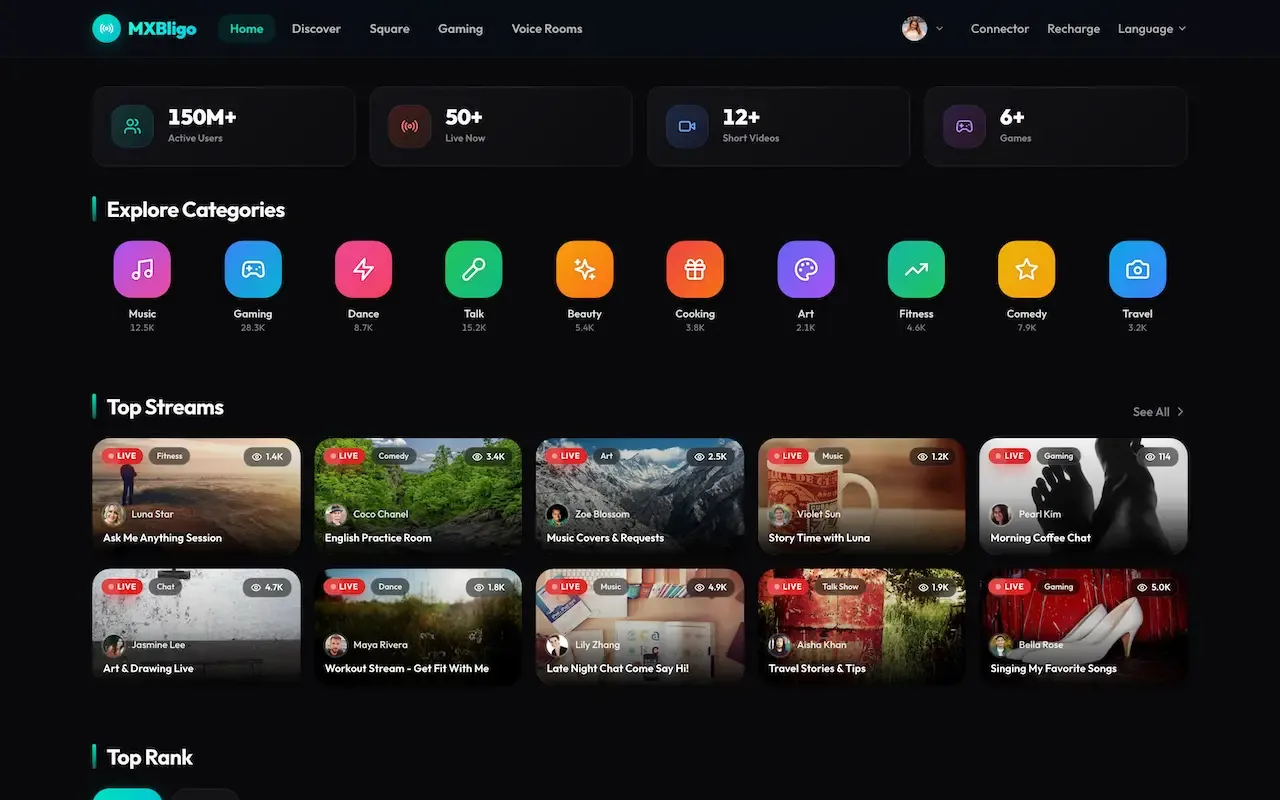
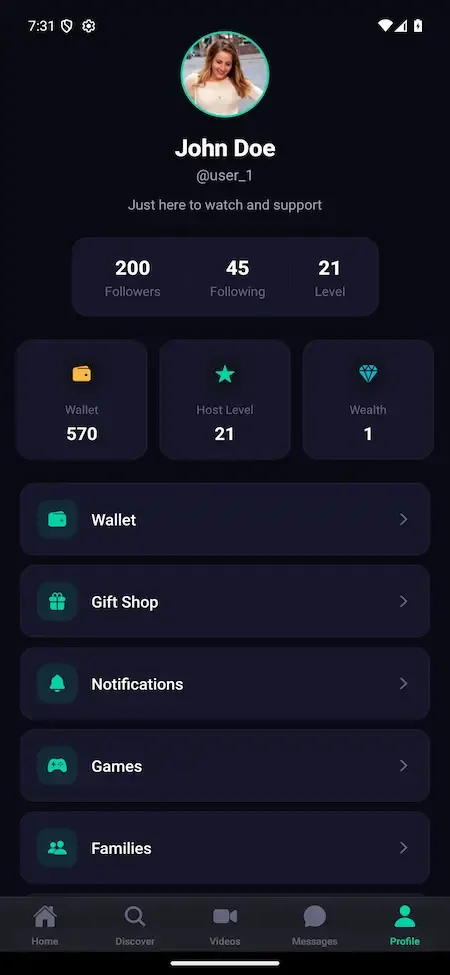
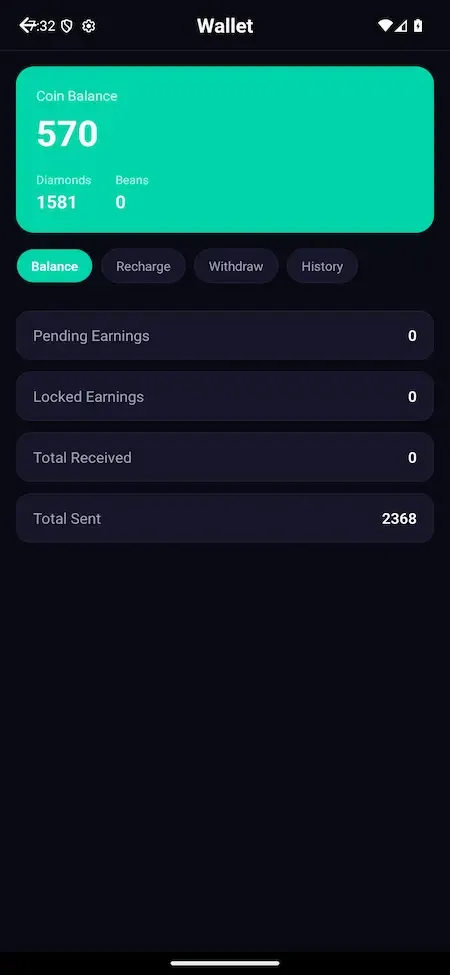
Real screens from the working product. Your platform ships rebranded with your name, logo and colors.
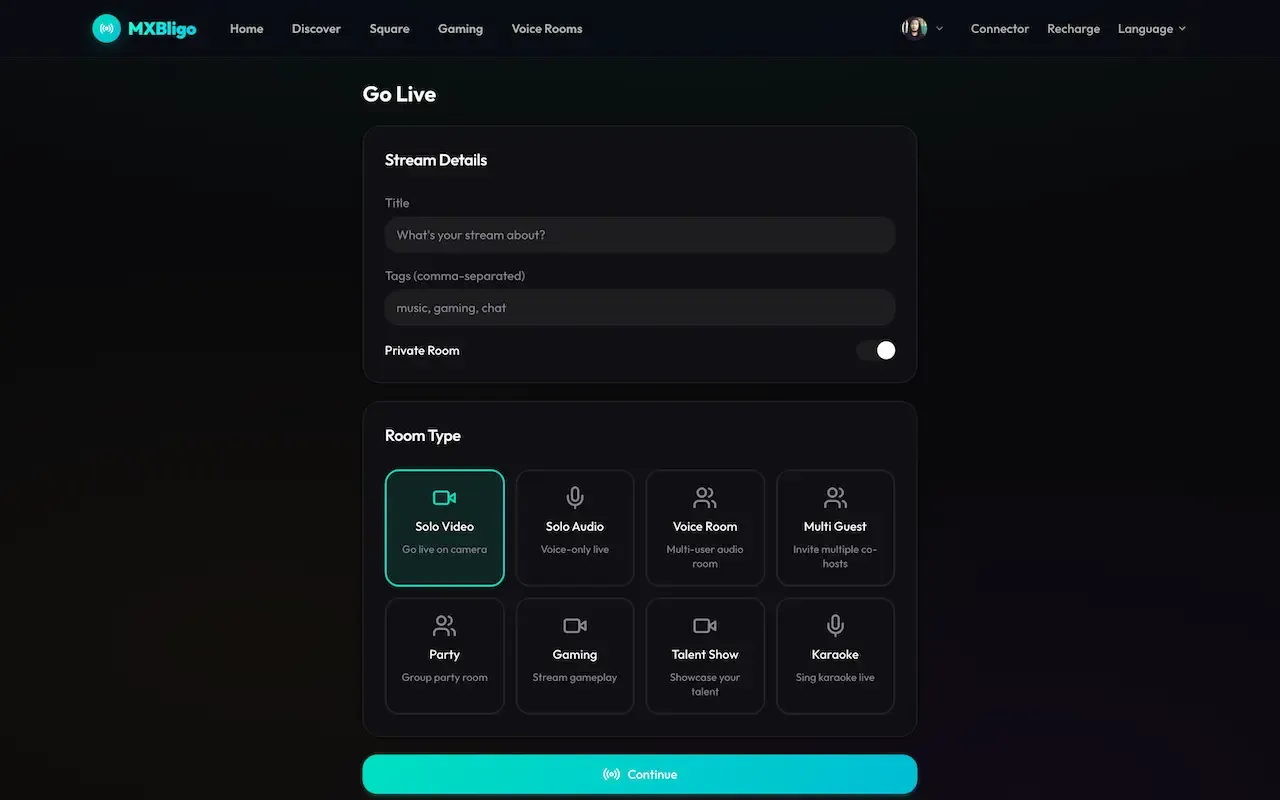
Web app 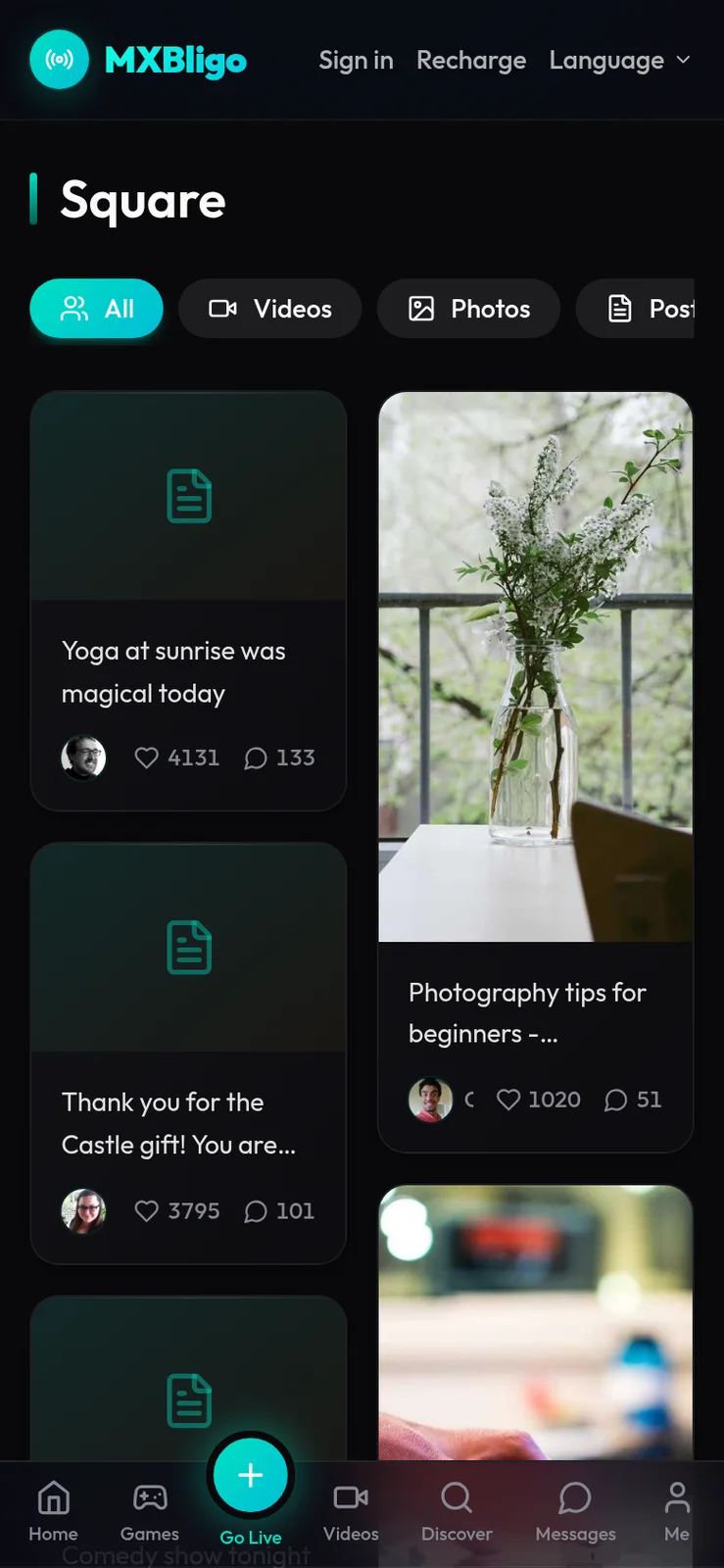
Web app 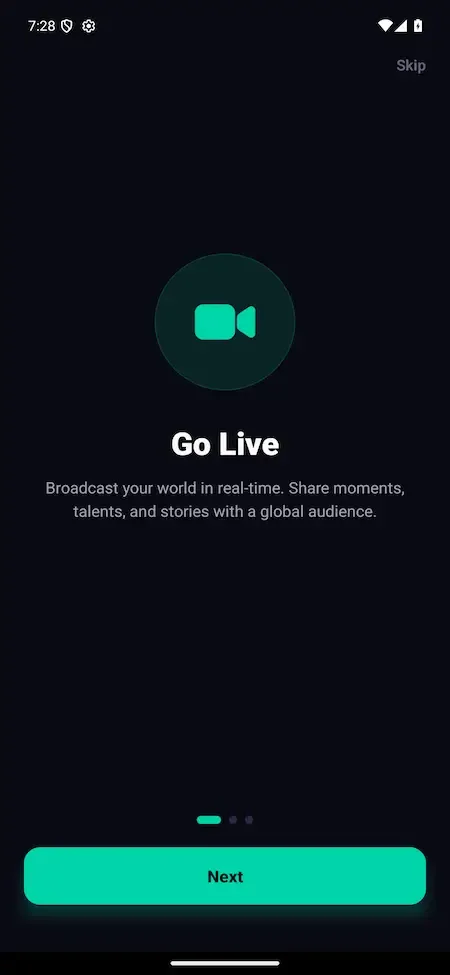
User app 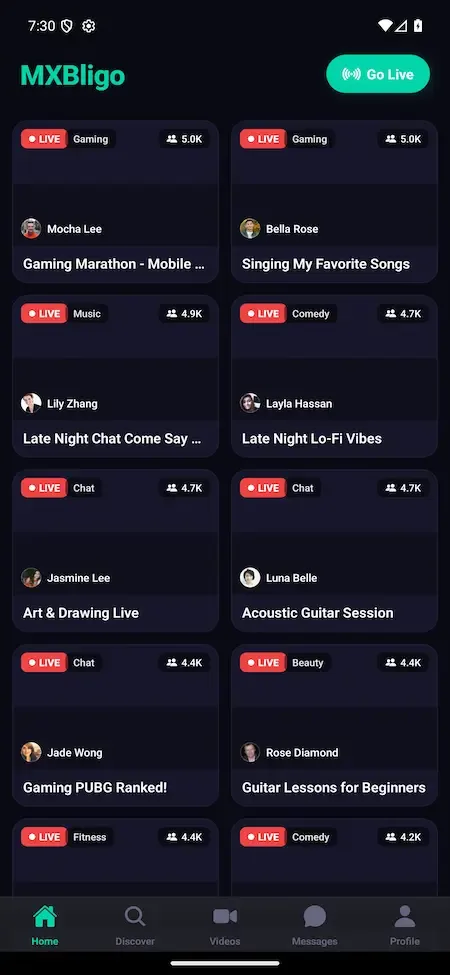
User app 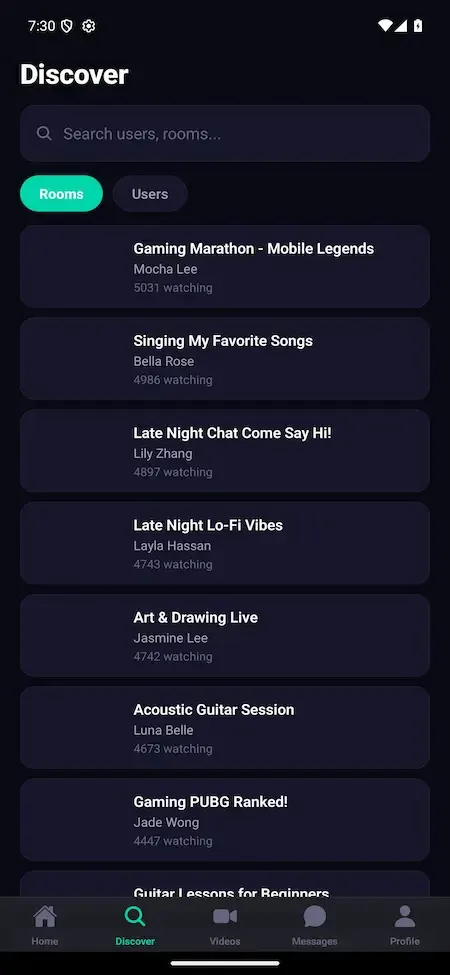
User app
How the Bigo Live model works
Bigo Live is widely known as a live streaming app where viewers send virtual gifts to broadcasters, and broadcasters turn those gifts into earnings. The company behind it takes a share, and broadcasters are commonly recruited and managed through talent agencies, sometimes called guilds, that earn from the hosts they bring. The pattern is common across live entertainment: the app sets the rules for gifts and payouts, and everyone who earns from a broadcast does so inside those rules.
A clone follows the same economic shape but under your own brand and on your own terms. You decide the splits, the agency rules, the gift catalog and the markets you serve. We make no claims about how Bigo Live runs its own business, only about the mechanics this style of platform is known for. That freedom is the practical difference from joining an existing app as a broadcaster, where the terms are written by someone else and can change without your say.
How the model changes as the platform matures
The right lever depends on how many hosts and viewers you have. Early on the problem is supply and trust, and later it becomes margin and retention. The table suggests what to emphasize at each stage.
| Stage | Lever to use | Why |
|---|---|---|
| Launch | Coin sales with a generous host share | Attracting your first broadcasters matters more than margin |
| Early growth | Agency contracts and invite codes | Partners bring hosts in bulk and make recruiting measurable |
| Engagement | PK battles and family rankings | Competition turns viewers into regular spenders and gives groups loyalty |
| Scale | Region-specific splits and VIP tiers | Different markets tolerate different terms, and tiers add recurring income |
| Maturity | Withdrawal fees and game participation | Margin improves once supply is stable and members hold large balances |
Ways operators run a live gifting platform
The same software supports quite different businesses. Which one you build decides who your first hosts are, what you promise them and which parts of the platform you lean on most.
Agency-led host network
You recruit a handful of talent agencies and let them bring broadcasters under contract. The agency layer carries the work, with commission or salary contracts and sub-agency rates. This route scales supply quickly but depends on keeping the agencies satisfied. A realistic first step is to sign two or three agencies on clear commission terms and watch their hosts' first weeks of earnings before opening the door wider.
Community-led family platform
You build around families and voice rooms for a particular language or region, with viewers organizing themselves into groups that compete in battles. Growth is slower and organic, but loyalty is high and acquisition cost stays low. Voice rooms in one language, a family treasury and weekly family battles can sustain a community with little paid acquisition, though the first members have to be recruited by hand.
Talent-owner branded home
You already manage creators or performers and want a branded home for them. The host application, contracts and withdrawal queue give you control over onboarding and payouts, and you can mix in outside hosts later. A management company with an existing roster can onboard its people through the application flow, attach them to its own agency record and keep their earnings history in one place.
Niche entertainment app
You focus on a single format, such as karaoke, dating or gaming rooms, and tune gifts and battles to it. A focused audience simplifies marketing and makes it easier to design a gift catalog that people care about. A karaoke app, for example, would lean on the karaoke room, a themed gift set and rankings for the best performers, and leave other room types switched off.
Mistakes that sink new gifting platforms
Most failures in this category come from business decisions, not from software. These are the errors we see operators make most often, and each is avoidable with planning before launch rather than repair afterwards.
Launching without hosts
Opening the doors to viewers before you have engaging broadcasters leaves them in empty rooms and they do not return. Secure a roster of hosts, ideally through an agency, before spending anything on viewer acquisition. Test it by counting how many hosts can reliably hold a room for an hour before you advertise to viewers.
Starving the host share
Taking too large a platform cut early makes it hard to recruit or keep broadcasters. A generous host share costs margin you do not yet have, but it buys supply, which every other line depends on.
Letting payouts run late
Hosts who wait weeks for approved withdrawals talk to competing agencies. Staff the approval queue properly and keep the review process quick, because trust in payouts is the foundation of host loyalty. Set a target turnaround for approvals and publish it to hosts, so a delay is a visible failure rather than a silent habit.
Treating moderation as optional
Live rooms attract abuse, and a single serious incident can drive away hosts, viewers and payment processors. Plan reviewers, policies and escalation from day one instead of after the first complaint. Strikes, appeals and a report queue are included, but they only protect you if someone works them while rooms are open.
Copying one market's terms
Gift prices, host expectations and agency norms differ between countries. Applying a single split everywhere ignores the regional settings the platform offers and tends to underperform in at least some of your markets. Start with separate splits for your two most important markets, and review them after the first month of real gifting data.
Ignoring rule changes
Payment, payout and live-content rules vary by market and change over time. Operators who treat compliance as a one-time task find themselves exposed, so build a habit of review with qualified local advice. A quarterly review with local counsel, with the resulting settings changes tracked in the operator panel, keeps the platform aligned.
Which lever to switch on first
Start with coin sales and gift commission, and keep the host share generous. These two lines are the core loop, they work from the first room, and they give you real data about what viewers buy and what hosts earn. Add an agency share only when you have agencies ready to recruit, because an unused commission setting recruits nobody.
Leave VIP tiers, games and withdrawal fees for after the first stable weeks. They are tuning tools, not launch tools, and each one is easier to judge once you can see real balances. Introduce them one at a time so you can tell which change moved behavior. A sensible order is games after the first month, VIP tiers once regular spenders appear, and withdrawal fees once hosts routinely cash out, so each change meets enough behavior to be judged.
Try the live Bigo Live Clone demo
The demo is a running copy of the platform with demo branding and public sample accounts, so you can play every role without installing anything. Join a room as a viewer, go live as a host, then open the operator console and watch the same gift show up in the settlement and review queues.
-
Viewer and wallet
Open the Viewer and wallet demo- Login
user1@mxbligo.live- Password
password123
Worth trying
- Browse rooms by type, country and language
- Send a gift and watch the coin balance fall
- Open the wallet and review recharge packages
- Follow a host and check the top fans list
-
Host studio
Open the Host studio demo- Login
host1@mxbligo.live- Password
password123
Worth trying
- Start a room and choose one of the formats
- Open the seat controls for guests
- Start a PK battle and read the score
- Follow diamonds through to a withdrawal request
-
Operator console
Open the Operator console demo- Login
admin@mxbligo.live- Password
password123
Worth trying
- Review a host application in the queue
- Approve or reject a pending withdrawal
- Open the revenue settings and the split
- Read the audit log after your own actions
-
Android build
Open the Android build demo- Login
user1@mxbligo.live- Password
password123
Worth trying
- Sign in with the viewer account
- Join a voice room from the phone
- Check the wallet on the device
Bigo Live Clone business model FAQs
Where does the platform earn money first?
Revenue starts when a viewer buys coins and spends them on gifts, since you keep a share of each gift at the moment it is sent. Other lines such as withdrawal fees and VIP tiers add to that base once members hold balances.
Can I change the split after launch?
Yes. The platform, agency and host shares are operator settings, and you can vary them by room type, gift category and region. Changing them affects new gifts from that point and does not rewrite earlier transactions.
Do I need agencies to run the platform?
No. You can recruit hosts directly through the application and approval flow. Agencies are an option for operators who want partners to supply broadcasters in bulk, and you can enable that layer later when you are ready.
How do hosts get paid?
Hosts earn diamonds from gifts, convert them to beans at your rate and raise a withdrawal request. An operator reviews each request, the fee is applied and payment is made. The platform records approvals, but moving the money out is handled through your own banking arrangements.
Can I charge viewers to enter a room?
Subscriber-only and private room formats let hosts limit access to chosen members or paying followers. That gives you an entry-based option alongside open rooms funded by gifts, which suits premium or niche content. Entry-based rooms suit premium or niche content, but they depend on a host with an existing following, so most operators keep open rooms for discovery and gate only some sessions.
Is advertising part of the model?
The platform is built around gifting rather than advertising, and no ad network is included. Because you own the code, a developer can add placements later, but the revenue lines described here do not depend on them.
How do I stop gift fraud?
Balances are tracked in separate currencies, every gift runs as one recorded transaction and each withdrawal needs operator approval, which together limit what a fraudster can extract. You still need staff who review unusual patterns, since tooling cannot replace judgment.
Explore the Bigo Live Clone
The overview and its companion pages answer the main questions in turn. Pick the one you need next.
-
Bigo Live Clone
The overview: live demo, screens, price and everything in the box.
Back to the overview -
Features
This page goes past the feature list and follows the platform the way money and people move through it: a host opens a room, a viewer spends, a battle raises the stakes, an agency takes its share and an operator signs off the payout.
See the full breakdown -
Development cost
The cost of a live streaming platform depends on whether you buy a finished product or commission a build.
See exact pricing -
Development company
A live gifting platform is mostly financial plumbing with a video feed on top, so the provider you pick matters more than the demo you see.
Compare options
→Start here
Tell us what you want to launch.
Share the platform and your market. You get a walkthrough of the live demo, the exact scope of what ships, and a fixed price in writing. First response in under 2 hours, Monday to Saturday, 10:00 to 19:00 IST.
Trademark and independence notice
This page uses the name Bigo Live to describe a type of platform. The product sold here is separate software, built independently, and Bigo Live has no part in it.
Why this name
"Bigo Live clone" is industry shorthand that founders use when searching for software with a comparable business model. It names a category of product, not a copy of Bigo Live.
Who built this
The platform is an original product designed and written by Miracuves. It contains no code, design, graphics or content originating from the Bigo Live website or applications, and it ships under your own brand.
Trademarks
Bigo Live and its logos are trademarks of their respective owner and are named here for reference only. GetFame is not affiliated with, sponsored by or endorsed by Bigo Live. Rights holders can write to legal@miracuves.com.
Operator responsibility. The operator of a launched platform is responsible for legal compliance in the markets it serves. Nothing on this page is legal advice.Read the full disclaimer